What Can an Executor Do: Powers & Duties in California
Your phone rings. A relative has died, the family is grieving, and then someone says, “You're the executor.” In that moment, the role can feel like an honor and a burden at the same time.
Individuals appointed under a will in California often have no prior experience with probate cases. They don't know what papers matter, whether they can enter the decedent's house, what to tell beneficiaries, or whether they're allowed to sell property. They're also worried about making a mistake that causes family conflict or personal liability.
That reaction is normal. Being named executor means the person who died trusted you to handle unfinished business carefully and responsibly. But trust alone doesn't answer the practical question many people ask first: What can an executor do?
In California, the answer is both broader and narrower than many families expect. An executor has real authority, but it's not unlimited. You may be able to collect assets, protect a home, deal with creditors, and eventually distribute property. At the same time, you can't treat estate assets as your own, ignore the will, or take shortcuts just because everyone seems to agree for the moment.
A useful way to think about probate is this. The estate is a separate project with its own paperwork, money flow, rules, and timeline. As executor, you're the person in charge of moving that project from loss and confusion to lawful closure. That includes practical work, family communication, and court procedure under California law.
For families in Orange County and Los Angeles, the hardest issues often involve homes, rental property, blended families, and disagreements about what the deceased “really wanted.” Those are the places where executors most often need guidance.
Table of Contents
- Introduction Honored and Overwhelmed
- The Executor's Role and Fiduciary Duty Explained
- Core Powers and Duties of an Executor in California
- Common Limits and Pitfalls to Avoid
- Navigating Orange County Real Estate and California Probate
- When to Call a Probate Attorney for Help
Introduction Honored and Overwhelmed
A newly appointed executor often starts with small, urgent questions. Can I pick up the mail? Should I change the locks? Do I need to tell the bank? Can I let my brother move into Mom's house while probate is pending?
Those questions matter because early decisions set the tone for the rest of the estate administration. A careful executor protects assets and keeps records from day one. An overly casual executor can create a mess without meaning to.
The first misunderstanding
Many people think being named in the will means they can act immediately. Under California law, that isn't usually how it works. In many estates, your authority becomes practical and enforceable only after the probate court appoints you and issues the documents that confirm your role.
That distinction confuses families all the time. They hear “executor” and assume “owner” or “decision maker.” You're neither. You're the person chosen to administer the estate according to the will and California probate rules.
Practical rule: An executor manages estate property for others. The property doesn't become the executor's simply because the executor has access to it.
What families often expect
Beneficiaries often want quick answers, quick distributions, and quick access to sentimental items. That's understandable. It's also where pressure begins.
In a typical California probate, the executor has to slow the process down enough to do it correctly. If there's a house in Orange County, for example, you may need to secure the property, identify title issues, review mortgage statements, inspect insurance coverage, and determine whether anyone is living there with a legal or informal claim. None of that should be handled by guesswork.
A simple comparison helps. Think of the estate like a storage unit full of labeled and unlabeled boxes. Some boxes belong to the estate. Some may pass outside probate. Some may contain debts instead of value. Your job isn't to hand out boxes quickly. Your job is to identify what each box is, preserve it, and transfer it to the right person in the right order.
A better way to approach the job
If you've been asking what can an executor do, the better question is often, “What am I responsible for protecting before anything gets distributed?” That mindset keeps executors out of trouble.
Use this lens as you move forward:
- Protect first: Secure homes, documents, valuables, and financial information.
- Verify next: Confirm what the will says, what the court requires, and what assets exist.
- Pay and report: Handle valid debts, taxes, and court-required accountings.
- Distribute last: Transfer what remains only after the estate is ready.
That order matters. In California probate, the executor's power is tied to duty.
The Executor's Role and Fiduciary Duty Explained
Why the role matters
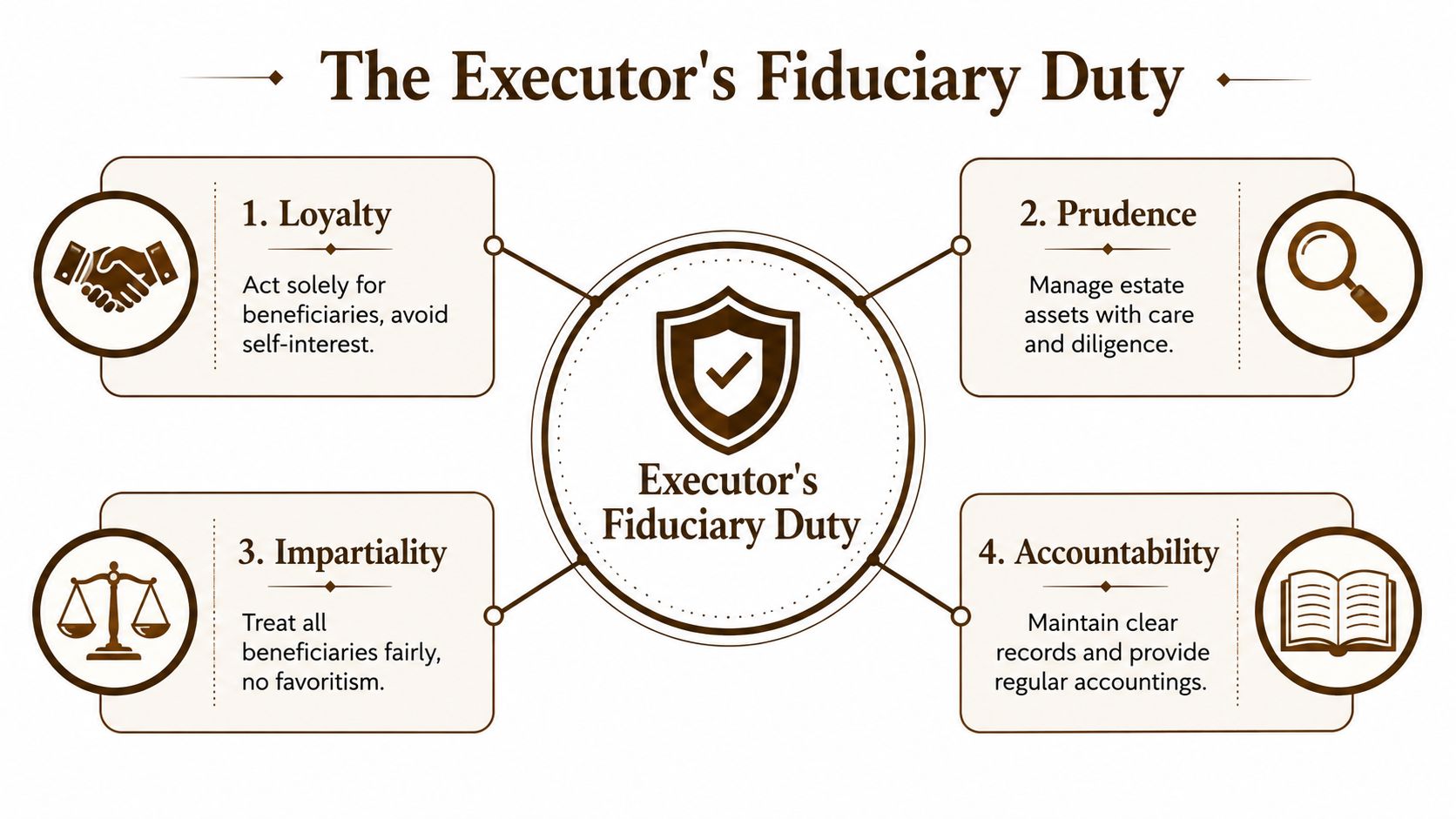
Under probate law, an executor is not just a helpful family volunteer. An executor is a fiduciary. That means the law holds you to a high standard of honesty, care, and fairness.
The New York City Bar explanation of an executor's role describes the executor as the legally appointed fiduciary who carries out the will, including probate filing, locating and inventorying assets, paying debts and taxes, and distributing what remains to beneficiaries. The same source notes that settling an estate can take an executor roughly 570 hours on average, which helps explain why the work often feels like a part-time job for months and why detailed records and a final accounting matter.
That's the heart of the role in California too. The title may sound formal, but the daily work is practical. You gather facts, make responsible decisions, document what you do, and stay loyal to the estate rather than your own preferences.
What fiduciary duty means in plain English
Think of yourself as the captain of a ship carrying cargo that belongs to other people. You control the route, but you don't own the cargo. You must protect it, account for it, and deliver it according to the instructions you were given.
In plain language, fiduciary duty usually means four things:
- Loyalty: You must act for the estate and beneficiaries, not for your personal advantage.
- Care: You need to handle money, property, and paperwork with reasonable caution.
- Fairness: If multiple beneficiaries are involved, you can't play favorites.
- Accountability: You should assume every dollar in and out of the estate may need to be explained later.
Keep receipts, save emails, log phone calls, and document decisions while events are fresh. Executors rarely regret being too organized.
A family member might say, “Dad would have wanted me to take the car now,” or “We all agree to skip the formalities.” Sometimes that's harmless conversation. Sometimes it's the first sign of a later dispute. A fiduciary doesn't act on memory and pressure alone. A fiduciary acts on authority, evidence, and the will.
Here's the point many new executors miss. Your job isn't to make everyone happy. Your job is to administer the estate lawfully under California law. If you do that consistently, you protect the beneficiaries and yourself.
Core Powers and Duties of an Executor in California
Starting the probate case
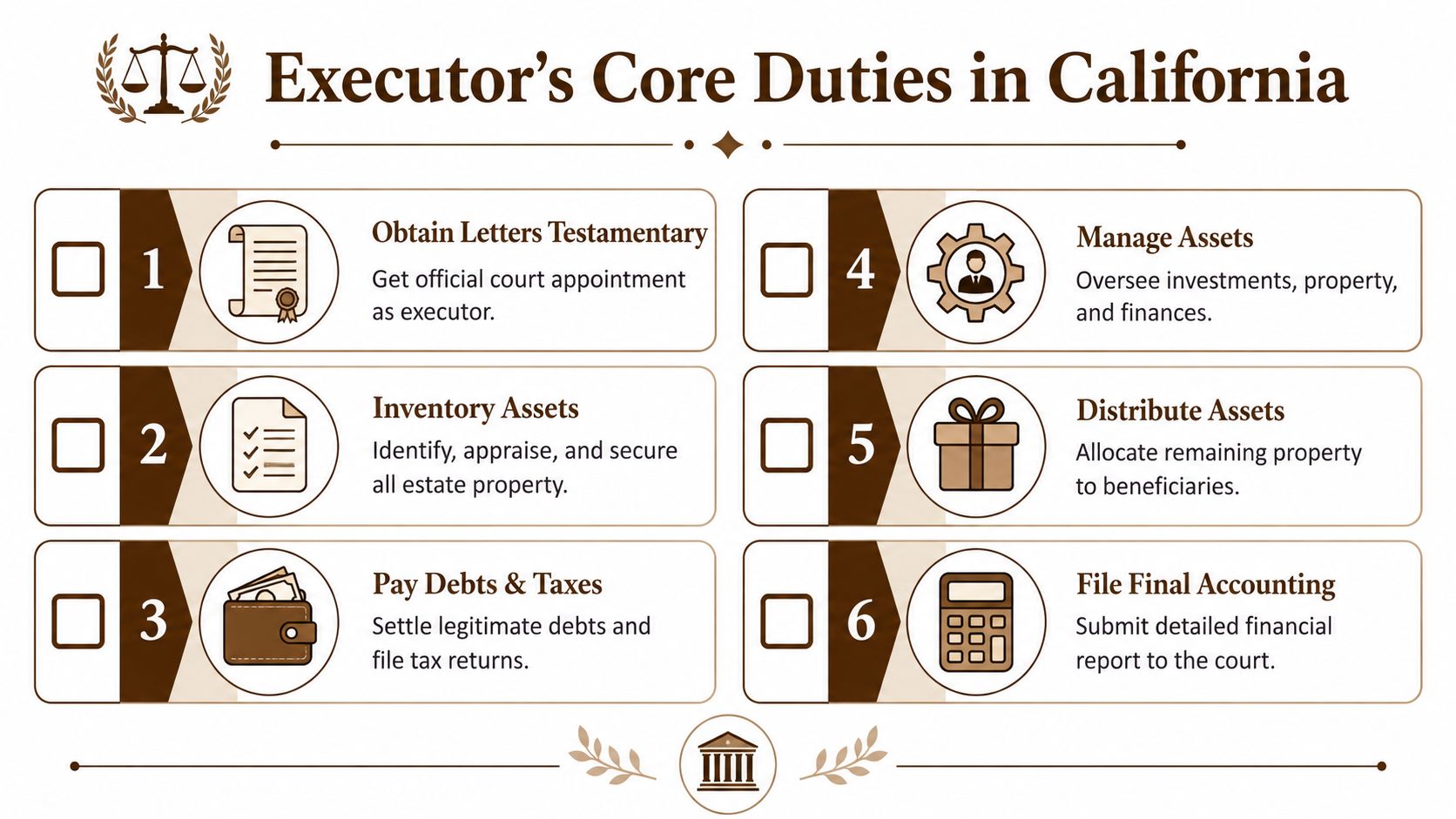
One of the first practical answers to what can an executor do is this. In California, the executor can begin the formal probate process and ask the court to recognize the appointment.
That usually means locating the original will, preparing the petition, filing required papers with the proper California court, and obtaining Letters Testamentary once appointed. Those letters function like your credentials. Banks, title companies, and other institutions often want to see them before they'll deal with you.
This is also where timing and accuracy matter. If the will has inconsistencies, if heirs disagree about who should serve, or if someone claims a later will exists, the case can become contested quickly.
A short checklist helps:
- Locate the controlling documents: Find the original will, codicils, trust papers if any, deeds, and account statements.
- Identify the right court: File in the California county with proper probate jurisdiction.
- Request formal authority: Obtain the court order and Letters Testamentary before taking major action.
- Notify interested parties: Beneficiaries and heirs generally need notice of the proceeding.
Later in the process, many executors find this overview useful before a hearing or filing deadline:
Gathering and protecting estate assets
After appointment, the executor can identify, collect, and safeguard estate property. In practice, that may include bank accounts, brokerage accounts, real estate, vehicles, business interests, household contents, and personal papers.
This step sounds simple. It rarely is. Families often know the obvious assets but overlook digital records, safe deposit boxes, refunds, or property held in only one spouse's name.
Some examples of proper early action include:
- Securing a home: Change locks if needed, confirm insurance remains in place, and document the property's condition.
- Taking inventory: Create a written list of accounts, real property, valuable personal items, and ongoing bills.
- Separating control: Open an estate account when appropriate and keep estate money separate from personal funds.
- Preserving value: Arrange maintenance for a vacant house, collect rent if tenants are in place, and protect mail and financial records.
Handling bills taxes and administration
Executors in California can pay valid estate expenses, debts, and taxes from estate assets. They can also work with accountants, appraisers, real estate professionals, and attorneys when those services are necessary for administration.
Restraint is essential. The executor doesn't pay every bill someone waves in front of them. The executor evaluates claims, confirms what the estate owes, and follows proper procedure.
Important: Beneficiaries come last in line. If you distribute too early and later discover legitimate obligations, you may create serious problems for the estate and yourself.
A practical way to think about expenses is to sort them into categories:
| Estate task | What the executor usually does |
|---|---|
| Ongoing property costs | Keep mortgage, insurance, utilities, or urgent maintenance under control where appropriate |
| Administrative expenses | Pay filing fees, appraisal costs, tax preparation fees, or professional fees tied to estate administration |
| Creditor issues | Review claims carefully before payment |
| Tax matters | Gather records and file required returns with proper help when needed |
Distributing property the right way
Yes, an executor can distribute assets to beneficiaries. But that power comes near the end, not the beginning.
Before distribution, the executor should be confident that estate assets are identified, expenses addressed, required approvals obtained, and the accounting is ready. In California, the details depend on the estate, the will, court orders, and the authority granted.
Distribution can take different forms:
- A deed transferring a house to a beneficiary.
- A sale of property followed by division of proceeds.
- Delivery of specific personal property named in the will.
- Final cash distributions after administration is complete.
The safest mindset is simple. Possession is not the same as entitlement. A beneficiary may be named in the will and still need to wait until the estate is ready for lawful distribution.
Common Limits and Pitfalls to Avoid

What an executor cannot do
Many family members assume the executor has unlimited discretion. In California probate, that's wrong.
An executor cannot rewrite the will because a distribution now feels unfair. An executor cannot decide that one sibling “needs it more” and shift assets around on that basis. An executor cannot take estate property for personal use without proper authority and fair process.
The biggest prohibited behavior is self-dealing. That means using the position to benefit yourself at the estate's expense. A common example is trying to buy estate property at a discount, moving into the decedent's house without authority, or using estate funds to pay personal bills.
Another limit is court supervision. Depending on the estate and the authority granted, significant acts may require notice, consent, or court approval. That's especially true when the action affects title to real estate, beneficiary rights, or the fairness of a transaction.
Mistakes that create trouble fast
Not every executor problem comes from bad intent. Many come from avoidable sloppiness.
Here are common pitfalls:
- Mixing money: Depositing estate funds into a personal account or paying estate bills from random personal funds without documentation.
- Poor records: Failing to track who received property, what bills were paid, or why a decision was made.
- Premature distributions: Handing out cash or personal items before debts and administration issues are resolved.
- Silence: Ignoring beneficiary questions until suspicion hardens into conflict.
- Informal deals: Letting relatives “borrow” vehicles, jewelry, or occupancy rights during probate.
A quiet executor often thinks, “I'll explain it all later.” Beneficiaries often hear, “Something is being hidden.”
A quick risk check
If you're unsure whether a proposed action is within your authority, ask yourself these questions before acting:
| Question | Why it matters |
|---|---|
| Does the will authorize this clearly | If not, the decision may need closer legal review |
| Does this benefit the estate or me personally | If it benefits you, conflict concerns rise immediately |
| Would I be comfortable explaining this to all beneficiaries and the court | If the answer is no, stop and reassess |
| Is there a paper trail | If not, create one before moving forward |
The practical limit of executor power becomes clear. You can make many decisions, but you must make them as a fiduciary, not as a family insider trying to smooth things over with shortcuts.
Navigating Orange County Real Estate and California Probate

Why real estate changes everything
In Southern California probate matters, the most valuable or disputed asset is often the house. That's especially true in Orange County and Los Angeles, where a family home may carry emotional significance, occupancy disputes, deferred maintenance, and title questions all at once.
A bank account can usually be identified and transferred with paperwork. A house is different. It may be vacant, occupied by a relative, rented to tenants, tied to a refinance, affected by community property issues, or clouded by an old deed problem. An executor has to deal with all of that carefully under California law.
If you're asking what can an executor do with a house, the answer usually includes securing it, maintaining it, insuring it, gathering title and loan information, and determining whether the property should be transferred or sold. But those actions must align with the will, the court's authority, and the estate's financial needs.
Selling a probate property in California
California gives some executors broader administrative flexibility than families expect, particularly where the estate has authority under the Independent Administration of Estates Act, often called the IAEA. That authority can make estate administration more efficient, but it doesn't erase fiduciary duties or the need for careful procedure.
A probate sale raises practical questions such as:
- Is a sale necessary: Does the estate need cash to pay debts, expenses, or equalize distributions?
- Who is living there: A vacant property and an occupied property present very different risks.
- What condition is it in: Repairs, cleanup, and disclosure issues can affect both value and timing.
- Is title clean: Old deeds, co-ownership claims, or recording errors can delay or derail a transaction.
A California executor should also be cautious when a beneficiary wants special treatment. For example, one child may want to buy the property directly, stay in the home during probate, or receive credits for caregiving or repairs. Those requests aren't automatically improper, but they need legal and factual scrutiny.
Real estate disputes in probate rarely stay “informal” for long. Once possession, money, and inheritance expectations collide, written agreements and legal authority matter.
Local disputes that call for caution
Orange County probate matters often become more complicated when real estate overlaps with family conflict. A surviving partner may claim ownership rights. A sibling may argue the home was promised to them. A co-owner may resist a sale. Tenants may stop cooperating once they learn the owner has died.
That's when an executor's role shifts from simple administration to risk management. The executor may need help evaluating whether the issue is purely probate, a title dispute, a partition problem, or a civil real estate conflict attached to the estate.
In those situations, caution is not delay. It's protection.
When to Call a Probate Attorney for Help
Some executors can handle routine tasks with steady organization. Others hit legal trouble almost immediately. Knowing the difference can save the estate time, cost, and conflict.
You should strongly consider calling a California probate attorney if any of these apply:
- The will is contested: Someone claims the will is invalid, forged, or replaced.
- Beneficiaries are fighting: Communication has broken down or one person is accusing you of favoritism.
- The estate includes real estate problems: Title issues, occupancy disputes, sale disagreements, or co-owner conflicts are in play.
- Debts may exceed assets: Insolvent estates require careful handling.
- A business or complicated asset is involved: You need guidance on valuation, management, or transfer.
- You're unsure of your authority: If you don't know whether you can act, don't guess.
- You've already made a move that worries you: Early legal advice is usually cheaper than repairing a preventable mistake later.
Serving as executor in California is manageable when the estate is straightforward and the process stays orderly. It becomes much harder when real property, family conflict, or unclear authority enters the picture. If you're facing probate in Orange County or Los Angeles and need clear answers about your duties, limits, or next steps, schedule a free consultation with Tanner Law.