How to Settle an Estate Without a Will: California Guide
A parent dies. There's no will in the desk, no trust binder in the closet, and now the family has to answer urgent questions while still grieving. Who can access the bank account? What happens to the house in Orange County? Can someone pay the mortgage, list the property, or deal with creditors without getting in trouble?
That situation is common, and in California, it has a name. When someone dies without a valid will, they die intestate. That doesn't mean the estate is stuck forever, and it doesn't mean the family is without options. It means California law supplies the default rules for who has authority to act and who inherits.
From a probate and real estate standpoint, the biggest mistake families make is assuming there's an informal shortcut. Sometimes there is. Often there isn't. In Los Angeles and Orange County, real estate is frequently the asset that turns a manageable situation into a formal probate case, especially when title is unclear, one child has been living in the property, or the estate has value on paper but very little cash to pay expenses.
Table of Contents
- What Happens When Someone Dies Without a Will in California
- The First Decision Is Probate Necessary
- Opening a Formal Intestate Administration
- Managing the Estate Inventory Notices and Creditors
- Distributing Property Under California Intestacy Law
- Common Pitfalls Costs and When to Call an Attorney
What Happens When Someone Dies Without a Will in California
A parent dies owning a house in Anaheim or Los Angeles, and the family's first instinct is often to “just handle it.” One child has the keys. Another starts calling an agent. The surviving spouse assumes the home can be sold once everyone agrees. Then the first hard problem shows up. The mortgage servicer wants documents, the tenant in the back unit stops paying rent, or a reverse mortgage lender sends a notice asking what the family plans to do with the property.
When a California resident dies without a will, California intestate succession law decides who inherits probate property. If court involvement is required, the probate court appoints an administrator to act for the estate. That person fills the role an executor would have filled under a will. The administrator collects assets, protects property, handles notices and claims, and asks the court for authority to distribute what remains.
Families often get into trouble before anyone is formally appointed.
A surviving spouse may believe everything passes to them automatically. An adult child may assume being the “responsible one” gives them authority to deal with the bank, the tenants, or the broker. A relative may start removing personal property from the house or forwarding mail. In California, legal authority comes from title, beneficiary designations, or a court order. It does not come from family agreement alone.
Practical rule: Until someone has legal authority, do not transfer title, drain accounts, sign listing papers, or promise a buyer that a sale can close.
That point matters more in Orange County and Los Angeles than many families expect. High property values turn even a modest family dispute into a serious probate problem. I regularly see estates where the only major asset is a house with significant equity but also a loan, deferred maintenance, insurance issues, or occupants who do not want to leave. A duplex in Long Beach or Santa Ana can create immediate pressure if rents stop coming in after death. A home with a reverse mortgage in Mission Viejo or Westchester can force the family to make decisions quickly because the lender will expect payoff, refinance, or a sale within a limited timeframe.
Real estate also exposes title problems fast. If the decedent held title in sole name, no heir can sign a deed just because everyone “knows” who should inherit. If title was held as joint tenancy, community property with right of survivorship, or in a trust, the result may be very different. If the family gets this wrong early, they can lose time, create escrow delays, and make a later sale harder than it needed to be.
At this stage, four questions matter:
- What did the decedent own in their individual name
- How was each asset titled
- Who are the legal heirs under California intestacy rules
- What immediate property issues need attention, such as mortgage payments, insurance, taxes, security, or tenants
The good news is that intestate estates follow a defined legal process. The bad news is that families often create avoidable problems in the first month by acting before they understand who has authority and what kind of estate they are dealing with. In California, especially where real estate is the main asset, the first job is not dividing property. It is protecting it and identifying the correct legal path.
The First Decision Is Probate Necessary
A daughter finds a deed showing her mother's Los Angeles home is still in sole name. Her brother is already talking to a realtor. The bank account has a payable-on-death beneficiary, the IRA names one child but not the other, and the property tax bill is due next month. Before anyone files anything, the first job is to sort assets by title and transfer method.

Start with the asset map
Families usually use the word “estate” to mean everything the person owned. California probate does not. The court only deals with assets that are part of the probate estate, and that depends largely on title, beneficiary designations, and whether some other transfer method controls.
Common non-probate assets include:
- Life insurance with a named beneficiary: Proceeds usually go directly to that beneficiary.
- Payable-on-death bank accounts: The named recipient can usually collect from the institution without opening probate for that account.
- Retirement accounts with beneficiary designations: These often transfer outside probate.
- Transfer-on-death arrangements: If validly created, these can move certain property outside the probate estate.
That distinction matters because a family can spend weeks preparing for a full probate case when the main issue is narrower. In other estates, the opposite happens. Relatives assume everything passes automatically, then learn too late that the house, rental property, or vacant lot cannot be sold or refinanced because no one has legal authority to sign.
Why California real estate often decides the issue
In Orange County and Los Angeles, real estate is often the asset that forces a hard answer. A house in the decedent's sole name does not transfer because the family agrees on who should receive it. Title companies, lenders, and buyers want a legally valid chain of title.
That gets more serious when the property carries a mortgage, has a reverse mortgage, needs hazard insurance updated, has a tenant in place, or sits vacant in a high-value neighborhood where small delays get expensive fast.
I see this often with family homes that were refinanced years ago, rental properties held informally among relatives, and older deeds that do not match what the family believes happened. In these markets, title problems are not academic. They delay escrows, complicate listings, and reduce options when the family needs to sell to pay debts or equalize distributions.
A practical screening checklist
Use this checklist before deciding that a formal probate is required:
List every asset
Include bank accounts, brokerage accounts, retirement accounts, life insurance, vehicles, business interests, and each piece of real property.Pull title and beneficiary documents
The deed, account agreement, and beneficiary form carry more weight than family recollection.
Practitioner's Note: In OC and LA, I regularly see inter-family deeds, old quitclaim deeds, and refinance documents that created title confusion years before death. Order the recorded deed history early if anything looks inconsistent.Separate probate assets from non-probate assets
An asset with a valid beneficiary designation or survivorship feature may pass outside court administration. A sole-name house usually raises a different issue.Review debts and cash flow
A valuable property with little liquid cash can create immediate pressure. Mortgage payments, taxes, insurance, HOA dues, utilities, and property security do not stop because the owner died.Check whether a simplified California procedure may apply
California has smaller-estate procedures in some cases, but eligibility turns on the asset type, how title is held, and the estate's value under current California rules.
Practitioner's Note: Families often assume a “small estate” shortcut applies because there is only one house. In Los Angeles or Orange County, that assumption is often wrong once you look at title and market value.
If the main asset is a house held in the decedent's sole name, the case may still require formal court authority even when the family is cooperative.
What works and what causes trouble
A document-first review works. Start with deeds, account statements, beneficiary forms, loan information, and the most recent property tax records. That approach answers the probate question faster than family consensus ever will.
Mistakes usually start with urgency and assumptions. Someone cleans out the house, promises a sale date, collects rent, or signs a listing agreement before confirming who has authority. In California intestate estates, especially those involving Southern California real estate, that is where preventable trouble starts.
Opening a Formal Intestate Administration
If probate is required, the case usually begins with filing a Petition for Probate in the California Superior Court for the county where the decedent lived. In an intestate case, the court is being asked to appoint an administrator and issue Letters of Administration, which are the official documents that give that person authority to act.
Who has priority to serve
California law gives certain relatives priority to ask the court for appointment. In many estates, that means a surviving spouse or adult child seeks appointment. If the family agrees, this part can move in an orderly way. If multiple people want control, the case can slow down before the administrator ever gets authority.
That delay isn't unusual. Families often assume there's a fast default path when there's no will, but the court-appointment stage itself can become contentious, particularly when relatives disagree, heirs live out of state, or the estate is asset-rich but cash-poor, as discussed in ClearEstate's explanation of delays in estates without a will.
What the court wants to see
A strong opening petition usually depends on basic discipline. The court expects accurate names, correct heir information, proper notice, and a clear request for appointment. Errors here create avoidable continuances.
Common filing issues include:
- Incomplete heir information: Leaving out a child, a deceased child's descendants, or a prior marriage can create serious problems.
- Bad property descriptions: “Dad's house in Anaheim” is not a legal description or a title record.
- Assuming agreement means no notice is needed: California still requires formal notice procedures.
- Confusing possession with authority: Living in the home doesn't authorize a relative to manage the estate.
What Letters of Administration actually do
Once the court appoints the administrator, the clerk issues Letters of Administration. This document is what banks, escrow officers, title companies, and others rely on. Without it, the family often can't complete the transactions that need to happen.
That authority is practical, not ceremonial. It lets the administrator marshal estate assets, obtain information, deal with institutions, and begin the formal work of administration.
For readers who want a visual overview of the appointment process, this short video is a useful starting point:
Real estate problems that appear immediately
In Orange County and Los Angeles, the opening stage often intersects with property problems fast. The house may be vacant. Insurance may need to be updated. The mortgage company may still be sending statements in the decedent's name. One heir may want reimbursement for repairs or utilities.
At that point, the administrator needs to think like a fiduciary. That means preserving value, documenting expenses, and avoiding side deals.
A probate case can survive family tension. It won't survive sloppy records and unauthorized transactions nearly as well.
If there's real property, blended family issues, or disagreement over who should serve, professional help is usually worth getting early rather than after a petition has already gone sideways.
Managing the Estate Inventory Notices and Creditors
A lot of families hit their first real stress point here. They have court authority, but now they have to locate assets, secure a house, sort the mail, respond to creditors, and keep records good enough to withstand objections from heirs, the court, or both.
The time commitment is real. EstateExec reports that settling an estate often takes hundreds of hours of work, about 570 hours on average, and formal notice requirements can stretch the timeline for weeks or months depending on the case and the court process involved, as discussed in EstateExec's probate statistics and timing discussion.
The inventory turns a probate file into a real administration
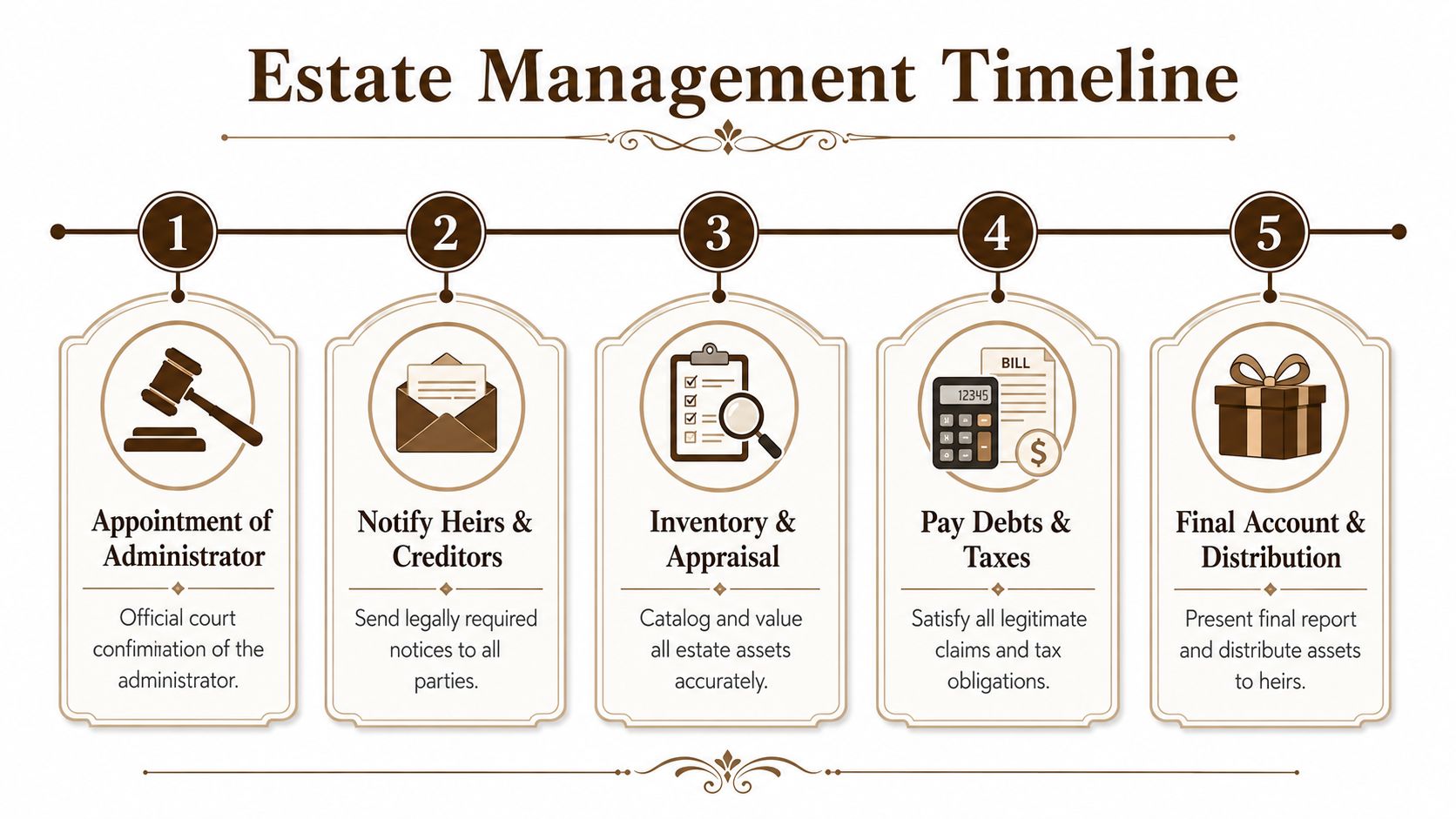
The inventory is more than a list. It is the administrator's sworn accounting of what the decedent owned and what needs protection, valuation, and, in some cases, court supervision before transfer.
Start with the obvious assets, then keep going. Bank accounts, brokerage accounts, retirement benefits payable to the estate, vehicles, life insurance payable to the estate, business interests, tax refunds, personal property with resale value, and claims the decedent may have had all need to be identified. In California, I also tell families to pay close attention to real property records early, especially in Los Angeles and Orange County where a single home can be the largest asset by far.
Real estate creates its own problems. I regularly see title issues tied to old refinance transactions, interspousal transfer deeds, quitclaim deeds signed years earlier, informal family arrangements, and property tax questions under Proposition 13 rules. Before anyone promises that a house will pass a certain way, the deed history and the character of the property need to be reviewed carefully.
Date-of-death value is the number that matters
For probate purposes, the key question is the asset's value on the date of death. It is not the family's estimate, the insurance number, the Zillow number, or the price an heir hopes to get after cleanup and listing.
That point causes trouble with houses all the time. In practice, courts and probate referees often question casual real estate valuations, and those questions can delay the case or create disputes among heirs. In higher-value California markets, a loose estimate can distort everything from sale strategy to equalization between beneficiaries.
A careful administrator gets reliable valuation support and keeps it in the file.
Notice to heirs and creditors needs precision
Notice work sounds mechanical until someone misses a deadline or mails the wrong form to the wrong address. Then it becomes expensive.
California probate requires formal notice to interested parties and a structured process for creditor claims. The details matter. A missed mailing, bad address, incomplete proof of service, or sloppy record of publication can extend administration and create arguments later about whether the estate was properly handled.
A careful administrator should:
- Create a clean paper trail from day one: Keep copies of every notice, proof of mailing, publication document, creditor claim, rejection, and response.
- Use an estate account for estate money: Do not deposit rent, refunds, or sale proceeds into a relative's personal account.
- Document property expenses as they happen: Mortgage payments, hazard insurance, HOA dues, utilities, emergency repairs, trash-out costs, and storage charges should all have backup.
- Review creditor claims before paying them: Some are valid, some are inflated, and some should be challenged or formally rejected.
- Protect vacant real estate immediately: Confirm insurance coverage, secure access, photograph condition, and track who enters the property.
Caution: The administrator is a fiduciary. Using estate funds informally, paying one heir back without support, or ignoring the notice process can create personal liability.
What competent administration looks like
In a well-run estate, the file is boring in the best sense. Every asset is listed. The house is insured. The mail is being reviewed. The creditor claims are tracked. Every payment can be matched to a receipt or bank record.
Problems usually start small and then grow:
| Problem | Consequence |
|---|---|
| Incomplete asset list | Delays, missed property, and later disputes |
| Casual handling of house expenses | Reimbursement fights and accounting objections |
| Weak support for real estate value | Court questions, heir objections, or a need to redo work |
| Paying claims without review | Unnecessary losses to the estate |
| Poor notice records | Delayed closing and added legal expense |
This part of the case separates families who finish probate from families who stay stuck in it. If the estate includes a house, rental property, business interests, contested debts, or conflict among heirs, getting probate counsel involved early is usually the cheaper decision.
Distributing Property Under California Intestacy Law
Once debts, expenses, and required administration steps are handled, the question every family asks comes back to the front. Who inherits? In a California intestate estate, the answer depends on the family tree and on whether the asset is separate property, community property, or property that passed outside probate.
The basic hierarchy
California intestacy law follows a statutory order. A surviving spouse may inherit all or part of the estate, depending on what kind of property is involved and which other relatives survive the decedent. Children, grandchildren, parents, siblings, and more remote relatives may inherit if the closer class is absent.
Here is a simplified view:
| Surviving Family Members | How the Estate is Divided |
|---|---|
| Surviving spouse only | The spouse may inherit the estate, subject to California characterization rules and whether assets are probate assets |
| Spouse and children | Distribution depends on whether the property is community or separate property and on the number of children or lineal descendants |
| Children but no spouse | Children generally inherit in equal shares by the applicable California succession rules |
| Parents but no spouse or children | Parents may inherit |
| Siblings or their descendants | They may inherit if there is no surviving spouse, child, or parent |
| More remote relatives | California law continues down the statutory line of succession |
This table is simplified on purpose. Real cases turn on facts that families often miss, especially marital history, predeceased heirs, half-siblings, adoption, and the characterization of the property.
Real property is where distribution gets complicated
In high-value California markets, the house isn't just one asset among many. It is usually the most important asset, and title transfer must be done carefully. The administrator typically needs court authority to distribute the property, and title must be cleared so the heirs can hold, refinance, or sell it.
A few recurring issues create trouble:
- One heir has been living in the property: Occupancy doesn't equal ownership.
- The family wants to “just put the house in the kids' names”: Title insurers want the probate paperwork done correctly.
- There are unequal expectations: A child who paid expenses may believe that creates a larger ownership share.
- The date-of-death value was handled casually: That can affect the court's review and later disputes over fairness.
What usually happens before title changes
In a formal probate, the administrator normally seeks a court order approving final distribution. That order becomes part of the title record and supports the transfer of ownership to the proper heirs.
For Southern California property, the practical steps often include:
Confirm legal title history
Review the last deed and any related transfers that may affect ownership.Use a defensible valuation
For real estate, this should be grounded in a proper date-of-death appraisal.Match the distribution request to California heirship rules
Family assumptions are not enough.Prepare transfer documents that title companies will accept
A distribution order means little if the follow-up title work is defective.
In probate real estate matters, the legal answer and the marketable-title answer have to line up. If they don't, the family can win the probate issue and still struggle to sell or refinance.
That's why understanding how to settle an estate without a will in California requires more than reading the heirship chart. You have to get the title work right too.
Common Pitfalls Costs and When to Call an Attorney
A family usually calls my office after the same moment. Someone has been paying the mortgage from a personal account, one sibling has moved into the house, another wants to sell, and nobody is sure who has authority to act. In California, that is how an intestate estate turns from a paperwork problem into a liability problem.
Some estates can be handled without heavy conflict. The trouble is that families often underestimate where the risk sits. In Orange County and Los Angeles, one house can carry enough value that a small title, valuation, or notice mistake affects tens or hundreds of thousands of dollars.
Based on our decades of practice, unrepresented administrators struggle most when the estate includes real property, creditor issues, or unclear family history. In those cases, mistakes often drive total costs up because the family has to correct filings, repeat notices, resolve disputes, or fix title problems before a sale can close.
The mistakes that cost families the most
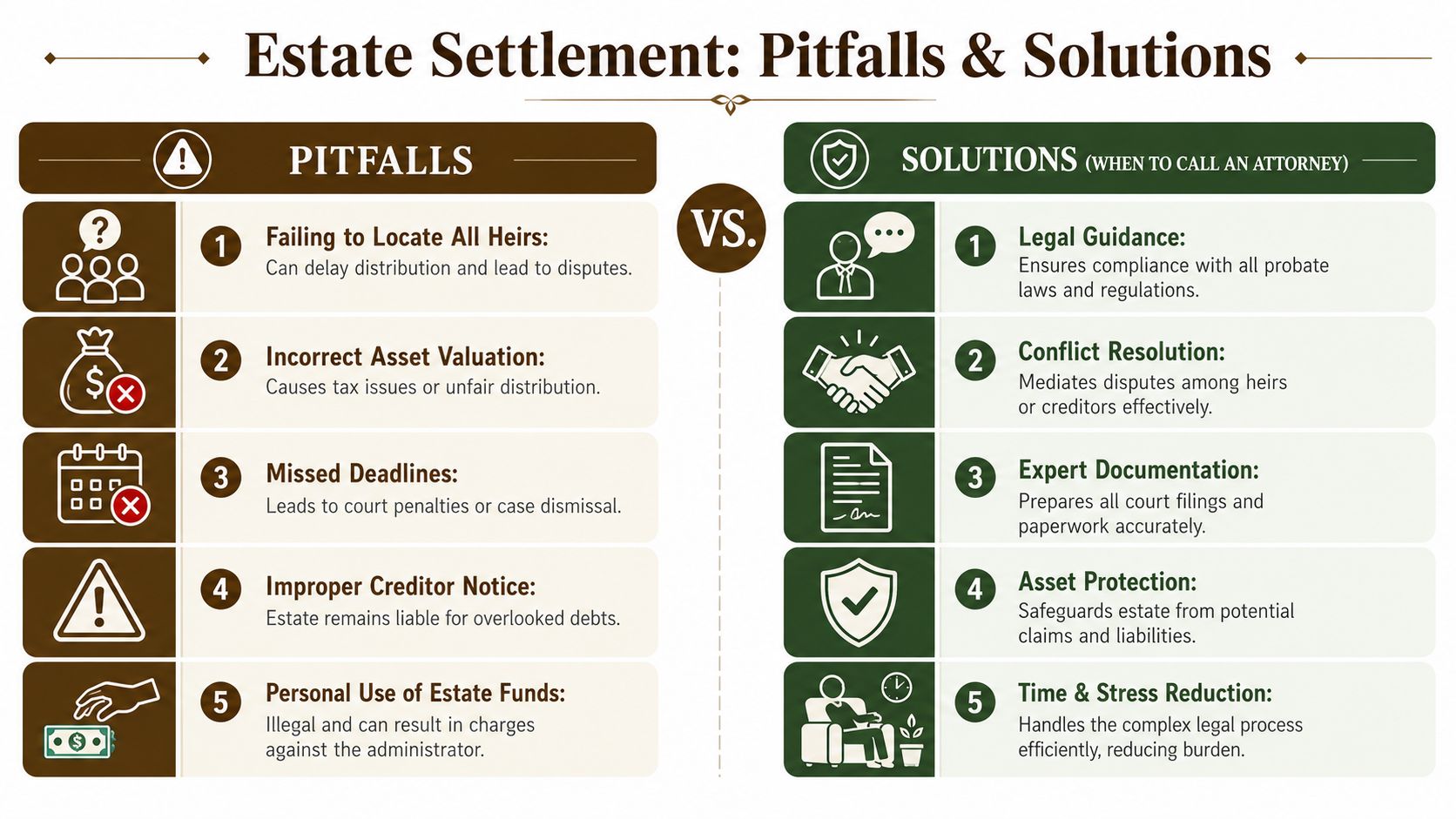
The expensive errors rarely look dramatic at the start.
- Missing an heir: One omitted relative can delay the case late in probate and force amended petitions, added notice, and renewed court review.
- Using a casual property value: In Southern California, a rough estimate invites trouble. It can affect the court file, tax reporting, negotiations among heirs, and the numbers a title company or buyer later examines.
- Mixing estate money with personal money: Administrators who pay bills from personal accounts or deposit rent into a personal account create accounting problems and invite objections.
- Handling creditor claims informally: Paying the loudest creditor first, or ignoring a valid claim because it seems unfair, often creates a bigger problem later.
- Letting one heir control the property too early: If one child collects rent, changes locks, approves repairs, or promises a sale before distribution authority is clear, the dispute usually gets worse, not better.
I also see families make verbal side deals that California probate law does not honor. A promise that one child will "get the house" because they helped more, or that another will be repaid later, should be documented and reviewed before money changes hands.
When professional help is necessary
Get probate counsel involved early if any of these apply:
- There is real estate in Orange County or Los Angeles
- The family is blended or there are children from different relationships
- An heir cannot be located
- A family member is living in the decedent's property
- The estate includes a business interest
- There are significant debts or creditor pressure
- Relatives disagree about who should serve as administrator
- The title history is unclear
Those are not technicalities. They are the cases where delay usually creates extra filings, extra carrying costs, and avoidable fights over authority.
Property cases deserve special caution. A house with a mortgage, deferred maintenance, tenant issues, or a sibling in possession needs both probate handling and a real-world plan for access, insurance, repairs, and sale timing. The legal answer alone is not enough if the property cannot be sold or refinanced cleanly.
The practical bottom line
If the estate is modest, the heirs agree, and there is no real property issue, a careful limited approach may work.
Once a California intestate estate includes a house, debt pressure, title uncertainty, or family conflict, the administrator is taking on real legal exposure. At that point, getting advice early is usually cheaper than repairing the case later.
If you're dealing with a California estate and need clear answers about authority, title, heirs, or the next filing, schedule a free consultation with Tanner Law. You'll get practical guidance focused on California probate and real estate issues, including estates involving property in Orange County and Los Angeles.