Breach of Real Estate Contract: California Rights
A real estate deal rarely falls apart at a convenient moment. It happens after inspections are scheduled, movers are lined up, probate timelines are moving, or a family has already started making plans around a sale. Then the phone rings. The buyer says they won’t close. The seller says they’ve changed their mind. The broker forwards an email that raises more questions than answers.
That moment feels personal, but it’s also a legal problem with very real financial consequences. A breach of real estate contract can affect far more than the property itself. It can delay an estate administration, disrupt a trust distribution, create carrying costs for a vacant home, or force a family to make decisions under pressure.
Those disputes are also more common than many people expect. Real estate contract breaches reached record cancellation levels in recent years, with over 40,000 purchase agreements cancelled in December alone, representing approximately 16% of all homes under contract at that time, according to this discussion of housing contract cancellations. In other words, failed escrows and broken purchase agreements aren’t unusual outliers. They’re a recurring part of the California real estate market.

When that happens, the first question usually isn’t academic. It’s practical. Can the deal be forced through? Is the deposit gone? Can the other side be sued? Did the broker make the problem worse? Under California law, the answer depends on the contract language, the type of breach, the timing, and the remedy that best protects your position.
Table of Contents
- Introduction When Your Real Estate Deal Goes Wrong
- What Legally Constitutes a Breach of Contract in California
- Common Types of Real Estate Contract Breaches
- Your Legal Remedies for a Breach of Contract
- Common Defenses Against a Breach of Contract Claim
- Navigating the Legal Process in California
- How Tanner Law Protects Your Real Estate Investment
Introduction When Your Real Estate Deal Goes Wrong
Most clients don’t call a lawyer because they enjoy conflict. They call because a transaction that seemed settled suddenly isn’t. In Orange County and Los Angeles, that often means more than disappointment. It may mean a probate sale is stalled, a family home can’t be distributed, or a replacement purchase is now at risk because the expected sale proceeds never arrived.
A broken deal creates two problems at once. The first is legal. Someone may have failed to do what the contract required. The second is strategic. Even when a breach is clear, deciding what to do next isn’t simple. Some clients want the sale completed. Others want out, with compensation. Some need to protect title quickly before the property is offered to someone else.
A good legal response starts by slowing the situation down enough to identify leverage, deadlines, and proof.
California real estate law gives buyers and sellers meaningful remedies, but it also rewards the party who documents the problem early and chooses a realistic objective. Chasing the wrong remedy can cost time and money. Waiting too long can weaken an otherwise strong claim.
That’s why a breach of real estate contract should be treated as a business and legal emergency, but not as a reason to panic. A careful review of the purchase agreement, addenda, disclosures, escrow instructions, communications, and contingency deadlines usually reveals where the case stands.
The issue is common, but every contract is different
The broad increase in cancelled purchase agreements shows how often deals unravel. What matters under California law, though, is not just that the deal failed. It’s why it failed, when the refusal occurred, and whether the contract gave that party a valid exit.
A buyer who lawfully cancels under an active contingency is in a very different position from a buyer who refuses to close. A seller facing legitimate title problems is in a different position from a seller who decides to hold out for a better offer.
For families dealing with trust property, probate real estate, or inherited homes, these distinctions matter even more. Delays can ripple through the entire estate administration. A precise legal analysis helps separate a frustrating setback from an enforceable breach claim.
What Legally Constitutes a Breach of Contract in California
Under California law, a real estate contract is a binding agreement once the essential terms are accepted and the parties are obligated to perform. In plain terms, each side promises to do specific things by specific deadlines. If one side doesn’t do what the contract requires, that may be a breach.
The key word is may. Not every disagreement, delay, or inconvenience becomes a lawsuit. Courts look at whether the missed obligation was important enough to affect the heart of the deal.
One useful way to think about it is as a blueprint. If the contract is the blueprint for the transaction, a missing foundation is a serious defect. A cosmetic flaw is still a problem, but it usually doesn’t justify tearing the whole structure down.
Actual breach
An actual breach happens when a party plainly fails to perform a contractual duty. That can include a buyer refusing to pay the agreed purchase price or a seller refusing to transfer the property as promised. As noted in this discussion of broken real estate deals and contract performance, actual breaches can lead to lawsuits, deposit disputes, and other remedies.
In practice, common examples include:
- Buyer nonperformance: The buyer doesn’t deliver funds, doesn’t sign closing documents, or refuses to close after contractual obligations are due.
- Seller nonperformance: The seller won’t sign transfer documents, won’t deliver possession as agreed, or refuses to complete the sale without legal justification.
- Escrow failures tied to one party: A party doesn’t provide required documents, approvals, or cooperation needed to finish the transaction.
Material breach versus minor breach
The distinction between a material breach and a lesser breach matters because it affects available remedies.
A material breach undermines the core purpose of the agreement. If a seller refuses to convey title, that’s not a side issue. It defeats the deal. If a buyer refuses to close after the contract requires performance, that can also be material because the seller loses the benefit of the bargain.
By contrast, a minor breach involves a less central obligation. It may still create a claim for money damages, but it usually doesn’t justify ending the entire contract.
Practical rule: Ask whether the alleged breach prevented the other side from receiving what they reasonably contracted for. If the answer is yes, material breach analysis usually follows.
Timing matters as much as conduct
California breach analysis also depends on when performance was due. A contract may include contingencies, cure periods, disclosure obligations, and escrow deadlines. Before calling something a breach, the contract has to be read as a whole.
That’s why the first review should focus on a short set of documents:
- The purchase agreement
- All addenda and counteroffers
- Escrow instructions
- Contingency removal documents
- Emails, texts, and broker communications
A clear timeline often decides the case before any lawsuit is filed.
Common Types of Real Estate Contract Breaches
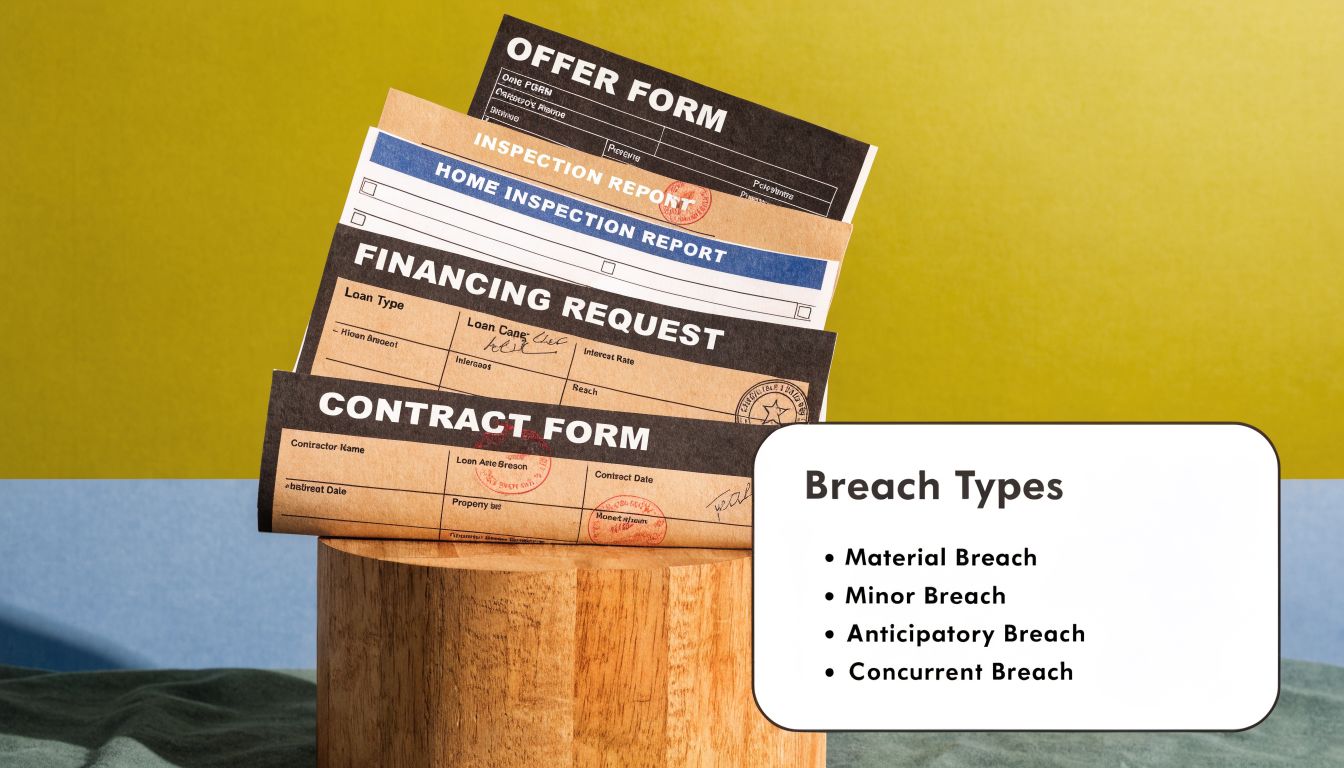
The label attached to the conduct isn’t just legal vocabulary. It shapes the remedy, the urgency, and the tone of the dispute. In California, most breach of real estate contract cases fall into a few recurring categories.
Material breach
A material breach is the one that changes everything. It goes to the center of the agreement and deprives the non-breaching party of the main benefit of the contract.
Examples often include a seller refusing to transfer ownership, a buyer refusing to complete payment, or a party failing to perform after contingencies have been removed and closing obligations are due. In estate and trust sales, a material breach can also disrupt court-related timelines, beneficiary expectations, and related transactions.
Signs that a breach is likely material include:
- The closing can’t happen because of the conduct
- The breach affects title, possession, or payment
- The non-breaching party can’t receive the property or the sale proceeds as promised
- The problem isn’t easily corrected without significant delay or loss
A material breach often supports stronger remedies, including a claim for damages or, in the right case, specific performance.
Anticipatory breach
An anticipatory breach happens before the deadline for performance, when one party clearly signals they won’t perform. The signal has to be direct enough to show non-performance isn’t just possible, but intended.
That matters because you may not have to sit and wait for the formal closing date to pass if the other side has already made their refusal clear. According to this discussion of anticipatory breach in real estate transactions, anticipatory breach arises when a party unequivocally signals non-performance before the deadline, and benchmark data shows 25-35% of breaches in high-value ($1M+) transactions are anticipatory.
Practical examples include:
- A seller emails that they’ve changed their mind and won’t sell.
- A buyer states they won’t close, even though no contingency protects that decision.
- A party takes inconsistent actions that show they no longer intend to honor the contract.
The advantage of recognizing anticipatory breach early is that it allows counsel to act promptly. That may mean preserving evidence, making a formal demand, recording appropriate notices when allowed, or preparing a suit before the situation gets worse.
A short explanation of breach categories can be helpful if you're trying to identify where your situation fits:
Minor or partial breach
Not every contract problem destroys the transaction. A minor or partial breach usually involves a failure that should be corrected, but doesn’t necessarily justify cancellation.
Examples might include a dispute over a smaller repair item, a paperwork issue that can be cured, or a delay that doesn’t make the deal impossible. These disputes often create friction, but they’re usually handled through negotiation, credit adjustments, written amendments, or limited damages claims.
That distinction matters because overreacting to a minor breach can backfire. A party who wrongfully declares the contract dead may create a new dispute and expose themselves to claims.
When clients bring in a file full of angry emails, the first task is separating a real material default from a noisy but fixable transaction problem.
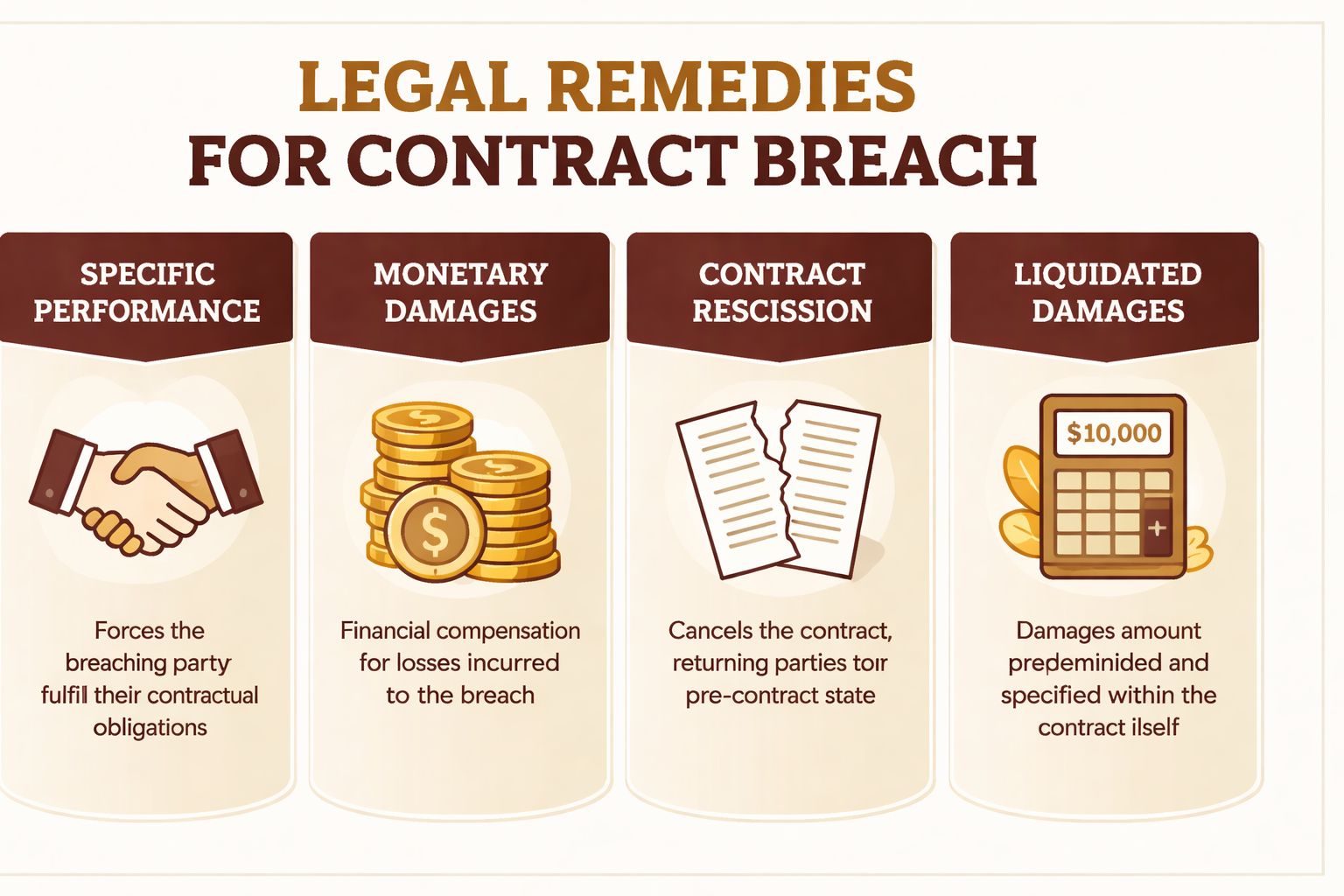
Your Legal Remedies for a Breach of Contract
Once a breach is identified, the next question is usually, “What can I do about it?” California law offers several remedies, but the right choice depends on your objective. Some clients want the property. Some want compensation. Some want a clean exit.
Many cases are won or lost. While more than one remedy may be available, these are not interchangeable in a practical sense.
Why remedy choice matters
There is a recognized Remedy Selection Paradox in real estate disputes. As explained in this discussion of real estate contract breach and remedy choice, specific performance is common because each property is considered unique, yet proving that uniqueness and pursuing that remedy can be difficult. The choice between damages and specific performance becomes a strategic decision with different costs, timelines, and risks.
That’s especially true in California. A remedy should fit the client’s real-world goal, not just the legal theory that sounds strongest on paper.
Some cases look powerful in a complaint but weak in terms of cost, timing, or collectability. A smart remedy is one the client can actually use.
Monetary damages
Monetary damages compensate the non-breaching party for financial harm caused by the breach. In seller cases, available damages can include the difference between the agreed sale price and the property’s fair market value at the time of breach, as described in the earlier discussion of breach remedies. In buyer cases, the remedy may include recoverable losses tied to the failed sale, depending on the facts and contract language.
Damages often make the most sense when:
- The property has already been sold to someone else
- The client no longer wants the transaction completed
- The non-breaching party’s losses can be shown with reliable evidence
- Time matters more than forcing performance
The challenge is proof. Damages claims require evidence, not assumptions. Appraisals, market data, escrow records, invoices, carrying costs, and correspondence all become important.
Specific performance
Specific performance is a court order requiring the breaching party to complete the transaction. Buyers often pursue it when a seller refuses to transfer a property that can’t be replaced by money alone. Sellers may also seek it in appropriate circumstances.
This remedy is often powerful because real estate is unique. But it’s not automatic. The party seeking specific performance usually needs to show they were ready, willing, and able to perform their side of the deal.
Specific performance is often strongest when:
- The property has unusual value to the buyer
- Comparable substitute properties won’t solve the problem
- The non-breaching party fully complied or was prepared to comply
- Preserving the transaction itself matters more than immediate cash recovery
The drawback is that this remedy can be slower, more demanding, and more expensive to litigate than a straightforward damages claim.
Rescission and liquidated damages
Rescission unwinds the contract. The goal is to place the parties back in their pre-contract positions as much as possible. This can be useful when the relationship has broken down beyond repair or when a completed sale no longer makes practical sense.
Liquidated damages involve a pre-agreed damages provision in the contract. These clauses can matter a great deal in California, but they must be reviewed carefully. They don’t eliminate strategic analysis. In some cases, they shape the recovery. In others, they become their own point of dispute.
Comparing Legal Remedies for a Breach of Contract
| Remedy | Primary Goal | Best For… | Typical Scenario |
|---|---|---|---|
| Monetary Damages | Recover financial loss | Parties who want compensation rather than the transaction itself | Buyer or seller backs out and the injured party can document economic harm |
| Specific Performance | Force completion of the sale | Cases involving a unique property or a client who still wants the deal | Seller refuses to transfer title after the buyer is prepared to close |
| Rescission | End the contract and unwind obligations | Situations where continued performance no longer makes sense | Trust has changed course, facts have shifted, or the transaction can’t realistically be saved |
| Liquidated Damages | Enforce a contractually stated recovery | Cases where the agreement contains a valid damages clause | Deposit and damages disputes tied directly to contract terms |
A disciplined remedy analysis keeps the case focused. The best outcome often comes from choosing one path early and building the evidence around it.
Common Defenses Against a Breach of Contract Claim
Even when the breach looks obvious from one side, the other side usually has a story. Understanding likely defenses helps you evaluate settlement options, avoid blind spots, and prepare stronger evidence.
Contingencies and contract excuses
One of the most common defenses is that a contingency was still active or properly invoked. In California transactions, financing, inspection, appraisal, title, and sale-of-other-property contingencies can affect whether a cancellation was wrongful.
If the buyer had a valid contractual right to cancel and followed the notice requirements, what feels like a breach may be permitted conduct. That’s why timing and paperwork matter so much.
Another defense is that the accusing party didn’t perform their own obligations. A party generally can’t demand strict performance from the other side while overlooking their own unfulfilled duties.
Common defense themes include:
- Failure of contingency: The contract allowed cancellation under the circumstances.
- Lack of plaintiff performance: The party bringing the claim wasn’t ready or able to perform.
- Contract ambiguity: The language was unclear enough that the alleged duty wasn’t as definite as claimed.
Misrepresentation waiver and impossibility
Fraud or misrepresentation can also become a defense. If one side concealed major defects, misstated material facts, or induced the contract through false information, the accused party may argue the contract shouldn’t be enforced as written.
Waiver is another important issue. If a party repeatedly accepted late performance, ignored defaults, or acted as if the contract was still moving forward after the alleged breach, the other side may argue that strict compliance was waived.
Then there’s impossibility or impracticability. If a true outside event makes performance impossible, that can affect liability. These arguments are highly fact-specific and should be approached carefully, especially in disputes involving damaged property, title complications, or court-supervised sales.
A defense doesn’t have to be perfect to create leverage. It only has to be plausible enough to complicate proof and increase litigation risk.
That’s why breach cases should never be evaluated from only one set of emails or one person’s memory. The contract file has to be reviewed as a whole.
Navigating the Legal Process in California
A strong case can weaken quickly if the process is mishandled. California procedure, deadlines, and evidence rules all matter in a breach of real estate contract dispute.

What to do first
Start by preserving every relevant document. That includes the signed agreement, counteroffers, disclosures, escrow instructions, cancellation notices, text messages, emails, inspection reports, and proof of funds or financing communications. Small details often become decisive.
California written contract claims are also subject to deadlines. The verified material provided here notes a four-year statute of limitations in California for written contract actions in the context of real property breach claims, as discussed in this analysis of residential real estate contract breaches. Even with that window, waiting is rarely wise. Delay can mean lost evidence, changed positions, or additional transfers that complicate relief.
A practical early response usually includes:
- Build a timeline: Identify contingency deadlines, notice dates, and closing obligations.
- Send a focused demand: The goal is clarity, not anger.
- Evaluate the remedy before filing: Lawsuits should support a strategy, not replace one.
- Protect the asset and the evidence: This is especially important if the property may be remarketed.
When broker conduct becomes part of the case
Many articles stop with buyer versus seller. Real disputes are sometimes broader. General legal content often omits the issue of real estate broker liability exposure, especially when negligent drafting, missed disclosures, or dual agency problems contributed to the breach, as noted in this discussion of rights after a breached real estate contract.
That matters in California because broker conduct can affect both liability and negotiating advantage in settlements. If an agent failed to communicate material information, mishandled timelines, or created confusion in the contract process, there may be an additional avenue to investigate.
This doesn’t mean every failed transaction justifies claims against a broker. It does mean the file should be reviewed with that possibility in mind, particularly when the contract language, disclosures, or communications don’t line up cleanly.
Broker mistakes can change the pressure points in a case. Sometimes they explain the breach. Sometimes they create another path to recovery.
For families handling inherited property, trust sales, or probate-related transactions, that broader review can be especially important because more participants are often involved and mistakes can compound quickly.
How Tanner Law Protects Your Real Estate Investment
A breach of real estate contract isn’t just about who was right. It’s about what result protects your property, your time, and your finances under California law. That requires more than reciting a list of remedies. It requires judgment about whether to push for performance, pursue damages, unwind the deal, or examine whether a broker’s conduct played a role.
That judgment matters even more in Orange County and Los Angeles, where many disputes involve family homes, inherited property, trust assets, and transactions that carry emotional weight as well as financial value. A legal response should be clear-eyed, cost-conscious, and built around the client’s real objective.
Tanner Law brings a particularly useful perspective to these disputes because William T. Tanner serves as both an attorney and a licensed real estate broker. That combination helps clients evaluate not only litigation strategy, but also how transactions are supposed to work in the first place. It allows the file to be reviewed through both a courtroom lens and a transactional one.
Clients facing a broken deal usually need answers to a few urgent questions. Is this a true breach? What remedy is realistic? What evidence matters most? Should the broker’s role be examined? Those answers should come early, before the other side gains momentum.
If your sale, purchase, probate transaction, or trust-related real estate matter has gone off course, experienced California counsel can help you regain control and protect your investment.
If you're dealing with a breach of real estate contract in California, Tanner Law can help you assess your rights, your remedies, and the best next step for your situation. Schedule a free consultation to discuss your Orange County or Los Angeles real estate dispute and get practical guidance suited to your case.