Contesting a Will in California: A Legal Guide
A parent dies. The family is grieving, trying to plan a service, sort through papers, and answer basic questions about the house, accounts, and personal property. Then someone finds a will that doesn’t match what everyone had heard for years. A child who was always included is suddenly left out. A new caregiver appears as a major beneficiary. A document was signed near the end of life, during a period of serious illness, isolation, or confusion.
That’s usually when people start asking whether contesting a will is possible in California.
It can be. But a will contest is not a general complaint process for unfair results, hurt feelings, or family disappointment. California probate courts start from the assumption that a properly signed will reflects the decedent’s wishes. To undo that document, you need legal standing, a valid legal ground, and evidence that can hold up in court. In Orange County and Los Angeles, that means moving quickly, focusing on facts, and avoiding the common mistake of building a case around suspicion alone.
If you’re in that position now, the right first step is to understand whether your concern is legally actionable or emotionally understandable but not something a court will fix.
Table of Contents
- When to Question a Will's Validity
- The Four Legal Grounds for Contesting a Will in California
- Key Deadlines and Initial Procedures in California Courts
- Gathering Evidence and Building Your Case
- The Financial Realities and Potential Outcomes of a Will Contest
- When to Partner with a Probate Litigator
When to Question a Will's Validity
Families usually don't walk into a probate lawyer’s office saying, “I’d like to file a formal will contest.” They say something more human. “This doesn’t look like my mother.” “My brother kept everyone away at the end.” “He never would have signed this if he understood what it did.”
Those reactions can point to a real legal problem. They can also reflect grief, conflict, or long-running family tension that a court won’t treat as proof. The hard part is telling the difference early, before time and money are spent in the wrong direction.

Signs that deserve a closer look
Some situations justify immediate legal review:
- A sudden last-minute change that sharply benefits one person and cuts out expected heirs.
- Isolation before signing where the decedent was kept away from children, siblings, or longtime advisors.
- Serious cognitive decline around the time the will was executed.
- A document that appears irregular because the signature, witnesses, or surrounding circumstances seem off.
- Conflicting stories about how the will was prepared, explained, or signed.
None of those facts automatically wins a contest. They do tell you the issue is serious enough to evaluate under California law.
Practical rule: If your concern can be summed up only as “it feels unfair,” that’s not enough. If your concern is tied to capacity, pressure, deception, or signing defects, it may be.
What California courts are really asking
Probate judges don't decide whether a will was kind, balanced, or consistent with family expectations. They decide whether it was valid.
That distinction matters. A parent can legally favor one child over another. A decedent can disinherit relatives. A will doesn’t fail because it surprised the family. It fails only if the challenger proves a recognized legal defect.
In practice, the first conversation should focus on timing, the history of earlier estate plans, the decedent’s health and relationships, and who was present when changes were made. Those facts often reveal whether contesting a will is a realistic case or a painful dispute better addressed another way.
If you’re unsure whether your concerns rise to that level, a free consultation can help you assess the facts before you commit to litigation.
The Four Legal Grounds for Contesting a Will in California
A daughter walks into my office with a copy of her father’s final will. Six months earlier, she says, he was forgetting names, missing medications, and relying on one caregiver for nearly everything. The new will cuts out two children and leaves most of the estate to that caregiver. Her first question is usually the wrong one. “Can the judge fix something this unfair?” The better question is whether the facts fit a recognized legal ground under California probate law.
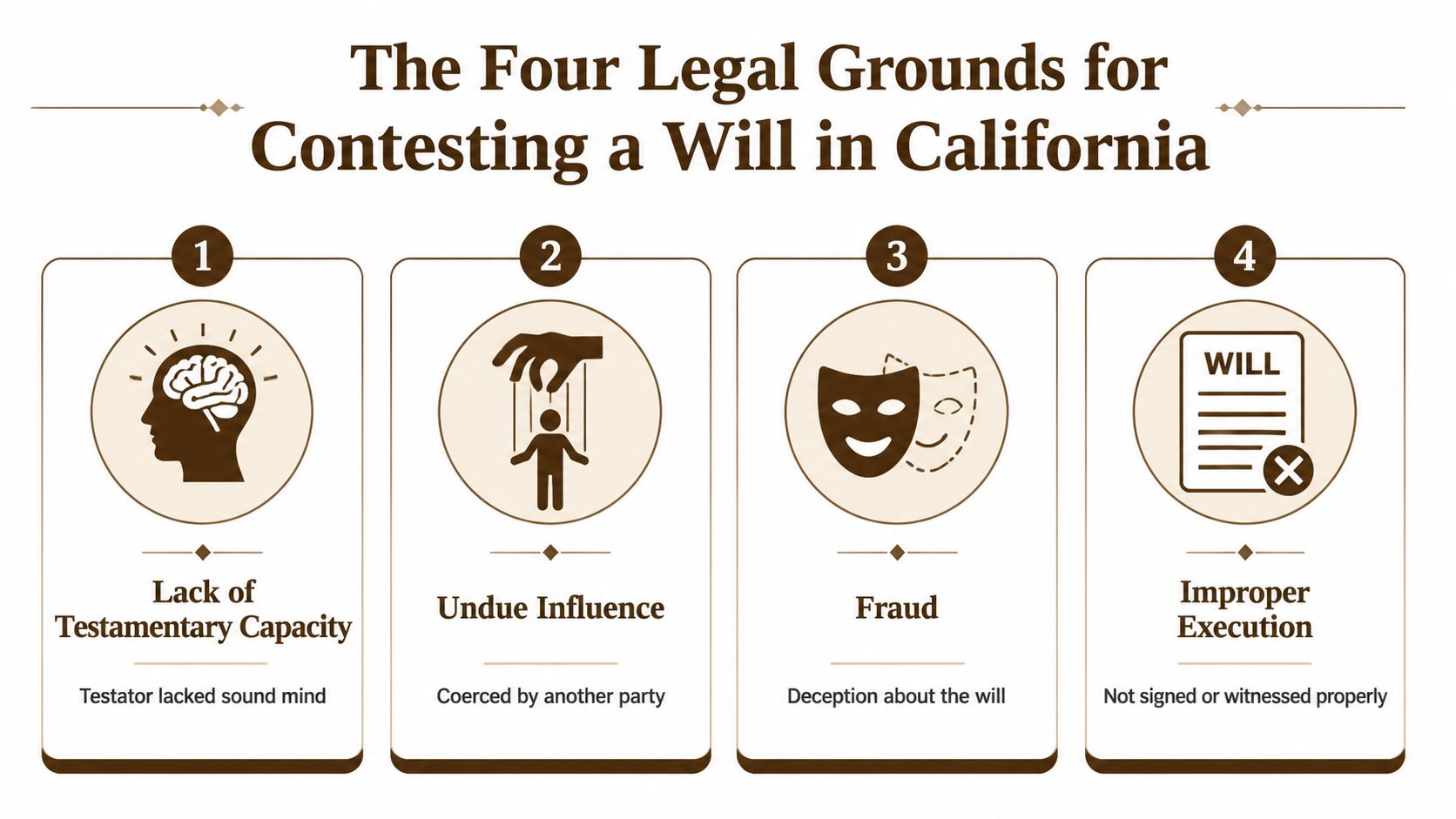
California courts do not rewrite wills because a family expected a different result. They examine whether the document is legally valid. In practice, nearly every viable contest falls into one or more of four categories: lack of testamentary capacity, undue influence, fraud, or improper execution.
Lack of Testamentary Capacity
California sets a low bar for capacity to make a will, but it is still a real bar. The person signing must understand that they are making a will, understand the nature of their property in a general way, and recognize the people who would ordinarily be expected to receive it.
This ground turns on the decedent’s mental state at the time of signing. A diagnosis of dementia, Alzheimer’s, or cognitive impairment does not automatically invalidate a will. I have seen cases where a person had a serious diagnosis yet still had a lucid period when the will was explained and signed. I have also seen the opposite. A person looked socially pleasant, could carry on a short conversation, and still had no real understanding of the document put in front of them.
The useful evidence is usually concrete. Medical records near the signing date. Notes from treating physicians. Care facility charts. The drafting attorney’s file. Witness observations about confusion, memory loss, or inability to follow a basic explanation.
Undue Influence
Undue influence is one of the most litigated grounds in California will contests because it often develops subtly inside a dependent relationship. The legal question is whether pressure, manipulation, or control overcame the testator’s free judgment so that the will reflects someone else’s intent.
California courts do not treat ordinary persuasion as wrongful. Adult children argue. New spouses advocate for themselves. Caregivers become close to vulnerable elders. None of that alone proves undue influence. The facts get stronger when the beneficiary isolated the decedent, controlled access to information, arranged the lawyer, attended meetings, translated communications, handled medications, or kept other family members away.
In Orange County cases, judges often want a clean timeline. When did the dependency begin? Who contacted the attorney? Who drove the decedent to the signing? Who kept the original will afterward? Those details matter because undue influence cases are rarely won with suspicion alone.
Fraud
Fraud involves deception that caused the will to be made, changed, or signed. Sometimes the lie concerns the document itself. A decedent is told they are signing a different paper, or that the document only handles a narrow administrative issue. In other cases, the lie concerns family facts. Someone falsely reports theft, abuse, abandonment, or disloyalty to push the testator toward disinheritance.
These cases are hard for a practical reason. The key witness is often gone. That means fraud claims usually depend on indirect proof, such as inconsistent statements, text messages, emails, attorney notes, or testimony from people who heard the false story being repeated before the will was changed.
Fraud can be a strong claim, but it usually needs more than a family member saying, “Dad would never have done this otherwise.”
Improper Execution
Even a will that reflects the decedent’s wishes can fail if it was not executed the way California law requires. Formalities matter in probate court because they protect against substitution, coercion, and mistake.
The usual questions are straightforward. Did the decedent sign the will, or acknowledge the signature, in the required manner? Were there proper witnesses? Were the witnesses present at the right time? Is there a self-proving affidavit or a clear attestation clause? If the signing happened at home, in a hospital, or under rushed circumstances, those details deserve close attention.
This ground can be technical, but technical does not mean weak. A bad signing ceremony can create a real contest, especially when the witnesses later give conflicting accounts or no one can explain how the document was prepared and executed.
Here is the practical framework:
| Ground | What the court is asking | Evidence that often matters |
|---|---|---|
| Capacity | Did the testator understand they were making a will and the basic effect of it? | Medical records, attorney notes, witness observations, care records |
| Undue influence | Did another person overcome the testator’s free will? | Isolation, dependency, beneficiary involvement, sudden plan changes |
| Fraud | Did deception cause the will to be signed or changed? | False statements, emails, texts, witness testimony, contradictory explanations |
| Improper execution | Was the will signed and witnessed in compliance with California law? | The original will, attestation language, witness testimony, drafting file |
The strongest contests usually combine law and proof. A weak capacity claim can become stronger when it overlaps with undue influence. An execution problem can become more serious when no neutral attorney supervised the signing. The reverse is also true. A troubling family story may still be a poor lawsuit if the medical records are clean, the drafting lawyer is credible, and the witnesses are solid.
That is the trade-off potential clients need to hear early. A valid claim is not the same as a cost-effective claim. Before filing, the issue is not whether the will feels wrong. The issue is whether the evidence can prove one of these four grounds in a California probate court.
Key Deadlines and Initial Procedures in California Courts
A common California probate call goes like this. A son learns his mother’s new will was admitted in Orange County. He believes a caregiver pushed the change. The family spends a month arguing, another month waiting for records, and by the time anyone is ready to act, the court deadline is close or gone.
That is why the first conversation is usually about timing and standing, not family history. In a will contest, those two issues can end the case before the court ever reaches fraud, undue influence, capacity, or execution problems.
Who can actually file
California probate courts do not let every unhappy relative file a contest. The person challenging the will must usually qualify as an interested person under Probate Code § 48(a). In practical terms, that means a direct financial stake in the outcome.
That often includes:
- An heir at law who would inherit if there were no valid will
- A beneficiary under a prior will who loses out under the newer document
- Someone whose property or financial interest is directly affected by admitting the challenged will
Standing sounds technical, but it is often straightforward. If the will stands and your financial position does not change, the court may decide you have no right to contest it, even if your concerns are sincere.
The deadline that usually controls
For many California will contests, the key deadline is 120 days after the will is admitted to probate under Probate Code § 8270.
That window is short.
In practice, families often lose time before they understand what has happened procedurally. They assume the deadline runs from the date they discovered something felt wrong. Usually it does not. The safer approach is to confirm the actual probate filing date immediately by reviewing the court file.
In Orange County, that means checking the probate case docket, the order admitting the will, and the proof of notice. Those details matter. I often start there because clients are frequently told an incomplete version of the timeline by relatives, fiduciaries, or other beneficiaries.
What the opening stage usually looks like
A will contest generally begins with a petition in the probate case or a related filing in the court handling the estate. The filing has to do more than express suspicion. It needs to state a recognized legal ground and enough supporting facts to survive early attack.
Early procedural work usually includes:
- Reviewing the probate file to confirm what document was admitted, when the order was entered, and what deadlines are active
- Confirming standing before fees are spent on a case the court may dismiss at the outset
- Selecting the legal theory carefully so the petition matches California probate law rather than broad family grievances
- Serving the personal representative and other interested parties under the applicable probate rules
- Preparing for the first hearing, where judges often focus on timeliness, standing, and whether the petition states a legally valid contest
Local practice matters here. Orange County probate judges expect organized pleadings, clean service, and a file that makes procedural sense. A weak petition can create settlement pressure in the wrong direction because the other side sees the contestant is already behind.
What to do first
Start with the court file and the documents already in your possession. Get a copy of the admitted will, any prior wills, the probate petition, and the order admitting the will to probate. Save texts, emails, letters, and calendar notes that help establish when changes occurred and who was involved.
Use caution before sending accusations to siblings, caregivers, or the executor. Those messages often become exhibits. Angry emails rarely help a contested probate case, and they can make settlement harder.
A consultation with California probate counsel should answer three questions quickly. Do you have standing. Has the limitations period started or already expired. Is there enough factual support to justify the cost of filing in probate court.
Those are not small details. They are the gatekeepers to the whole case.
Gathering Evidence and Building Your Case
A will contest is won or lost on proof. Courts don’t invalidate wills because a story sounds troubling. They look for records, witnesses, timelines, and documents that support a recognized legal ground.

The key is matching the evidence to the theory. Medical records may matter greatly in a capacity case and much less in an execution case. Witness testimony may be central in an undue influence claim. Drafting attorney files can become critical where fraud or suspicious changes are alleged.
What evidence matters most
Different claims call for different proof.
- For capacity claims, lawyers usually look for medical charts, memory assessments, physician notes, medication histories, and observations from people who saw the decedent near the signing date.
- For undue influence claims, the pattern matters. Emails, texts, caregiver notes, visitor restrictions, transportation control, and testimony about isolation can help show pressure and dependence.
- For fraud claims, the focus often turns to who said what, when, and in what form. Contradictory messages, altered drafts, or misleading explanations surrounding signature can matter.
- For improper execution, the details of the signing ceremony become central. Witness identities, attorney notes, draft history, and the physical document itself may all become important.
The strongest evidence usually comes from neutral sources. Treating doctors, longtime accountants, drafting attorneys, neighbors, and independent witnesses often carry more weight than relatives already in conflict.
Build a timeline early. Dates of hospitalization, medication changes, caregiver involvement, and estate plan revisions often reveal the case more clearly than anyone’s opinion does.
Discovery is where weak theories get exposed
After the case begins, formal discovery can require parties to produce documents, answer written questions, and appear for depositions. That process often clarifies whether a suspicion can be proved.
Sometimes discovery helps the contestant. Other times it confirms that the decedent understood exactly what they were doing and made a choice the family didn’t expect. Good counsel should tell you the difference as soon as the paper trail develops.
This video gives a helpful general overview of proving undue influence and related concerns in estate disputes:
Digital evidence now matters far more
Will contests no longer revolve only around paper files and live witnesses. Text threads, emails, scanned drafts, video recordings, and electronically stored communications now appear in many cases. That creates opportunity and risk.
The burden of proof is also changing. With California's AB 2013, effective January 2026, requiring disclosure of AI in legal documents, proving fraud or undue influence increasingly involves forensic authentication of digital communications and media to rule out manipulation, as discussed in this analysis of AI disclosure rules and proof of undue influence.
That means lawyers may need to look at metadata, chain of custody, file history, and whether a recording or message is authentic before treating it as reliable evidence. A dramatic video clip is not automatically persuasive if its origin cannot be established.
What usually does not work
Some evidence sounds powerful in a family conversation but performs poorly in court:
- General statements about unfairness
- Old family grievances unrelated to the signing
- Speculation about motive without supporting documents
- Secondhand stories with no witness willing to testify
- Social media accusations made in anger
A persuasive case is built from admissible facts, not volume. If you suspect a will is invalid, a free consultation can help determine what evidence should be preserved now and what proof a California court is likely to require.
The Financial Realities and Potential Outcomes of a Will Contest
Probate litigation is rarely cheap, quick, or emotionally clean. Even strong cases require time, document review, court appearances, and often expert analysis. Families should go into a will contest understanding that legal merit and practical value are not always the same thing.
That doesn’t mean contesting a will is a bad decision. It means the case should be evaluated with discipline. The question is not only “Can I sue?” It’s also “What is the likely path, what are the costs, and what result will serve my interests?”
What clients often underestimate
The first surprise for many people is that a courtroom win is not the most common ending. According to Keystone Law’s discussion of will contest outcomes, trial success rates for completely overturning a will are often below 10%, while 90% to 97% of litigated will contest cases settle out of court.
That changes how experienced lawyers approach these disputes. A case should be prepared thoroughly enough to withstand litigation pressure, but with an eye toward negotiated resolution if that preserves estate value and reduces risk.
Here are the main trade-offs:
| Issue | Litigation approach | Settlement approach |
|---|---|---|
| Cost | Can rise as discovery and experts expand | Often contains expense earlier |
| Timing | Court schedules can be slow and unpredictable | Resolution may come sooner |
| Privacy | Family conflict becomes part of the court record | Discussions can be more controlled |
| Outcome control | Judge decides if the case doesn't settle | Parties have more say in structure |
A practical win in probate court often means a negotiated result that protects your position without consuming the estate in fees and conflict.
What a successful result usually looks like
“Success” in a will contest does not always mean the will is wiped out after trial. In practice, outcomes usually fall into a few categories.
- The will is upheld. The challenger doesn’t prove a legal defect, and the estate proceeds under the admitted document.
- The challenged will is invalidated. If that happens, a prior valid will may control, or the estate may pass under California intestacy rules if no prior valid will exists.
- The parties settle. A beneficiary share may be adjusted, a disputed distribution may be resolved by agreement, or the parties may structure a practical compromise to end the case.
Settlement is not surrender. In many cases, it is the most rational outcome because it reduces uncertainty and limits the damage that prolonged litigation can do to the estate and the family.
Cost should be weighed against evidence
The weakest cases are often the most expensive for the client because they require a lot of litigation effort to pursue a theory that never had adequate proof. The better approach is early case triage. Identify the documents, evaluate the witnesses, and decide whether the evidence can support capacity, undue influence, fraud, or execution defects.
That kind of honest assessment saves people from spending heavily on a claim built mostly on suspicion. If you’re weighing whether contesting a will makes economic sense as well as legal sense, a free consultation can help you understand the likely paths and risks.
When to Partner with a Probate Litigator
A will contest in California is not a form you fill out and hope for the best. It is a focused piece of litigation that turns on standing, deadlines, pleading quality, evidence preservation, and local court practice. If any one of those pieces is mishandled, the case can weaken quickly.
That’s especially true in Orange County and Los Angeles, where probate departments move on schedules and procedures that can feel unforgiving to self-represented parties. Even people with valid concerns often damage their position by waiting too long, contacting witnesses in the wrong way, or filing allegations that are emotionally compelling but legally incomplete.
A probate litigator brings more than knowledge of statutes. Their principal value is judgment. Which facts matter. Which records should be subpoenaed first. Whether the drafting attorney is likely to help or hurt the case. When settlement makes sense. When it doesn’t. How to present a serious claim without inflaming the dispute beyond repair.
If you suspect a will doesn’t reflect your loved one’s actual intentions, get legal advice early. The right review can tell you whether you have a case worth pursuing, whether urgent action is required, and what strategy fits the facts under California law.
If you're considering contesting a will in California and need clear, practical guidance, Tanner Law offers free consultations for families in Orange County, Los Angeles, and surrounding courts. You can discuss your situation directly, get an honest assessment of your options, and decide on the next step without obligation.