Estate Planning for Real Estate Owners California
A lot of California families are in the same position right now. They bought a home in Orange County or Los Angeles years ago, watched its value climb, paid manageable property taxes because of long-held assessments, and assumed a simple will, or no plan at all, would be enough.
Then a parent dies, a child inherits, and the family discovers that California real estate doesn’t transfer cleanly just because everyone agrees on what “should” happen. Probate gets triggered. Property tax rules change the economics overnight. A deed turns out to be wrong. A title issue nobody addressed during life becomes a lawsuit after death.
That’s why Estate Planning for Real Estate Owners California requires more than generic documents. California law creates a specific mix of probate exposure, property tax reassessment risks, deed-titling consequences, and title problems that can undo an otherwise reasonable plan. When real estate is the core family asset, the plan has to be built around that reality.
Table of Contents
- Why Your California Property Needs a Specific Estate Plan
- The High Cost of Doing Nothing Understanding California Probate
- Your Primary Tools for Avoiding Probate in California
- Protecting Your Legacy from Property Tax Reassessment
- Navigating Co-Ownership and Community Property Rules
- The Hidden Danger Why You Must Clear Your Property Title
- Your California Real Estate Estate Planning Checklist
Why Your California Property Needs a Specific Estate Plan
A longtime homeowner in Southern California often has two very different numbers attached to the same property. One is the old assessed value that keeps annual taxes relatively stable. The other is the current market value that makes the property a major part of the family’s wealth. Estate planning has to protect both.
California law makes that harder than many people expect. Real estate that seems straightforward can raise separate issues involving probate, community property, inherited property tax treatment, and the way title is held. A generic online will usually doesn’t address those issues with enough precision. An out-of-state trust often misses California deed practice, California reassessment rules, or the family realities that come with multiple heirs.
The problems usually start before the funeral
In practice, the trouble often begins with assumptions. Parents assume their children can “just sign something.” Adult children assume a house passes automatically because their names appear somewhere in old paperwork. Spouses assume joint ownership always produces the best tax result. None of those assumptions is safe without reviewing the deed, the plan, and the transfer path under California law.
Practical rule: If real estate is a major asset in your estate, your estate plan should be built around the property, not added as an afterthought.
A sound plan usually answers a few practical questions early:
- Who should inherit the property and whether they should inherit it outright or through a trust structure.
- Whether the current deed matches the family’s intent, especially for married couples, blended families, and co-owners.
- Whether the property has title issues that could interfere with a clean transfer.
- How to reduce court involvement, delays, and avoidable tax consequences.
The right plan is legal and practical
Good planning isn’t only about drafting documents. It’s about matching the documents to the deed, the tax posture, and the family’s goals. For some owners, that means a revocable living trust. For others, it also means fixing title before the property ever goes into the trust. For married couples, it often means reviewing whether the current vesting preserves the best tax result.
If you own California real estate and your plan hasn’t been reviewed with these issues in mind, schedule a free consultation to discuss how your property should be handled under California law.
The High Cost of Doing Nothing Understanding California Probate
For real estate owners, probate is usually the first expensive consequence of not planning. In California, probate isn’t just paperwork. It’s a court-supervised process that can delay transfers, expose family matters to the public record, and reduce what heirs ultimately keep.
California’s probate threshold for real estate is $208,850 in gross value as of 2025, which means many estates with real property above that amount require formal probate under California probate threshold guidance. In Orange County and Los Angeles, that threshold captures far more estates than people expect.
Probate takes time and removes control
When probate is required, the family does not transfer the property when they’re ready. The court process controls timing. That matters when heirs need to sell, refinance, occupy, or manage a house quickly.
The same California source notes that probate commonly lasts 12 to 18 months and statutory fees often run 4% to 7% of the estate’s value, frequently exceeding $20,000 even for modest estates in Orange or Los Angeles County. Those fees are especially frustrating because they’re based on gross estate value, not net equity.
A family can own a property with a mortgage and still face substantial probate expense because the valuation method doesn’t work the way many nonlawyers assume it should.
Real estate makes probate more painful
A bank account can often sit. A house usually can’t. Someone has to pay taxes, insurance, utilities, maintenance, and sometimes mortgage payments while the case moves through court. If family members disagree about repairs, sale price, or occupancy, probate tends to magnify the conflict instead of containing it.
Probate is public. Anyone can review much of the court file, which is one reason many California families prefer trust-based planning.
Common problems during probate include:
- Delayed sale decisions when heirs need cash but can’t move quickly.
- Property deterioration because no one wants to invest in maintenance during a pending court process.
- Tension between siblings when one wants to keep the property and another wants to liquidate.
- Extra procedural steps if the title record, deed history, or ownership claims aren’t clean.
Doing nothing is still a legal choice
Many families don’t actively choose probate. They drift into it because no one completed the planning while the owner was alive and competent. That’s common, but it’s rarely the best outcome for a California real estate owner.
If you want your family to avoid court control over your property transfer, schedule a free consultation and evaluate your probate-avoidance options before a crisis forces the issue.
Your Primary Tools for Avoiding Probate in California
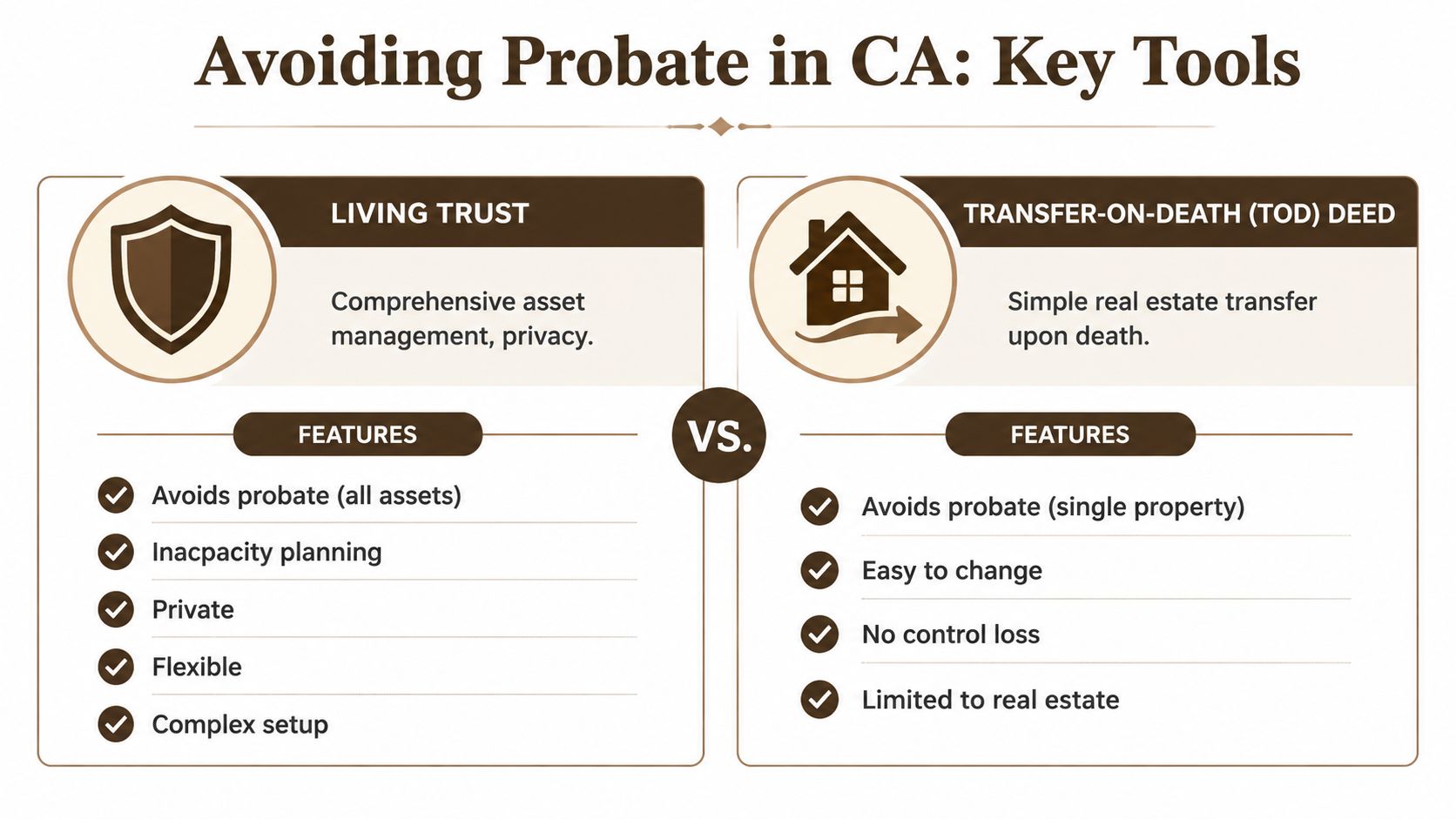
Most California homeowners who want to avoid probate focus on two tools. The first is a revocable living trust, which is the main planning vehicle for many families. The second is a Transfer on Death deed, often called a TOD deed, which can work in narrower situations.
Neither tool is universally “better.” The right choice depends on how many properties you own, whether you want ongoing management instructions, whether there are multiple beneficiaries, and whether there’s any chance of conflict.
The revocable living trust
A revocable living trust is usually the most complete probate-avoidance tool for California real estate. The owner creates the trust, signs the trust agreement, and then transfers title to the trust by deed. During life, the owner usually remains in control as trustee.
That structure works well because the trust can do more than pass title at death. It can also name successor trustees, give directions for management during incapacity, control when beneficiaries receive property, and coordinate multiple assets under one plan.
A trust is often the stronger choice when:
- You own more than one property
- You have a blended family
- You want one child to manage property for others
- You need detailed instructions for sale, occupancy, or staged distributions
- You want privacy instead of a public court file
Client-level advice: A trust only works if it’s funded. If the deed never moves the property into the trust, the plan may fail when it matters most.
The transfer on death deed
A TOD deed is simpler. It names a beneficiary who will receive property on the owner’s death without probate, assuming the deed was properly executed and recorded and the transfer remains appropriate at death.
The appeal is obvious. It’s easier to understand, and the owner doesn’t give up present control. But that simplicity is also the limitation. A TOD deed doesn’t offer the same level of management, contingency planning, or flexibility that a trust does.
A TOD deed is often better suited for a straightforward situation involving one property, a clear intended beneficiary, and little likelihood of dispute. It becomes less attractive when several heirs are involved, when the owner wants conditions on inheritance, or when the property’s title history needs close attention.
Comparing Revocable Living Trusts vs. TOD Deeds in California
| Feature | Revocable Living Trust | Transfer on Death (TOD) Deed |
|---|---|---|
| Probate avoidance | Usually avoids probate for properly transferred trust assets | Can avoid probate for the specific property named in the deed |
| Scope | Can cover real estate and other assets | Limited to real estate transfer |
| Incapacity planning | Yes. A successor trustee can step in under the trust terms | No comparable built-in management structure |
| Privacy | Generally private administration | More limited and property-specific |
| Flexibility | Better for multiple beneficiaries and detailed instructions | Best for simpler transfers |
| Complexity | More setup work and funding required | Easier to create, but narrower in function |
| Best fit | Families who need a durable, coordinated plan | Owners with a simple, low-conflict transfer goal |
California law also recognizes TOD deeds under the Probate Code, but they should be reviewed alongside the broader estate plan rather than used in isolation. A simple tool can create complicated results if it conflicts with a will, trust, mortgage issues, or family expectations.
If you’re deciding between a trust and a TOD deed, schedule a free consultation and choose the tool that fits your property, family structure, and long-term goals.
Protecting Your Legacy from Property Tax Reassessment
A family inherits a California home that has been owned for decades. They expect a smooth transfer because the estate plan is in place. Then the county reassesses the property, the annual tax bill jumps, and the heir who wanted to keep the home starts asking whether a sale is the only realistic option.
That result is common enough that property tax planning needs to be part of the estate plan from the start, not an afterthought. For many owners, the main question is not who receives the property. It is whether the next owner can afford to hold it.

Why Proposition 13 matters
Under Proposition 13, California generally limits annual increases in assessed value until a sale or other reassessable transfer occurs. As noted in California property tax guidance from the State Board of Equalization, that system often leaves longtime owners with tax bills based on values far below current market prices.
That low base year value is often one of the most valuable features of the property. I regularly see families focus on probate avoidance and miss the larger financial issue. A transfer can be legally effective and still create a tax bill that changes the economics of keeping the property.
How Proposition 19 changed inheritance planning
Proposition 19 narrowed the old parent-child exclusion rules. The broad protection many families relied on is gone. For inherited residential property, avoiding reassessment usually depends on whether the transferee qualifies for the principal residence exclusion and follows the filing requirements described by the California State Board of Equalization's Proposition 19 resources.
The practical problem is simple. A trust does not prevent reassessment by itself. A transfer on death deed does not prevent it either. The ownership structure, the beneficiary’s actual use of the property, the timing of occupancy, and the paperwork all matter.
That is why I advise clients to test the plan against the actual facts before signing transfer documents. If the child who is supposed to inherit the home lives out of state and plans to keep it as a rental, the tax outcome may be very different from what the family expected.
Good estate planning for California real estate addresses both transfer mechanics and reassessment risk. If title is unclear, that review has to happen before any deed goes out for signature.
That last point is often overlooked. If a property has an old quitclaim deed, an unresolved death of a co-owner, a mistaken vesting clause, or a trust transfer that was never properly completed, those title defects can interfere with the intended tax strategy. Fixing title first is not administrative cleanup. It is part of protecting the tax position you are trying to preserve.
What careful planning can still do
Careful planning starts with the current assessed value and the county’s likely view of the transfer. Then it turns to the human facts. Who is inheriting the property. Will that person move in. Is the property already in the correct trust. Is the title clean enough to transfer without creating a new problem?
Here’s a brief video overview that helps frame why these rules deserve early attention:
Practical planning usually includes:
- Reviewing the current assessed value and transfer history before changing title
- Confirming who will inherit the property and how it will be used
- Checking whether the existing deed and trust funding match the intended plan
- Resolving title defects before any transfer so the tax strategy is not built on a broken chain of title
- Preparing the right exclusion claims and supporting paperwork on time
Families usually have options, but they need to be evaluated early. Once the wrong transfer is made, reversing the tax result can be difficult, expensive, or impossible.
Navigating Co-Ownership and Community Property Rules
A couple comes in after one spouse dies, certain the house will pass cleanly because they "owned it together." Then we pull the deed. It says joint tenancy, not community property. The survivor may still receive the property without probate, but the tax result can be far worse than the family expected.
That happens often in California because co-ownership terms sound interchangeable in conversation and operate very differently in law.
Community property versus separate property
California follows community property rules for many married couples, but title, source of funds, and the spouses' later agreements still matter. A house bought during marriage is not always treated the same way as a house owned before marriage, inherited by one spouse, or refinanced and retitled years later. The label on the deed does not answer every question, but it is often where the problem starts.
For married couples, one of the biggest planning issues is income tax basis at the first death. Property held as community property can produce a full basis adjustment on the entire asset at the first spouse's death, while joint tenancy often adjusts basis only on the deceased spouse's share. The California State Board of Equalization discusses this distinction in its guide to property ownership and transfers, including community property with right of survivorship.
On appreciated California real estate, that difference can shape whether a later sale produces little capital gain or a large tax bill. I regularly see families focus on avoiding probate and miss the tax cost built into the vesting choice.
Why deed language matters
Joint tenancy is popular because it offers survivorship. For some owners, that simplicity is enough. For others, it is the wrong fit because survivorship decides who gets the property first, but it does not solve larger questions about tax treatment, control during incapacity, or what happens after the surviving owner dies.
Co-ownership also gets more complicated outside a first marriage.
If spouses have children from prior relationships, or if a parent added an adult child to title for convenience, the deed can create rights no one intended. A joint tenant can acquire a present ownership interest. That can affect creditor exposure, sale decisions, and the inheritance plan later. If the transfer happened years ago without tax or title review, the family may be relying on assumptions that do not match the recorded chain of title.
A careful review usually asks:
- How title is vested today
- Whether the property was acquired before marriage, during marriage, by gift, or by inheritance
- Whether one owner was added to title for convenience rather than as part of a planned transfer
- Whether the deed works with the trust, or conflicts with it
- Whether any prior death, divorce, refinance, or partial transfer left the title record unclear
That last point gets overlooked. Co-ownership planning is not only about choosing between joint tenancy, tenancy in common, or community property. It also requires confirming that the current title is clean enough to support the plan. If an old deed was defective, a prior transfer was never properly completed, or an heirship issue was left unresolved, changing title again can stack a new problem on top of an old one.
For that reason, the right answer is not always an immediate retitle. Sometimes the better course is to review the deed history, confirm the character of the property, and fix title issues first so the estate plan transfers what the family thinks it owns.
The Hidden Danger Why You Must Clear Your Property Title
A trust can be perfectly drafted and still fail to deliver a smooth transfer if the property itself has title problems. This is one of the most overlooked issues in California estate planning.

What a clouded title looks like
A clouded title means something in the public record, or in the property’s ownership history, creates uncertainty about who owns what. That can include an old deed error, an unresolved lien issue, a missing transfer, conflicting heirship claims, a boundary dispute, or another defect that makes future transfer harder.
These issues often stay hidden while the original owner is alive and in control. They surface only when a successor trustee, heir, or buyer asks for a clean chain of title. At that point, the family learns that the estate plan transferred a problem instead of a marketable asset.
Why this belongs in estate planning
Unresolved title issues can force beneficiaries into litigation even when the family has a trust and everyone thought probate had been avoided. According to California discussion of title disputes and quiet title planning, contested property matters in California can lead to expenses often exceeding $50,000, and a proactive Quiet Title action before death can cleanse title and reduce later conflict.
That’s why title work should be treated as part of estate planning, not as a separate emergency project. If the deed history is broken or ownership is uncertain, transferring the property into a trust doesn’t automatically cure the defect. Sometimes it complicates the record further.
Often overlooked: The best time to fix title is while the owner is alive, available, and able to sign corrective documents or support a quiet title action.
Owners should pay close attention if any of these apply:
- A prior owner died and no formal cleanup was completed
- Family members made informal transfers without recorded deeds
- Someone else has occupied or claimed part of the property
- The legal description looks inconsistent across recorded documents
- A refinance, sale, or inheritance previously stalled because of title questions
For California families with longtime holdings, inherited property, or multiple generations of use, title review can be just as important as trust drafting. A clean title makes every later step easier. A dirty title turns succession into litigation.
If you suspect there’s any uncertainty in your deed history or ownership record, schedule a free consultation and evaluate whether title cleanup should happen before the next transfer.
Your California Real Estate Estate Planning Checklist
A workable plan usually starts with the questions I ask before I draft anything. If those answers are unclear, the documents tend to fail at the moment the family needs them most.
Start with the record itself. Have you pulled the current recorded deed, recent property tax bill, mortgage statement, and any HOA documents? Do you have copies of your existing trust, will, or prior transfer documents? If the deed is missing, inconsistent, or different from what you believe you own, that issue needs attention before any transfer.
Then turn to outcomes. Who should receive the property? Should that person receive it outright, hold it in trust, or have a right to live there for a period of time? If one child is expected to keep the property, how will the others be treated fairly? Those decisions shape the trust terms, the deed strategy, and the tax analysis.
The next set of questions is where many plans either hold up or break down.
Is title vested the right way for your family and tax goals? If you are married, does the current deed reflect the community property treatment you intended? If the property was inherited, have you checked the reassessment risk before changing title? If there are rental properties or multiple parcels, has each one been reviewed separately rather than assumed to fit the same plan?
Then ask the question owners often miss. Is the title clean enough to transfer?
A trust can direct where property goes. It does not fix a broken chain of title, an unrecorded family transfer, a deed signed incorrectly years ago, or a dispute over who owns what share. In my practice, that title review is not a side issue. It is part of the estate plan, because unresolved title problems are what turn a planned transfer into a probate or real estate fight later.
Use this checklist as a practical screening tool:
- Have you located the current recorded deed for each California property you own?
- Do you know exactly who holds title now, and in what percentages or form of ownership?
- Have you identified every person who expects to inherit, use, manage, or receive income from the property?
- Have you decided whether the property should be kept, sold, rented, or distributed after death?
- Have you reviewed whether the current vesting matches your probate, tax, and spouse protection goals?
- Have you checked for title defects, old family transfers, lien issues, boundary disputes, or deed inconsistencies before signing new documents?
- Have you coordinated the estate plan with the rest of your trust, will, insurance, and beneficiary designations?
The right lawyer for this work needs to understand both succession planning and real property disputes. That combination matters because a well-drafted trust is only as useful as the title it holds.
If you own real estate in Orange County, Los Angeles, or elsewhere in California, Tanner Law can help you evaluate probate exposure, deed issues, trust planning, and title problems before they become court disputes. Schedule a free consultation to review your property, your family goals, and the most practical plan for protecting your legacy under California law.