Quitclaim Deed With Rights of Survivorship: Avoid Probate
A lot of California families arrive at the same idea the same way. A parent owns a home in Orange County or Los Angeles, wants to spare the family from probate, and hears that adding a child to title with a quitclaim deed with rights of survivorship is the simplest fix.
It can work. It can also create a different problem than the one you were trying to solve.
After decades in California real estate and probate matters, I've seen this tool used for exactly the right reason and exactly the wrong way. The attraction is obvious. The deed looks simple, recording feels routine, and the promise of automatic transfer at death sounds cleaner than a full estate plan. The trouble is that title law, creditor law, and tax law don't care how simple the form looked on the day it was signed.
A quitclaim deed with rights of survivorship is not just paperwork. It changes ownership now, not later. In California, that immediate change can affect control of the property, exposure to disputes, and the tax result your family lives with after death. Many DIY deed services skip those consequences entirely.
Table of Contents
- The Popular But Perilous Path to Avoiding Probate
- What This Deed Actually Means for Your Property
- Comparing Your California Deed Options
- Major Risks and Unintended Consequences
- How to Correctly Execute This Deed in California
- Safer Alternatives for Your California Estate Plan
- Frequently Asked Questions
The Popular But Perilous Path to Avoiding Probate
In practice, the usual fact pattern is straightforward. A mother owns her longtime California home. She wants one child to receive it smoothly when she dies. Someone tells her to sign a quitclaim deed adding that child as a joint tenant with right of survivorship. The pitch is always the same: avoid probate, save money, keep it simple.
That idea is common for a reason. A National Association of Realtors report summarized here found that 28% of U.S. residential family transfers used quitclaim deeds with survivorship clauses, and the figure rose to 42% in community property states like California by 2022. The same source reports that 15% to 20% of such deeds were later invalidated due to issues like improper execution.
Those numbers should get your attention. Families use this approach often, but the failure rate is too high for something that is supposed to create certainty.
Why families reach for this deed
The motivation is usually sensible:
- Probate avoidance: California probate can be time-consuming and burdensome for families.
- Speed: A deed feels faster than creating a broader estate plan.
- Familiarity: Many people have heard of quitclaim deeds from divorce, family transfers, or refinance situations.
- Cost sensitivity: People often assume one recorded deed is cheaper than planning correctly.
The problem is that people focus on the word avoid in "avoid probate" and ignore the word transfer in "transfer ownership."
Practical rule: If the deed changes title today, you need to evaluate today's legal and tax consequences, not just what happens after death.
What tends to go wrong
In California, the trouble usually isn't bad intent. It's incomplete planning. Someone downloads a form, signs in front of a notary, records it, and assumes the home is now protected from probate and future dispute. Then a refinancing issue appears, a family disagreement erupts, a tax reassessment concern surfaces, or the deed language turns out not to have created what the family thought it created.
A quitclaim deed with rights of survivorship can be useful in a narrow set of circumstances. It is not a safe default for most parent-child transfers of California real estate.
What This Deed Actually Means for Your Property
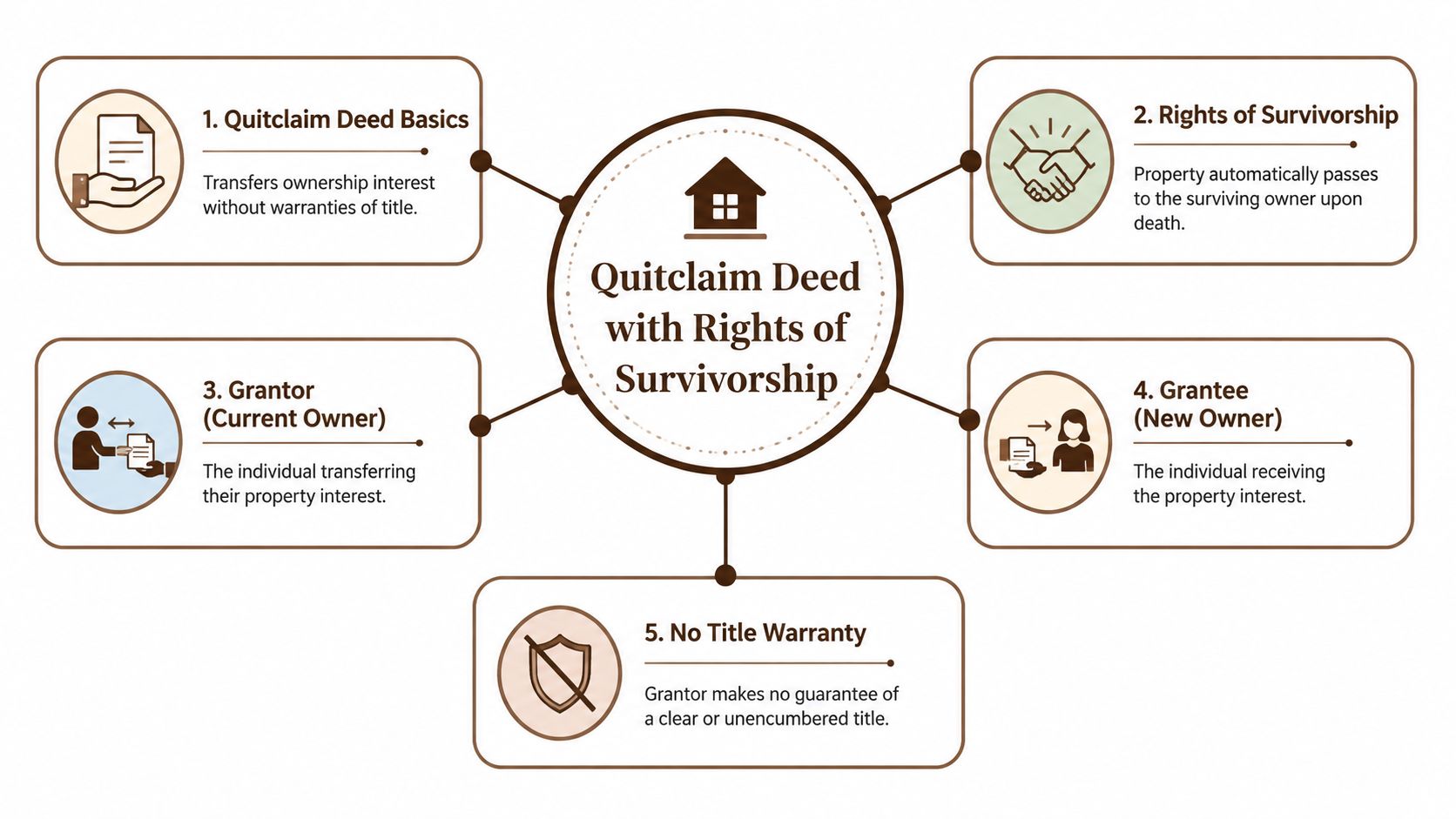
A quitclaim deed with rights of survivorship combines two separate legal ideas. If you don't separate them, it's easy to misunderstand what you've signed.
Quitclaim means no title promises
A quitclaim deed transfers whatever ownership interest the signer has, if any, but it doesn't promise clear title. It is the leanest form of deed. The person signing it is not giving the warranties that come with a grant deed or warranty deed.
For a family, that distinction matters because the deed does not clean up old title problems. If there is a prior lien, a recording defect, a boundary issue, or a cloud on title, a quitclaim deed does not fix it. It only moves the present interest from one name configuration to another.
Think of it this way. A quitclaim deed hands over whatever keys the grantor has. It does not promise those are the only keys, that the lock is free of defects, or that someone else won't claim access later.
Survivorship means the last co-owner standing takes title
The second part is joint tenancy with right of survivorship. That means co-owners hold equal, undivided interests, and when one joint tenant dies, that person's interest does not pass through probate to heirs under a will. Instead, the surviving joint tenant automatically absorbs the deceased owner's extinguished interest.
The law relies on the old concept of the four unities. In plain English, the co-owners must take title at the same time, by the same instrument, with the same type of interest, and with equal rights of possession. If those elements are missing, the intended joint tenancy may fail.
A useful analogy is two co-pilots operating the same aircraft. Each has equal authority while both are alive. If one dies, the survivor doesn't wait for a probate court to hand over control. The survivor already has the legal structure in place to continue alone.
If the deed doesn't clearly create survivorship, California law may treat the owners as tenants in common instead. That changes everything at death.
That is why exact wording matters. In California, title should expressly state ownership as joint tenants with right of survivorship. Without explicit survivorship language, the deed may not accomplish what the family intended.
Comparing Your California Deed Options
Families usually compare the wrong things. They compare "deed versus probate" and stop there. The better comparison is broader: probate avoidance, control during life, exposure to a co-owner's problems, and tax treatment for heirs.
California property transfer methods compared
| Method | Avoids Probate? | Control & Flexibility | Creditor Exposure | Tax Basis for Heirs |
|---|---|---|---|---|
| Joint Tenancy | Usually yes, as to the deceased joint tenant's interest | Shared present ownership. One co-owner can create serious complications by acting against the other's expectations | Higher risk because a co-owner's personal legal problems can affect the property interest they own | Can create basis problems for heirs in parent-child transfers |
| Tenancy in Common | No automatic survivorship. A deceased owner's share generally goes through their estate | More flexible for unequal shares and separate inheritance plans | Each owner's separate interest may be targeted through that owner's issues | Depends on how the interest passes at death |
| Revocable Living Trust | Yes, when property is properly titled into the trust | The owner usually keeps practical control during life and can amend the plan | Better insulation from a co-owner's personal issues because no child is made a present co-owner | Often better for preserving a full step-up result on inherited property |
| Transfer on Death Deed | Can avoid probate if validly executed and effective at death | Owner keeps title during life and can usually change course before death | Better than adding a present co-owner because no immediate ownership share is given away | Often preferable to a current co-ownership transfer when tax planning matters |
The quitclaim deed with rights of survivorship looks attractive only if you focus on the first column.
The hidden comparison point is present ownership
A revocable living trust and a Transfer on Death deed are often safer because they don't require the parent to make the child a current co-owner just to avoid probate later. That distinction matters in California. Once a child is on title as a joint tenant, the transfer is no longer only an estate planning choice. It becomes a current ownership arrangement with all the rights and hazards that current ownership brings.
For many families, that's the wrong trade.
When joint tenancy may still fit
There are limited situations where joint tenancy can make sense. Spouses often use survivorship-based title arrangements for practical reasons. Some tightly aligned family co-owners also choose it knowingly. But where the primary goal is "I want my child to inherit the house someday, and I want to stay fully in control until then," joint tenancy is usually a poor fit for the goal.
The legal form has to match the actual family objective. In California estate planning, that is where many DIY deeds fail.
Major Risks and Unintended Consequences
The most expensive deed mistakes are the ones that looked harmless on signing day.
You give away present ownership, not just a future inheritance
When a parent signs a quitclaim deed with rights of survivorship to add a child, the parent has not merely named a future beneficiary. The parent has transferred a current ownership interest.
That can affect:
- Control of sale decisions: Co-owners can disagree about whether to sell, refinance, or improve the property.
- Borrowing and title decisions: One owner's actions can complicate financing or future transfers.
- Exposure to disputes: A child going through divorce, debt problems, or litigation can pull the property into trouble.
- Family expectations: Other children may later claim the parent didn't understand the deed or was pressured into signing it.
These cases often show up after a death, when documents are fixed but relationships are not.
The tax trap many families don't see coming
The most overlooked danger is income tax basis.
As explained in this discussion of parent-child quitclaim deeds and basis consequences, when a parent quitclaims property into joint tenancy with a child, the child's tax basis is partially tied to the parent's original purchase price. This can result in massive capital gains tax when the property is sold, because the full step-up in value at death under IRC §1014 is lost for the survivor's original share. In contrast, inheritance through a trust typically provides a full step-up.
That issue catches families by surprise because probate avoidance feels like savings. Then the property is sold later, and the capital gains result is far worse than expected.
A deed that avoids probate can still produce a tax outcome your family hates. Probate savings and tax efficiency are not the same thing.
This is why I often tell clients to stop asking only, "Will this avoid probate?" and start asking, "What tax basis will my child have after my death?"
Prop 19 makes title changes more sensitive in California
California families also need to think about property tax reassessment. Prop 19 changed the situation for parent-child transfers in California. DIY deed services rarely explain that title changes can have property tax consequences that outlast the convenience of the original transfer.
A joint tenancy transfer may also require careful handling of related filing issues with the county assessor and recorder. If that is missed, the family can create a tax problem while trying to solve an estate problem.
Mortgage and lender concerns still matter
Another issue that gets glossed over is the mortgage. Some transfers raise lender-review concerns. Even where a family transfer may fit within a permitted category, the existence of a deed does not guarantee the lender will treat the transfer the way the family expected in all later transactions. Refinancing and title insurance review can expose prior deed mistakes at the worst possible time.
The broader point is simple. This deed is not a shortcut around real planning. It is a legal choice with real consequences.
How to Correctly Execute This Deed in California
If someone decides, after legal advice, to use this deed in California, execution has to be precise. Small drafting mistakes can undo the entire plan.

The wording has to be exact
California does not reward vague deed language. A deed intended to create survivorship should say so clearly. According to this California survivorship deed form discussion, to be valid in California, a deed creating joint tenancy with right of survivorship must be notarized and recorded with the county. Failure to use explicit survivorship language, such as "as joint tenants with right of survivorship," can cause the deed to create a tenancy in common by default, thereby failing to avoid probate as intended. The same source states that up to 85% of contested survivorship deeds fail due to drafting errors.
That tells you two things. First, wording is not cosmetic. Second, contested deeds often fail because somebody treated the drafting as clerical.
The California filing steps that matter
The usual execution checklist includes these core items:
Accurate legal description
The deed must use the correct legal description of the property, not just the street address.Clear vesting language
The deed should identify how title is being held, with explicit joint tenancy survivorship language.Proper signatures
The grantor must sign correctly. If there are trust, conservatorship, or power of attorney issues, those must be reviewed before signing.Notarization
This is mandatory for recording and for basic validity in practice.Recording in the correct county
The deed must be recorded with the county recorder where the property is located, such as Orange County or Los Angeles County.Preliminary Change of Ownership Report
In California, this filing matters. If the transfer is recorded without the proper related paperwork, the family may invite avoidable tax and assessment issues.
What works: attorney-drafted vesting language, reviewed title information, and coordinated recording paperwork.
What doesn't: copying a generic form and hoping the county recorder's acceptance means the deed did what you intended.
County recording offices check recordability, not whether your estate plan is wise.
Safer Alternatives for Your California Estate Plan
For most California homeowners whose real goal is simple transfer at death without loss of control during life, there are better tools than a quitclaim deed with rights of survivorship.
Why a revocable living trust is usually the stronger choice
A revocable living trust is often the best California answer because it addresses the same probate concern without forcing the homeowner to make a child a present co-owner. The parent typically keeps control of the property during life, can change beneficiaries, can sell or refinance in the ordinary course, and usually preserves a better tax outcome for heirs than a lifetime joint tenancy transfer.
That combination matters. The trust aligns with what most parents want: "I keep control while I'm alive, and my children receive the home smoothly when I'm gone."
A trust also fits better where there are multiple children, blended families, prior marriages, rental properties, or any concern about later conflict.
When a Transfer on Death deed may be enough
A Transfer on Death deed can be a reasonable option in a more limited California situation. It is simpler than a full trust plan, and it generally lets the owner retain title during life instead of giving away an immediate ownership share.
It is not the right tool for every family. It has its own formalities, timing requirements, and practical limits. But compared with adding a child as a current joint tenant through a quitclaim deed, it often avoids many of the control and creditor problems that create later litigation.
This short video gives a helpful overview of planning options families often weigh:
For California homeowners, the best plan usually is not the fastest document. It is the document that matches the family's real priorities, including control, taxes, and the likelihood of future dispute.
Frequently Asked Questions
Can a quitclaim deed with rights of survivorship be reversed
Sometimes, yes. Practically, reversal is easiest when all current owners agree and sign the corrective documents. If the relationship has deteriorated, one owner may refuse to cooperate, and then the "simple fix" is no longer simple. In California, once you've made someone a present co-owner, unwinding that choice can become its own legal project.
Does a will or trust override survivorship
Usually, no. A valid survivorship arrangement operates outside the normal probate transfer process. That means a later will usually cannot redirect the property away from the surviving joint tenant. This is one of the most misunderstood parts of joint tenancy. Families often assume the newest estate document controls everything, but title law may point in a different direction.
The deed controls how that asset passes if the survivorship language is valid and the joint tenancy still exists at death.
What if joint tenants die at the same time
That scenario can become complicated quickly. California has rules addressing simultaneous death issues, and the result may place the property back into estate administration rather than allowing one owner to take by survivorship. If a family wants certainty in a disaster scenario, a broader estate plan usually handles that better than relying on title alone.
Is this deed a good idea for a parent and one child
Often, no. That arrangement raises the most common mix of problems: loss of control, exposure to the child's legal issues, conflict with siblings, and basis concerns at sale. There are exceptions, but this is the setting where I most often advise families to slow down and compare a trust or TOD deed before signing anything.
Does county recording mean the deed is legally safe
No. Recording means the county accepted the document for its records. It does not mean the deed was drafted correctly, avoids probate as intended, protects against future litigation, or produces a favorable tax result.
If you're considering a quitclaim deed with rights of survivorship for California property, get advice before you sign and record anything. A short review now can prevent a title dispute, probate fight, or tax problem later. Schedule a free consultation with Tanner Law to discuss your Orange County or Los Angeles property, your family goals, and the safest way to transfer your home under California law.