How to Respond to Unlawful Detainer
If you're holding a Summons and Complaint for unlawful detainer, you're probably dealing with two problems at once. The first is practical: where will you live, what happens next, and how fast do you need to act? The second is legal: the court has started a case, and the clock is already running under California law.
In Orange County, I've seen that the people who protect themselves best aren't always the ones with the perfect facts on day one. They're the ones who respond quickly, read the papers carefully, and treat the Answer as more than a form. A well-prepared response preserves defenses, avoids default, and often facilitates a favorable settlement long before a judge decides anything.
Table of Contents
- Your First 24 Hours Understanding the Unlawful Detainer
- Decoding the Legal Documents You Received
- Building Your Legal Defense and Response Strategy
- How to File Your Answer with the Orange County Court
- After Filing Your Answer Navigating Settlement and Trial
- Why and When You Must Consult an Attorney
Your First 24 Hours Understanding the Unlawful Detainer
You come home, open the packet, and see that your landlord has already filed in court. At that point, the case is no longer a housing dispute in the abstract. It is a live deadline. What you do in the first day can determine whether you keep the right to tell your side of the story or lose by default before the judge ever hears from you.
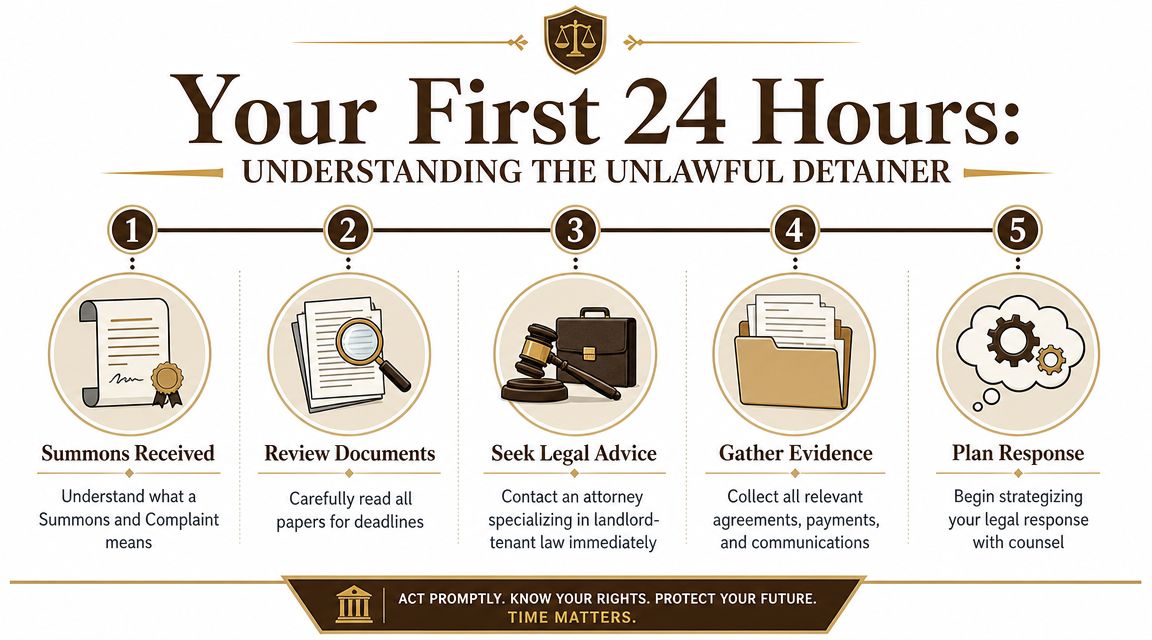
In Orange County, I tell clients to focus on one goal first. Protect your deadline to respond. The Answer is not just paperwork. Filed on time, it preserves defenses, keeps the landlord from taking an easy default, and often creates room to negotiate from a stronger position.
Identify the service date and method first
Your response time depends on how the papers were served. Start there.
Look at the summons and any proof of service attached to the packet. Confirm the exact date you received the papers, how they were delivered, and whether someone else in your household accepted them first. Those details matter because the response period in an unlawful detainer case runs quickly, and misreading the service method is one of the most common early mistakes.
If anything about service looks unclear, do not guess. Write down what happened while it is fresh. Save the envelope if the papers came by mail. Take a photo of every page. If I am evaluating whether a tenant still has time to respond, those small facts often matter.
Practical rule: Treat the summons like an immediate court deadline, not a warning letter. If the response is late, the landlord can seek a default and move the case ahead without your Answer on file.
The Legal Aid Foundation of Los Angeles explains in its unlawful detainer answer guide that if you do not file an Answer by the deadline, "you may lose the case automatically."
What to accomplish on day one
The first day is about control, not perfection. You do not need every defense lined up yet. You need the case organized well enough to respond correctly and on time.
Focus on these steps:
- Read the full packet once without skipping attachments. The summons, complaint, notice, and proof of service each serve a different purpose.
- Calendar the response deadline in more than one place. Put it in your phone and write it somewhere visible.
- Gather documents tied to the tenancy. Pull the lease, notices, rent receipts, screenshots, repair requests, photos, emails, and text messages.
- Check whether the landlord has an attorney. If counsel is listed, that affects who will receive papers and who may discuss settlement.
- Get legal advice quickly if you can. A short review early can prevent a bad filing choice that is harder and more expensive to fix later.
Avoid the mistakes that cost tenants time
Early missteps are usually procedural, not dramatic.
Do not assume a call with the landlord extends your deadline. It usually does not. Do not rely on a promise that the case will be dropped unless you see formal dismissal paperwork filed with the court. Do not set the packet aside because you plan to explain everything at the hearing. In eviction cases, missing the response window can keep you from reaching the hearing in a meaningful way.
One point causes confusion often. LAFLA's guide distinguishes between a court-mailed notice and formal service of the summons and complaint. If you learn a case exists but do not yet have the full pleadings, get a copy from the clerk right away and confirm your response date.
A disciplined first 24 hours gives you options. A delayed response gives the landlord procedural momentum, and in Orange County unlawful detainer court, that momentum matters.
Decoding the Legal Documents You Received
An unlawful detainer packet looks intimidating because it mixes court language with factual allegations. Once you break it apart, it becomes easier to see what the landlord is claiming and what you need to admit, deny, or challenge.
The two papers that matter most
The Summons is the court's notice that a case has been filed against you. Its most important function is simple: it tells you that you must file a written response by the deadline. It is not a warning letter. It is the formal start of the lawsuit.
The Complaint for Unlawful Detainer is where the landlord states the reasons they believe they're entitled to possession. That usually includes the property address, the parties, the kind of tenancy alleged, the notice the landlord says was served, and the relief requested.
When I review these papers with clients, I usually ask them to stop reading for emotion and start reading for specifics. Names. Dates. Addresses. Amounts claimed. The stated reason for eviction. Those details drive the response.
Where tenants often miss key issues
Use this quick reference when reading the complaint:
| Document area | What to check | Why it matters |
|---|---|---|
| Party names | Whether your name is correct and complete | Errors can affect service and identification |
| Property address | Unit number, city, and description | The case must identify the premises accurately |
| Reason alleged | Nonpayment, holdover, breach, or another stated basis | Your defenses depend on the specific claim |
| Notice allegations | What notice was served and when | Defective notice is often important |
| Money demand | Whether the complaint seeks more than possession | This affects how you should answer |
Watch for deadline confusion
This area has become more confusing because public materials don't always match. Los Angeles County consumer guidance states that, effective January 1, 2025, tenants have 10 days, excluding weekends and judicial holidays, to file an Answer instead of 5 days, according to the Los Angeles County eviction guidance.
That matters even if your case is in Orange County, because many tenants find older forms, older articles, or advice from friends that still refer to the prior rule. If you're trying to figure out how to respond to unlawful detainer in California, don't rely on outdated timelines.
Read the summons and complaint as a set. The summons tells you when to act. The complaint tells you what you're fighting about.
A complaint is not just paperwork. It is the landlord's version of the story, stated in a form the court can act on. Your job is to answer that story carefully, not casually.
Building Your Legal Defense and Response Strategy
A rushed Answer usually does one thing well. It gets filed. A strong Answer does more. It identifies what the landlord still has to prove, preserves your defenses, and gives you a stronger bargaining position that a vague denial often won't.
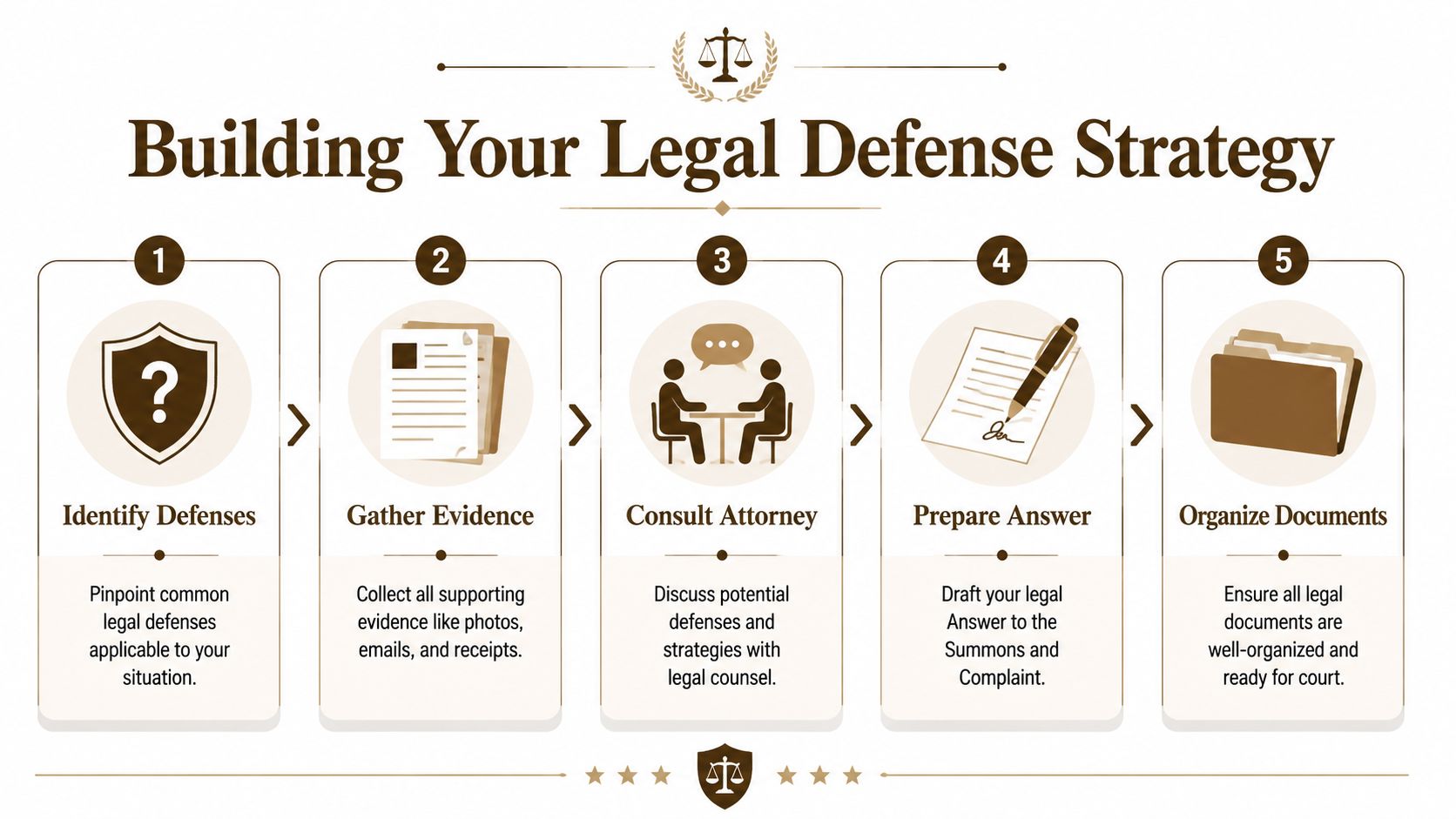
Why detail matters in the Answer
California courts instruct tenants to use Answer. Unlawful Detainer (UD-105) and, when needed, attachments that provide specific facts. The California Courts tenant response guidance also points out an important trap: the general denial option is limited and should not be used if the complaint demands more than $1,000.
That point gets overlooked often. Tenants understandably want to check a box and move on. But when the pleading calls for factual detail, a thin response can box you into a weaker position.
Common defenses in real life
Not every defense fits every case. Still, these are the issues I most often see mattering in practice:
- Defective notice: If the landlord served the wrong notice, used the wrong dates, or failed to comply with required notice procedures, the case may have a serious problem.
- Improper service of the lawsuit: If service wasn't done correctly, you may have grounds to challenge how the case started.
- Habitability issues: If serious repair conditions existed and the landlord failed to address them, those facts can matter both legally and strategically.
- Waiver or acceptance of rent: If the landlord's conduct after notice is inconsistent with immediate eviction, that can become important.
- Retaliation: If the filing followed complaints about conditions or protected tenant conduct, that issue may need to be raised.
- Factual inaccuracies: Sometimes the landlord's timeline, amounts, or occupancy allegations are wrong.
What a strategic Answer looks like
A strategic Answer is not dramatic. It is precise.
If the complaint says rent wasn't paid for a certain period, your response should identify what was paid, when, and how. If the issue is repairs, identify the conditions, dates of notice, and what the landlord did or didn't do. If the notice itself is defective, describe the defect in plain language.
A good Answer narrows the dispute. It tells the court, and the landlord, that you know what facts matter.
Use attachments if the form itself doesn't give enough room. A short attachment with organized facts is often far more useful than a broad statement that “everything in the complaint is false.”
What works and what doesn't
Here is the trade-off in simple terms:
| Approach | What it does well | Main weakness |
|---|---|---|
| Bare denial | Fast to prepare | Preserves less factual detail |
| Particularized Answer | Builds leverage and clarifies defenses | Takes more work up front |
| Late response without a plan | Sometimes buys a little time if no default yet | Very risky and easy to mishandle |
The Answer is your first strategic document in the case. In Orange County, that matters because many unlawful detainer disputes move quickly, and the side that organizes facts early usually has more room to negotiate from strength.
How to File Your Answer with the Orange County Court
A tenant comes into my office with five days left on the clock, the papers folded in half, and one question: “If I file this wrong, can they still lock me out?” The short answer is yes. In Orange County unlawful detainer cases, small filing mistakes can cost time, defenses, and settlement options. A properly filed Answer does more than avoid default. It keeps you in the case and puts pressure on the landlord to prove it.
Prepare the court forms with trial in mind
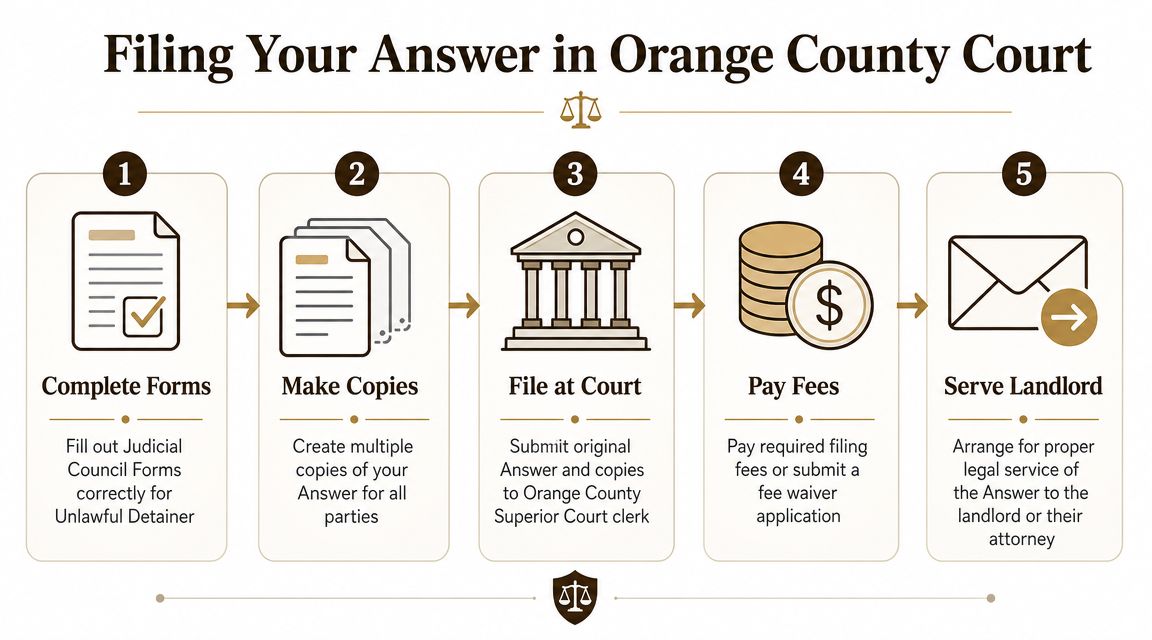
For many tenants, the main form is UD-105, Answer. Unlawful Detainer. If the form does not give you enough room, attach extra pages and label them clearly. The point is not to write everything that has happened in the tenancy. The point is to respond to the complaint accurately, preserve defenses, and make your position easy for the court and the landlord's lawyer to follow.
Check these items before you file:
- Caption and case number: Match the court name, party names, and case number exactly as they appear on the summons and complaint.
- Responses to allegations: Admit, deny, or state lack of information carefully. Overbroad denials can hurt credibility later.
- Affirmative defenses: Include the defenses supported by your facts. Leave out defenses you cannot explain or document.
- Attachments: Use short, organized attachments if needed. Dates, notices, payment history, and repair complaints should be easy to identify.
- Signature: Sign every required form. An unsigned Answer can create avoidable trouble at the clerk's office.
A rushed Answer often creates a second problem. It gets filed, but it does not help. I would rather see a concise, accurate Answer than a long one filled with generic defenses that do not fit the case.
File it in the correct Orange County courthouse and keep proof
Orange County unlawful detainer cases are often handled at the Central Justice Center or the Lamoreaux Justice Center, depending on the case and filing assignment. Do not guess. Check the summons, complaint, and any court paperwork carefully so you file in the right place and follow that courthouse's current procedures.
If you file in person, bring the original and copies. Ask the clerk to stamp your copies for your records. If you file electronically or by another approved method, save the confirmation receipt and a complete copy of what was submitted.
That paper trail matters. If there is ever a dispute about whether the Answer was filed on time, the stamped copy or electronic confirmation is what resolves it.
Pay attention to filing fees and fee waiver options
Some tenants are ready to file and then get stuck on the filing fee. If you cannot afford the fee, ask about a fee waiver at the same time you prepare your Answer. Waiting until the deadline day to sort that out is risky.
This is a real trade-off. Filing early gives you time to correct a rejected submission or missing signature. Filing at the last minute may preserve one more day to draft, but it leaves no room for problems at the clerk's office or with e-filing.
Serve the other side correctly
Filing the Answer with the court is only half the job. A copy must also be served on the landlord or the landlord's attorney, and the required proof of service must be completed.
Do not serve it yourself if the rules require another adult to do it. Use someone who qualifies, make sure service is done promptly, and keep the proof of service with your filed papers. In practice, tenants often lose momentum here. They file, assume they are done, and then create an avoidable dispute over notice.
A good filing is quiet and clean. Correct court, correct forms, correct service, clear proof.
What your filed Answer changes procedurally
As noted earlier, once a tenant responds on time, the landlord cannot take the easiest default route. The landlord must move the case to the next stage by requesting a trial setting. That matters in Orange County because it shifts the case from a paper deadline problem to an active court case with dates, preparation demands, and settlement pressure on both sides.
That change has practical value. A filed Answer preserves your right to raise defenses, challenge the landlord's facts, conduct yourself as an active party, and negotiate from a stronger position than a tenant who missed the response deadline.
A practical filing checklist
- Complete UD-105 carefully
- Add labeled attachments only if they help explain specific facts
- Confirm the courthouse, case number, and party names
- File before the deadline, not on the assumption that the clerk will fix errors
- Serve the landlord or the landlord's lawyer properly
- Keep filed copies, fee receipts or waiver papers, and proof of service together
If there is any doubt about the deadline, the courthouse, or which defenses belong in the Answer, get legal advice before filing. In unlawful detainer court, a one-day delay or a simple clerical mistake can change the entire case.
After Filing Your Answer Navigating Settlement and Trial
Filing the Answer changes the case. You are no longer the party who failed to show up. You are now an active litigant, and that alone affects what the landlord must do next and how seriously the other side treats the dispute.

Why the filed Answer gives you leverage
A filed Answer doesn't guarantee victory. It does something just as important at the early stage. It preserves your right to participate, present defenses, and force the case into its next phase.
That matters because default is common in eviction court. A New America review of court data found that 30% to 50% of tenants lose their cases by default for not appearing, and Governing reported Eviction Lab data estimating 3.6 million eviction filings in 2018, or 7.8 filings for every 100 renter households, as discussed in Governing's report on eviction data and defaults.
In practice, once you've avoided that outcome, the case usually moves toward one of two paths: settlement or trial.
Settlement is often a business decision
Landlords file unlawful detainer cases to recover possession, money, or both. Tenants often want time, clarity, or a manageable exit. Those interests can overlap more than people expect.
A strong Answer can help produce practical discussions about:
- Payment arrangements: If the dispute is primarily about money, structure matters.
- Move-out agreements: Sometimes extra time and clear terms are more valuable than a rushed fight.
- Dismissal terms: In some cases, a negotiated dismissal may be possible if conditions are met.
- Mediation: A neutral setting can help both sides reach a workable resolution.
Here is a useful way to understand this:
| Path | Advantage | Risk |
|---|---|---|
| Settlement | More control over outcome | Terms must be reviewed carefully |
| Trial | Full chance to present defenses | Less predictability and more stress |
A settlement only helps if the written terms are clear. Vague agreements create new disputes.
Later in the process, many clients benefit from seeing the courtroom dynamic before deciding how far to push the case:
If the case goes to trial
Once the landlord requests trial, preparation becomes much more focused. Your documents should already be organized. Your timeline should be written out. Your witnesses, if any, should be identified early.
What tends to work is disciplined preparation. What tends not to work is assuming the judge will “see what happened” without organized evidence. In unlawful detainer, facts need structure.
Why and When You Must Consult an Attorney
Some tenants can file a basic response on their own. Some should not try. The challenge is knowing the difference early enough to matter.
Signs the case is too risky to handle alone
You should speak with a California attorney promptly if any of these are true:
- The landlord already has counsel: You're dealing with someone who knows the procedure and will use it.
- The complaint seeks significant money as well as possession: The case may affect more than housing.
- You missed the response deadline or think you did: That requires immediate damage control.
- There are title or ownership issues: Unlawful detainer is a limited proceeding, and those disputes can become complicated fast.
- The facts involve fraud, retaliation, or serious habitability issues: Those defenses often need careful pleading and evidence planning.
- The property may be subject to local tenant protections: Rules can differ, and local procedure matters.
- You've received confusing court notices after service: Mixed signals are common, and mistakes often follow confusion.
What an attorney actually adds
Hiring counsel is not an admission that you've lost. It's a strategic choice to protect your position.
A good unlawful detainer lawyer helps in three ways. First, they identify procedural defects and preserve defenses that tenants often miss. Second, they evaluate settlement terms with an eye toward what the case is worth to each side. Third, they present the case in a way the court can act on quickly and clearly.
The most expensive mistake in eviction court is often the avoidable one. A short consultation early can prevent a much larger problem later.
Why local experience matters in Orange County
Orange County procedure isn't just California procedure in the abstract. Local court practices, filing expectations, and timing all affect how a case unfolds. A lawyer who regularly appears in Orange County and Los Angeles courts will usually spot issues faster than someone working from generic forms alone.
If you're trying to decide how to respond to unlawful detainer, the safest approach is simple. Act immediately, preserve every defense you have, and get legal advice before the court or the other side defines the case for you.
If you've been served with an unlawful detainer in Orange County or Los Angeles County, Tanner Law can help you assess your deadline, prepare the right response, and protect your position under California law. Schedule a free consultation to discuss your case and get clear, practical guidance on your next step.