Stop Power of Attorney Abuse in California
Your mother has always paid her bills on time. Then, over a few months, the utilities fall behind, bank statements stop arriving at the house, and a relative who recently became her agent under a power of attorney starts saying, “I'm handling everything.” You ask simple questions and get vague answers. You notice a transfer on her property records you don't understand. Now you're wondering whether this is confusion, family friction, or something more serious.
That situation is painfully common in probate and elder financial abuse matters. A power of attorney is supposed to help someone manage finances and property when they need assistance. It's built on trust. But when the wrong person has broad authority over bank accounts, real estate, and documents, that same tool can be used to isolate the principal, move assets, and create damage that takes months or years to unwind.
The scale of elder financial abuse is sobering. The National Council on Aging reports that annual losses from elder financial abuse are over $28 billion in the United States, and other estimates place the figure as high as $36.5 billion. The same organization reports that only 1 in 24 abuse cases are reported to authorities, which means many families don't learn the full extent of the problem until long after the money or property is gone. You can review that data in the National Council on Aging's elder abuse overview.
If you're in Orange County or Los Angeles and you suspect power of attorney abuse, you're not overreacting by taking a closer look. Under California law, there are practical steps to stop ongoing harm, protect real estate, and pursue recovery. In many cases, speed matters as much as proof. The sooner you act, the better the chance of preserving accounts, tracing transfers, and protecting title to a home or investment property.
Table of Contents
- Introduction A Tool of Trust Can Become a Weapon of Harm
- What Constitutes Power of Attorney Abuse in California
- Recognizing the Red Flags of Financial Exploitation
- Immediate Steps to Stop the Abuse and Protect Assets
- Your Legal Remedies Civil and Criminal Actions
- How to Draft a POA to Prevent Future Abuse
- How Tanner Law Protects Your Rights and Property
Introduction A Tool of Trust Can Become a Weapon of Harm
A California power of attorney often starts with a sensible decision. A parent wants help with banking. A homeowner wants someone to sign documents during an illness. A family wants a backup plan in place before a crisis hits. In healthy families, the document works exactly as intended.
The trouble is that a power of attorney can give one person enormous practical control. If the agent has access to accounts, mail, passwords, deeds, and financial records, abuse may not look dramatic at first. It may look like “help.” Then the patterns change. Bills go unpaid. Withdrawals don't make sense. A house is refinanced, transferred, or listed without clear family knowledge.
What makes these cases so difficult is that they often begin inside a family system that already has stress, secrecy, or unequal access to information. One sibling lives nearby and handles everything. Another lives in Los Angeles and only hears updates by phone. By the time concerns become concrete, records may be missing and explanations may have hardened into a script.
Power of attorney abuse often hides behind paperwork that appears valid on its face.
That's why families need a calm, structured response. In California, the key questions usually aren't limited to “Was there a power of attorney?” The harder questions are whether the agent acted in the principal's best interest, whether property was transferred for an improper purpose, and what can be done immediately to stop further loss.
For many readers, the biggest fear is the family home. That fear is justified. Once real estate gets transferred, encumbered, or mixed into a larger dispute, the case can shift from simple concern to urgent litigation. A fast review of title records, account activity, and the scope of the POA can make the difference between preserving assets and chasing them after they've been dissipated.
If your family is facing this, don't wait for more damage to accumulate. A free consultation can help you understand your options under California law.
What Constitutes Power of Attorney Abuse in California
A power of attorney is a written authorization that lets one person act for another. The person giving authority is the principal. The person receiving authority is the agent or attorney-in-fact. In California, the agent's role is not ownership. It's responsibility.

The basic roles under a California power of attorney
The easiest way to understand the relationship is this. The principal lends authority, not personal freedom to do whatever the agent wants. Under California law, an agent has fiduciary duties. That means the agent must act loyally, with integrity, and for the principal's benefit.
If you've ever trusted someone to hold a house key while you were away, you already understand the idea. You gave access for a limited purpose. You did not give permission to move in, sell your furniture, or put their name on the title. A financial power of attorney works the same way, except the stakes are much higher.
In practice, a fiduciary should keep records, avoid conflicts of interest, and treat the principal's money and property as the principal's. Not as a personal resource.
Abuse isn't limited to outright theft
A common perception of power of attorney abuse is stealing cash. That certainly happens, but California cases are often messier. Abuse can include:
- Self-dealing with property. The agent signs a deed transferring the principal's home to themselves or to an ally for little or no real benefit to the principal.
- Using funds for personal convenience. The agent pays their own expenses from the principal's account and claims it was “reimbursement,” even when records don't support that explanation.
- Conflicted transactions. The agent places themselves on title, changes how assets are held, or steers a sale to someone connected to them.
- Financial decisions that hurt the principal. Even if the agent doesn't receive direct cash, they may still breach duty by making harmful transactions that don't serve the principal's interests.
- Concealment. The agent withholds statements, redirects mail, or refuses to explain major decisions.
A signed document doesn't excuse that conduct. Authority on paper and lawful conduct are not the same thing.
Practical rule: In California, the question is often whether the agent used power for the principal's benefit, not whether the agent had access to sign.
That distinction matters in probate court and in property litigation. If a deed, loan document, or transfer was executed through abuse of a fiduciary relationship, the family may have remedies that go beyond demanding repayment. They may be able to challenge title, unwind a transfer, or ask the court to intervene before the property changes hands again.
If you're seeing these patterns, a free consultation can help you evaluate whether the conduct crosses the line into actionable abuse under California law.
Recognizing the Red Flags of Financial Exploitation
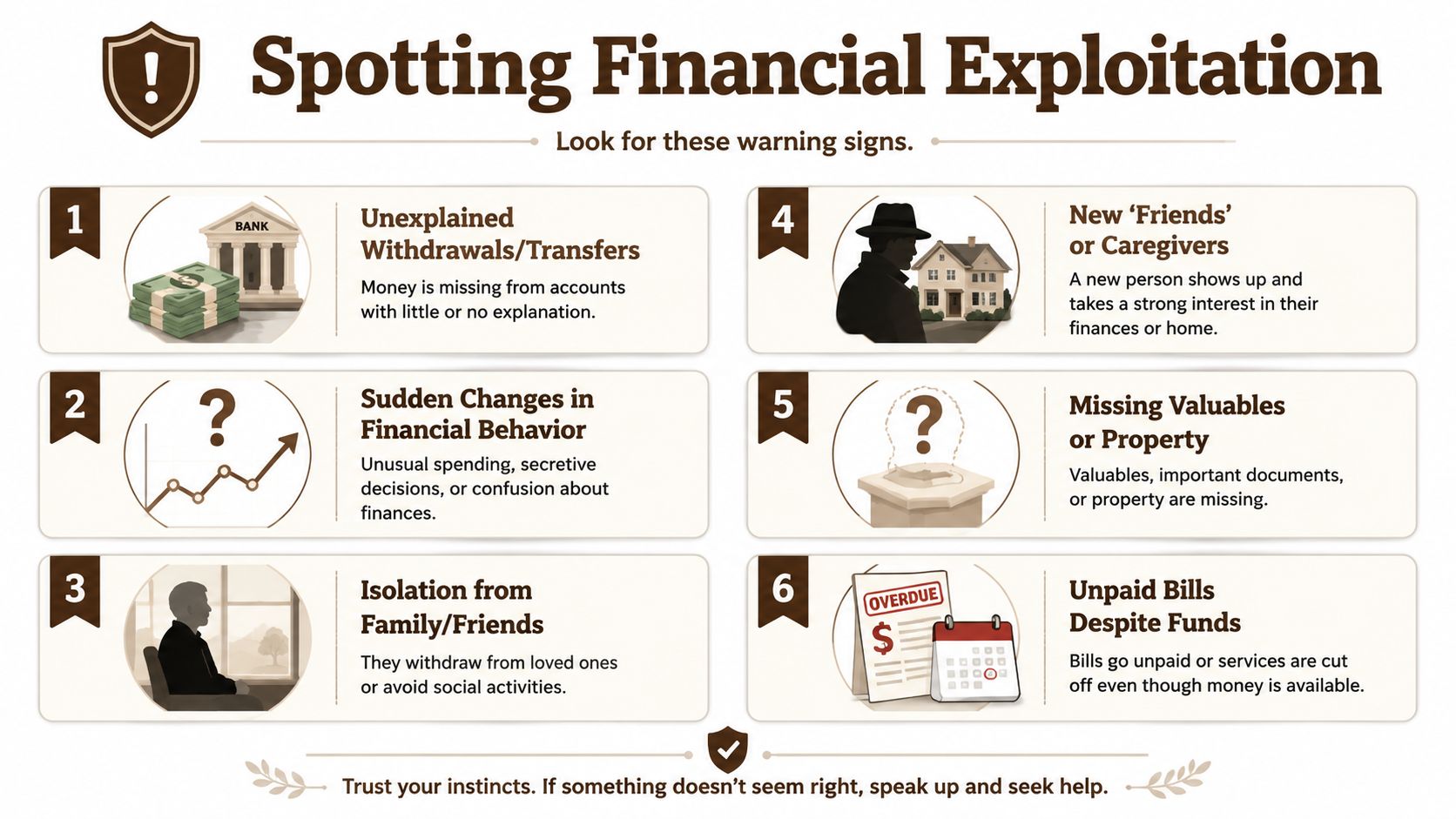
In many California families, no judge is reviewing account activity in real time. No court clerk is checking each transfer. That's one reason these cases can continue undetected. A resource on power of attorney elder abuse notes that financial POAs often grant direct access to assets with little or no routine court oversight, and abuse can continue for months or even years before discovery. It also highlights red flags such as unexplained withdrawals and unusual transfers in the Nursing Home Abuse Center discussion of power of attorney abuse warning signs.
Why families usually spot the problem first
A bank may notice an unusual transaction. A title company may question a signature issue. But most of the time, a daughter, son, sibling, or neighbor notices that something feels off before any institution does.
Often the first clue isn't a missing account. It's a change in daily life. The refrigerator is empty even though there should be money. Property tax notices are piled up. A longtime routine has been interrupted, and the person controlling finances has become defensive.
The warning signs to document right away
Use a simple checklist. Don't argue about motive yet. Just record what you can observe.
| Category | Red flag | Why it matters |
|---|---|---|
| Financial | Unexplained withdrawals, transfers, or checks | They may show misuse of access |
| Financial | Bills unpaid despite available funds | Money may be diverted or hidden |
| Property | Sudden deed changes or refinance activity | Real estate may be at immediate risk |
| Behavioral | Agent isolates the elder from family | Isolation often prevents oversight |
| Document | Missing statements or changed mailing address | The flow of information may be controlled |
| Relationship | A new “friend” or caregiver appears in key decisions | Influence may have shifted abruptly |
Other signs deserve attention too:
- The house changes hands on paper. A parent still lives there, but title records show a transfer you didn't know about.
- The agent speaks for the principal constantly. Every question gets filtered through one person.
- Records disappear. Online access is cut off, check registers are gone, or file cabinets are suddenly “being organized.”
- The explanation keeps changing. First it was a gift, then a loan, then reimbursement.
If your notes would make sense to a stranger reading them later, you're documenting well.
Keep copies of statements, letters, emails, text messages, escrow papers, and property records. Write down dates, names, and what you personally observed. Don't alter originals. Don't confront the suspected abuser with every concern before you have a plan, especially if real estate or liquid assets can be moved quickly.
When families act early, they usually preserve more evidence and more options. If the warning signs involve a house, deed, or escrow activity, the case may need both probate and real estate litigation analysis. A free consultation can help you decide what to do next.
Immediate Steps to Stop the Abuse and Protect Assets
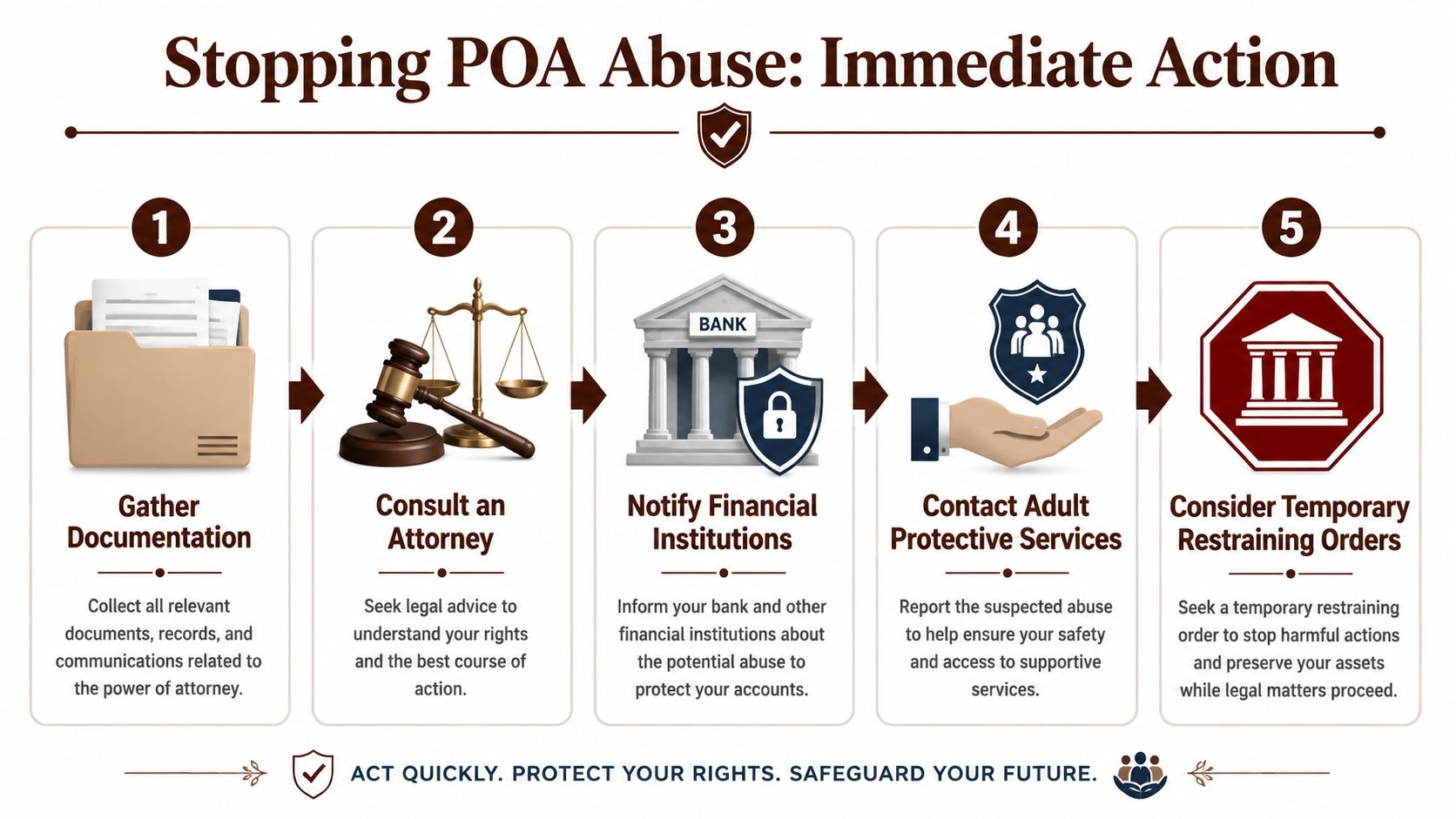
When abuse is ongoing, families often lose time debating what label fits. Don't wait for perfect certainty if assets are actively moving. Focus first on control, notice, and preservation.
Start with control of the documents and accounts
If the principal still has legal capacity, revoking the power of attorney may be the first move. In California, that usually needs to be done carefully and in writing. Then the revocation has to be communicated to the banks, brokerage firms, property managers, escrow holders, and anyone else who may rely on the old document. A revocation that stays in a desk drawer won't stop a transaction.
Gather the paper trail at the same time. Bank statements, deeds, loan records, escrow communications, tax notices, emails, text messages, and caregiver contracts can all matter. If online access exists, preserve what you can lawfully access. If not, make a list of institutions and account numbers so counsel can move quickly.
A legal education resource on POA abuse identifies a broader emergency toolkit that includes revocation, seeking an accounting, temporary freezing of assets, and court review under the Uniform Power of Attorney Act. Those remedies are discussed in the NAPSA legal materials on stopping dissipation of assets in POA abuse matters.
Before you watch the short video below, keep one point in mind. Speed is often the difference between a recoverable case and a much harder one.
When property or major assets are at risk
If the suspected abuse involves a house, rental property, or planned sale, immediate court relief may be necessary. Depending on the facts, California counsel may evaluate whether to seek emergency orders to prevent a transfer, preserve sale proceeds, or stop further encumbrances.
Here's a practical order of operations many families need:
- Secure the records. Pull title records, recent statements, and any signed POA documents.
- Notify institutions promptly. Banks and other third parties need written notice if authority is being challenged or revoked.
- Consider APS and law enforcement reporting. A civil strategy and a report to authorities can proceed on parallel tracks.
- Evaluate emergency court remedies. Temporary restraints or asset freezes may be necessary when funds or property can disappear quickly.
- Protect the property itself. If title has changed or a sale is pending, the litigation plan should address the property directly, not just the money trail.
Some families hesitate because they don't want to “make it worse.” The risk is that delay gives the wrongdoer more time to sell, refinance, withdraw, or obscure the transaction history. If you need urgent help protecting assets under California law, schedule a free consultation right away.
Your Legal Remedies Civil and Criminal Actions
Once immediate harm is contained, the focus shifts to recovery and accountability. In California, that usually means looking at two tracks. One is civil. The other is criminal. They can overlap, but they serve different purposes.
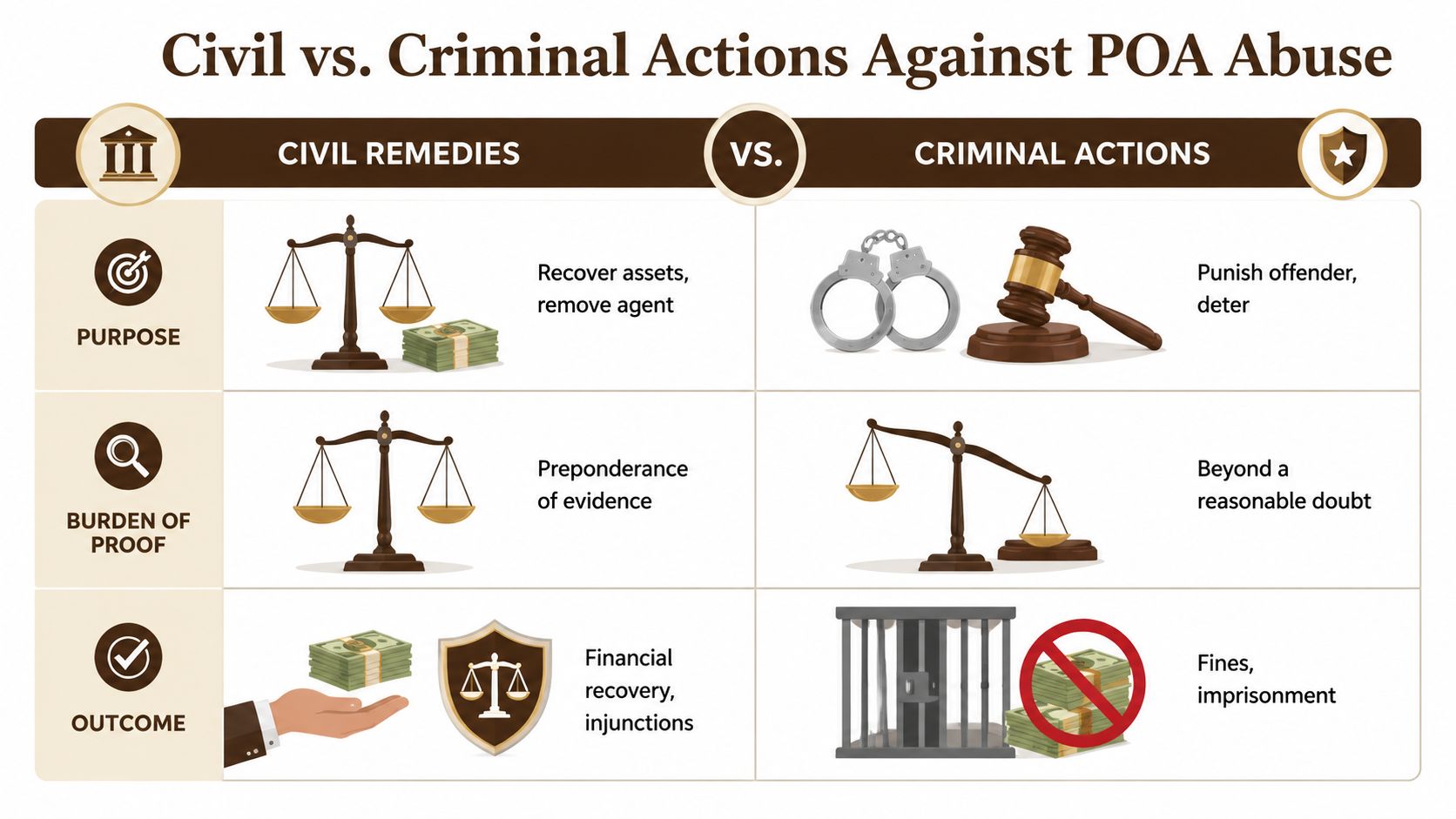
Civil remedies in California probate and real estate disputes
A civil case is about protecting the principal and recovering what was taken or wrongfully transferred. In probate court, families may seek an accounting, suspension or removal of the agent, and orders addressing breaches of fiduciary duty. If the principal is incapacitated, a conservatorship or related protective proceeding may also become part of the solution.
When real estate is involved, the remedy has to fit the property problem. That's where many articles stay too general. In practice, California families often need property-specific tools such as:
- Quiet title actions when an abusive agent signed or caused a deed that clouded ownership.
- Claims to void or unwind a transfer when the deed or transaction should not stand.
- Injunctive relief to stop a pending sale, refinance, or distribution of proceeds.
- Accounting and tracing remedies to follow where sale proceeds or rental income went.
- Partition-related litigation if ownership has been altered and co-owners are now in conflict.
A simple example shows why this matters. Suppose an agent uses a POA to transfer a parent's home into joint ownership with themselves, then argues the document allowed it. A probate petition alone may not fully solve the title issue. The family may need a quiet title strategy to restore the record and clear the ownership chain.
In property cases, the legal question isn't just “Who signed?” It's also “Should that signature have legal effect?”
Criminal reporting and the proof problem
Criminal reporting is different. The goal is public enforcement, not just family recovery. In California, reports may go to Adult Protective Services, local law enforcement, or both. Whether charges are filed depends on the available evidence and the prosecutor's assessment.
One of the hardest issues is proof when the agent points to the POA and says, “I was authorized.” A law-enforcement training presentation emphasizes that the existence of a power of attorney does not shield someone from prosecution. Key issues often involve intent, consent, and whether the conduct served the principal's best interests. That point is addressed in the law-enforcement training discussion on proving abuse despite formal POA authority.
That principle is especially important in California real estate disputes. An agent may have technical signing authority and still commit abuse by transferring property for personal benefit, concealing the transaction, or acting against the principal's interests. A deed can look polished and still be challengeable.
Here's a useful way to think about the two tracks:
| Track | Primary goal | Common tools |
|---|---|---|
| Civil | Protect assets and recover property | Accounting, injunctions, quiet title, rescission-type relief |
| Criminal | Investigate and punish wrongdoing | APS report, police report, prosecution if supported |
A strong case often starts with disciplined evidence. Gather the POA, account records, title records, care records, correspondence, and a clean timeline. If your family is weighing probate court action, property litigation, or reporting to authorities, a free consultation can help sort out the fastest and most effective path.
How to Draft a POA to Prevent Future Abuse
The best power of attorney is not the broadest one. It's the one that gives useful authority while making abuse harder. In California estate planning, families often focus on convenience. They should also focus on oversight.
Draft for oversight not just convenience
A good first question is not “Who is available?” It's “Who is trustworthy under pressure?” Family members are often involved in financial abuse, and vulnerability can increase when cognitive decline enters the picture. A prevention-focused resource recommends careful vetting of agents, regular transaction reviews, and clear reporting mechanisms to catch suspicious transfers early in the University of Minnesota presentation on power of attorney abuse risk factors and prevention.
That advice fits California practice well. A durable POA can be drafted with guardrails such as:
- Named successor agents if the first choice can't serve or shouldn't continue.
- Required accountings to a trusted relative, CPA, or advisor.
- Specific limits on gifting so the agent can't treat assets as their own.
- Written consent rules for major transfers, especially those benefiting the agent.
- Recordkeeping requirements that make later review easier.
Property powers deserve special limits
Real estate deserves extra attention because property transactions can create lasting damage. If a POA will include authority over a home, rental property, or sale proceeds, the document should be drafted with precision. Many families benefit from restrictions on self-dealing, beneficiary changes, and title changes that benefit the agent directly or indirectly.
Consider whether major property decisions should require a second signature, written notice to a third party, or narrow authorization only for identified transactions. A POA can also distinguish between ordinary bill-paying authority and extraordinary powers affecting deeds, loans, or sale escrow instructions.
A broad POA may be easy to sign today and expensive to fix later.
Families in Orange County and Los Angeles often discover that estate planning documents were technically valid but practically unsafe. Careful drafting can reduce that risk. If you're creating or updating a California power of attorney, a free consultation can help you build in the right safeguards.
How Tanner Law Protects Your Rights and Property
Power of attorney abuse often lands at the intersection of probate and real estate litigation. That's where many families need more than general advice. They need a lawyer who can evaluate title, escrow activity, deed history, fiduciary conduct, and court remedies together.
Tanner Law represents clients in Orange County and Los Angeles in disputes involving wrongfully transferred real estate, contested ownership, probate-related accounting issues, and urgent property protection. That includes situations where an abusive agent may have signed a deed, changed title, diverted sale proceeds, or created a cloud on ownership that now has to be removed through litigation.
Because William T. Tanner is both an attorney and a licensed real estate broker, the firm brings courtroom analysis and practical property insight to the same problem. That matters when the case involves quiet title claims, partition disputes, probate conflicts tied to real estate, or the need to trace what happened in a transaction that should never have occurred.
Clients also benefit from direct, clear communication. These cases are stressful. Families need straightforward advice about what can be stopped now, what can be recovered later, and which court path makes the most sense under California law.
If you suspect power of attorney abuse involving a parent, relative, home, or investment property, don't wait for the situation to become harder to reverse.
If you need help addressing power of attorney abuse in California, contact Tanner Law to schedule a free, confidential consultation. The firm helps families in Orange County and Los Angeles evaluate urgent remedies, protect property, challenge wrongful transfers, and pursue practical solutions in probate and real estate litigation.