Tenant in Common Contract: What It Is and How to Draft One
Three siblings inherit a Riverside rental, but the deed and the family conversation never answer the questions that matter. Who pays the mortgage when rent is late? Can one sibling move into the property? What happens if another wants cash instead of a long-term investment? Without written rules, an inheritance can become a dispute over possession, expenses, valuation, and sale.
A tenant in common contract is designed to prevent that result. The deed establishes who owns the estate and in what form. The contract explains how those owners will operate the property, contribute money, make decisions, handle a death, and exit without immediately turning to a partition lawsuit. California law matters at every stage, from recording and lender consent to probate and the limits on waiving partition.
Table of Contents
- What a Tenant in Common Contract Actually Does
- When You Need a Written Co-Ownership Agreement
- Drafting the Essential Clauses Step by Step
- California Law Considerations That Change the Draft
- Common Pitfalls That Lead to Partition Lawsuits
- Next Steps Intake Costs and When to Call a Lawyer
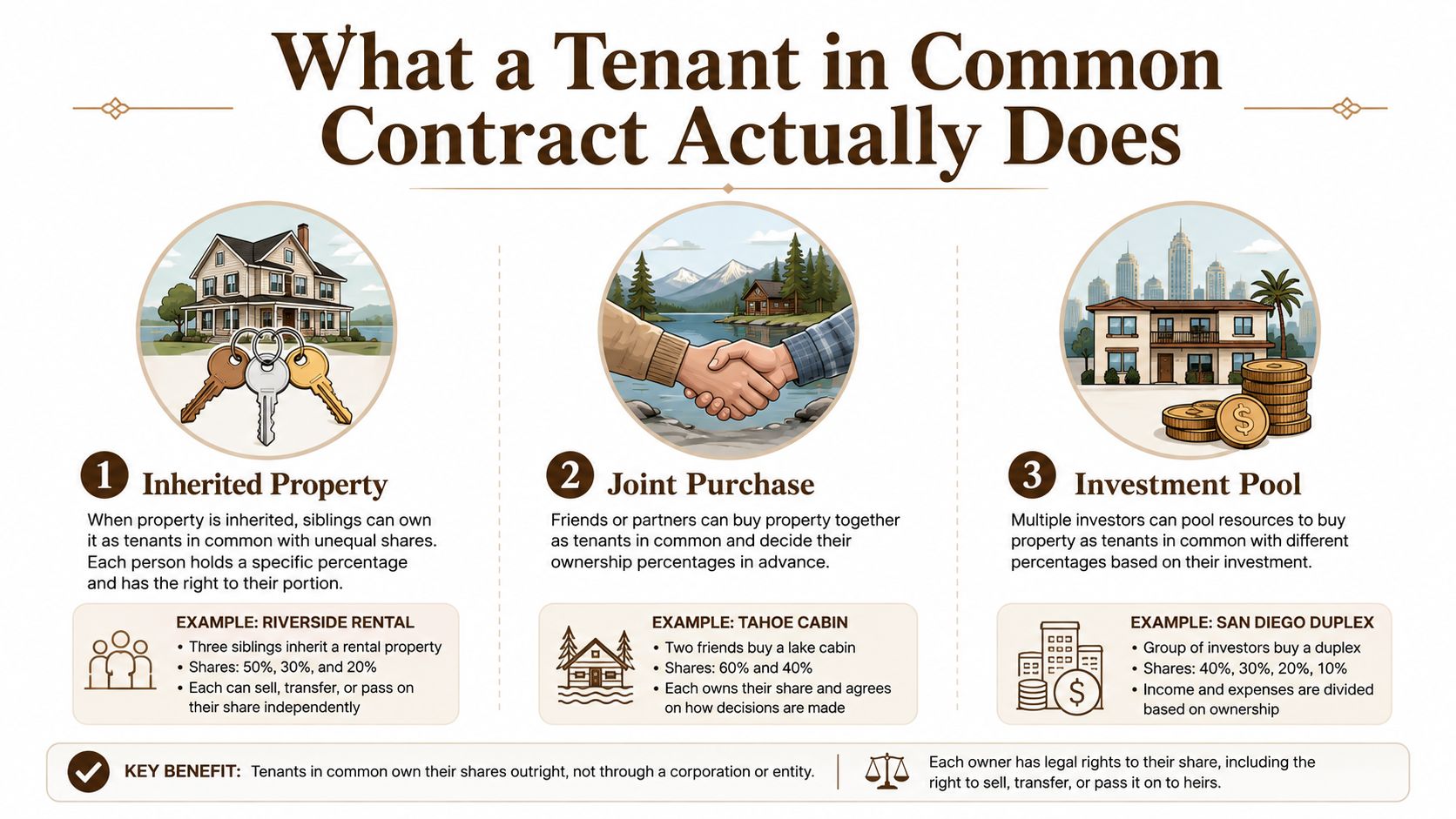
What a Tenant in Common Contract Actually Does
A tenancy in common is one of the three classic forms of concurrent ownership recognized in common-law systems. Historical scholarship traces its recognition as a distinct estate in medieval English law by the 14th century, and notes that by the time of Henry VIII, co-owners could seek court-ordered termination through partition. That history still matters because partition remains a durable remedy when California co-owners cannot agree. The historical development of tenancy in common and partition explains why this ownership form has always combined individual transfer rights with a potentially powerful exit remedy.
Suppose three siblings inherit a Riverside rental. One contributed substantial money to improvements before the parent died, while the others inherited their interests through the estate. A tenancy in common can reflect unequal shares, such as 50/25/25, while each sibling still owns an undivided interest in the entire property. No sibling owns a particular bedroom, unit, or physical slice unless a written agreement changes how possession works.
A tenant in common can generally transfer that separate fractional interest by deed, gift, sale, or estate administration. The interest passes through the deceased owner's estate rather than automatically transferring to surviving co-owners. That is the fundamental difference from joint tenancy, where the defining feature is a right of survivorship. In California, the deed must accurately state the intended vesting, because title language determines whether survivorship applies and whether the interest remains part of probate planning.
The deed establishes ownership, the contract establishes the working relationship
A deed answers questions such as:
- Who owns the property: It identifies the grantees and the form of title.
- What each person owns: It should state the fractional interests when they aren't equal.
- What happens at death: A tenancy in common interest ordinarily passes through the owner's estate, not automatically to the survivors.
The contract answers the operational questions the deed rarely addresses. It can allocate mortgage payments, property taxes, insurance, repairs, utilities, reserves, rental income, management duties, access, refinancing authority, and sale procedures. It can also create a staged buyout process before one owner seeks partition.
This structure appears in more than inherited property. Two friends may buy a Lake Tahoe vacation home, or investors may pool capital for a San Diego duplex. Co-ownership isn't rare. A JW Surety bonds survey reported by Rocket Mortgage's explanation of tenancy in common found that 15% of Americans had bought property with someone other than a romantic partner. That doesn't decide whether tenancy in common is appropriate, but it shows why a private agreement must do more than repeat the deed.
Practical rule: Treat the contract as a partition-prevention instrument first and an ownership summary second. If the agreement doesn't explain how an owner gets out, the court may eventually supply the exit process.
When You Need a Written Co-Ownership Agreement
A grant deed may prove ownership, but it rarely explains how several people will live with that ownership over time. A formal agreement is especially important for inherited property with multiple heirs, unmarried partners buying together, friends purchasing a vacation home, and investors holding rental property. It also deserves careful attention when a parent adds a child for estate-planning reasons, or when members of an LLC-related investment structure hold real estate directly as tenants in common.
Consider two friends who buy an Oakland duplex as 50/50 co-owners. The deed may establish equal title, but it won't answer whether both must contribute equally to a roof replacement, whether one owner can occupy one unit, or whether rental income first funds reserves. It won't establish what happens if one friend loses employment, wants to refinance, or believes the property should be sold while the other wants to hold it.
A written contract turns those disagreements into predetermined procedures. That matters even where the owners trust each other. Trust helps people cooperate, but it doesn't establish an appraisal process, a payment deadline, a notice requirement, or a binding method for resolving a deadlock.
Situations that call for more than a handshake
- Inherited property: Heirs may have different financial needs, personal relationships, and views about keeping the property. Probate can introduce additional participants and delays.
- Unmarried co-buyers: The owners may not share automatic inheritance rights, and their contributions may differ even when the deed shows equal ownership.
- Vacation and investment property: Use schedules, renters, repairs, and distributions create recurring decisions that family goodwill won't reliably resolve.
- Parent-child planning: Adding a child to title can affect control, creditors, estate administration, and tax treatment. The deed and estate plan must tell the same story.
- Mortgage-backed property: The agreement should identify who is responsible for loan payments and what requires lender consent. Fannie Mae's tenancy-in-common agreement requirements call for a validly executed TIC agreement before or at loan closing in the institutional setting addressed by its guide, with all co-tenants bound by it.
A basic deed may be enough for a simple family inheritance where the owners have equal interests, no loan, no rental activity, and a shared plan to sell promptly. It may also be unnecessary for a short-flip partnership or a single-event purchase intended for immediate resale. Transfers between spouses held through a living trust may belong primarily in the trust and title documents, although counsel should still confirm that the arrangement doesn't create conflicting obligations.
More than two owners, any contribution imbalance, or an expectation of holding the property beyond a short transaction should trigger a written agreement.
Drafting the Essential Clauses Step by Step
A useful tenant in common contract follows the property's life cycle. It starts with title and money, then moves through control, use, default, and exit. The following sample language is illustrative, not a substitute for review of the deed, loan documents, trust instruments, and the owners' actual objectives.
Identify the parties and lock down the percentages
Begin with every owner's legal name, address, and contact information. Identify the property by street address and complete legal description, then state the ownership interests in both words and numerals.
“The parties own the real property described in Exhibit A as tenants in common. Owner A holds an undivided 50% interest, Owner B holds an undivided 25% interest, and Owner C holds an undivided 25% interest.”
The deed and contract must match. If the deed says equal interests but the agreement says 50/25/25, the parties have created a dispute before making a single payment. Confirm vesting with the county recorder and address any correction or confirmatory deed before relying on the contract.
Allocate contributions and property expenses
State each owner's initial contribution, including cash, credits, improvements, and assumed debt. Then distinguish expenses that follow ownership percentages from expenses caused by one owner's special use.
“Each owner shall pay their percentage share of mortgage principal and interest, property taxes, insurance, ordinary repairs, utilities attributable to common areas, and approved reserves. A payment made by one owner for another owner's share creates a reimbursable advance.”
Include payment dates, notice of an unpaid amount, a cure period, and whether a documented advance bears interest. Don't rely on a vague promise to “share expenses fairly.” Fairness is often the issue being litigated.
Separate routine management from major decisions
Routine management can be assigned to one owner or a professional manager, subject to a budget and reporting duties. Major decisions should require a defined voting threshold.
A clause might provide that ordinary repairs within an approved budget require majority approval by ownership percentage, while a sale, refinance, new mortgage, material capital improvement, change in use, or long-term lease requires unanimous consent. State whether an emergency repair can proceed without advance approval and how the owner must document it.
Address income, reserves, and use
The distributions clause should cover rent, security deposits, sale proceeds, reserve accounts, and accounting records. It should also address whether an owner may occupy the property and whether that use creates rent or expense credits.
“Net rental income shall be deposited into the designated property account. Approved reserves shall be funded before distributions. Distributable cash shall be paid according to ownership percentages unless the parties approve a different written allocation.”
That language prevents one owner from collecting rent informally while another pays the insurance bill. For a residence or vacation home, add booking procedures, access rules, guest responsibility, damage allocation, and a process for resolving calendar conflicts.
Build the buyout before discussing partition
The contract should provide a realistic exit route. A right of first refusal can give the remaining owners an opportunity to purchase the departing owner's interest, but it must state the notice period, valuation method, response deadline, closing date, and treatment of debt.
“An owner wishing to transfer their interest shall first deliver written notice stating the proposed transfer terms. The remaining owners may elect to purchase the interest at the independently appraised value, adjusted for agreed credits and encumbrances, by written election within the stated period.”
Define the appraisal process. Identify who selects the appraiser, how a second appraisal works, whether the values are averaged, and who pays. A formula may work for a simple property, while an appraisal is usually more defensible when value, improvements, debt, or minority-interest arguments are contested.
Tie default to a buyout remedy
A default clause should address missed contributions, unauthorized transfers, failure to maintain insurance, and material violations. Give the defaulting owner notice and a cure opportunity, then permit the nondefaulting owners to pursue reimbursement, interest, or a defined buyout.
Any partition provision must be drafted with California law in mind. A private agreement shouldn't say “no owner may ever seek partition.” A more durable design uses notice, mediation, a buyout election, valuation, and a sale fallback, while preserving whatever rights California law doesn't allow the parties to eliminate.
California Law Considerations That Change the Draft
A generic form can identify the owners and still fail in California. Recording, partition, property-tax treatment, lender rights, and probate administration each affect a different part of the agreement, so the draft must coordinate the contract with the deed and related planning documents.
Recording and priority
California Civil Code sections 1170 and 1170.5 should be considered when deciding what belongs in the public record. Some owners record a grant deed or quitclaim deed confirming the intended vesting, then record a Memorandum of TIC Contract that gives notice of the agreement without placing every private financial term in the public chain of title. Others may record the agreement itself when broader notice is appropriate.
The choice affects later buyers, lenders, and title review. A private contract that is never recorded may bind the original parties but leave a later transaction vulnerable to notice and priority disputes. A memorandum should identify the property and the existence of the agreement accurately, and the deed must reflect the intended ownership percentages.
Partition and sequencing
California Code of Civil Procedure section 872.210 permits a co-owner to commence a partition action. Section 872.730 provides a framework relevant to buyout elections in a partition proceeding, but the contract should not assume that a statutory election automatically replaces careful private sequencing.
The agreement should require written exit notice, a valuation process, a defined buyout period, mediation, and only then a sale or litigation fallback. California authorities and practitioner guidance emphasize that a co-owner can seek partition and that a property that cannot be practically divided may be sold, with proceeds distributed according to the parties' interests. California partition risks for tenants in common discusses why a buyout structure is more useful than a bare promise never to seek court relief.
Property taxes and estate administration
Revenue and Taxation Code section 62 can affect whether a transfer is treated as a change in ownership for property-tax purposes. Transfers into a qualifying living trust may receive different treatment than other title changes, so a deed should not be prepared in isolation from the estate plan. The contract should identify which transfers require tax review and prohibit unilateral retitling without notice and appropriate consent.
California has a specific exception for certain transfers at death involving principal residences. The California Board of Equalization change-in-ownership guidance states that the exclusion requires the two cotenants together to have owned 100% of the property, been owners of record for the one-year period immediately before death, and used the property as both cotenants' principal residence during that same period. The surviving cotenant must obtain a 100% interest and sign an affidavit confirming continuous residence.
| Code section | What it controls | Matching contract clause |
|---|---|---|
| Civil Code 1170 and 1170.5 | Recording and notice of instruments affecting real property | Memorandum, recording authorization, and title-consistency clause |
| Code of Civil Procedure 872.210 | Commencement of a partition action | Exit notice, buyout election, mediation, and litigation fallback |
| Code of Civil Procedure 872.730 | Buyout election mechanics in partition proceedings | Sequencing clause coordinated with statutory remedies |
| Revenue and Taxation Code 62 | Certain change-in-ownership exclusions | Transfer, trust, tax-review, and reassessment clause |
When a co-owner dies intestate or without a properly coordinated pour-over will, the interest can enter probate and pass to heirs or other beneficiaries. The contract should require prompt notice, identify how an heir becomes a recognized co-owner, and coordinate with beneficiary deeds, transfer-on-death instruments where available, and trust documents. A contract can't privately override a valid estate plan or probate process.
Common Pitfalls That Lead to Partition Lawsuits
The most dangerous contract isn't always the missing contract. Sometimes it's a document that appears complete but leaves the critical exit questions unanswered.
Ambiguous percentages are a common starting point. The deed may use one ownership description, the agreement another, and the parties' payment records a third. State the interests in the vesting document and contract, attach the legal description, and explain how later contributions affect, or don't affect, ownership.
Financial defaults need equal precision. “The owners will share expenses” doesn't identify a payment date, notice method, reserve requirement, or remedy when one person stops paying the mortgage or property taxes. A strong agreement permits an owner who advances another's share to seek reimbursement and, after defined notice and cure procedures, exercise a buyout remedy.
Valuation language must be usable under pressure
“Fair market value” is not a valuation procedure. The agreement should identify an independent appraiser, the valuation date, permitted assumptions, treatment of deferred maintenance, outstanding debt, liens, and whether the departing owner receives a pro rata share of net equity.
A right of first refusal also must be practical. If a minority owner can't obtain financing within the stated period, the clause should explain whether another owner may step in, whether the property goes to an outside sale, and how the failed buyout affects the next option. A right that leaves an owner trapped without a realistic purchase or sale route can intensify the dispute it was intended to prevent.
Lender consent is another frequent omission. A co-owner can't assume that transferring a fractional interest releases existing loan obligations or avoids a due-on-sale issue. Any refinance, assumption, transfer, or release should identify lender approval requirements and the consequences if approval is refused.
A court can't enforce a business deal that the owners never actually wrote down. “We had an understanding” is often the beginning of an expensive evidentiary fight.
Don't overreach on partition waivers
A blanket clause stating that no owner may ever seek partition may conflict with California's statutory framework, including Code of Civil Procedure section 872.210. The safer objective is not to pretend the remedy doesn't exist. It is to require a meaningful buyout sequence, valuation, mediation, and sale process before litigation, while drafting any waiver only to the extent California law permits.
The cleanup matters too. Record the memorandum, confirm the deed's vesting, align the agreement with the lender's documents, update the trust or estate plan, and notify the insurer of the ownership arrangement. California guidance on tenants in common disputes and possession rights explains that each cotenant generally has an undivided interest and an equal right to possess the whole property unless a written agreement changes that result.
Next Steps Intake Costs and When to Call a Lawyer
Before drafting begins, the owners should answer practical questions rather than start with a template. Identify the source of each contribution, the intended ownership percentages, the expected use, the rental plan, and the preferred exit. Ask whether any owner has a pending divorce, bankruptcy exposure, creditor concern, or estate-planning restriction that could affect title or transfer.
Cost depends on the work, not merely the number of pages. A basic two-party agreement is usually less demanding than a multi-party contract with unequal contributions, lender approvals, rental operations, reserve accounting, a detailed appraisal process, and buyout financing. Estate-planning integration also increases the review because the deed, trust, will, beneficiary designations, and co-ownership agreement must not contradict one another.
A transaction can move efficiently when the parties agree on business terms and no lender consent is needed. If lender review, title correction, trust amendments, or competing ownership expectations arise, the process takes longer. The important milestone isn't signing a document that everyone only partly understands. It is completing the deed, agreement, memorandum, lender coordination, insurance notice, and estate-plan updates as one coordinated package.
Information to gather before the consultation
- Title documents: Bring the current grant deed, preliminary title report, recorded liens, and any prior co-ownership agreement.
- Loan materials: Include the promissory note, deed of trust, lender contact information, and current payment responsibilities.
- Financial records: Prepare contribution records, improvement receipts, tax statements, insurance information, rent records, and reserve details.
- Estate documents: Gather wills, trusts, beneficiary designations, probate papers, and any written inheritance instructions.
- Decision history: Write down existing agreements about use, repairs, rent, sale, and prior disputes, including agreements made by email or text.
A consultation is particularly valuable when one owner contributes unequal capital, someone is considering a 1031 exchange, one party is a non-citizen, or the property will be the primary residence of only one owner. Those circumstances can affect financing, tax treatment, possession rights, estate administration, and the design of a buyout.
If you own property with siblings, friends, an unmarried partner, or an investor group in Orange County or Los Angeles, don't wait for the first missed payment or family disagreement. A California real estate and probate lawyer can review the title, identify the partition risk, and draft an agreement that matches the ownership and estate plan.
Tanner Law helps California property owners address tenant in common contracts, partition exposure, probate complications, title disputes, and real estate contract enforcement with practical guidance for the property and the people involved. Schedule a free consultation by visiting Tanner Law so you can address valuation, buyout sequencing, lender consent, and the documents needed to protect your co-ownership.