Trust Accounting Requirements for California Attorneys
A California lawyer may receive a settlement check, an advance for costs, or funds connected with a probate administration and think the hard part is just depositing it into the right bank account. The work starts afterward. Every dollar must remain traceable to the person, estate, or matter entitled to it, and the records must still make sense long after the transaction feels finished.
For attorneys in Orange County and Los Angeles handling estate planning, probate, real estate, or trust litigation, trust accounting requirements involve more than IOLTA mechanics. California law also imposes separate accounting duties when a lawyer serves as trustee, executor, or fiduciary representative. A firm can maintain a technically proper client trust account and still mishandle a trustee accounting owed to beneficiaries.
Table of Contents
- Why California Attorneys Cannot Afford to Wing Their Trust Accounting
- What a Client Trust Account Is
- Core Recordkeeping Rules Under California Law
- Retention Timelines and Jurisdictional Comparisons
- Running a Monthly Three-Way Reconciliation
- Probate and Trustee Accounting Duties That Intersect
- General Trust Accounts Versus Separate Client Accounts
- Common Discipline Triggers and a Practical Compliance Wrap-Up
Why California Attorneys Cannot Afford to Wing Their Trust Accounting
A solo estate-planning attorney receives a State Bar investigator's letter after a former client reports missing settlement funds. The request covers bank statements, client ledgers, deposit records, and reconciliations for several years. The attorney remembers the matters, but cannot rebuild the file cleanly. The bookkeeper changed, the accounting software was replaced, and several checks have no matter identifiers.
Intentional theft is not required for this to become a disciplinary problem. A weak paper trail can create serious exposure even when the lawyer believes every client received the correct amount. California's client trust accounting framework established a specific recordkeeping regime effective January 1, 1993, as described in the State Bar's Client Trust Accounting Handbook. The guidance requires attorneys to retain trust-accounting records for five years after the funds are paid out.
The Client Trust Account Protection Program, or CTAPP, added active oversight in 2022. Attorneys must register client trust accounts annually, complete an annual self-assessment, and certify compliance with safekeeping rules.
Practical warning: A correct balance does not prove compliance. Records must show whose money arrived, the reason for each disbursement, who authorized it, and how the remaining balance was checked.
The consequences may include client loss, fee disputes, discipline, and suspension. Routine shortcuts create many of the problems: postponing reconciliations, leaving a negative client balance unresolved, depositing earned fees into trust, or treating a probate fiduciary account like an ordinary legal retainer.
A workable system is procedural. Separate funds by ownership and purpose. Record transactions promptly. Reconcile each month. Preserve deposit slips, checks, statements, approvals, and related correspondence. Then identify whether the lawyer is also acting as trustee, executor, or another fiduciary, because California Probate Code accounting duties may apply alongside attorney trust-account rules. That overlap is where firms often mistake a properly maintained IOLTA record for a complete trustee accounting owed to beneficiaries.
What a Client Trust Account Is
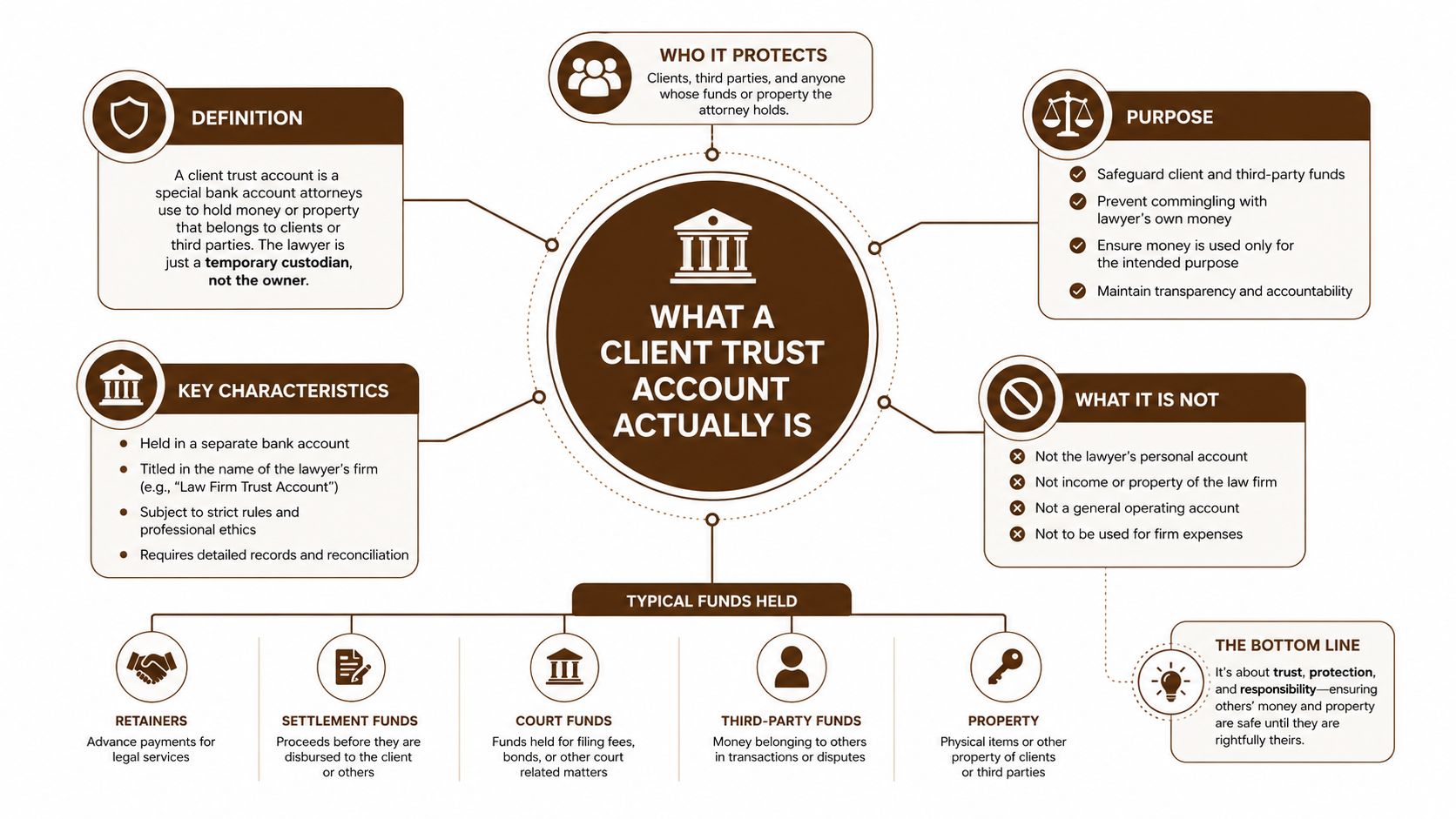
A client trust account is a fiduciary holding account, not an operating account. Money deposited there belongs to a client, beneficiary, estate, or another person whose funds the lawyer has agreed to safeguard. Common examples include unearned retainers, disputed fees, settlement proceeds, advanced costs, and probate-related funds, as described in this practical overview of client trust accounting.
The bank sees one balance, while the lawyer must track each client's and matter's share separately. The bank is only the custodian. The attorney remains responsible for identifying ownership, documenting every transaction, and delivering funds promptly when the client becomes entitled to them.
California attorneys commonly use a pooled IOLTA account for funds that are nominal in amount or held too briefly to earn net income for an individual client. The interest moves through the IOLTA structure rather than becoming firm revenue. Funds expected to earn income for the client beyond the cost of maintaining a separate account belong in a separate, non-IOLTA trust account, with the interest credited to that client. These account distinctions are described in the State Bar's guidance on IOLTA and non-IOLTA account distinctions.
The pooled structure is efficient, but it does not identify ownership for you. A client ledger must show every receipt, withdrawal, transfer, and remaining balance for each matter. A single bank balance cannot establish that the right client will receive the right funds.
Commingling blurs ownership and creates a public-protection risk. If firm money and client money share an account, an accounting error can make it impossible to determine whether a payment used earned fees or another person's funds. Estate and probate lawyers also need to keep the roles separate: an IOLTA ledger tracks attorney-held funds, while trustee or executor accounting may require a broader report to beneficiaries under the California Probate Code.
Core Recordkeeping Rules Under California Law
California's core recordkeeping system is built around transaction journals and matter-level ledgers. The State Bar's Client Trust Accounting Handbook provides the working framework, including records that allow an examiner to trace the account from the bank statement to each client balance.
The records that must tell the same story
A reliable file contains:
- Cash receipts journal: Record the date, amount, source, check or transaction reference, and client or matter receiving the funds.
- Cash disbursements journal: Record the date, payee, amount, purpose, check or transfer reference, and affected client ledger.
- Individual client ledger: Track each client's receipts, withdrawals, transfers, and balance separately. Cost advances need clear treatment rather than being buried in a general fee ledger.
- Client trust listing: Maintain a current report showing each client or matter with funds remaining in trust.
- Supporting documentation: Preserve deposit slips, bank statements, canceled checks or electronic confirmations, invoices, authorizations, settlement statements, and communications explaining unusual transactions.
The journals show activity. The individual ledger shows ownership. The client trust listing provides the aggregate comparison needed for reconciliation. If any one of those records is missing, the account becomes difficult to audit.
CTAPP changes the compliance mindset
The 2022 CTAPP framework requires annual registration, self-assessment, and certification. That duty reflects a shift from waiting for a problem to asking every active licensee to examine the firm's controls. A firm that doesn't currently hold client funds still needs to understand and complete the applicable reporting and certification obligations described by the State Bar.
A State Bar inquiry commonly focuses on bank statements, canceled checks, receipts, disbursements, ledgers, and reconciliation materials. Follow-up questions often arise from details that seemed minor at the time, such as a deposit slip without a client identifier or a disbursement with no written authorization in the file.
The question isn't whether you remember the transaction. The question is whether another person can verify it from the file.
Use a consistent naming convention, restrict access to trust-account software, and require a second review for transfers and unusual disbursements. Technology can help, but it doesn't replace judgment. An automated system that carries forward an incorrect client balance only produces a more polished error.
Retention Timelines and Jurisdictional Comparisons
California's current guidance uses a five-year retention period after funds are paid out, making the State Bar's rule more specific than a general instruction to keep records “for several years.” The requirement is described in the California State Bar's trust accounting handbook.
The broader professional pattern is similar but not uniform. The ABA Model Rule on client trust account records recommends retaining core records for five years after termination of the representation. Illinois requires preservation for seven years after representation ends and requires quarterly reconciliation reports. Wisconsin requires complete trust-account records for at least six years after termination. Those timelines show that trust accounting is treated as a long-term fiduciary obligation, not a temporary bookkeeping task.
| Jurisdiction | Minimum retention | Clock trigger | Notes |
|---|---|---|---|
| California | Five years | After funds are paid out | State Bar guidance also operates alongside CTAPP self-assessment and certification |
| ABA model guidance | Five years | After representation terminates | Calls for journals, ledgers, and accountings |
| Illinois | Seven years | After representation ends | Requires quarterly reconciliation reports |
| Wisconsin | Six years | After representation terminates | Requires complete trust-account records |
The clock trigger matters. A firm should identify whether the relevant event is final disbursement, matter termination, account closure, or another event specified by the governing rule. For probate and estate work, the State Bar minimum may be too short as a practical matter. A beneficiary dispute or accounting challenge can emerge long after a routine matter appears closed.
Build retention for proof, not just storage
Paper originals can work, but they become difficult to search and protect. Scanned PDFs are useful when they are complete, readable, securely backed up, and tied to the underlying ledger. Accounting software exports should be preserved in a durable format rather than assuming a vendor will always support an old database.
A conservative firm policy links trust records to the life of the matter and applicable limitation periods, with additional time for disputes and audit response. The California floor is not necessarily a responsible ceiling, particularly for estates, trusts, and real estate matters involving continuing obligations.
Running a Monthly Three-Way Reconciliation
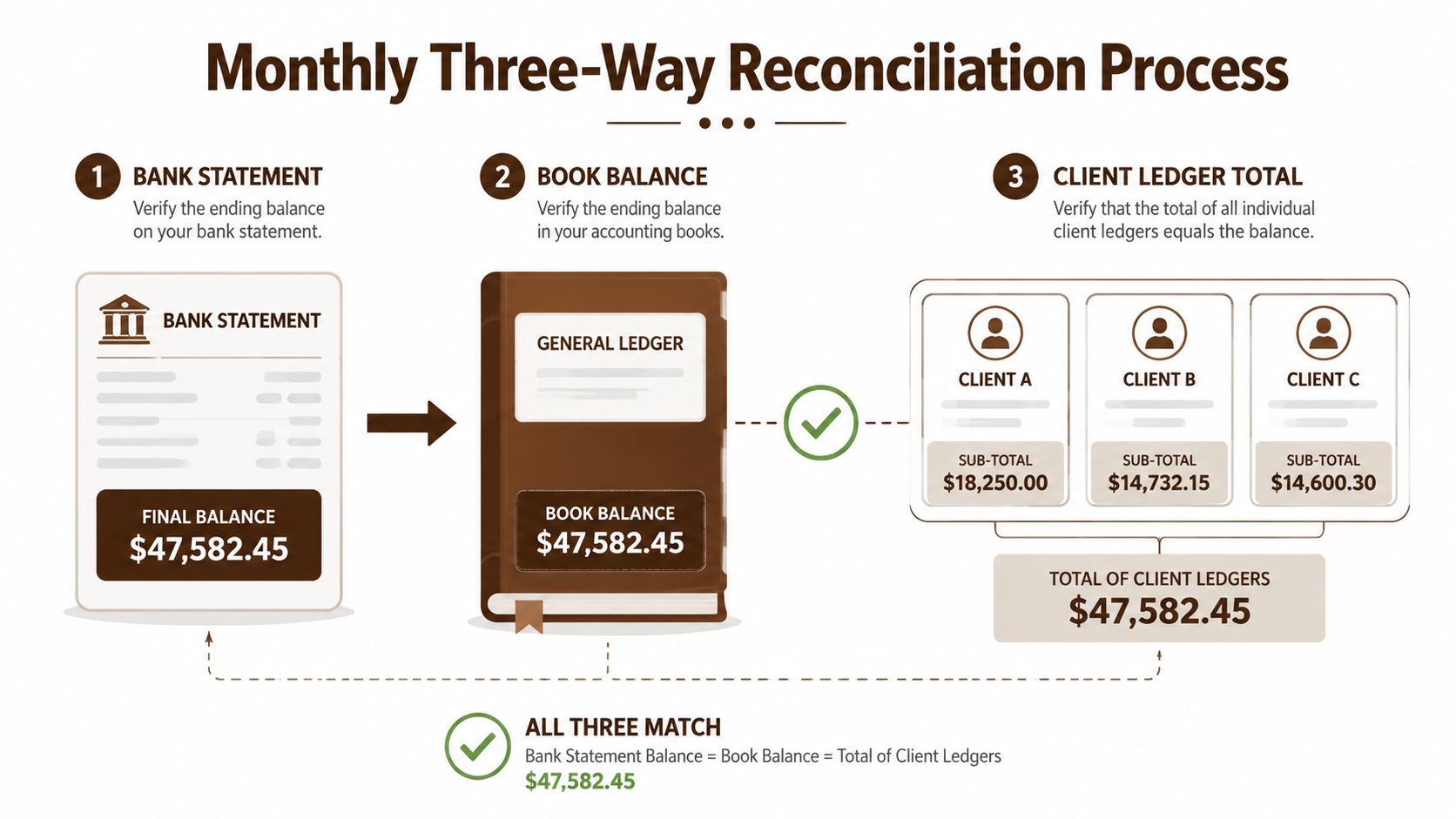
A monthly reconciliation should answer one question: Does the bank's money equal the money assigned to clients? California practitioners should compare three separate records, not just the bank statement and a cashbook.
Match the three records
- Start with the bank statement. Use the ending balance for each trust account, including pooled and separate interest-bearing accounts.
- Review every client ledger. Add the balances matter by matter. Include cost-advance sub-ledgers and any funds held for a specific purpose.
- Compare the client trust listing. This aggregated report should identify every client or matter with money still on deposit.
- Investigate every difference. Outstanding checks, deposits in transit, bank fees, posting errors, stale checks, and unauthorized transfers need documented treatment.
- Sign only after review. The reconciliation should show who prepared it, who reviewed it, the date, the records used, and the explanation for any reconciling item.
The three totals must agree to the penny after legitimate reconciling items are addressed. A cashbook-only review can miss a disbursement that was posted to the wrong client, a vendor check that remains outstanding, or funds that moved into the operating account. Three-way matching forces the firm to compare the bank's actual cash with both the accounting records and the client-by-client ownership schedule.
A simple worksheet can use these fields:
| Reconciliation item | Amount or status |
|---|---|
| Bank statement ending balance | Enter the statement balance |
| Deposits in transit | Identify and document each item |
| Outstanding checks or transfers | List payee, amount, and date |
| Adjusted bank balance | Calculate after supported adjustments |
| Total client ledger balances | Include every active matter |
| Client trust listing total | Confirm the report date |
| Difference | Explain before signing |
Keep the signed reconciliation with the bank statement, transaction detail, and supporting explanations. That packet is far more useful than a spreadsheet saved without a preparer, reviewer, or audit trail.
For a visual walkthrough of the process, review the embedded demonstration below.
Never sign a reconciliation you can't explain. If the difference is small, the control failure is still real. A minor unexplained variance can conceal a larger posting error or an incorrect client balance.
Probate and Trustee Accounting Duties That Intersect
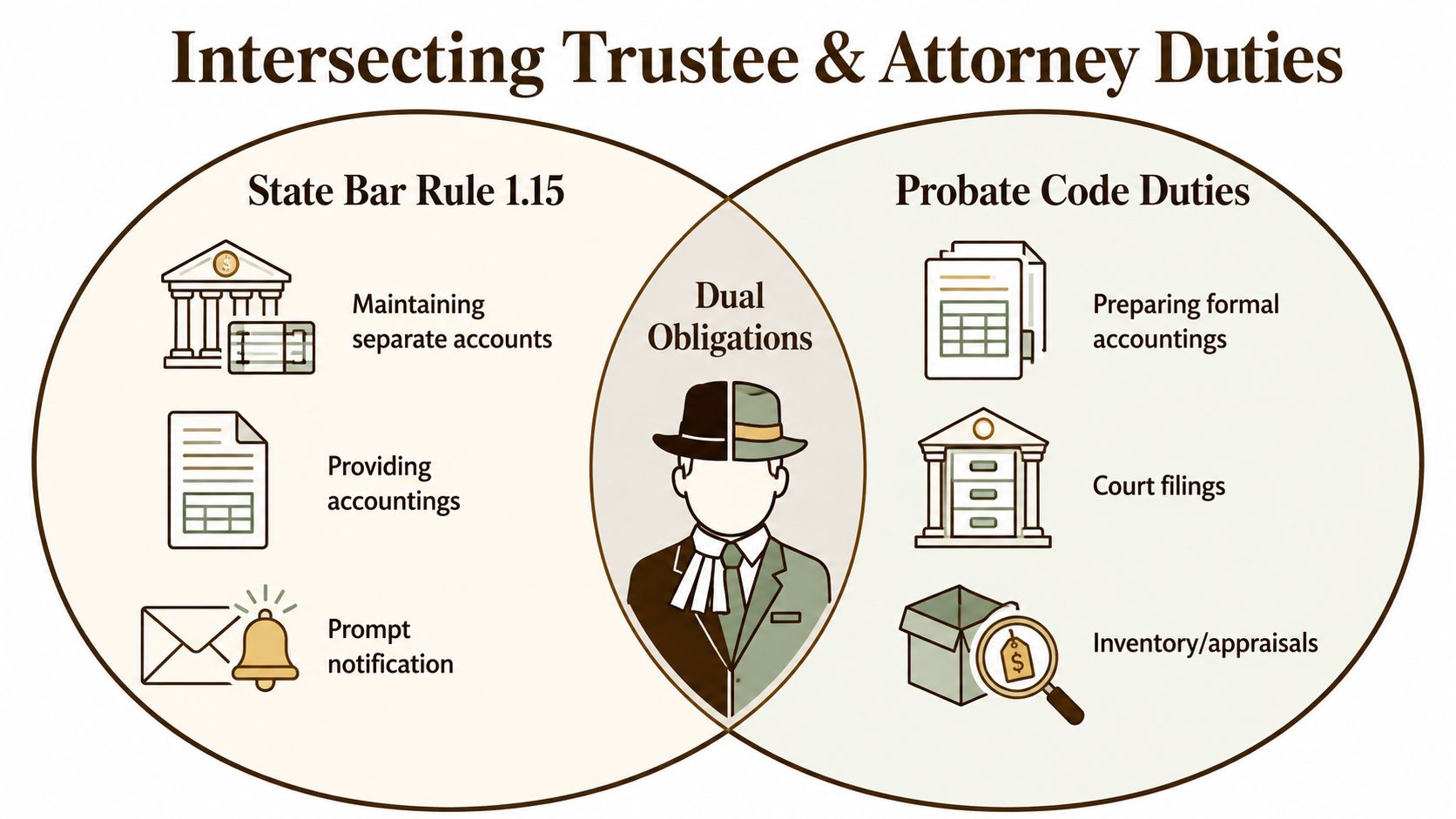
A California attorney who serves as trustee occupies two professional roles. Rule 1.15 governs the lawyer's handling of client funds, while the California Probate Code governs the fiduciary's administration and reporting of trust assets. Those obligations overlap, but they aren't interchangeable.
The attorney trust-account regime focuses on safekeeping, segregation, transaction records, prompt notice, and delivery of funds. The trustee regime addresses the larger fiduciary picture, including inventory, valuation, receipts, disbursements, liabilities, compensation, beneficiary reporting, and court oversight where applicable. A trustee may control brokerage accounts, real property, operating expenses, and distributions that never pass through the law firm's IOLTA.
One matter can require two ledgers
Suppose an attorney becomes successor trustee of a revocable trust and also represents the trust in an estate-related dispute. The attorney needs a fiduciary accounting for trust assets and a separate client trust ledger for any money held in the attorney's account on behalf of the trust or another client.
The transaction may therefore appear in two systems for different reasons:
- Trust accounting record: Shows the asset, receipt, expense, distribution, liability, and fiduciary purpose.
- Attorney trust ledger: Shows the amount deposited with counsel, the date received, authorized disbursements, fees earned, and remaining client balance.
- Beneficiary accounting: Presents the information required for beneficiaries to evaluate administration.
- Law firm reconciliation: Confirms that the funds held in the client trust account match the bank and aggregate client listing.
California Probate Code section 16062 requires a trustee to provide an accounting at least annually, at trust termination, and upon a change of trustee to beneficiaries currently entitled to income or principal distributions, as described in Probate Code section 16062. Section 16063 requires receipts and disbursements of principal and income, along with assets and liabilities at the end of the accounting period, under Probate Code section 16063. The accounting also discloses trustee compensation and hired agents, including relevant relationships and compensation, as explained in this California trustee accounting discussion.
A beneficiary accounting is not a substitute for a client ledger, and a client ledger is not a substitute for a trustee accounting.
Commingling fiduciary funds with active client matters creates a separate problem. Probate petitions and beneficiary objections often expose missing records that would otherwise remain unnoticed. Before accepting a successor-trustee appointment, an attorney should identify every account, define the fiduciary role, and establish who will prepare and review each accounting.
General Trust Accounts Versus Separate Client Accounts
California's two main structures serve different practical purposes. A pooled IOLTA account holds funds belonging to multiple clients, with the firm maintaining separate sub-ledgers. A separate client trust account is titled and maintained for one client's funds when those funds can earn income for that client beyond the cost of maintaining the account, or when isolation makes sound fiduciary sense. The State Bar outlines these distinctions in its guidance on IOLTA and non-IOLTA accounts.
| Feature | Pooled IOLTA account | Separate client account |
|---|---|---|
| Ownership tracking | Matter-level sub-ledgers | Account directly tied to the client or matter |
| Interest treatment | Interest flows through the IOLTA program when funds are nominal or short-term | Interest accrues for the client |
| Best fit | Routine advances, short-term deposits, and multiple client balances | Funds expected to earn income or requiring heightened isolation |
| Administrative burden | Centralized banking, demanding ledger discipline | More account setup, monitoring, and closing work |
| Main risk | Misapplied sub-ledger entries or commingling | Incorrect titling, tax information, or neglected account maintenance |
A real estate closing with a substantial earnest-money deposit may justify a separate structure because the money has a distinct purpose and ownership question. Probate funds may also warrant isolation where multiple beneficiaries, statutory deadlines, or court scrutiny make a single pooled ledger harder to administer. Confidential settlements and arrangements involving co-counsel or fee-sharing parties deserve the same deliberate review.
Before opening an account, ask:
- Who owns the funds?
- How long will the funds likely remain on deposit?
- Can the funds earn net income for the client?
- Does the governing agreement require a separate account?
- Who may authorize withdrawals?
- What tax identification and bank titling information will the institution require?
- Can the firm reconcile and close the account promptly?
The cheapest structure is not always the safest. A pooled account reduces bank administration, but a separate account can reduce ambiguity in a high-value or heavily contested matter. Whatever structure the firm selects, the bank records, client agreement, ledger, and accounting instructions should all describe the arrangement consistently.
Common Discipline Triggers and a Practical Compliance Wrap-Up
California trust-account discipline often begins with a small process failure that continues unchecked. Reconciliations get postponed, a bookkeeper guesses at a client allocation, and the attorney signs without reviewing the supporting records. The resulting problem may involve commingling, an inaccurate ledger, an unresolved negative balance, or a failure to respond to a State Bar inquiry.
Common red flags include:
- Missed reconciliations: The firm can't demonstrate regular comparison of the bank balance, client ledgers, and client trust listing.
- Missing or fabricated ledgers: Staff reconstruct balances from memory or create records after an inquiry rather than maintaining them contemporaneously.
- Commingled funds: Earned fees, personal funds, or operating expenses enter the client account without a permitted and documented reason.
- Premature fee withdrawals: The firm transfers disputed or unearned fees before the client has received the required notice and opportunity to object.
- Negative client balances: One client's funds cover another client's payment, even temporarily.
- Personal-card or ATM use: The attorney treats pooled client money as available cash instead of fiduciary property.
- Unanswered CTAPP correspondence: The attorney ignores annual certification or a records request, allowing an accounting issue to become a separate compliance problem.
- Early record destruction: The firm discards trust records before California's five-year retention floor expires, as stated in the State Bar handbook.
The outcome depends on facts. Client harm, prior discipline, concealment, dishonesty, and failure to cooperate can aggravate a matter. A prompt correction, complete disclosure, reliable controls, and demonstrated cooperation can affect how the problem is evaluated. No attorney should assume that a small balance or innocent mistake eliminates disciplinary exposure.
A monthly control sheet that works
Use a signed checklist:
- Download every trust-account bank statement.
- Record deposits, checks, transfers, and electronic withdrawals.
- Compare the bank balance with the total client ledgers.
- Compare both with the client trust listing.
- Investigate outstanding items and unexplained differences.
- Confirm that every disbursement has a client, matter, purpose, and supporting authorization.
- Review negative, dormant, or unusually old balances.
- Sign and date the reconciliation only after an independent review.
An annual self-audit
Once each year, select several closed and active matters. Trace each receipt from the source document to the bank statement and client ledger. Trace each disbursement from authorization to check or electronic confirmation. Confirm that the firm has retained the records and that CTAPP registration and self-assessment information is current.
For every new fee deposit, use a simple decision tree. If the money is earned and undisputed, deposit it into operating funds. If it belongs to the client, represents an advance, or remains disputed, place it in the appropriate trust structure. If ownership or entitlement is unclear, don't move the money until the issue is resolved and documented.
Attorneys serving as trustees should obtain California probate advice before accepting the appointment. The fiduciary accounting may expose obligations that ordinary client-ledger procedures don't address, especially when trust assets, beneficiary distributions, real property, and legal fees overlap.

If your firm has delayed reconciliations, uncertain client balances, incomplete probate records, or an upcoming State Bar inquiry, address the problem before someone else finds it. A confidential review can identify what must be corrected, what records should be preserved, and whether a trustee accounting requires separate work.
Tanner Law helps Orange County and Los Angeles clients address probate, trust, and real estate disputes with direct, practical guidance, including matters involving fiduciary records and property ownership. Visit Tanner Law to schedule a free consultation about your trust accounting, probate, or related fiduciary concern.