How Much Does a Partition Action Cost in California
A typical California partition action costs roughly $10,000 to $30,000 in total, while court filing fees alone are usually around $435 to $450. The larger figure reflects attorney work, service, motions, appraisals, title issues, referee expenses, and the work required to sell or otherwise resolve the property.
You may be dealing with a situation that started inside your own family. One sibling wants to sell an inherited house in Orange County, another wants to keep it, and a third co-owner has stopped responding. Or former spouses, investors, or heirs may agree that the property should change hands but disagree about value, repairs, rent, debt, or who should receive the proceeds.
The important question isn't just, “How much does a partition action cost?” You also need to ask who advances the money, which expenses benefit all owners, and what amount ultimately comes out of the sale proceeds. Under California law, the filing fee is often the smallest part of the financial picture.
Table of Contents
- What a Partition Action Really Costs in California
- The Four Fee Categories That Make Up the Bill
- How a Partition Case Moves From Filing to Sale
- Factors That Push Costs Up or Down
- Buyouts and Mediation as Cost-Saving Alternatives
- Three Sample Cost Scenarios From California Practice
- Who Ultimately Pays and How to Get Started
What a Partition Action Really Costs in California
A California partition action commonly falls in the range of $10,000 to $30,000 from filing through sale or buyout, based on the practical benchmark described in this California partition-action cost publication. That range generally reflects a relatively standard case, not merely the courthouse filing fee. It can include attorney time, pleadings, service, motion practice, court appearances, referee work, appraisal, and the steps needed to divide or sell the property.
The range can rise when the case becomes contested. Ownership disputes, extensive discovery, accounting claims, appraisal disagreements, additional court orders, or resistance to the sale all require more legal work. A property inherited by several heirs often creates more factual questions than a simple two-owner residence because the parties may disagree about contributions, repairs, occupancy, rent, taxes, or reimbursement.
The filing fee is only the entry cost
California Superior Court filing fees are commonly reported at approximately $435 to $450, with additional filings potentially adding about $60 each, according to this California partition litigation fee analysis. That initial payment starts the case, but it doesn't pay for serving defendants, preparing evidence, attending hearings, reviewing title, or negotiating a resolution.
A cooperative case may remain near the lower end when title is clear, every owner can be located, the parties agree on value, and one owner buys out the others. A dispute over a contribution claim or the distribution of sale proceeds can move the matter in the opposite direction.
Practical rule: Ask counsel for a written estimate that separates filing costs, ordinary attorney work, contested litigation, professional services, and sale-related expenses. A single blended number makes it difficult to decide whether litigation is economically sensible.
Why the estimate should include the entire case
The primary financial question is whether the legal process will create enough value to justify its cost. A filing fee may look manageable, but attorney time and professional services usually determine the final bill. The court may also appoint a partition referee, whose fees and expenses can become part of the common cost of the action.
California law recognizes that certain expenses may benefit all co-owners. California Code of Civil Procedure section 874.010 includes reasonable attorney's fees incurred for the common benefit, referee fees, surveyor compensation, title-report costs, and other court-approved disbursements, as explained in the California statutory text on recoverable partition costs. The court still examines whether an expense was reasonable and connected to the common benefit, rather than automatically accepting every charge one party incurred.
The Four Fee Categories That Make Up the Bill
Partition expenses become easier to evaluate when you separate them into four groups. The categories overlap, but each creates a different budgeting question.
| Fee Category | Common Costs | What Can Increase the Amount |
|---|---|---|
| Court and case-start costs | Filing, service, additional filings, and hearing-related charges | Multiple defendants, difficult service, publication, and repeated hearings |
| Attorney fees | Pleadings, discovery, motions, negotiations, appearances, and trial preparation | Ownership disputes, accounting demands, noncooperation, and trial |
| Valuation and sale costs | Appraisal, title work, surveyor services, referee expenses, escrow, recording, and commission | Title defects, disputed value, property-condition issues, and complicated closing |
| Property-carrying costs | Insurance, taxes, utilities, maintenance, security, and management | A prolonged case, tenant disputes, deferred repairs, or disagreement over contributions |
Court and attorney expenses
The first category includes the initial California filing fee, service of process, and later court charges. Other jurisdictions illustrate how these entry costs vary. Massachusetts Land Court lists a $240 partition filing fee, a $15 surcharge, and a $5 summons fee per defendant, while North Carolina's reported clerk filing fee for a special proceeding to partition real property is approximately $225. Florida county filing fees are commonly placed around $400 to $500, with processing charges of $50 to $100 and service costs of $40 to $100 per person served, as summarized in this Florida partition cost discussion.
Those examples aren't California pricing, but they show why the filing fee shouldn't be confused with the total case budget. Attorney work usually dominates once the parties begin exchanging records, filing motions, challenging ownership positions, or preparing for a hearing.
Professional, sale, and carrying costs
The property may require an appraisal, title report, survey, repair assessment, or referee involvement. A sale can also generate escrow, recording, broker, and other closing expenses. Meanwhile, someone must keep the property insured, maintained, and secure while the case proceeds.
Multiple owners increase the risk of compounding costs. Each party may retain counsel, request documents, object to valuation, or insist on a separate accounting of taxes and improvements. Before filing, request an itemized estimate identifying which expenses are fixed, which are hourly, which are third-party charges, and which may be recoverable from the eventual sale.
How a Partition Case Moves From Filing to Sale
A partition lawsuit follows a sequence, and each stage presents a different opportunity for cooperation or delay. Understanding that sequence helps you identify where legal spending is necessary and where a negotiated decision may prevent additional work.
Starting the lawsuit and establishing ownership
The plaintiff generally begins by filing a verified complaint that identifies the property, the co-owners, their interests, and the requested form of relief. The other owners must receive proper notice and an opportunity to respond. If a defendant cannot be located, service may require additional investigation and court involvement.
The parties then exchange information about the deed, mortgages, taxes, insurance, repairs, rents, occupancy, and contributions. The court may need to determine the parties' ownership interests before deciding how to proceed. Disagreement at this stage can produce discovery requests, depositions, motions, and an accounting dispute.
Choosing division or sale
A partition can sometimes divide land physically, but an in-kind division isn't practical for many homes, duplexes, and income properties. If dividing the property would materially harm its value or unfairly disadvantage an owner, the court may order a sale instead.
The valuation stage deserves careful attention. The parties may agree on a value, retain an appraiser, or ask the court to address a disagreement. An appraisal objection can be expensive because it may require updated valuation evidence, additional attorney review, and a hearing.
Referee sale and distribution
When the court orders a sale, it may appoint a partition referee to oversee the process. The referee may coordinate marketing, offers, title review, lender payoff demands, escrow, and closing, subject to court requirements. Referee compensation and related professional expenses are part of the financial calculation, even when they aren't paid directly by each owner at the beginning.
Costs rise when an owner refuses to sign documents, disputes the listing terms, requests an accounting, or challenges how proceeds should be distributed. A cooperative case with agreed value and uncomplicated title may take months. Contested litigation can last a year or longer, which creates additional legal and property-carrying expense.
Before filing, request a phase-by-phase estimate. You should know the expected cost of filing, service, ownership determination, valuation, sale supervision, and distribution disputes.
Factors That Push Costs Up or Down
No two California partition cases have the same financial profile. The deed, the property, the number of owners, and the conduct of the parties all matter.
| Factor | Typical Cost Impact | Why It Matters |
|---|---|---|
| Clear title and reachable owners | Low | Counsel can identify and serve the necessary parties efficiently |
| Several co-owners | Moderate to high | More communications, service, documents, and potential positions |
| Recorded liens or title defects | Moderate to high | Title work and additional court orders may be necessary |
| Improved property with tenants | Moderate | Repairs, occupancy, rent, and management issues complicate the sale |
| Raw or irregularly shaped land | Moderate to high | A survey or analysis of physical division may be needed |
| Accounting or reimbursement dispute | High | Counsel must analyze records and argue competing financial claims |
| Cross-complaint or appeal | High | The case requires additional pleadings, hearings, and review |
| Signed stipulations and agreed broker | Lowers expense | The parties reduce duplicated work and contested decisions |
Property and ownership structure
Joint tenancy and tenancy in common can raise different title and succession questions. A probate proceeding, an out-of-state owner, an incapacitated party, or an unclear ownership history can require additional coordination. Property held through an LLC may bring business records and entity documents into the dispute. A dissolved marriage trust can create touchpoints with probate or family-law issues.
The number of owners matters even when everyone is nominally cooperative. Each additional person may need separate notice, document review, and approval of sale terms. An owner who lives outside California may also need special attention to signatures, service, or closing logistics.
Litigation conduct
The parties' choices often determine whether a matter stays manageable. A defendant who accepts the ownership percentages, agrees on a listing broker, and provides records can reduce attorney hours. A defendant who denies another person's interest, contests every appraisal, or seeks an extensive accounting creates more work.
California law also addresses expenses incurred to protect, confirm, or perfect title, set boundaries, or conduct a survey. Section 874.020 allows reasonable expenses, including attorney's fees, for those purposes, with interest at the legal rate from the time the money was spent, as provided in the California statute addressing title and boundary-related partition expenses. That doesn't mean every private expense will be shifted. The work must fit the statutory purpose and be reasonable.
Buyouts and Mediation as Cost-Saving Alternatives
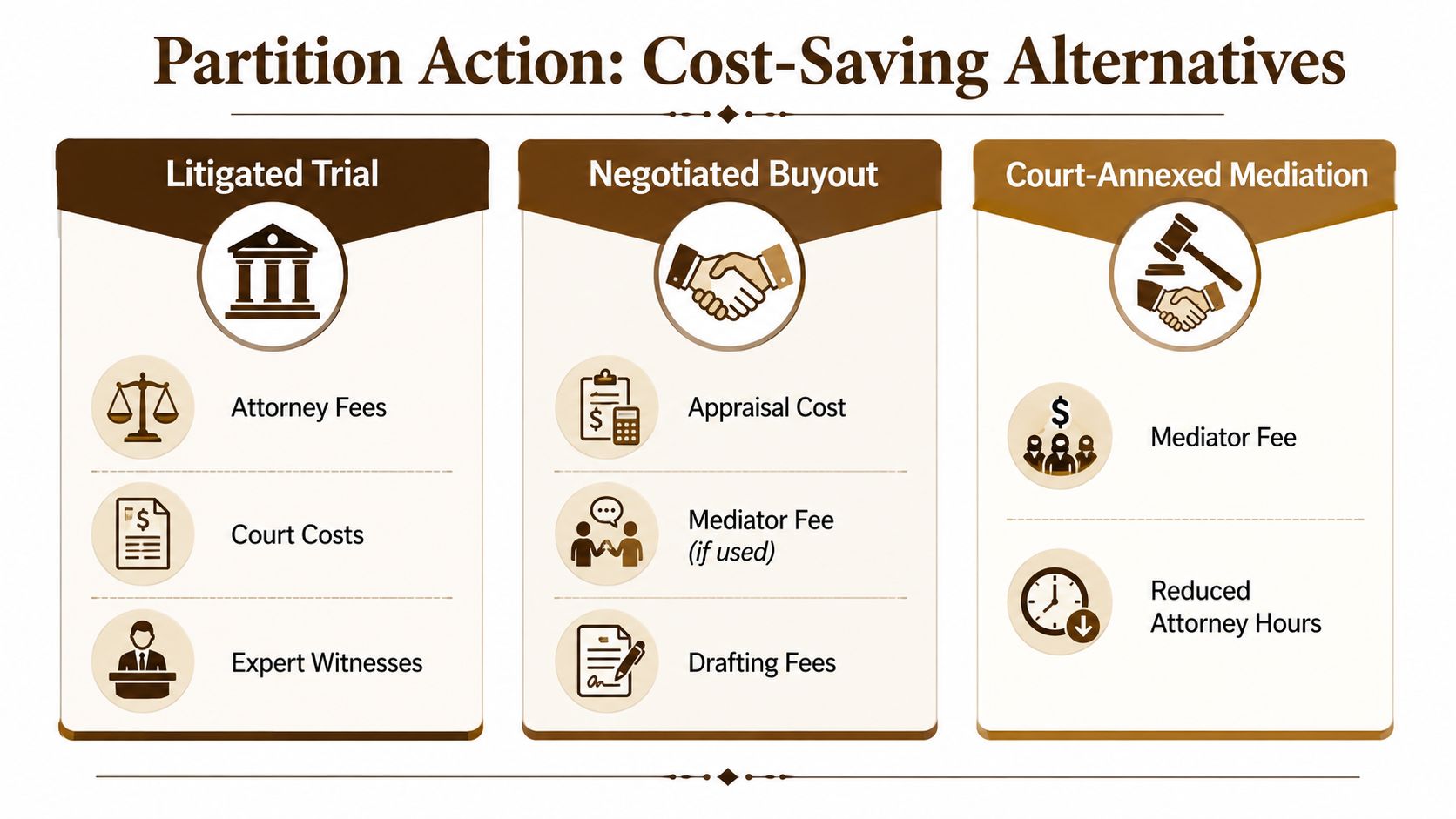
A partition lawsuit is powerful, but filing shouldn't be the automatic first move when the parties can reach a business solution. A negotiated buyout and mediation often address the same deadlock with fewer procedural steps.
| Option | Strength | Trade-off |
|---|---|---|
| Litigated partition | Can compel a sale or division when cooperation fails | Attorney time, court supervision, discovery, and uncertainty |
| Negotiated buyout | Gives one owner the property and others liquidity | The buyer must qualify for financing and agree on value |
| Mediation | Lets a neutral help resolve value, payment, possession, and sale issues | The parties must negotiate in good faith and pay for the mediator |
A buyout works best when the parties can establish a defensible value and the purchasing owner can obtain financing or use other assets. The agreement should address the deed transfer, existing mortgage, taxes, repairs, possession, releases, and payment timing. An appraisal can give the parties a common reference point, although it won't eliminate every disagreement.
Mediation can produce a broader settlement than a simple sale order. The parties may negotiate cash, deferred payments, a promissory note, possession terms, responsibility for repairs, or the treatment of rental income. A neutral retired judge or experienced attorney can help separate the emotional dispute from the economic decisions.
The specific mediation cost depends on the neutral, preparation, number of participants, and complexity of the dispute. Don't assume mediation is free, but compare its expense with the legal work that a contested case can require. A settlement reached before extensive discovery usually preserves more equity and gives the family greater control over timing and terms.
Partition by allotment may also be relevant in an appropriate case, while equitable remedies such as owelty are uncommon and highly fact-dependent. A buyout may preserve a rental business or family relationship, but the parties should obtain tax and lending advice before signing.
Three Sample Cost Scenarios From California Practice
The safest way to use a cost range is to compare the facts driving your case, not to treat any example as a promise. The following illustrations show how cooperation, ownership complexity, and the sale method can change the budget.
Scenario A, cooperative Orange County duplex
Two siblings own an Orange County duplex and agree that selling is preferable to continued co-ownership. They agree on a listing price, provide the deed and financial records, and don't contest one another's ownership interest. A matter on that cooperative track may run near $12,000, with attorney time and the referee's sale compensation forming major components.
That illustration assumes a straightforward title, no meaningful accounting dispute, and an orderly sale. If the siblings instead agree that one will buy out the other, they may avoid some sale-related work, but they still need reliable valuation, transaction documents, and lender coordination.
Scenario B, contested Los Angeles home
Four heirs own a Los Angeles single-family home. One heir lives outside California, and another seeks offsets for alleged repairs, taxes, or other contributions. Appraisal updates, service issues, discovery, and a half-day bench trial can place the total around $28,000 to $35,000.
The point isn't the exact total. The additional owners create more opportunities for disagreement, while the offset request requires counsel to review records and connect those records to the requested distribution. A settlement before trial could reduce the work, but the parties must resolve both the sale and the accounting issues.
Scenario C, complex Inglewood fourplex
Three co-owners hold an Inglewood fourplex through a dissolved LLC. The matter requires business-record discovery, coordination with a partition referee, and planning related to a 1030s exchange. The resulting total can exceed $50,000 because entity records, income issues, sale coordination, and tax-related planning add layers beyond a routine residential partition.
These examples use the figures supplied in the practical scenario framework, not a guaranteed fee schedule. A lawyer should review the deed, entity documents, equity, title, occupancy, and expected remedy before giving a case-specific estimate.
| Cost Component | Scenario A: Amicable Duplex | Scenario B: Contested LA Home | Scenario C: Complex Inglewood Fourplex |
|---|---|---|---|
| Overall illustrated cost | About $12,000 | About $28,000 to $35,000 | Above $50,000 |
| Main cost pressure | Attorney work and referee sale | Appraisal updates, discovery, service, and trial | Entity records, referee coordination, and tax planning |
| Sale path | Agreed listing | Contested sale and distribution | Complex referee-supervised sale |
Who Ultimately Pays and How to Get Started
The person who files the case may advance expenses, but that doesn't necessarily mean that person bears the final economic burden. California Code of Civil Procedure section 874.040 provides that the court must generally apportion partition costs among the parties in proportion to their interests, unless another allocation is equitable, as stated in the California cost-apportionment statute.
That rule works alongside sections 874.010 and 874.020. Reasonable attorney's fees for the common benefit, referee expenses, surveyor compensation, title-report costs, and qualifying title or boundary work may enter the recoverable cost pool. The court can allocate allowable expenses from sale proceeds before distributing the remaining funds, or require parties to address advances and reimbursements according to the judgment.
A 50/50 ownership arrangement would ordinarily point toward an equal share of recoverable partition costs, subject to an equitable adjustment. The court still evaluates whether a charge benefited the common ownership and whether one party's conduct created unnecessary expense. Private litigation choices, unrelated claims, and unreasonable charges aren't automatically transformed into shared costs.
The gross attorney bill and your final net burden are different questions. Ask both before deciding whether to file.
Prepare these records before a consultation
Gather the documents that let counsel identify ownership, equity, and the likely remedy:
- Title documents: Locate the recorded deed, trust documents, probate orders, LLC records, and any prior transfer paperwork.
- Financial records: Compile mortgage statements, property-tax records, insurance information, repair invoices, utility records, and rent documentation.
- Co-owner information: List every owner, current contact information, known address, and ownership interest shown in the title records.
- Property information: Obtain a preliminary valuation and note occupancy, tenants, deferred maintenance, liens, and known title concerns.
- Settlement positions: Write down whether you prefer a sale, a buyout, mediation, or physical division, and identify any payment or reimbursement issue that must be resolved.
A California partition attorney can use that material to estimate each phase, explain the likely allocation of recoverable costs, and compare litigation with a buyout or mediation. Schedule a free consultation with Tanner Law to review your co-ownership dispute, estimate the likely partition expenses, and develop a cost-conscious plan under California law. Visit Tanner Law to discuss whether a negotiated resolution can protect your equity before litigation costs escalate.