Tenant Attorney Orange County: What It Does for You
Fewer than 5% of tenants in eviction cases have an attorney, while more than 80% of landlords have counsel. A tenant attorney in Orange County can help correct a defective notice, protect response deadlines, and negotiate a housing outcome before an eviction record becomes the central problem.
That imbalance matters because eviction cases move quickly and involve rules that are easy to miscalculate. A notice may contain the wrong rent amount, omit payment instructions, use an improper service method, or rely on facts the lease doesn't support. The first 72 hours after receiving a notice are often more valuable than a dramatic courtroom argument later.
Orange County housing disputes also carry substantial financial pressure. The U.S. Census Bureau reported median gross rent of $2,352 per month for Orange County, California, using data from 2019–2023, according to the BAHFA tenant legal services report. At that rent, a household would spend $28,224 annually before utilities and other housing expenses. A disputed deposit, repair obligation, or rent payment can therefore threaten a family's stability even when the immediate legal issue appears small.
Table of Contents
- Why Tenant Representation Matters in Orange County
- Common Tenant Legal Issues Handled by Counsel
- Understanding the California Eviction Timeline
- Fighting the Case Versus Negotiating an Exit
- Fee Structures and What to Expect From Counsel
- Getting Started with Tanner Law
Why Tenant Representation Matters in Orange County
As noted earlier, the representation gap is severe. What matters for a tenant in Orange County is what that gap does in the first few days after a notice arrives. CalMatters' reporting on eviction lawyers shows how often landlords appear with counsel. In practice, that means tenants who wait to get advice often lose ground before the court ever weighs the facts.
The first 72 hours are usually the highest-value part of the case. This is when counsel can examine the notice, payment history, service method, and lease terms for defects that may stop a filing, support a dismissal, or create an advantage for a better resolution. That kind of early review can matter more than a later court appearance, especially if it helps avoid an eviction record altogether.
That is the practical difference representation makes. A tenant under pressure may focus on coming up with money or explaining what happened. A lawyer starts with narrower questions that can change the case: Is the rent demand accurate? Did the notice include charges the law does not allow in that form? Was it served correctly? Do the lease and ledger match the landlord's position?

What counsel changes in practice
A partial-payment case shows the point. A tenant may read a pay-or-quit notice as a simple demand for the remaining balance and rush to respond informally. Counsel examines whether the amount stated is legally usable, whether the notice mixes rent with other claims, and whether the landlord's own records undercut the demand.
Early answers create options. Sometimes the right move is to correct the record and press the landlord to withdraw or revise the notice. Sometimes it is to negotiate more time or a move-out on terms that reduce damage. Sometimes it is to prepare a defense quickly and avoid careless statements that become admissions later.
Practical rule: Treat the first notice as a legal document, not just a warning letter.
Good representation also keeps tenants from spending money on weak arguments while missing the stronger ones. The job is to identify the position that fits California law and the client's budget, housing needs, and risk tolerance.
Common Tenant Legal Issues Handled by Counsel
California landlord-tenant disputes usually turn on documents, dates, and proof. A useful review begins by identifying the type of conflict rather than applying the same response to every landlord disagreement.

Unlawful detainer and eviction defense
An unlawful detainer case starts with a notice and can proceed to a court filing if the landlord claims the tenant didn't comply. Counsel reviews the lease, payment records, notice language, service method, and the landlord's allegations together. The aim isn't to create technical objections for their own sake. The aim is to determine whether the landlord has satisfied the legal requirements for ending the tenancy and filing suit.
For a three-day notice to pay rent or quit, the notice generally must identify the tenant, rental address, exact rent allegedly owed, deadline to pay or move, and payment instructions. It generally can't add unrelated charges such as late fees, utilities, or property-damage claims, as explained in the California Courts eviction guidance.
Habitability and repair disputes
A tenant may have rights when serious conditions affect health or safety, but withholding rent without a defensible process can create additional risk. California's repair-and-deduct remedy applies only within legal limits and can't be used more than twice during any 12-month period, according to the California Department of Real Estate's tenant resource guide.
A careful record should include dated written notice, delivery evidence, photographs before and after the repair, and itemized invoices. Counsel can assess whether the defect qualifies, whether the landlord had a fair opportunity to respond, and whether the amount deducted relates specifically to the repair.
Security deposits and lease disagreements
California Civil Code section 1950.5 requires a residential landlord to provide an itemized statement explaining the basis and amount of security-deposit deductions and return any remaining balance no later than 21 calendar days after the tenant vacates, under the California Legislature's text of section 1950.5.
Lease disputes can also involve storage, guests, alleged property damage, unauthorized occupants, maintenance duties, or rent increases. Start with the written agreement and preserve communications. A lawyer can distinguish an enforceable lease term from a landlord's preference, a past practice, or an oral understanding that's difficult to prove.
Understanding the California Eviction Timeline
California eviction procedure is deadline-driven. A landlord generally must serve a written notice, wait for the notice period to expire, and then file an unlawful detainer if the tenant hasn't complied. Depending on the circumstances, the notice period may be 3, 30, 60, or 90 days, as summarized by California court information on unlawful detainer cases.
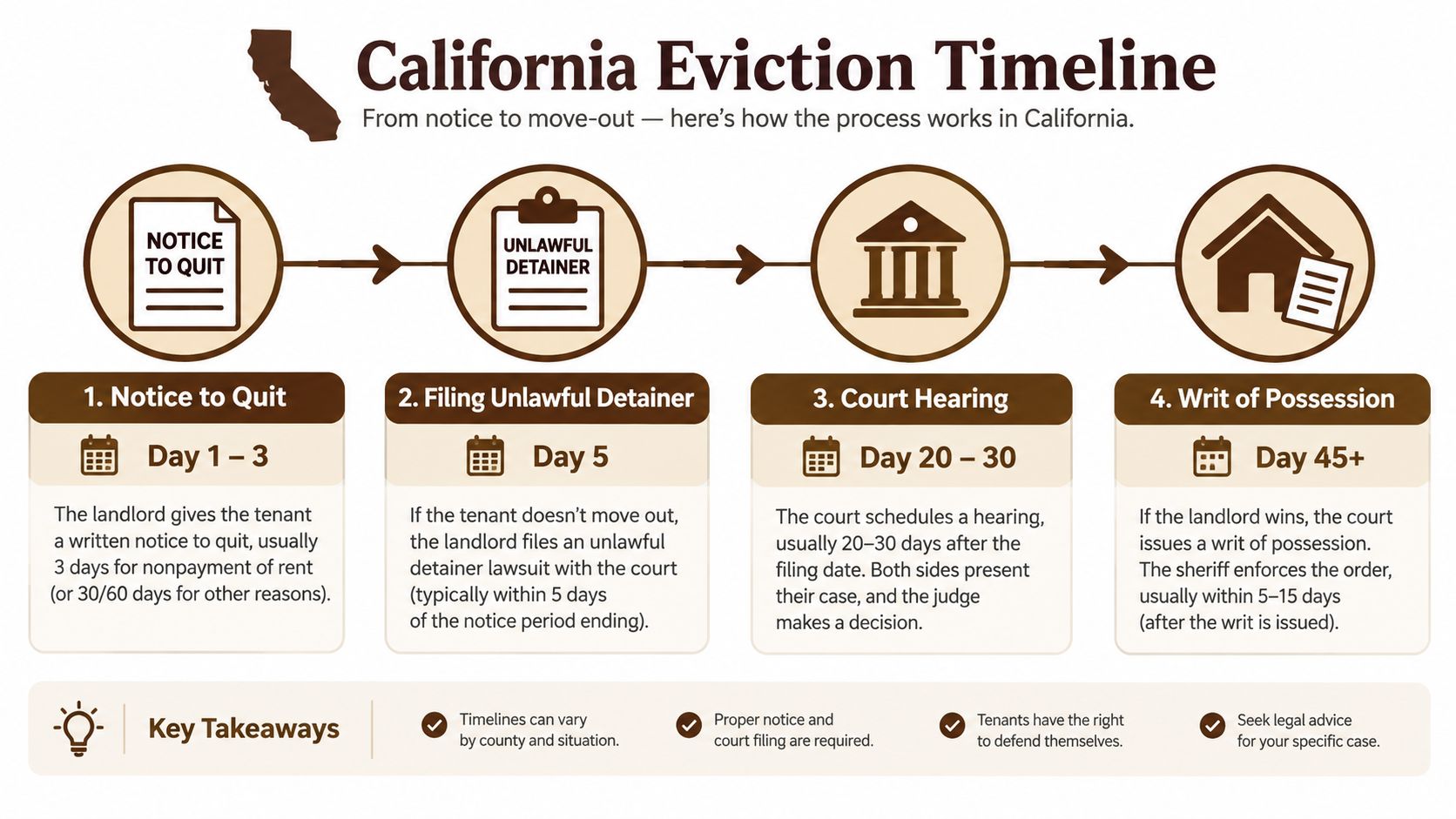
The first review
Read the notice slowly. Identify the stated reason, the amount demanded, the deadline, the delivery method, and every document referenced. For a three-day pay-or-quit notice, weekends and court holidays aren't counted in calculating the curable period. Service details matter just as much as the printed date.
Preserve rent receipts, bank records, repair requests, photographs, text messages, emails, lease amendments, and prior notices. Don't delete messages or rely on memory to reconstruct a payment history.
After a lawsuit is filed
After service of a summons and complaint, current California court guidance states that a personally served tenant generally has 10 business days to file an Answer or another responsive pleading, according to the San Luis Obispo Superior Court eviction guidance. Other California court materials describe a shorter five-day response period excluding judicial holidays for certain service and filing circumstances, so a tenant should follow the summons and applicable court instructions immediately, rather than assume one deadline applies to every case.
A missed deadline can allow a default judgment without full litigation of defenses such as defective notice, payment, retaliation, discrimination, or habitability. If the landlord obtains judgment, the court can issue a writ of possession. The sheriff, not the landlord, carries out the physical eviction.
The safest response to an eviction document is immediate legal review, even when you believe the landlord is plainly wrong.
What to do during the first 72 hours
- Create a document folder. Save the lease, notice, envelope, court papers, payment proof, and communications in one place.
- Write a timeline. Record rent payments, repair complaints, landlord responses, and service events while the details are fresh.
- Avoid impulsive admissions. Keep communications factual and don't sign a move-out or payment agreement before understanding its effect.
- Request needed access support. Ask promptly for an interpreter or disability accommodation when necessary.
- Get triage advice. Determine whether limited-scope notice review is enough or whether the case requires full representation.
Fighting the Case Versus Negotiating an Exit
Staying in the property is sometimes the right objective. It isn't always the best legal outcome. A tenant may have a strong notice defense but still face rent arrears, an unaffordable monthly obligation, unsafe conditions, or a landlord unwilling to repair. The practical question is which result protects housing stability and future rental access.
Los Angeles provides a useful major-market benchmark. Its 2025 tenant-services reporting recorded 3,108 unlawful-detainer representations. Of represented tenants, 50% remained in their homes, while another 45% received a soft landing intended to prevent homelessness, according to the Los Angeles tenant-services report. Orange County is different, but the figures illustrate why lawyers should measure success by the client's realistic housing needs, not only by whether the case reaches trial.
When fighting makes sense
Litigation may be appropriate when the notice is defective, the rent calculation is wrong, the landlord is retaliating, the property has serious unresolved conditions, or the tenant has evidence supporting discrimination or another legal defense. A successful challenge may produce dismissal, more time, or bargaining power for a better agreement.
Courtroom confidence alone isn't a strategy. A tenant should understand the cost, stress, delay, and risk involved before choosing to pursue every available defense.
When settlement is stronger
A negotiated exit can protect the tenant when remaining is financially unrealistic. Useful terms may address:
- Payment obligations: A clear payment plan or a defined resolution of alleged arrears.
- Case status: Dismissal rather than a judgment when legally and practically available.
- Move-out terms: A specific date, belongings, keys, and access arrangements.
- References: Agreed language for future rental inquiries.
- Deposit handling: Return of undisputed funds and a process for disputed deductions.
- Records and confidentiality: Terms addressing what each party may disclose, where available.
A tenant attorney should compare the proposed agreement with the consequences of fighting. The right settlement isn't surrender. It's a controlled outcome that may reduce debt and preserve the ability to rent again.
Fee Structures and What to Expect From Counsel
Legal fees should match the work required. A tenant facing a notice may need a focused document review, while a filed unlawful detainer may require pleadings, negotiation, discovery, a settlement conference, or trial preparation. The same fee arrangement won't fit both situations.
Common arrangements
A lawyer may offer a flat fee for a defined service such as reviewing a termination notice or preparing a response. Ongoing representation is often billed hourly, sometimes with an agreed cap or clearly defined scope. Some damages disputes may involve a contingency arrangement, but that structure isn't appropriate for every tenant matter and should never be assumed.
Ask what the fee includes, what triggers additional work, who communicates with the opposing side, and whether court appearances are covered. Get the arrangement in writing.
Limited advice or full representation
Limited-scope counsel can be cost-conscious when the issue is narrow and the tenant can manage filing and communication after receiving guidance. Examples include reviewing a notice, assessing a deposit demand, or explaining a proposed settlement.
Full representation may be more appropriate when a complaint has been filed, the household faces immediate displacement, the facts are disputed, or the tenant needs someone to manage deadlines and negotiations. The decision should reflect the legal risk, not just the initial price.
Orange County's housing costs make that assessment consequential. The BAHFA report citing U.S. Census Bureau data places median gross rent at $2,352 per month for Orange County, based on 2019–2023 data. A legal dispute involving one payment, a deposit, or a repair can affect a substantial household expense, so early advice may be more economical than waiting until a court deadline or settlement conference.
Bring the lease, every notice, payment records, photographs, communications, and a short timeline to the consultation. Ask the attorney to identify the strongest issue, the immediate deadline, the likely alternatives, and the work that can be handled without full litigation.
Getting Started with Tanner Law
If you're facing an eviction notice, deposit dispute, or serious habitability problem, California law doesn't require you to handle the situation without guidance. The important first step is to preserve the documents and obtain a clear assessment before a deadline passes or a settlement term becomes difficult to change.

Tanner Law is the Orange County practice of William T. Tanner, an attorney and licensed real estate broker serving clients since 1994. The practice handles landlord-tenant and broader property disputes across Orange County, Los Angeles, Riverside, and Santa Barbara, combining courtroom advocacy with transactional insight. It also assists with probate, estate planning, trust litigation, real estate contracts, consumer debt, civil defense, small claims, and expungements.
The office offers free initial consultations by phone or email at 1913 E. 17th Street, Suite 212, Santa Ana, CA 92705. Bring your notice or court papers, lease, payment history, repair records, and communications so counsel can focus on the decision that matters most: whether to challenge, negotiate, or protect your next housing step.
Here is additional information about approaching a landlord-tenant dispute with practical legal guidance:
Tanner Law offers practical California landlord-tenant guidance, notice and eviction review, settlement assistance, and representation tailored to the facts and urgency of your Orange County dispute. Visit Tanner Law to schedule a free consultation and discuss how to protect your housing rights, finances, and future rental options.