Real Estate Contract Contingencies in CA
You've found the home your family wants, submitted a strong offer, and entered escrow. Then the inspection reveals a serious roof issue, the appraisal comes in below the contract price, or the lender asks for documents that threaten the closing timeline. The outcome may depend less on the problem itself than on which contingency applies, whether it remains available, and how the contract requires you to act.
California real estate contract contingencies are not routine paperwork to sign and forget. They allocate risk between buyer and seller, create decision windows, and can affect the deposit, closing date, cancellation rights, and potential breach claims. That's especially important for Orange County and Los Angeles families, probate representatives, estate-planning clients, and investors who may be committing substantial assets to a transaction.
Table of Contents
- Understanding Real Estate Contract Contingencies
- Common Contingency Types in California Transactions
- Active Removal Versus Passive Expiration
- The Hidden Risks of Waiving Contingencies
- Strategic Checklists for Buyers and Sellers
- Navigating Disputes and Liquidated Damages
- Protecting Your Investment with Legal Counsel
Understanding Real Estate Contract Contingencies
A buyer may discover a major defect only after waiving an inspection contingency. A foundation concern, concealed water intrusion, or unsafe electrical condition can turn an attractive purchase into an expensive legal and financial problem. Whether the buyer can cancel, renegotiate, or pursue a later claim depends on the signed agreement, disclosures, timing, and the precise language used.
A real estate contract contingency makes one party's performance conditional on an objectively verifiable event. Loan approval, an appraisal meeting the lender's requirements, satisfactory property investigation, clear title, or the sale of another property can all serve as contractual conditions. The contingency gives the protected party a structured opportunity to investigate and decide before becoming fully committed to the next stage.
The National Association of REALTORS® reported that 81% of purchase contracts contained at least one contingency, with typical provisions involving financing, appraisal value, property inspection, title, or the buyer's sale of another property, as summarized in the California Department of Real Estate reference material.
A contingency is a risk-allocation device
Think of a contingency as a controlled decision gate. The buyer doesn't receive an unlimited right to reconsider the purchase. Instead, the contract identifies a condition, a deadline, a required notice, and consequences if the condition fails or the buyer proceeds.
For example, a financing contingency may protect a buyer who cannot obtain the specified loan despite acting diligently. An inspection contingency may allow the buyer to investigate the property and then request performance, negotiate an amendment, remove the contingency, or exercise a contractual cancellation right. A title contingency may protect against liens, judgments, ownership disputes, or other defects that prevent a reliable transfer.
Practical rule: The label “inspection contingency” or “loan contingency” matters less than the clause's trigger, deadline, notice method, and stated remedy.
California law also recognizes that a contingency can affect the order in which parties must perform. In Fogarty v. Saathoff, the California Court of Appeal treated removal of a loan contingency by placing evidence of lender approval into escrow as a condition precedent to the seller's obligation to obtain a termite inspection and report. The Fogarty v. Saathoff decision illustrates why attorneys analyze the exact contract language rather than assuming every contingency operates as a general buyer exit right.
Why the wording affects the deposit
A contingency may protect the buyer from being forced to close on a property that cannot be financed or that presents unacceptable conditions. But protection is not automatic. The buyer may need to provide documents, act diligently, deliver written notice, or follow a specified escrow procedure.
A missed deadline, ineffective notice, or unsupported cancellation can create an argument that the buyer defaulted. The seller may then assert entitlement to the deposit or pursue other contractual remedies. For a probate property or investment acquisition, where several decision-makers may be involved, documenting each action is as important as identifying the defect itself.
Common Contingency Types in California Transactions
California purchase agreements often separate related protections instead of treating financing as one broad issue. A buyer may have a general investigation contingency, an appraisal contingency, and a loan contingency, each with a different purpose and potentially different deadline.
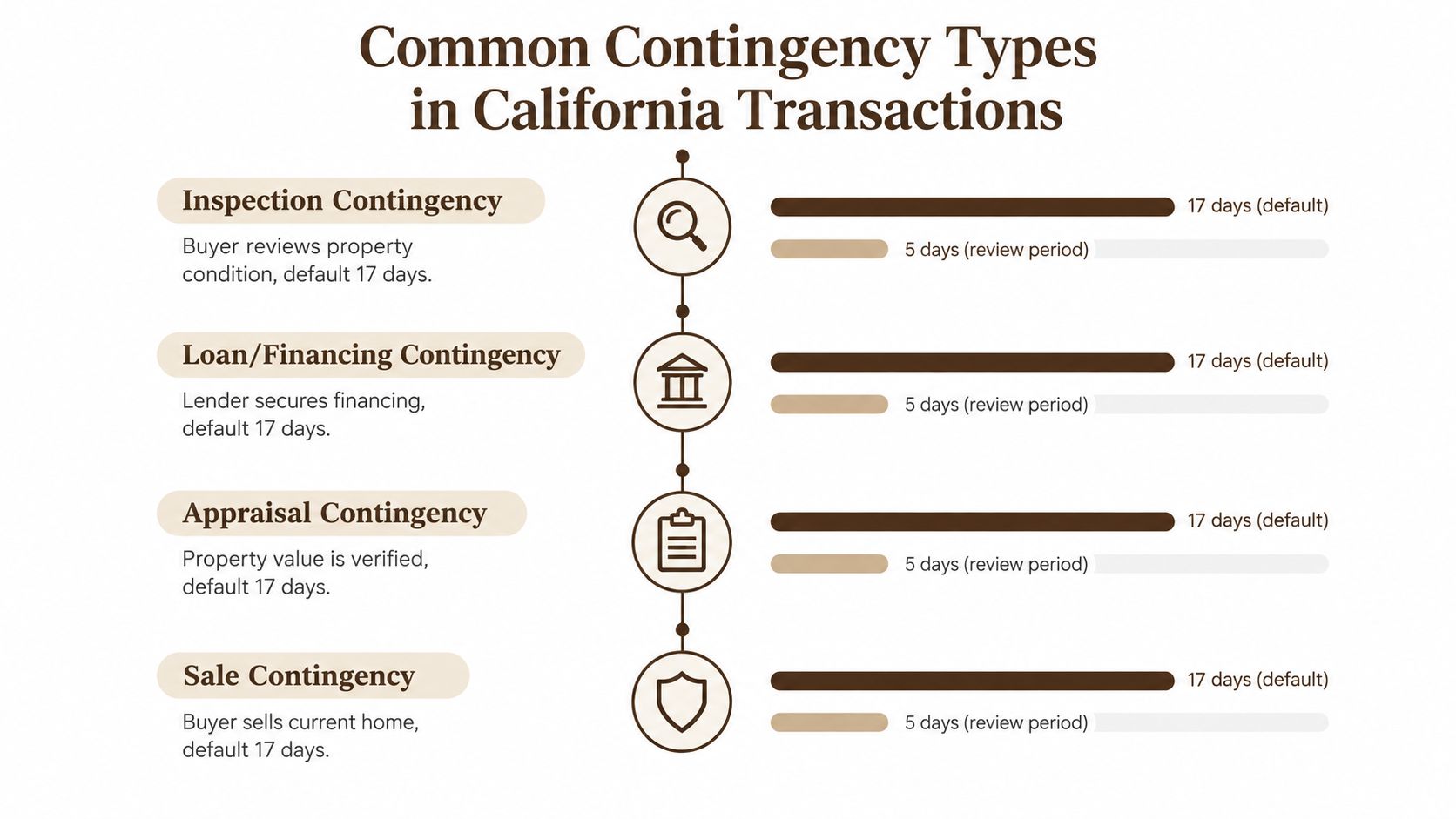
Under the California Association of REALTORS® standard residential agreement, the appraisal contingency commonly has a 17-day default period, while the loan contingency commonly has a 21-day default period, measured from acceptance unless the parties agree otherwise in writing. The California Association of REALTORS® contingency guide also distinguishes these protections from other investigation and document-review provisions.
Investigation and inspection
The general investigation contingency gives the buyer time to examine the property and relevant information. That may include physical inspections, seller disclosures, permits, leases, insurance availability, environmental concerns, zoning, and other matters identified in the agreement.
California's standard residential contract commonly uses a 17-day default period for appraisal and general investigation contingencies. Document-review contingencies generally must be removed by the later of 17 days after acceptance or five days after delivery of the relevant documents, under the standard agreement summarized by the California Department of Real Estate reference book.
The legal question isn't just whether an inspection occurred. It may be whether the buyer timely investigated, what the inspection revealed, whether the buyer requested repairs or an amendment, and whether the buyer signed a removal notice.
Appraisal and loan protection
An appraisal answers a valuation question. The lender wants to know whether the property supports the loan and whether the collateral reasonably reflects the agreed price. Loan approval answers a different question, whether the buyer qualifies for the financing under the lender's underwriting requirements.
A pre-approval doesn't guarantee either result. The lender may approve the buyer but value the property below the contract price. The buyer may then need to renegotiate, contribute additional cash, challenge the valuation, or rely on the remaining appraisal contingency.
The loan contingency protects against a financing failure under the contract's specified terms. The buyer's diligence obligations matter, including timely delivery of income records, asset documentation, authorization forms, and other lender-requested materials. A buyer who stops cooperating with the lender may have difficulty claiming that the contingency failed through no fault of the buyer.
Title, HOA, and sale contingencies
A title review examines whether the seller can transfer the promised ownership interest and whether recorded matters affect the buyer's intended use. For a trust, probate estate, or co-owned property, authority and signature requirements can become central to closing.
An HOA document review can reveal restrictions, assessments, rental limitations, maintenance obligations, or governance provisions that matter to an owner or investor. The buyer's rights depend on the contract's document-delivery rules and review period.
A sale-of-buyer's-property contingency makes the new purchase dependent on selling another property. Sellers may resist it because it introduces uncertainty, but the provision can be essential for a family that cannot safely carry two homes or for an investor relying on a prior sale to fund the acquisition. The parties should address marketing rights, notice procedures, and what happens if the seller receives a competing offer.
Active Removal Versus Passive Expiration
A buyer may finish an inspection, watch the contingency deadline pass, and assume the protection ended automatically. Under California's standard residential purchase agreement, that assumption can expose both sides to avoidable conflict.
The agreement generally uses an active-removal system. Passing the stated deadline does not necessarily eliminate the buyer's contractual rights. The buyer typically removes a contingency with a written, signed removal notice. Until removal occurs as required by the agreement, the buyer may retain a contractual cancellation right based on a good-faith exercise of a contingency that remains open.
Why passive expiration creates danger
The seller may believe the buyer accepted the property without protection. The buyer may believe the right to cancel still exists. Those opposing assumptions can affect the deposit, closing obligations, and each party's response when a problem appears late in escrow.
Use the agreement's wording as the starting point:
- Identify the event: Determine what must happen before the contingency can be removed or exercised.
- Calculate the deadline: Confirm whether the period runs from acceptance, document delivery, or another defined event.
- Confirm the notice method: Check whether the contract requires a signed writing delivered through escrow, the agents, or another specified channel.
- Preserve the record: Keep inspection reports, lender communications, appraisal materials, amendments, and delivery confirmations.
- Avoid informal assumptions: A conversation with an agent may not replace the notice required by the contract.
Conditions are not all the same
California attorneys distinguish among a condition to contract formation, a condition to a party's performance, and a discretionary cancellation right. A condition precedent may delay a party's duty to perform until a specified event occurs. A cancellation right may permit termination after a party evaluates the condition. The distinction can affect breach, deposit entitlement, anticipatory repudiation, and specific performance.
A signed removal document therefore deserves careful review. It may show that the buyer accepted a known risk, triggered the other party's duty to perform, or surrendered a contractual decision right. The document should identify the contingency precisely and satisfy the agreement's signing and delivery requirements. When the wording or timing is disputed, preserving the buyer's or seller's position requires prompt contract review rather than reliance on a deadline assumption.
The Hidden Risks of Waiving Contingencies
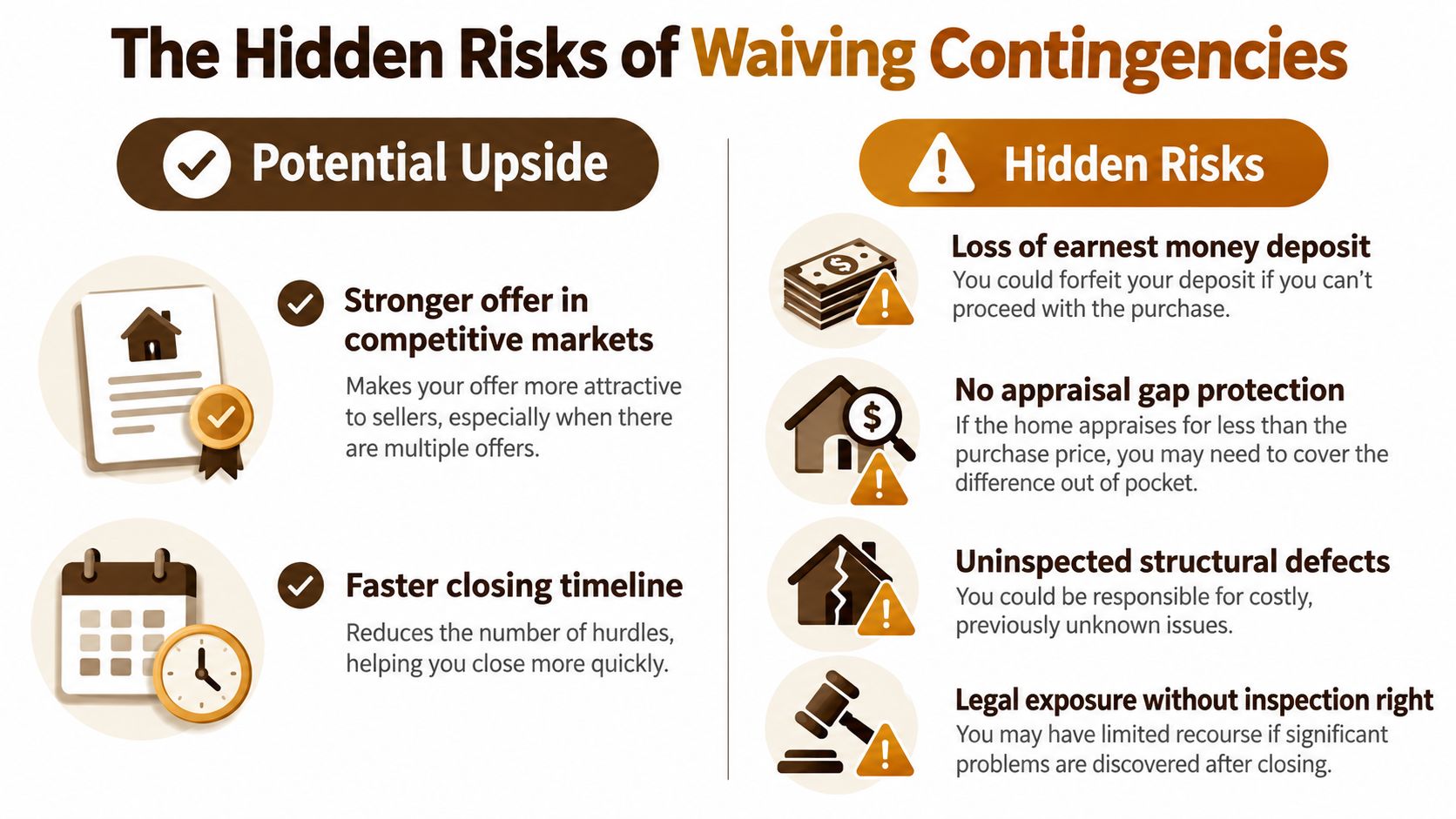
Waiving a contingency can make an offer more attractive to a seller. It can also transfer a substantial portion of transaction risk to the buyer before the buyer knows the property's condition or final valuation.
The REALTORS® Confidence Index reported that, in its May 2025 survey, 25% of buyers waived an inspection contingency and 24% waived an appraisal contingency. The survey reported a maximum margin of error of 3 percentage points at the 95% confidence level. The May 2025 REALTORS® Confidence Index shows that waiver decisions are commercially significant in competitive conditions.
Inspection waiver versus as-is purchase
These terms aren't interchangeable.
A full inspection waiver may remove the buyer's contractual ability to investigate, renegotiate, or cancel based on property condition. An as-is provision may allocate repair responsibility to the buyer while leaving other contractual rights intact. A shortened investigation period may preserve a review right but give the buyer less time to act. A limited waiver may address only particular defects or repair requests.
The precise result depends on the signed language, seller disclosures, the defect's discoverability, notice timing, and applicable California law. Waiving a contingency doesn't necessarily waive every statutory disclosure duty or every remedy for fraud or concealment. It also doesn't guarantee that a later claim will succeed. The buyer must analyze what was known, what was disclosed, what was concealed, and what the contract says survived removal.
Appraisal waiver and cash exposure
An appraisal waiver can require the buyer to proceed even if the lender values the property below the contract price. The buyer may need to contribute additional cash, renegotiate, challenge the valuation, or risk default if financing also fails.
The short-term advantage is a cleaner offer. The long-term exposure includes a valuation gap, reduced liquidity, and possible deposit litigation. Families should compare the waiver against their actual available funds, not an optimistic assumption that the appraisal will match the offer. Investors should also consider whether the lower valuation affects refinancing, borrowing, or projected returns.
Risk-management point: A waiver should be a documented financial decision, not a reflexive response to competition.
The practical alternative isn't always “keep every contingency unchanged.” Parties can negotiate narrower protection, a shorter review period, a cap on repair requests, additional documentation, or an appraisal-gap provision. Those alternatives still require careful drafting because a partial waiver may be interpreted differently from a complete removal.
Strategic Checklists for Buyers and Sellers
Good contingency management is operational. The parties should assign responsibility, record dates, and treat every notice as a legal document rather than a casual email.

Buyer checklist
-
Read the signed agreement first. Mark every contingency, trigger, deadline, required document, and notice recipient. Don't rely on a generic calendar because amendments may change the default terms.
-
Schedule diligence immediately. Arrange inspections, review disclosures, examine title materials, confirm insurance availability, and provide lender documents promptly. A buyer who waits may lose the practical ability to negotiate even if a formal right remains disputed.
-
Separate appraisal from financing. Ask the lender what remains outstanding for underwriting and how the appraisal affects the loan. Pre-approval isn't a substitute for a property-specific valuation or final loan decision.
-
Choose a written strategy. If the buyer wants repairs, credits, an extension, removal, or cancellation, communicate the requested action in the form and manner required by the contract. Preserve proof of delivery.
-
Don't sign removal casually. A removal notice may surrender a valuable protection. Before signing, confirm that the inspection, appraisal, loan, title, or document review has produced the result the buyer requires.
Seller checklist
- Disclose known conditions: Provide required disclosures accurately and promptly. A waiver doesn't convert an inaccurate disclosure into a reliable one.
- Coordinate access: Make the property available for agreed inspections and investigations, while protecting occupied units and tenant rights.
- Track buyer performance: Keep a written record of document delivery, requested materials, appraisal status, loan updates, and removal notices.
- Respond strategically: A repair request may be answered with performance, a credit, an amendment, a refusal, or a negotiated extension. Each response should match the contract and the seller's closing goals.
- Use notices carefully: If a deadline approaches, have counsel review whether a notice to perform or other contractual notice is available and properly delivered.
Counsel's review
Counsel should compare the purchase agreement with addenda, escrow instructions, disclosures, title materials, and lender-related provisions. The review should identify inconsistent deadlines, unusual waiver language, incomplete signatures, and provisions that shift risk without explaining the remedy.
A clear written timeline often prevents a dispute. It should show acceptance, document delivery, inspection activity, appraisal receipt, lender milestones, removal notices, amendments, and closing obligations.
Navigating Disputes and Liquidated Damages
When a transaction collapses, the parties often disagree about whether the contingency failed, whether the buyer acted diligently, whether removal was effective, and whether the seller had already become obligated to perform. The dispute may involve the deposit, repair obligations, closing rights, or a claim that one party repudiated the agreement before the closing date.
California Civil Code sections 1675 through 1677 govern important residential liquidated-damages limits. For a buyer-occupied residential property containing no more than four dwelling units, an amount equal to or below 3% of the purchase price is generally presumed reasonable when statutory requirements are satisfied. An amount above 3% isn't automatically enforceable, and the party seeking enforcement must establish reasonableness under the circumstances. The California liquidated-damages discussion also addresses the required execution and formatting rules, including separate signing or initialing.
Deposit analysis requires more than a deadline
A seller seeking the deposit should examine:
- The contingency language: Did the buyer have a valid cancellation right?
- The triggering event: Did the appraisal, inspection, title issue, or financing failure satisfy the contractual standard?
- Diligence: Did the buyer reasonably pursue the loan or investigation?
- Notice: Did the buyer deliver a timely and effective written cancellation or removal?
- Execution: Was the liquidated-damages provision separately signed or initialed as required?
- Causation and conduct: Did either party prevent, delay, or frustrate the condition?
A buyer shouldn't assume that an earnest-money dispute is resolved merely because the seller demands the funds. The seller shouldn't assume that a signed deposit provision guarantees recovery. Contract language and statutory compliance control.
Conditions precedent and sequential duties
The Fogarty decision illustrates how one party's performance may depend on a prior condition. If a buyer must provide evidence of loan approval before the seller must take a specified inspection-related action, the buyer's failure to satisfy that condition may affect the seller's obligation. Conversely, a seller who prevents the buyer from investigating or fails to provide required documents may face a different analysis.
The legal remedies can include deposit claims, damages, defenses to breach allegations, anticipatory repudiation arguments, or specific performance disputes. Specific performance is particularly fact-sensitive because the parties must establish an enforceable agreement and satisfy the requirements for compelling the transaction rather than accepting money damages.
Before authorizing a deposit release, each side should preserve the complete contract file, including amendments, notices, escrow communications, inspection reports, appraisal materials, and lender records.
Protecting Your Investment with Legal Counsel
Contingencies work only when the agreement clearly defines the condition and the parties follow the required process. A buyer who waives protection without understanding the consequence may assume valuation, inspection, and financing risk. A seller who treats a deadline as automatic may miscalculate the buyer's rights or issue an ineffective demand.
California transactions involving probate estates, trusts, co-owners, inherited property, or investment acquisitions require additional care because authority, title, disclosures, and funding may involve more than one decision-maker. A contract review before signing can identify inconsistent provisions, problematic addenda, unclear waiver language, and deadlines that don't match the transaction's practical needs.
Tanner Law handles real estate contract disputes and related ownership matters for clients in Orange County and Los Angeles, including breach-of-contract disputes, quiet title actions, partition matters, probate-related property issues, and other civil claims. The firm's approach combines transactional analysis with litigation planning, which helps clients evaluate both the immediate contingency question and the consequences if negotiations fail.
Tanner Law offers contract review and representation in real estate disputes involving contingency waivers, deposit claims, title problems, and alleged breaches. Schedule a free consultation by visiting Tanner Law to discuss how California law applies to your transaction and protect your property investment before the dispute escalates.