How Long Do You Have to Contest a Trust in CA
In California, you generally have 120 days from the date the trustee serves a valid statutory notice to file a trust contest, or 60 days from the date you receive the actual trust terms if that happens during that window, whichever is later. If you wait past that deadline, you may lose the right to challenge the trust in court.
If you've just received a trustee letter after a parent, spouse, or other family member died, that kind of notice can feel sudden and unfair. The worst mistake I see is treating it like ordinary estate paperwork and putting it aside for later. California trust law does not give you much room to do that.
Table of Contents
- The Core California Trust Contest Deadline
- Auditing the Trustee Statutory Notice
- Not Every Trust Dispute Is a Formal Contest
- How California Deadlines Compare to Other States
- Immediate Steps to Protect Your Legal Rights
- Securing Expert Trust Litigation Counsel
The Core California Trust Contest Deadline
A trustee notice starts the clock in California, not your first conversation with family and not the day you heard the trust existed. Under California Probate Code section 16061.8, a person served with the statutory notice generally has 120 days to file a contest, but if the trust terms are delivered during that window, the deadline becomes the later of 120 days from the notice or 60 days from delivery of the trust terms California Probate Code section 16061.8.
How the timing works in real life
Suppose notice is served on January 1. If the trust document arrives on February 15, the later deadline may be the 60-day document-delivery period, even though the original 120-day period is already running. That is why you cannot look at only one date and assume you know the filing deadline.
Practical rule: count both dates, the service date for the notice and the date the trust terms were actually delivered.
The deadline is also a filing deadline for a court action challenging the trust's validity. It is not just a deadline to ask questions, request more documents, or try to work things out informally with the trustee. Families often lose precious time by assuming a conversation with the trustee stops the clock. It usually does not.
California's framework is strict because the law ties the deadline to service of the statutory notice after the trust becomes irrevocable. That means the central question is not just "how long do you have to contest a trust," it's "when did a valid notice go out, and what exactly was delivered with it?" If you can answer those questions correctly, you can calculate the actual deadline much more accurately.
Auditing the Trustee Statutory Notice
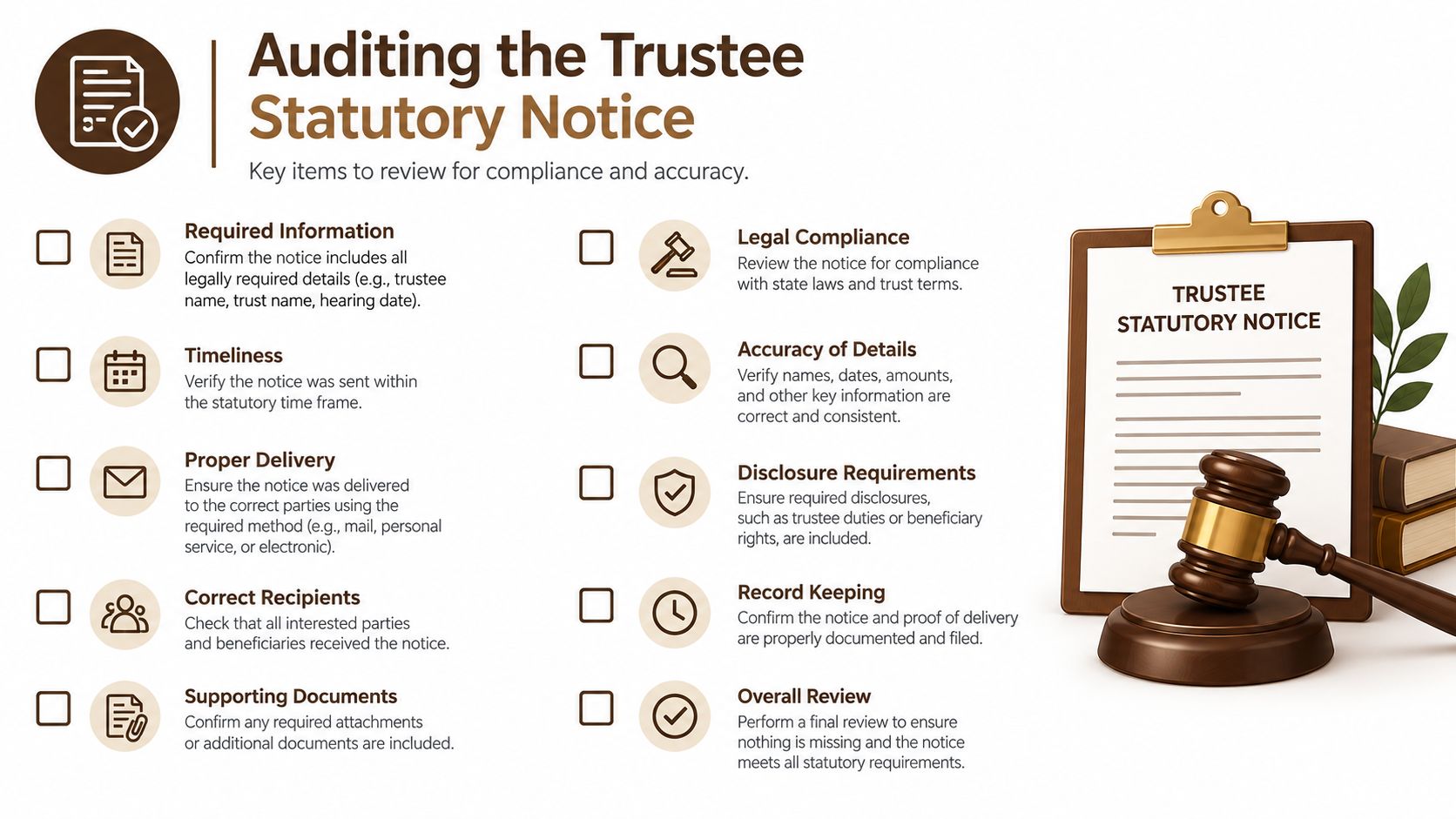
A lot of people focus on the death date, but California focuses on the trustee's statutory notice. The notice must comply with Probate Code section 16061.7, and the shortened contest period starts only when that notice is legally effective. Informal texts, phone calls, and even a casual email about the trust are not the same thing as statutory service.
What to check first
The notice should identify the trust, include the required warning language, and be served on the correct person. If any of that is off, the shortened clock may not have started the way the trustee claims it did. California courts have held that a defective trustee notice does not start the 120-day contest clock, and mailing is generally complete when the notice is deposited in the mail under Probate Code section 1215, which makes the postmark date important for deadline calculations California court treatment of defective notice and mailing rules.
That is why I tell people to keep the envelope, the notice, every attachment, and anything showing how and when it was mailed. If the trustee sent the notice by mail, the mailing date can matter as much as the receipt date. If the trustee never used the correct statutory process, that detail may change the entire deadline analysis.
Do not throw away the envelope. It may be the best proof you have about when the notice was mailed and whether the timeline really began.
Why the paperwork matters
The trustee's separate duty to provide notice is one thing. Your filing deadline is another. A trustee who sends a late notice does not automatically erase the deadline once a valid notice is served, but a bad notice may mean the shortened period never started in the first place. That distinction is exactly why a fast document review matters.
If you are trying to protect a potential claim, the notice itself is evidence, not just a letter. Read it like a litigator would, then save it like you expect to need it in court.
Not Every Trust Dispute Is a Formal Contest
People say “contest” to describe almost any disagreement about a trust, but the law does not treat every dispute the same way. A claim that the settlor lacked capacity, was under undue influence, or was pressured into signing a trust amendment is different from a request to interpret language, compel an accounting, or pursue trustee misconduct. That classification matters because the deadline can change with the claim.
The remedy controls the deadline
A recent trust litigation decision treated a petition to reform a trust amendment for a drafting mistake as outside the statutory definition of a validity contest. That means it was not automatically locked into the shortened 120-day filing period trust amendment reformation precedent.
That distinction matters in real families. A person might be trying to fix a mistaken phrase in a document, while another person is trying to invalidate the entire trust. Those are not the same lawsuit. If you call everything a contest, you can make two opposite errors, giving up a viable claim too early or relying on a longer deadline when the court sees a validity challenge.
The first legal question is not “how many days do I have,” it is “what claim am I actually bringing?”
Common claim types that need separate analysis
- Validity challenges. These include claims like incapacity, undue influence, fraud, or improper execution.
- Administration disputes. These can involve accountings, trustee conduct, or internal trust administration issues.
- Reformation or correction claims. These seek to fix a drafting mistake rather than strike the trust down.
- Construction issues. These ask what the trust language means, which is often a different procedural path.
A careful lawyer has to identify the remedy before counting the days. That is especially true in California, where a trust dispute that sounds broad at first can turn out to be governed by a narrower, more technical deadline.
How California Deadlines Compare to Other States
California's trust-contest rule is strict, but it is not universal. Other states use different triggers, different outer limits, and different notice frameworks, which is why online articles from another state can be misleading when your trust is tied to California. If the settlor lived here, the trust is administered here, or the trustee served California notice, California law may control the analysis.
Same problem, very different clocks
Utah's statute requires a judicial proceeding contesting a revocable trust to be started by the earlier of three years after the settlor's death or 90 days after the trustee sends notice and the trust instrument Utah Code section 75B-2-604. Massachusetts uses a different model and allows one year after the settlor's death for an action contesting the validity of a revocable trust [same Utah reference page summarizing comparative examples]. The District of Columbia also uses a notice-based framework with an earliest applicable limitation period, including 90 days after notice in qualifying cases District of Columbia trust contest deadline.
Those differences are exactly why a trust contest deadline can't be guessed from a general internet search. A family in Orange County may be looking at a California notice rule, while another state uses a death-based deadline or an earlier-of structure that cuts off the claim much faster than expected.
Why jurisdiction changes everything
The governing law, the settlor's domicile, the trust's situs, and the notice method can all change the result. A trust may have California property and still implicate another state's law in some respects, or the opposite may be true. That makes a quick conflict-of-law review essential before anyone assumes the deadline is fixed.
If the notice came from a trustee and the trust has California ties, do not compare your situation to a friend's case in another state. The deadline may be completely different.
The safest move is to treat California as its own rule set, then confirm whether another jurisdiction affects the trust file. That keeps you from missing a deadline because someone else's statute sounded more generous.
Immediate Steps to Protect Your Legal Rights
The first days after receiving trustee notice matter more than most families realize. Waiting to “see what happens” can shrink your options fast, especially if the trustee's notice turns out to be valid and the deadline is already running. Your job is to preserve proof before anyone starts arguing about the merits.

What to do right away
- Save every version of the notice. Keep the envelope, attachments, and any email or message that came with it.
- Write down the dates. Record when the notice arrived, when you first saw the trust terms, and when anyone discussed them with you.
- Ask for the complete trust file. You need the actual document set, not just a summary from another beneficiary.
- Stop relying on informal negotiations. A trustee conversation can be useful, but it should not replace a legal review.
- Get the notice reviewed quickly. A lawyer can spot service defects, missing warnings, and claim-classification issues that change the deadline analysis.
The reason this matters is simple. California courts and probate rules care about proof, not memory. If the trustee mailed the notice, if the envelope shows a postmark, or if the trust terms were delivered later, those details can shift the filing date.
If you're in Orange County or Los Angeles, it also helps to work with counsel who knows the local probate process and can move quickly on trust disputes. Tanner Law handles these kinds of deadline-driven issues and can review whether the notice was valid, whether the claim is a contest, and what filing window applies.
Act now, not later. Once the statutory period expires, the court may never reach the merits.
Securing Expert Trust Litigation Counsel
A missed deadline can end a trust contest before it begins. That is why California courts stress the need to get the complete trust file and speak with a qualified probate attorney before time runs out California Probate Code section 17200. In a trust dispute, speed matters, but accuracy matters just as much.
Trust litigation in California often turns on details that families don't see at first glance, like the exact notice language, proof of service, and whether the claim is a validity contest at all. In Orange County and Los Angeles, those issues can decide whether a judge hears the case at all. A lawyer who works in this area can identify the deadline, protect the record, and avoid a filing mistake that cannot be fixed later.
If you've received trustee notice, or you think a trust was signed under pressure or mistake, don't wait to see whether the problem goes away. Get the paperwork reviewed now, while your options are still open.
If you're facing a trust deadline in California, Tanner Law can review your notice, identify the correct filing window, and help you decide whether a trust contest is the right remedy. Schedule a free consultation with Tanner Law to get clear guidance before the clock runs out.