Statute of Frauds in California: A Practical Guide
A family meeting in Costa Mesa can feel productive until someone asks a simple question: Where is the signed agreement? Three siblings inherit a beach cottage. One says they orally promised to buy out the other two for $250,000. Everyone remembers the conversation, and one sibling may already have transferred money or started treating the property as their own. Months later, the family is divided, the title remains unchanged, and the home none of them expected to lose has become the center of a lawsuit.
That problem often falls under the statute of frauds in California, primarily California Civil Code section 1624. The rule requires certain agreements to be written and signed before a court will enforce them. It can affect real estate sales, long-term leases, broker commissions, probate transfers, trust claims, quiet title actions, and partition disputes.
The rule protects property owners from fabricated claims based only on memory and testimony. It can also trap families and business partners who made an honest handshake agreement and never realized that California law would treat the arrangement as unenforceable unless a signed writing or narrow exception applies.
Table of Contents
- Why the Statute of Frauds Matters in California
- What Civil Code Section 1624 Requires in Writing
- How California Courts Interpret the Writing Requirement
- Part Performance and Other Exceptions That Save Oral Deals
- Real Property, Probate, and Quiet Title Connections
- Sample Contract Language That Satisfies the Statute
- Litigation Steps and How to Protect Your Interests
Why the Statute of Frauds Matters in California
In the Costa Mesa cottage example, the oral promise sounds specific. The property is known, the family members are identified, and the buyout amount is remembered. Yet a court still must ask whether the agreement falls within a category covered by Civil Code section 1624, and whether the party seeking enforcement can produce a writing signed by the person being charged.
California's statute has a long history. The first California Statute of Frauds was enacted on April 19, 1850, and the modern version was codified in 1872 as Civil Code section 1624. Its early scope already included leases longer than one year, sales of land, and agreements that couldn't be performed within one year. California later amended the statute in 1905 to cover certain will contracts, showing how the rule expanded over time. The historical development is discussed in this Pepperdine Law Review analysis of California's statute.
The rule is about proof, not whether a conversation happened
A person may believe an oral agreement was made. That belief doesn't automatically create an enforceable contract. Section 1624 acts as an evidentiary safeguard, requiring a signed writing for specific types of commitments that carry lasting consequences.
The California Department of Real Estate identifies several categories covered by Civil Code section 1624 in its reference guide, including:
- Land transactions: Agreements to sell real property or an interest in real property generally need a signed writing.
- Long leases: A lease longer than one year falls within the statute.
- Broker compensation: Agreements authorizing a broker or agent to find a buyer or seller for compensation must be written.
- Long-term performance: A contract that can't be fully performed within one year generally requires a signed memorandum.
- Certain debt promises: A promise to answer for another person's debt can trigger the statute.
- Specific lifetime or secured-debt arrangements: California law includes additional categories involving performance during a promisor's lifetime and indebtedness secured by a mortgage or deed of trust.
Practical rule: If the agreement concerns ownership, possession for a long period, or a commission tied to real estate, assume the writing requirement matters until a California attorney evaluates the facts.
Why families encounter the rule in probate and title disputes
The statute often appears after a person dies, because death removes the person who supposedly made the promise and leaves heirs with conflicting memories. One child may claim a parent promised to transfer a house. Another may rely on the recorded deed, trust, or will. A personal representative may need to determine whether the estate can enforce or resist the alleged agreement.
The same tension appears in quiet title and partition cases. A co-owner may claim that an oral family arrangement changed ownership or required a buyout. The recorded title may say something else. Without a sufficient writing or a recognized exception, the oral claim may not support the requested transfer, ownership judgment, or specific performance remedy.
What Civil Code Section 1624 Requires in Writing
Civil Code section 1624 doesn't require every contract to be written. It targets particular agreements where uncertain testimony could produce serious consequences. The basic question is whether the agreement falls within a statutory category and whether a written memorandum identifies the essential transaction and is signed by the party against whom enforcement is sought.
The principal California categories
The following comparison highlights the practical triggers.
| Category | Real-World Example | Common California Trigger |
|---|---|---|
| Performance beyond one year | A service or property arrangement that, by its terms, can't finish within one year | The contract's own terms prevent complete performance within one year, as described in this California section 1624 discussion |
| Sale of real property | An agreement to purchase a home, parcel, condominium, or other real-property interest | A party seeks to enforce an oral land sale |
| Lease longer than one year | A long-term residential, commercial, or ground lease | The agreed lease term exceeds one year |
| Broker or agent authority | An owner authorizes a broker to find a buyer or seller for compensation | The authority or commission arrangement exists only orally |
| Loan-related commission | A person is promised compensation for procuring or negotiating a loan secured by real property | The claimed commission depends on an unwritten agreement |
| Promise to answer for another's debt | A person orally promises to pay someone else's debt | The promise is collateral to the principal debtor's obligation |
| Probate and lifetime-related agreements | A commitment concerning performance during a promisor's lifetime or certain property obligations | The agreement fits one of section 1624's additional statutory categories |
California's rule also includes a separate requirement for certain broker and finder agreements. The California Supreme Court reiterated in Phillippe v. Shapell Industries that an agreement authorizing a broker or other person to buy or sell real estate, or to find a buyer or seller for compensation, must be written and subscribed by the party to be charged or that party's agent.
What the writing should accomplish
A court doesn't need a beautifully formatted contract if the documents, read together, establish the essential deal. But the writing should identify the parties, property, transaction, and material financial terms with enough clarity that a judge isn't being asked to invent the agreement.
A recorded deed can satisfy the writing concern for the conveyance it makes. A conversation about a future transfer generally won't. An option to purchase also needs an enforceable written memorandum because it creates a contractual right to acquire property, even though the option holder hasn't yet completed the purchase.
The parallel rule for goods appears in California Commercial Code section 2201. That provision addresses sales of goods over the statutory threshold, but real estate disputes remain governed primarily by Civil Code section 1624.
How California Courts Interpret the Writing Requirement
The writing requirement is not satisfied by producing any document that mentions a property or family discussion. California courts examine whether the document supplies the essential terms and whether the signature belongs to the party against whom enforcement is requested.
Sterling v. Taylor and the memorandum rule
In Sterling v. Taylor, the California Supreme Court addressed the type of memorandum that may satisfy the statute. The decision is available through the California Supreme Court's opinion archive. In practical terms, the writing should identify the parties, subject matter, price, payment terms, and signature of the party to be charged, or provide enough information through permissible related writings to establish those terms.
Consider a text message saying, “I'll sell you the house we discussed.” That message may help prove negotiations occurred, but it may not identify the property, price, or payment terms sufficiently. A series of emails, a signed term sheet, and a deposit receipt may collectively provide stronger evidence, but the documents still must be evaluated as legal writings, not as mere proof that the parties had a conversation.
Phillippe and the danger of vague recitals
In Phillippe v. Shapell Industries, the California Supreme Court reinforced the importance of identifying the transaction and the party being bound. Vague references to a proposed purchase or a broker's involvement may not establish who authorized the arrangement or which seller is liable for compensation.
A document can be signed and still fail if it leaves the court guessing about the essential transaction.
California also limits attempts to use oral testimony to add terms that the writing doesn't contain. The Parol Evidence Rule can restrict evidence offered to vary or contradict an integrated written agreement. Code of Civil Procedure section 1856 supplies the statutory framework, and courts apply particular care when a party claims an oral modification to a written real estate contract.
Digital records create modern evidentiary questions. An email acceptance, electronic signature, or text exchange may qualify as a writing depending on the circumstances and the parties' intent. The federal E-SIGN Act and California's Uniform Electronic Transactions Act support electronic contracting, but they don't eliminate the need to identify the agreement, authenticate the sender, establish assent, and show that the record satisfies the statute.
Part Performance and Other Exceptions That Save Oral Deals
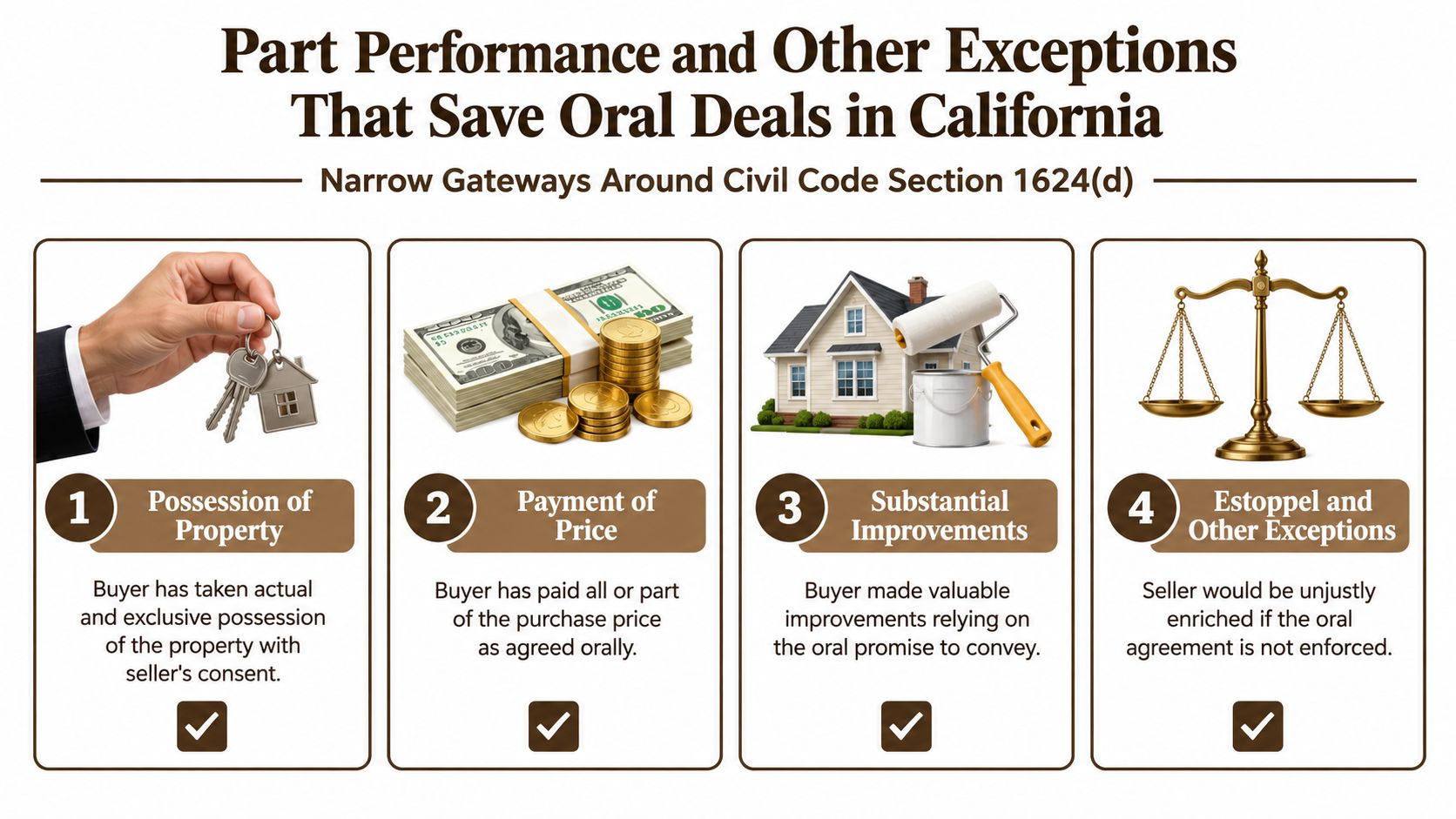
California recognizes narrow equitable paths around an otherwise missing writing. The most important is part performance, but courts don't enforce every oral arrangement just because someone paid money or moved into a property.
Part performance must point unmistakably to the deal
California courts look for conduct that is unequivocally referable to the alleged contract. In a land-sale dispute, the strongest combination may include possession, payment of all or part of the price, and substantial improvements made in reliance on the oral promise.
The question isn't merely whether the buyer acted. It's whether the conduct is difficult to explain without the claimed agreement. Ordinary rent payments by a tenant may not prove an oral promise to sell. Routine repairs may not establish a contract to convey. A buyer who took exclusive possession with the seller's consent, paid part of the agreed price, and made substantial improvements has a stronger equitable argument.
The California Supreme Court's discussion in Sterling v. Taylor illustrates why the threshold is demanding. Courts need conduct that reduces the danger of false claims rather than conduct consistent with many different arrangements.
Equitable estoppel addresses unfair conduct
Equitable estoppel may apply when a person's misleading conduct caused another party to rely on the alleged promise and it would be unjust to allow the promisor to invoke the statute. The doctrine is fact-specific. A disappointed party can't convert every failed negotiation into estoppel.
Courts examine who made the representation, what reliance followed, whether the reliance was reasonable, and whether refusing enforcement would produce an unfair result. The remedy may focus on preventing unjust enrichment rather than granting every term the claimant remembers.
Oral loan guarantees receive different treatment, and the one-year performance category has its own limits. A court won't assume that part performance automatically defeats every subsection of section 1624.
Evidence that makes an exception credible
Trial courts generally give more weight to objective corroboration than to conflicting recollections.
- Witness testimony: Look for independent witnesses who heard the agreement or observed the parties' conduct.
- Bank records: Deposits, transfers, cancelled checks, and payment descriptions can show whether money changed hands.
- Contractor files: Invoices, permits, plans, and receipts may establish substantial improvements and timing.
- Messages and emails: Communications can corroborate possession, price discussions, admissions, and reliance.
- Possession evidence: Utility records, insurance documents, access records, and property management materials may help establish the nature of occupancy.
Real Property, Probate, and Quiet Title Connections
Civil Code section 1624 becomes most consequential when a disputed promise reaches beyond a contract claim. In Orange County and Los Angeles matters, the same missing writing can affect a purchase action, an estate proceeding, and the title record at the same time.
Real estate disputes
A buyer seeking specific performance usually needs to show an enforceable agreement to sell identified property. If the parties never signed a purchase agreement or memorandum, the buyer may have to rely on part performance or estoppel. A broker faces a related problem if the owner disputes the broker's authority or commission arrangement.
The writing requirement also reaches agency authority. For a land-sale agreement, an agent's authority generally must itself be in writing. Oral authorization may not bind the owner when the agent is attempting to establish a conveyance or other transaction within the statute's scope. This California real estate analysis explains the writing and agency issues under section 1624.
Probate and trust litigation
Death often turns an informal promise into a title dispute. A child may claim that a parent promised to leave a house, transfer a parcel, or hold property in trust. California law requires a trust concerning real property to be evidenced by a signed writing or established by operation of law, as reflected in this California appellate trust opinion.
That issue can arise in a Heggstad-style petition, a Probate Code section 8500 proceeding, or a broader trust contest. A signed trust, amendment, deed, or other qualifying record may determine whether the estate must recognize the claimed interest. Without adequate documentation, the claimant may face both the statute of frauds and independent probate requirements.
Quiet title and partition
A quiet title action asks the court to determine ownership. A partition action asks the court to divide or sell co-owned property. Neither proceeding automatically validates an oral family arrangement that conflicts with the recorded chain of title.
An alleged oral gift of a parcel may fail if the claimant can't show a legally sufficient transfer. An oral buyout promise may not remove a sibling from title. A co-owner who paid expenses may have reimbursement claims without proving that ownership changed.

The practical lesson is unified: section 1624 functions as a litigation filter. It doesn't decide every ownership question, but it determines whether a claimant can move from a remembered promise to an enforceable property right.
Sample Contract Language That Satisfies the Statute
A useful written agreement should allow a third party to understand the deal without relying on family history or informal explanations. The sample below is a starting point for drafting, not a substitute for a reviewed California contract.
Real estate purchase provision
Agreement and integration. Seller, [full legal name], agrees to sell, and Buyer, [full legal name], agrees to purchase, the real property located at [street address], County of [county], California, legally described in Exhibit A, attached and incorporated by reference. The purchase price is $[amount], payable by a deposit of $[amount] upon execution, with the balance due at closing by [specified method]. The parties intend this writing to constitute their complete agreement concerning the sale. No amendment, waiver, or modification is effective unless it is in a writing signed by the party against whom enforcement is sought.
Property description. The property is the real property described in the recorded deed recorded in the official records of [county] as Instrument No. [number], together with all improvements and appurtenant rights. The legal description in Exhibit A controls over any street-address reference in the event of inconsistency.
Signatures. Seller: ____________________ Date: __________. Buyer: ____________________ Date: __________. If an agent signs for a principal, attach the written authorization establishing that authority.
A deed and related notary acknowledgment may be necessary for the actual conveyance and recording process. Civil Code section 1097 addresses the legal description requirement for instruments affecting real property, so copying the recorded legal description is safer than paraphrasing it.
Drafting choices that prevent avoidable disputes
| Required Element | Common Drafting Pitfall |
|---|---|
| Full legal names of parties | Using nicknames, abbreviated entity names, or an incomplete trust name |
| Identified property | Relying only on a vague description or an incorrect parcel reference |
| Price and payment terms | Writing an amount without stating when or how payment is due |
| Signature of the party to be charged | Assuming the other party's signature cures the missing signature |
| Written agent authority | Treating oral permission as sufficient for a land-sale agent |
| Complete amendment clause | Allowing informal text messages to create uncertainty about modifications |
| Consistent legal description | Using a paraphrase instead of the description from the recorded deed |
| Clear interest being transferred | Failing to distinguish fee title, leasehold rights, an option, or another interest |
Avoid shorthand that makes the price or payment obligation ambiguous, including phrasing tied to a T-bill rate without a clear calculation method. Include the APN as a helpful reference, but don't use it as a substitute for the full legal description.
Brokerage and trust language
A brokerage agreement should identify the principal, the property or transaction, the broker's authority, the compensation trigger, and whether the agency is exclusive. For example:
Exclusive agency and compensation. Owner, [full legal name], appoints Broker, [legal name], as Owner's exclusive agent to market and procure a buyer for the real property identified in Exhibit A. If Broker procures a buyer ready, willing, and able to purchase on the terms authorized by Owner, Owner shall pay Broker a commission of [stated amount or clearly defined formula], payable at closing. This agreement is signed by Owner and Broker and may be amended only in a writing signed by the party against whom enforcement is sought.
The commission provision must be reviewed alongside applicable California real estate licensing requirements, including Business and Professions Code section 1024.
For a trust holding real property, a written trust or amendment should identify the property, trustee, beneficiary, and intended ownership treatment. California Probate Code section 152 supplies important formal requirements for creating or amending a trust, so an informal family promise shouldn't be treated as a safe substitute for a properly executed document.
Litigation Steps and How to Protect Your Interests
A party defending a California real estate, probate, quiet title, or partition claim will often raise Civil Code section 1624 as an affirmative defense. The claimant then needs to produce a signed writing or establish a legally recognized basis for enforcement, such as part performance or equitable estoppel.
The dispute usually develops in stages
Preserve the evidence. Save texts, emails, handwritten notes, bank statements, canceled checks, contractor invoices, permits, photographs, and property records. Don't edit or delete messages, even if they seem unfavorable.
Send a focused demand. A demand letter should identify the alleged agreement, the requested performance, the documents supporting the position, and a reasonable path toward resolution. It should avoid overstating facts that later testimony can't support.
Seek discovery. Parties may request messages, emails, escrow records, brokerage files, financial records, and documents showing possession or improvements. Motions to compel may become necessary when a party withholds relevant evidence.
Address preservation risks. If a deed, account, property, or document may be altered or transferred, counsel may evaluate emergency relief, including an ex parte application where the legal requirements are met.
Evaluate summary judgment. Code of Civil Procedure section 437c may allow a party to seek summary judgment when the material facts show that the statute bars enforcement or that a sufficient writing exists.
Consider settlement early. A settlement conference under California Rule of Court 3.1380 can help the parties compare the cost and uncertainty of litigation with practical solutions involving a sale, buyout, title correction, or estate distribution.
Remedies depend on the legal and equitable record
A court may consider rescission and restitution when an agreement can't be enforced and money or property changed hands. Depending on the facts, relief may also involve cancellation of a deed, a quiet title judgment, partition, or a constructive trust designed to prevent unjust retention of property.
Attorney fees aren't automatic. A contract may contain a fee clause, and Civil Code section 1717 can govern reciprocal enforcement of contractual attorney-fee provisions. Prevailing-party costs may also apply under California procedure, but the result depends on the pleadings, contract language, and court orders.
The best time to test a missing-writing problem is before a family member signs a deed, pays for improvements, or files a petition. Early document review can reveal whether the dispute is contractual, equitable, probate-related, or primarily a title problem.
Tanner Law helps Orange County and Los Angeles families evaluate disputed real estate agreements, probate promises, trust claims, quiet title issues, and partition rights before the conflict becomes harder to resolve. Schedule a free consultation by visiting Tanner Law to review the available writings, payment records, title documents, and practical options for protecting your property interests.