Breach of Contract Statute of Limitations: 2026 Guide
A contractor has finished a kitchen remodel in your Orange County home, but the cabinets are misaligned, the plumbing leaks, and the promised repairs never happen. You wait while the contractor offers reassurance, hoping the dispute can be resolved without court. Years later, you learn that the deadline to sue may have expired before you sent your final demand.
That result surprises many homeowners, landlords, investors, and families handling property or probate-related agreements. The breach of contract statute of limitations isn't one universal deadline. California law looks first at the contract's form, then at the date of breach, the nature of the obligation, and any facts that may pause or alter the limitations period.
This guide focuses on California law, with practical examples for people in Orange County and Los Angeles. It explains the written-versus-oral distinction, accrual rules, tolling, hidden and continuing breaches, and the steps both claimants and defendants should take before relying on an assumed deadline.
Table of Contents
- Why the Filing Deadline Can Make or Break Your Contract Dispute
- Written vs. Oral Contracts Under California Law
- When the Clock Starts Accruing
- Tolling Rules That Can Extend or Pause the Deadline
- Statute of Limitations in California Real Estate Contracts
- Common Misconceptions and Costly Mistakes
- Practical Next Steps for Claimants and Defendants
- Protect Your Rights Before the Deadline Runs Out
Why the Filing Deadline Can Make or Break Your Contract Dispute
The filing deadline can matter more than the strength of your underlying argument. A homeowner may have photographs proving defective work, invoices showing payment, and messages in which a contractor promises to correct the problem. If the homeowner files after the applicable limitations period, the court may never reach the question of whether the contractor breached the agreement.
Statutes of limitations serve two practical purposes. They require an injured party to act while evidence remains available, and they protect defendants from disputes based on faded memories, missing records, unavailable witnesses, or changed property conditions. A court doesn't treat delay as harmless because the parties once had a valid agreement.
Start with the deadline, not the argument
Before calculating damages or writing a lengthy demand letter, identify four facts:
- The contract form: Determine whether the enforceable agreement is written, oral, or partly documented.
- The promised performance: Identify the specific obligation that wasn't completed.
- The breach date: Record when the other party failed to perform or clearly refused to do so.
- The filing forum: Confirm whether the contract requires court litigation, arbitration, or another dispute process.
California's basic written and oral contract periods create a sharp difference. A claimant who assumes the longer period applies may lose the claim before the complaint is filed. A defendant, by contrast, may have a strong limitations defense even when the claimant's account of the breach sounds persuasive.
Practical rule: Treat the earliest plausible breach date as the working deadline until a California attorney evaluates facts that might delay, pause, or otherwise affect accrual.
That approach is especially important in real-estate disputes. Purchase agreements, broker compensation arrangements, home-improvement contracts, leases, escrow instructions, and family property agreements often contain multiple promises performed at different times. One obligation may become actionable before another, so a single calendar date may not control every claim.
Written vs. Oral Contracts Under California Law
California generally gives a claimant four years to sue for breach of a written contract and two years to sue for breach of an oral contract. Those rules appear in California Code of Civil Procedure sections 337 and 339, as summarized by the California Courts, and California jury instructions also identify the four-year written-contract period and the two-year oral-contract period in CACI No. 338.
| Contract Type | Code Section | Deadline | Common Examples |
|---|---|---|---|
| Written contract | CCP section 337 | 4 years | Signed purchase agreement, email-based scope of work, written lease |
| Oral contract | CCP section 339 | 2 years | Handshake agreement for fence repairs, verbal side promise, oral price arrangement |
The key question isn't whether the parties used formal legal stationery. A handwritten note may document a contract. An emailed purchase agreement or statement of work may provide the written terms. A transcript of a recorded Zoom conversation may help prove what the parties agreed, although the transcript's legal effect depends on the specific facts and whether it contains the essential terms.
A freelance designer who sends an emailed statement of work describing services, payment, and delivery obligations has a very different limitations problem from a roofer who gives only a verbal price quote over the phone. The designer may be pursuing a written-contract claim. The roofer's claim may depend on proving an oral agreement unless later invoices, messages, or other documents establish the contract's essential terms.
Why classification changes the case
Misclassification can remove a claim before discovery begins. If a claimant files after the shorter period that applies to an oral agreement, the defendant may raise the statute of limitations through a demurrer or another dismissal motion. The claimant might have a genuine grievance, but the court can still bar the lawsuit.
The analysis can become more complicated when documents record some terms but leave essential terms to oral testimony. A lawyer will examine the entire agreement, later modifications, invoices, payment records, text messages, and conduct by both sides. Courts may distinguish between a writing that contains the essential bargain and a document that merely confirms part of an oral arrangement.
For Orange County and Los Angeles property owners, the written-versus-oral question should be answered before spending heavily on litigation. Gather every version of the agreement, including drafts, email attachments, text messages, change orders, escrow instructions, receipts, and signed acknowledgments. The document that seems informal may determine whether the filing window is measured in four years or two.
When the Clock Starts Accruing
Signing a contract usually isn't the event that starts the limitations clock. Accrual generally begins when a party fails to perform a contractual obligation, because that's when the other party's right to sue arises. A purchase agreement signed long before closing may create no breach until a seller refuses to convey the property, a buyer fails to pay, or another promised event doesn't occur.
Breach-date accrual
Assume a seller agrees in writing to deliver a grant deed through escrow but never authorizes the required recording. The relevant date may involve the seller's failure to perform the recording obligation, not the date the parties signed the purchase agreement. The exact answer depends on the contract language, the required sequence of performance, and the facts showing refusal or nonperformance.
A landlord's failure to pay percentage rent offers another example. If the lease requires recurring payments and the landlord stops paying, each missed payment may create a separate breach, or the contract may treat the course of nonpayment as one continuing violation. A seller who repeatedly misses agreed closing dates may create multiple accrual questions tied to separate promises and extensions.
Discovery and continuing breaches
The discovery rule can change the analysis when the breach is hidden and not reasonably discoverable. California jury guidance recognizes that a discovery theory may apply in appropriate hidden-breach circumstances, as described in CACI No. 455. The claimant must be able to explain when the injury became reasonably observable, while the defendant may argue that the claimant had constructive notice earlier.
A concealed construction defect illustrates the tension. A contractor may complete work that looks acceptable, while a hidden drainage or structural problem remains undiscovered. The claimant shouldn't assume that every construction defect receives delayed accrual, however. Contract claims often accrue at breach, and California courts examine the particular obligation and the circumstances of discovery.
The date you discovered a problem isn't automatically the date your contract claim began.
Continuing-breach arguments also require care. Repeated failures may support separate claims or a later accrual point, particularly where the agreement requires ongoing performance. Courts can analyze each contractual term independently, so a claim for a missed payment may expire while a later claim concerning a separate obligation remains viable. Preserve inspection reports, repair notices, payment histories, and communications showing when each breach became apparent.
Tolling Rules That Can Extend or Pause the Deadline
Tolling differs from accrual. Accrual identifies when the clock begins. Tolling may pause the running period after it has begun, but a tolling theory isn't a substitute for careful deadline analysis. California statutes and doctrines can involve issues such as minority, incapacity, a defendant's absence from the state, and death, with important exceptions and fact-specific limitations.

Potential grounds for pause or extension
- Minority: A person who was legally a minor when the claim arose may have a different limitations analysis. The contract, claim type, and applicable statutory exceptions still matter.
- Unsound mind or incapacity: A claimant's incapacity may affect the period, but incapacity isn't established merely because litigation was difficult or the person was under stress.
- Defendant's absence: California law can address periods when a defendant is absent from the state. Travel history, residence, service, and statutory exceptions can become critical evidence.
- Death: The death of a party can alter how a claim proceeds, particularly when an estate, personal representative, or probate procedure becomes involved.
Tolling is not the same as equitable estoppel. Tolling pauses or adjusts the time under a legal rule. Equitable estoppel may prevent a defendant from asserting the limitations defense when the defendant's conduct induced reasonable reliance, but the claimant must prove the facts supporting that reliance. A promise to “take care of it later” usually isn't enough by itself.
Negotiations also don't automatically stop the clock. If both sides need more time, a written tolling agreement may define the pause and protect the negotiation period. The agreement should identify the claims, parties, and duration clearly rather than relying on casual emails or verbal assurances.
Use this checklist before concluding that a claim is late:
- Identify the contract and breach date.
- Check whether the claimant was a minor or incapacitated.
- Confirm the defendant's California presence during the relevant period.
- Determine whether a party's death created an estate or probate issue.
- Look for a signed tolling agreement, written acknowledgment, or conduct that may support estoppel.
A California attorney should review these issues before anyone represents that the deadline has expired or remains open.
The following video provides a general visual introduction to deadline concepts. It isn't a substitute for advice about your contract or filing date.
Statute of Limitations in California Real Estate Contracts
Real-estate agreements illustrate why the same California rule can produce different accrual questions. The written-versus-oral distinction often determines the length of the period, while the contract's performance schedule helps identify the starting event.
| Contract Type | Written or Oral | Limitations Period | Typical Accrual Trigger |
|---|---|---|---|
| Purchase and sale agreement | Usually written | 4 years for a written claim | Failed closing, refusal to convey, or another contractual nonperformance |
| Listing agreement | Usually written | 4 years for a written claim | Broker's claimed entitlement to compensation after contractual performance |
| Commission dispute | Written or oral, depending on proof | 4 years written, 2 years oral | Failure to pay an earned commission |
| Construction or home-improvement agreement | Written or oral | 4 years written, 2 years oral | Nonperformance, defective completion, or failure to complete promised work |
Purchase agreements and escrow
A buyer may sign a purchase agreement, satisfy financing conditions, and then discover that the seller won't complete the transaction. The breach may arise at the failed closing or refusal to perform, rather than at signing. Escrow instructions, extension agreements, notices, and communications about readiness can help establish the relevant sequence.
The same issue appears when an escrow agent doesn't record or release a document required by the agreement. The claim may depend on the precise promise, who made it, and when performance became due. A property lawyer will compare the contract's deadlines with escrow records instead of relying on the date printed on the first page.
Brokers, commissions, and construction work
Listing and commission disputes often turn on whether the broker performed the agreed services and whether the commission became payable. A seller may argue that the broker didn't produce a buyer who met the contract's conditions. The broker may respond with a signed listing agreement, offer documents, closing records, and evidence that the seller prevented performance.
Construction claims require separate attention to written change orders and oral side promises. A written home-improvement contract may support the longer period, while a verbal promise to repair an additional defect may be treated separately. Completion, rejected work, notice of defects, and later repair attempts can all affect the accrual analysis.
For homeowners in Orange County and Los Angeles, keep the original contract with property records rather than only in an email account. Preserve escrow statements, inspection reports, contractor invoices, broker communications, and all signed modifications. Those records can determine both the deadline and the claim's classification.
Common Misconceptions and Costly Mistakes
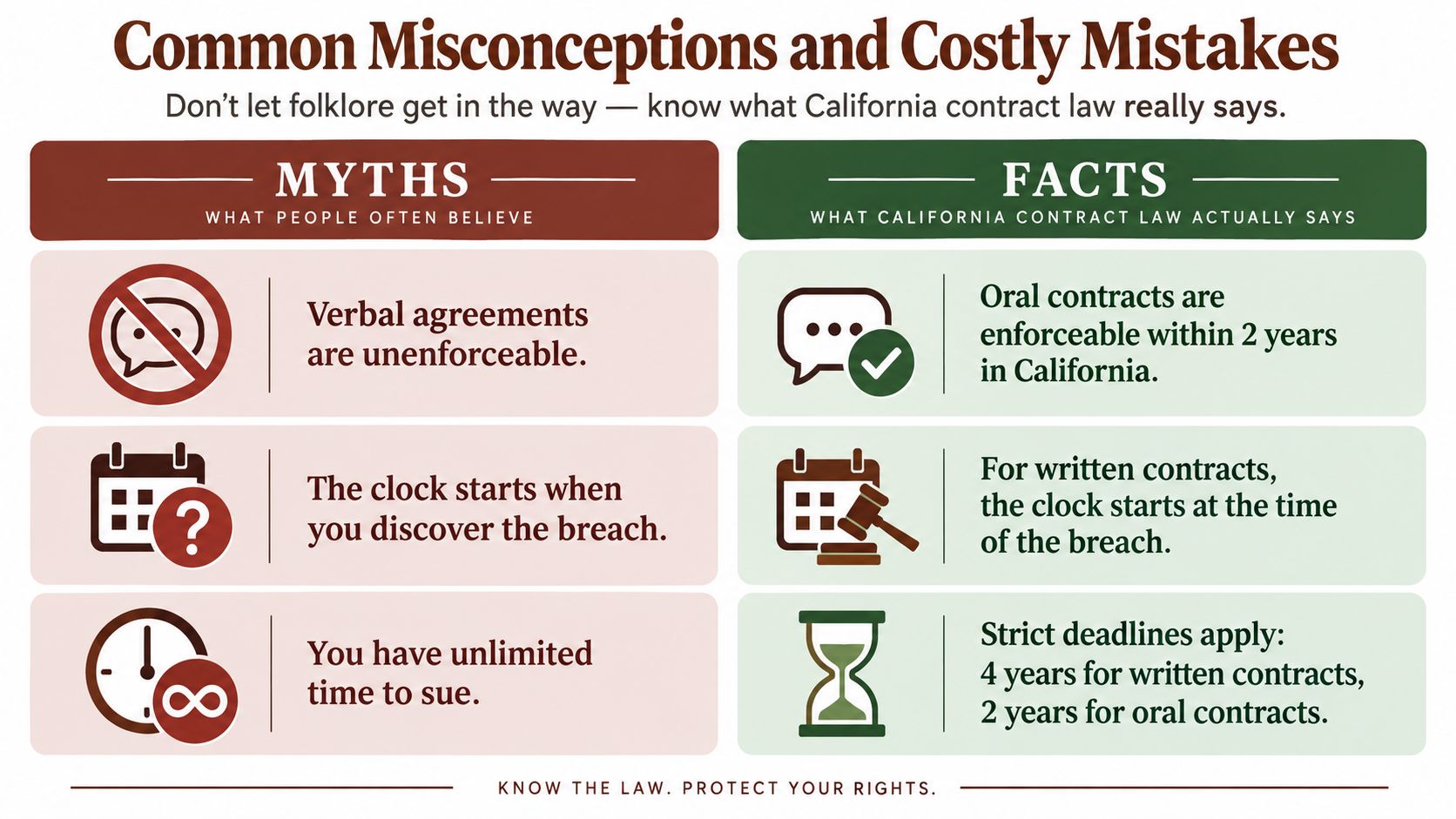
California property disputes often become harder because the parties rely on familiar advice that doesn't match the governing rule. A verbal agreement isn't automatically worthless, and a defendant's willingness to discuss payment doesn't give the claimant unlimited time.
Myth: A verbal agreement can't be enforced. Oral contracts can be enforceable, subject to the facts and any separate legal requirements. A claimant may still face the two-year limitations period for an oral contract under CCP section 339, so the absence of a signed document can make timing more urgent, not irrelevant.
Myth: The other side knows they owe the money, so the deadline isn't a concern. A defendant's awareness, apology, or promise to pay doesn't necessarily preserve a claim. Negotiations should be documented, and any agreement changing the limitations calculation should be reviewed and put in writing.
Other errors that cause avoidable losses
- Waiting for settlement talks: Discussions can continue while the filing period runs. A demand letter isn't the same as filing a lawsuit.
- Assuming partial performance solves the deadline: Payments, repairs, or other performance may affect the facts, but they don't automatically reset the limitations period.
- Treating small claims as a reset: Filing or resolving a small claims matter doesn't provide a general restart for a later superior court action.
- Assuming discovery always controls: Hidden breaches may raise a discovery issue, but ordinary contract claims commonly accrue when the breach occurs.
- Ignoring separate promises: A contract can contain obligations that mature at different times. One expired theory doesn't necessarily decide every other claim.
A claimant shouldn't wait for perfect certainty before seeking advice. The better practice is to identify the earliest possible breach, preserve evidence, and investigate exceptions without gambling the claim on an optimistic interpretation.
Practical Next Steps for Claimants and Defendants
A sound response begins with a dated file, not a heated exchange. Whether you're trying to enforce a purchase agreement or defending a contractor-payment claim, organize the facts so a lawyer can calculate accrual and assess proof quickly.

If you're the claimant
Start with the original agreement and every later modification. Add payment records, canceled checks, invoices, photographs, inspection reports, text messages, emails, notices of breach, and repair estimates. Write a chronology that identifies what each party promised, what happened, and when you first recognized the problem.
A focused demand letter can clarify the dispute. It should identify the contract, the missed obligation, the requested remedy, and the supporting records. It may refer to CCP section 337 or section 339 when that classification is supportable, but it shouldn't make an unsupported deadline assertion.
Next, compare resolution paths:
- Negotiation or mediation: Useful when both sides need a practical solution and the evidence is reasonably clear.
- Arbitration: Potentially required by a contract clause, so review the agreement before filing in court.
- Superior court: Appropriate when the dispute, remedies, or parties exceed the limits of another forum.
- Small claims court: May offer a simpler process for eligible disputes, but it doesn't eliminate the need to confirm timeliness.
If you're the defendant
Calendar the earliest alleged breach date as soon as you receive a demand. Preserve contracts, accounting records, project files, property photographs, employee communications, and insurance materials. Then assess whether the claimant's theory is written or oral, whether a discovery or continuing-breach argument is plausible, and whether a counterclaim, such as unpaid invoices, has its own deadline.
If negotiations need more time, request a written tolling agreement rather than relying on an informal promise. Also examine arbitration clauses, notice provisions, venue requirements, and any contractual attorney-fee language.
Must do: Preserve evidence, calculate the earliest deadline, identify all contract versions, and obtain advice before making admissions.
Optional but useful: Prepare a damages spreadsheet, organize witness contacts, collect comparable repair estimates, and evaluate mediation before litigation costs expand.
Tanner Law's civil practice includes contract and property disputes, including claims involving real estate agreements. A free consultation can help a claimant or defendant organize these issues before choosing a forum or response strategy.
Protect Your Rights Before the Deadline Runs Out
A contract dispute can look like a disagreement about workmanship, payment, a closing, a commission, or a family property promise. Legally, it also becomes a race against a filing deadline. The outcome may turn on whether the agreement is written or oral, when a particular promise was breached, whether the injury was hidden, and whether a valid tolling or estoppel theory applies.
California's basic framework is clear enough to guide the first review, but the facts can make the result difficult. A written agreement generally receives the longer period, while an oral agreement generally receives the shorter period. Real-estate contracts add practical complications because escrow, inspection, possession, recurring payments, construction completion, and later modifications can all affect how a lawyer identifies the breach.
Don't wait for the other party's next promise to pay or repair. Preserve the evidence and calculate the earliest plausible deadline first.
Homeowners, investors, landlords, brokers, and families handling inherited property should gather the complete file before negotiations stall. Defendants should preserve records and evaluate limitations defenses promptly, rather than assuming an old dispute will disappear on its own. The safest strategy is to obtain California-specific advice while there is still time to select among negotiation, mediation, arbitration, or litigation.
Tanner Law can review your contract, breach timeline, property records, and potential tolling issues during a free consultation. Visit Tanner Law to schedule a consultation and discuss how to protect your claim or prepare a timely defense.