Partition Action Lawsuit in California: A Practical Guide
Your mother's Tustin bungalow is now owned by three siblings. One sibling lives there without paying rent, another wants to sell, and the third has stopped responding to family messages. The mortgage, taxes, repairs, and memories keep accumulating while nobody can agree on what happens next.
A partition action lawsuit is California's legal mechanism for ending that deadlock. It can lead to a physical division, a court-supervised sale, or a buyout, depending on the property and the circumstances. The difficult part is often not proving that someone wants out. It's determining who receives what after liens, expenses, occupancy, improvements, and other credits are accounted for.
California partition law treats co-ownership as a property relationship, not a family vote. A co-owner may generally seek partition even when the other owners object, but filing doesn't produce an immediate check. The case can involve title review, valuation, a referee, sale expenses, accounting disputes, and court orders before proceeds are distributed.
Table of Contents
- When Co-Owners Cannot Agree
- The Three Forms of Partition
- Who May File a Partition Action
- How a California Partition Case Proceeds
- Valuation, Appraisal, and the Buyout Math
- What a Partition Action Really Costs
- Credits, Contributions, and Who Gets What
- Strategic Choices and How Tanner Law Can Help
When Co-Owners Cannot Agree
The sibling who wants to sell may begin with a reasonable proposal. Perhaps the resident sibling can refinance and buy out the others, or everyone can list the home with a local broker. Those conversations often fail because the disagreement isn't only about real estate. Grief, unequal financial contributions, and the belief that one sibling is receiving a private benefit can make a voluntary solution impossible.
A partition action provides an exit when joint tenants or tenants in common can't agree about use, occupancy, refinancing, maintenance, or sale. California law generally allows a co-owner to compel partition, even over the objections of the other owners. The remedy has deep roots in English common law and was formally expanded by statute during the reign of Henry VIII, before later becoming part of chancery equity practice, as explained in this historical overview of partition law.
Practical rule: Partition is usually about ending shared ownership, not proving that one family member is morally wrong.
A statutory exit, not a punishment
A resident sibling may feel entitled to remain because they cared for the parent or maintained the house. The sibling seeking a sale may feel excluded from an asset they inherited. Both positions can matter during the accounting, but neither position automatically gives one co-owner a veto over partition.
That distinction matters in Orange County probate disputes. A court can recognize ownership rights while separately examining expenses, occupancy, improvements, and other equitable adjustments. The lawsuit converts a shared asset into either separate property interests or divided value.
Why informal solutions break down
A buyout sounds simple until the parties disagree about value, financing, credits, or whether the resident owes rent. A private sale has the same problem if one owner refuses to sign listing documents or demands reimbursement before agreeing to a listing price.
Mediation can still work, especially when the parties obtain an early appraisal and exchange a documented accounting. But if negotiation doesn't produce a signed agreement, a partition action gives the court authority to establish ownership interests, decide the appropriate remedy, supervise the sale or buyout, and distribute the proceeds.
The Three Forms of Partition
California law recognizes three principal ways to resolve a partition dispute. Think of the property as a pie. Partition in kind slices the pie into separate pieces. Partition by sale sells the whole pie and divides the money. Partition by appraisal lets one person buy the others' slices.

Partition in kind
Partition in kind, sometimes called actual partition, physically divides the property into separately owned portions. It can make sense for raw acreage, a duplex, or land that can be divided without materially reducing its usefulness or value.
A single-family home on a typical residential lot usually can't be divided fairly. Creating separate parcels may violate zoning rules, eliminate access, or reduce the property's overall value. The court therefore examines practicality and economic consequences rather than assuming that a physical split is automatically fair.
Partition by sale
Partition by sale is the usual solution for an indivisible home or condominium. A court-appointed referee or another neutral may list, market, and sell the property under judicial supervision. The court then addresses liens, sale expenses, approved credits, and ownership shares before distributing the net proceeds.
This process isn't the same as a private family sale. The referee may control marketing and sale mechanics, and the court may review competing appraisals or bids. The structure is designed to reduce deadlock and protect the integrity of the disposition, although it adds professional fees and procedural steps.
Partition by appraisal
Partition by appraisal is the less familiar option. One co-owner may purchase the others' interests at a court-confirmed value under California's Partition of Real Property Act. It resembles buying the entire pie after the court determines the value of each slice.
For an inherited single-family home in Tustin, Santa Ana, Irvine, or Los Angeles, partition by sale or an agreed buyout will usually be more practical than physical division. Partition by appraisal can provide a more private exit when a qualified sibling can obtain financing and the parties can resolve credits and liens.
Who May File a Partition Action
California standing begins with an ownership interest in the property. Under California Code of Civil Procedure section 872.210, a partition action may be commenced by a co-owner of personal property or by an owner of an estate of inheritance, life estate, or term of years in real property held concurrently or in successive estates.
In practical terms, a present co-owner may include someone holding title as a joint tenant or tenant in common. A person with a life estate may also qualify, as may a trustee acting for a trust that holds the relevant ownership interest. The precise title and trust documents matter, particularly after a death when the deed, will, trust, and probate inventory don't align perfectly.
Standing is not the same as strategy
A minority co-owner generally doesn't lose the ability to seek partition because another owner holds a larger share. An heir living out of state may have the same right to pursue an exit as an heir living in the property. A beneficiary under a deed of trust, however, should distinguish a security interest from actual ownership before assuming partition is available.
The spousal exclusion also matters. California law expressly excludes actions between spouses or putative spouses concerning community, quasi-community, or quasi-marital property interests under section 872.210. That means a spouse or registered domestic partner whose only interest is a recorded homestead right can't use partition to compel division of the property, although that person may need to be joined in the case.
Confirm the title before filing
A complaint should identify everyone who holds or claims an interest, including owners, lienholders, and lenders. Unrecorded transfers, disputed deeds, probate claims, and trust amendments can create title issues that partition won't automatically cure.
A title report, recorded instruments, probate filings, and loan documents should be reviewed before filing. If ownership shares aren't clear, the court may need to determine those interests before it can decide how to divide or sell the property.
How a California Partition Case Proceeds
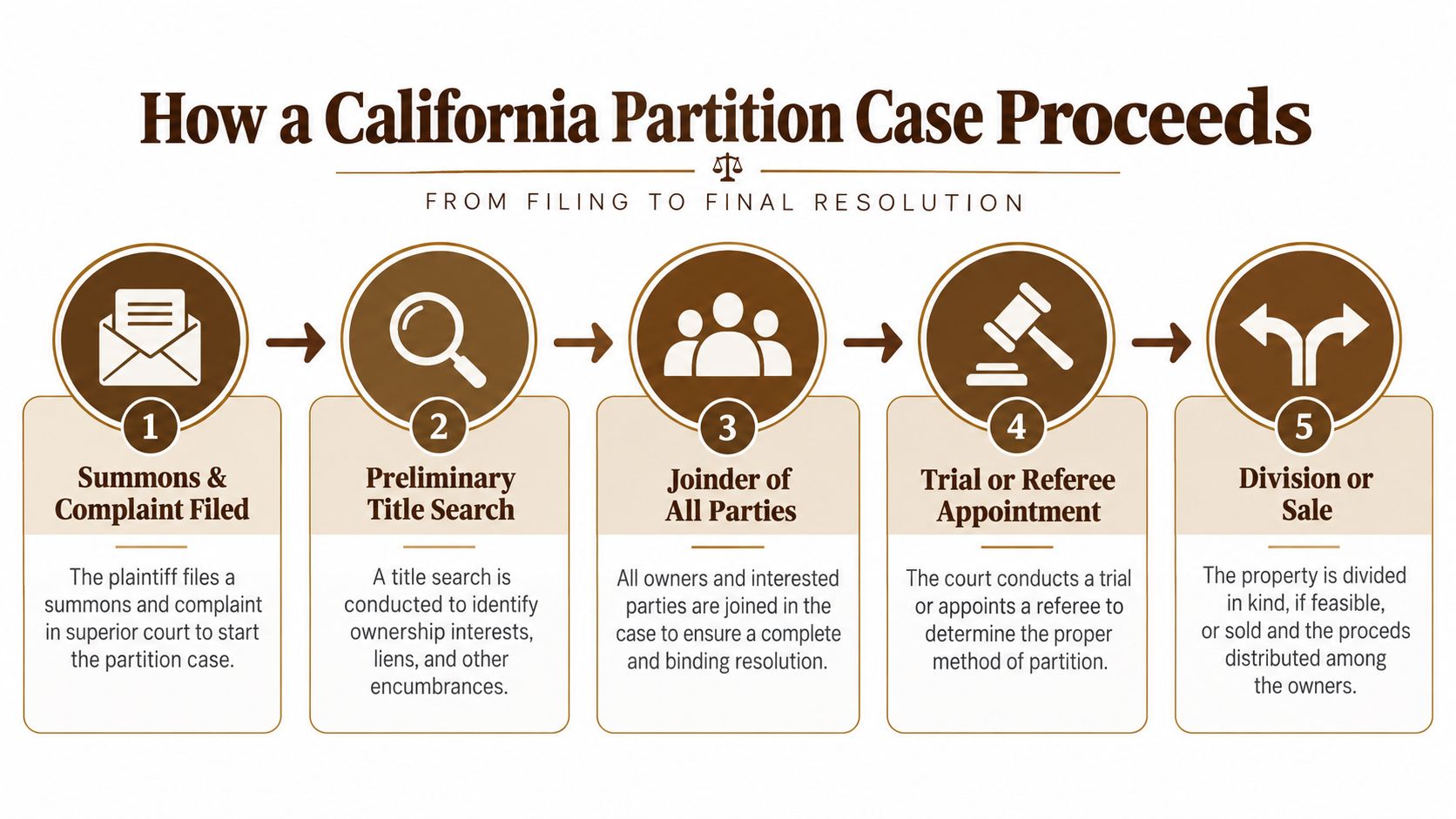
If three siblings inherit a house and one wants to sell while another continues living there, the case becomes more than a request for a listing. A California partition action proceeds as a civil lawsuit under Code of Civil Procedure sections 872.010 and following. The plaintiff files and serves the complaint, naming every person whose property interest may be affected.
Before the court can authorize a sale, it must determine who owns what, which liens attach to the property, and who must receive notice or participate. Those findings also shape the later accounting for mortgage payments, occupancy, repairs, and improvements.
The main procedural stages
Complaint and service: The complaint identifies the property, the requested type of partition, the ownership interests known to the plaintiff, and the relief sought. Each required party must be served correctly.
Title and interest review: The court reviews deeds, probate records, trust documents, mortgages, judgment liens, and other claimed interests. It determines lien status and priority as needed to grant relief. Under section 872.630, the court may appoint a referee to investigate and report on those issues.
Determination of the right to partition: The court may issue an interlocutory judgment confirming that partition is available and determining the parties' interests. The order can address whether the property should be divided, sold, or handled through an appraisal and buyout process.
Referee and sale mechanics: In a sale, the referee may obtain valuation information, coordinate marketing, receive offers or bids, and complete authorized tasks under court supervision. The referee does not replace the judge and reports back to the court.
Confirmation and distribution: After the sale, the court addresses the transaction, liens, expenses, and approved credits or charges. The final judgment directs distribution of the remaining proceeds based on ownership interests and the court's accounting rulings.
The straightforward pre-distribution process often takes 12 to 18 months. Cases involving title disputes or multiple liens can take 24 to 36 months or longer, according to this California partition procedure guide. No distribution check should issue until the court determines which creditors and co-owners must be paid.
The practical sequence is clear: establish ownership, determine value, pay valid claims and sale expenses, then calculate credits and charges that change each owner's net proceeds. That final accounting often determines whether the distribution feels fair, particularly when one co-owner occupied the property or paid expenses for years.
Valuation, Appraisal, and the Buyout Math
The court must size the pie before deciding how to divide it. If co-tenants can't agree on value, the court commonly orders a neutral appraisal unless an appraisal would not be cost-effective. The appraiser values the property as though it were owned by a single person or entity, rather than applying a discount merely because several people share title, as described in this California PRPA appraisal analysis.
California's appraisal process can involve an agreed appraiser, a court-appointed appraiser or referee, or a valuation tied to a public sale. Under the buyout procedure, the court-confirmed value becomes the baseline for calculating the price of the requested co-owner's fractional share.
A numerical example
Assume the court confirms a $1.2 million property value. Three siblings each hold a one-third interest, so the gross value of each share is $400,000. If one sibling buys the other two out, the starting purchase price is $800,000, before approved credits, liens, transaction expenses, or other accounting adjustments.
Suppose the purchasing sibling proves an approved credit of $30,000 for expenses paid beyond that sibling's ownership obligation. The court may carry that credit into the accounting and reduce the amount otherwise payable, rather than treating the gross share value as the final number.
The same principle applies when a property can't be divided cleanly. An owelty adjustment can equalize unequal physical divisions through cash payments or liens. The purpose is to match economic value, not merely to draw a line on a parcel map.
| Method | Who Selects | How Value Is Set | Best Used When |
|---|---|---|---|
| Agreed appraisal | The co-owners, subject to court acceptance | A mutually selected professional's valuation | The parties trust a neutral process |
| Court-appointed appraisal | The court | A neutral valuation without a co-ownership discount | The parties dispute the property's worth |
| Public-sale valuation | The court and sale process | Market evidence from an authorized sale | A sale is required and private agreement has failed |
A buyout can be efficient, but it only works if the purchasing owner can fund it and the parties can resolve the accounting. A high appraisal may increase the cash needed to consolidate title, while a low appraisal may trigger objections or competing evidence.
What a Partition Action Really Costs
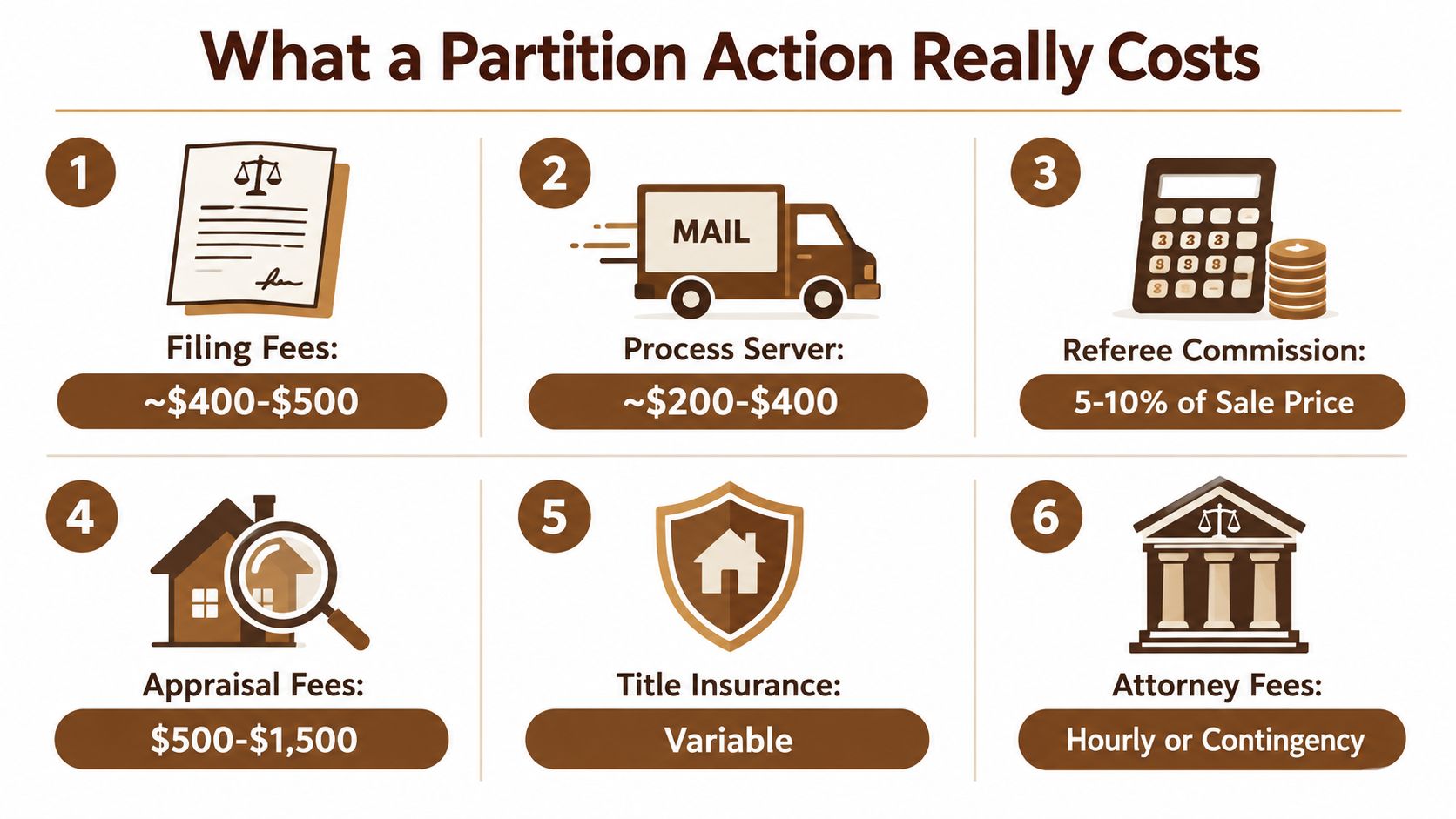
A partition lawsuit can consume a substantial portion of the equity in an inherited home. Even an uncontested judgment may cost at least $25,000 in legal fees and costs, with expenses rising when title, valuation, or related disputes become contested. The cited partition action cost and timing resource provides useful context, but it is not a fixed quote for every Orange County case.
The practical question is what remains after the case is finished. Filing and service charges, title work, appraisal, referee compensation, sale expenses, lien resolution, and attorney time can all come out before the owners divide the proceeds. Those deductions affect the final accounting, including any credits for mortgage payments, property expenses, or approved improvements.
Where the money goes
A partition case may involve:
- Court and service expenses: Filing, summons, service, recording, and notice costs.
- Title investigation: A title company or attorney may identify ownership interests, mortgages, judgment liens, and competing claims.
- Valuation: An appraisal may be needed before the parties can evaluate a buyout or sale.
- Referee and sale costs: A referee may handle marketing, offers, closing, and reports to the court.
- Legal fees: Counsel may prepare pleadings, conduct discovery, present motions, address settlement, and handle hearings and accounting issues.
A cooperative case can resolve sooner than one involving disputed liens, title defects, valuation evidence, or competing claims. Complex cases may remain active for years. Delay also has a financial effect because insurance, taxes, maintenance, mortgage obligations, and property deterioration continue while the case is pending.
Who pays
California generally apportions partition costs among the parties according to their interests, subject to a different allocation when equity requires it under section 874.040. The court may consider whether one party caused unnecessary work or delay.
Winning the right to partition does not guarantee an untouched ownership share. Appropriate expenses may be charged against the common fund or allocated among the co-owners. The amount each person receives depends on property value, liens, sale costs, and the accounting for contributions and occupancy, not just the headline sale price.
Credits, Contributions, and Who Gets What
The accounting phase is where many inherited-property disputes are won or lost. California courts can make allowances, order accountings and contributions, and impose compensatory adjustments among the parties according to equity under section 872.140, including adjustments for common expenses and improvements, as explained in this California partition credit overview.
The ownership percentage establishes the starting point. It doesn't always establish the final check.
Four recurring accounting issues
Occupancy: A sibling who has exclusive use of the home may face a claim for the fair rental value of that use. The claim requires context. Consent, an agreement among the owners, demands to vacate, and the circumstances of occupancy can all affect the analysis.
Mortgage payments and taxes: If one owner pays more than that owner's fair share of mortgage principal, interest, taxes, insurance, or necessary maintenance, that owner may seek a contribution credit. Bank statements and payment records matter more than a general statement that someone “covered the bills.”
Improvements: A permitted addition, new roof, or kitchen remodel may support a credit, but the cost of the work and the value added to the property aren't always identical. The court may examine permits, invoices, photographs, contractor records, and appraisal evidence.
Damage or neglect: A resident co-owner may face an offset for damage, waste, or deterioration caused by misuse or neglect. The owner asserting the claim should document the condition, timing, repair estimates, and connection to the resident's conduct.
Consider three siblings. One paid the mortgage for three years, another lived in the house without paying rent, and the third funded a $40,000 permitted addition. The court wouldn't divide the sale proceeds into three identical checks. It would need reliable evidence about the mortgage payments, the value and effect of the occupancy, the addition's contribution to market value, and any competing expenses.
| Credit Category | Typical Claimant | Required Proof | Effect on Net Share |
|---|---|---|---|
| Exclusive occupancy | Nonresident co-owners | Occupancy history, communications, rental-value evidence | May offset the resident owner's distribution |
| Mortgage, taxes, and insurance | Owner who paid more than a fair share | Bank records, statements, cancelled checks | May increase the paying owner's recovery |
| Capital improvements | Owner who funded documented work | Permits, invoices, contracts, photographs, appraisal evidence | May create a contribution credit |
| Damage or neglect | Owners seeking an offset | Inspection records, repair estimates, causation evidence | May reduce the responsible owner's share |
The practical lesson: Keep a dated ledger from the day ownership begins. Receipts without dates, unexplained transfers, and cash payments are difficult to present persuasively.
The final accounting can reallocate proceeds substantially without changing the deeded ownership percentages. That's why a resident sibling may receive less than a simple one-third calculation, while an owner who paid documented expenses may receive more.
Strategic Choices and How Tanner Law Can Help
Filing is sometimes necessary, but it shouldn't be automatic. Before a complaint is prepared, co-owners should compare the cost of litigation with a structured exit that addresses value, possession, liens, and credits in one written agreement.
A responding co-owner may seek to purchase the filing owner's share at the court-appraised price under California's Partition of Real Property Act. The parties may also consider a deed-in-lieu arrangement, an installment buyout supported by a promissory note, or an equalization payment when one owner keeps the property.
Options that can avoid a full sale
A voluntary sale works when every required owner signs and the parties agree on listing, repairs, price, and expenses. A buyout works when the remaining owner can qualify for financing and the accounting is specific enough to prevent future disputes.
For an investment property, the parties may also evaluate a 1031 exchange, but tax treatment depends on the transaction structure and each owner's circumstances. It should be coordinated with qualified tax professionals rather than inserted casually into a settlement agreement.
Mediation can be useful when the family needs a neutral person to test competing appraisals and organize reimbursement claims. It is less effective when one party refuses to provide records or uses occupancy as a bargaining chip without acknowledging the financial value of exclusive possession.
Preparing before the complaint
A practical pre-litigation file should include:
- Title materials: Deeds, trust documents, probate orders, loan records, and recorded liens.
- Property records: Appraisals, tax statements, insurance, permits, contractor invoices, and photographs.
- Payment history: Mortgage, utilities, repairs, taxes, and improvements tied to dates and accounts.
- Settlement proposal: A clear value, buyout price, treatment of credits, move-out terms, and deadline.
Tanner Law handles partition suits and related real estate disputes, with attention to early appraisal review, lien-payoff coordination, and credits-and-rents analysis. The firm offers a free initial consultation for Orange County and California co-owners deciding whether to file, defend, negotiate a buyout, or pursue a supervised sale.
Tanner Law can review your title documents, appraisal information, payment records, occupancy history, and proposed buyout or sale terms before the dispute becomes more expensive. Schedule a free consultation by visiting Tanner Law to discuss the most practical path for your inherited or co-owned property.