Sample Letter to Cancel Lease: California Tenant Guide 2026
Needing to leave a rental before the timing feels ideal is common in California. A job changes, a family member needs care, the unit becomes unlivable, or the lease reaches a point where staying no longer makes sense. In that moment, most tenants look for a quick sample letter to cancel lease and assume the template itself will solve the problem.
Usually, it won't.
The letter matters, but the legal reason for ending the tenancy, the dates you choose, and the way you deliver notice matter just as much. In my experience advising California clients, the biggest mistakes happen when a tenant sends a generic note, leaves out key facts, or can't later prove the landlord received it. Those mistakes can affect rent liability, move-out disputes, and the return of the security deposit.
This guide is written from a California real estate attorney's perspective. It focuses on what effectively protects you, not just what looks good in a template.
Table of Contents
- Why You Need a Formal Lease Termination Letter
- The Anatomy of an Effective Cancellation Letter
- Navigating California's Lease Termination Laws
- Sample Letters for Four Common Termination Scenarios
- How to Deliver Your Notice and Document Everything
- What to Expect After You Send the Letter
- When You Need to Contact a Lawyer
Why You Need a Formal Lease Termination Letter
When tenants are under stress, they often send a text, leave a voicemail, or mention verbally that they're moving out. That approach creates problems fast. A landlord may later dispute the move-out date, deny receiving notice, or claim the tenant abandoned the unit without proper communication.
A formal lease termination letter creates a record. It shows when you gave notice, what property is involved, and the exact date you intend to leave. If a dispute develops later, that document helps establish that you acted deliberately and gave notice in writing instead of disappearing or relying on casual communication.

What the letter actually protects
A proper letter does more than announce a move. It helps protect you in several practical ways:
- It fixes the timeline: The date on the letter and the stated termination date help define when your notice period started.
- It reduces ambiguity: The landlord can't credibly argue that you meant a different unit, a different lease, or a different move-out date.
- It supports deposit recovery: If your forwarding address and move-out details are clear, it becomes easier to track what should happen after possession ends.
- It helps defend against abandonment claims: Written notice shows you intended an orderly exit, not a sudden disappearance.
A generic template is better than no writing at all, but a letter tied to your actual lease situation is what carries legal weight.
What doesn't work well
Tenants get into trouble when they treat the notice like an informal courtesy. These are the patterns that often backfire:
- Vague language: “I'll probably be out by the end of the month” is not precise enough.
- Missing details: Leaving out the full property address or effective date invites conflict.
- Wrong objective: Some tenants focus on sounding polite and forget to state the legal basis, if there is one.
- No paper trail: A perfect letter is still weak if you can't show it was delivered.
If you need a sample letter to cancel lease in California, use it as a starting point, not the finish line. The stronger approach is to match the letter to your tenancy type, your reason for leaving, and the proof you may later need.
The Anatomy of an Effective Cancellation Letter
A strong cancellation letter is clear enough that a stranger could read it months later and understand exactly what lease is ending, who is involved, and when possession ends. That's the standard worth aiming for.
Guidance for both residential and commercial settings recommends a stepwise structure: identify the lease and parties, state the exact termination date, cite the governing notice period or lease clause, and include supporting documentation when early termination is involved, because that sequence reduces ambiguity and improves enforceability in later disputes, as discussed in Azibo's guidance on lease termination letter structure.
The core components
Checklist
- Date of the letter
- Landlord's name and tenant's name
- Full rental property address
- Clear statement that you are terminating or ending the tenancy
- Exact move-out or effective termination date
- Reference to the lease clause, notice requirement, or legal reason that applies
- Forwarding address
- Request for any needed inspection or move-out coordination
- Your signature and contact information
- Copies of supporting documents if your termination depends on a specific legal basis
Each item serves a purpose.
The date of the letter anchors the timeline. The names of the parties avoid confusion if a property manager, owner, or co-tenant later gets involved. The full address matters because many landlords manage more than one unit.
The exact termination date is one of the most important lines in the letter. “I intend to vacate on June 30” is far better than “I'm moving at the end of June.” Precision helps determine whether notice was timely and whether any additional rent may be claimed.
Where most templates fall short
A lot of online samples look complete because they include greetings, a closing, and a statement of intent. That isn't enough if you're ending a lease early or relying on a legal exception.
What matters is whether the letter answers the questions a landlord, judge, or mediator would ask later:
- What lease is being terminated
- When termination becomes effective
- Why the tenant believes that date is proper
- What documents support the request, if any
- Where future correspondence and the deposit should go
If your reason for leaving is unusual, the wording should reflect that. A mutual termination letter should read differently from a habitability-based notice or a military-service notice.
A practical drafting approach
Keep the tone calm and businesslike. This letter isn't the place to argue every grievance unless your legal reason for leaving depends on those facts.
A good sequence looks like this:
- Identify yourself and the rental property.
- State that the letter serves as formal written notice.
- Give the exact effective date.
- Cite the lease term, notice rule, or legal basis.
- State any request tied to move-out logistics.
- Provide your forwarding address and contact information.
That sequence works because it reads like evidence, not emotion.
Navigating California's Lease Termination Laws
A tenant who gives notice on the wrong legal theory can end up owing rent after moving out. I see that problem often. The letter looks polished, but it does not match the tenancy, the lease terms, or the California rule that applies.
California law matters because a month-to-month tenancy is handled differently from a fixed-term lease. Before you send any sample letter to cancel lease, identify which arrangement you have and what gives you the right to end it on the date you chose.

Month-to-month tenancies versus fixed-term leases
With a month-to-month tenancy, the main question is whether your written notice satisfies the notice period required by California law and your rental agreement. In practice, disputes usually come from timing. A tenant sends notice too late in the month, assumes the notice period runs from the mailing date instead of receipt, or picks a move-out date that does not fit the tenancy terms.
A fixed-term lease is different. Leaving early does not automatically end your rent obligation. Your ability to end the lease without further liability usually depends on one of three things: a lease clause that allows early termination, a written agreement with the landlord, or a specific legal protection that applies to your situation.
That distinction should shape the letter. For a month-to-month tenancy, the notice usually focuses on the effective date. For a fixed-term lease, the letter should also explain the legal or contractual basis for ending the lease early and attach any supporting records.
Security deposit rights in California
Your termination letter also sets up the security deposit process. According to Bay Legal's California guidance on lease termination letters, the notice should clearly identify the landlord, the property, the move-out date, and your forwarding address. That same guidance explains that California landlords generally have 21 days after move-out to return the deposit or send an itemized statement of deductions, and that tenants may request a pre-move-out inspection during the two weeks before vacating.
Those details are not clerical. They affect money. If the landlord later claims you abandoned the unit, failed to provide an address, or did not cooperate with inspection scheduling, a precise letter and proof of delivery put you in a much better position.
I usually tell tenants to treat the notice as the first exhibit in any future deposit dispute. Clear dates, a forwarding address, and a written request for inspection can matter as much as the condition of the unit itself.
Special situations that change the analysis
Some terminations require scenario-specific wording because the tenant is relying on a legal protection, not just a preference to move. Common examples include domestic violence protections, military service, and certain habitability or disability-related situations. In those cases, the landlord is not evaluating your formatting. The landlord is evaluating whether your notice states a recognized basis and whether your documentation supports it.
That is where generic templates fail. A letter that works for an agreed early move-out can be too vague for a protected termination. If your reason for leaving depends on facts you may need to prove later, state those facts carefully, attach the supporting documents that California law or your lease requires, and keep copies of everything you send.
A good practical question is this: what would a landlord, mediator, or judge need to see to confirm that your termination date was lawful? Draft to answer that question, and your letter will do more than announce a move. It will protect your position.
Sample Letters for Four Common Termination Scenarios
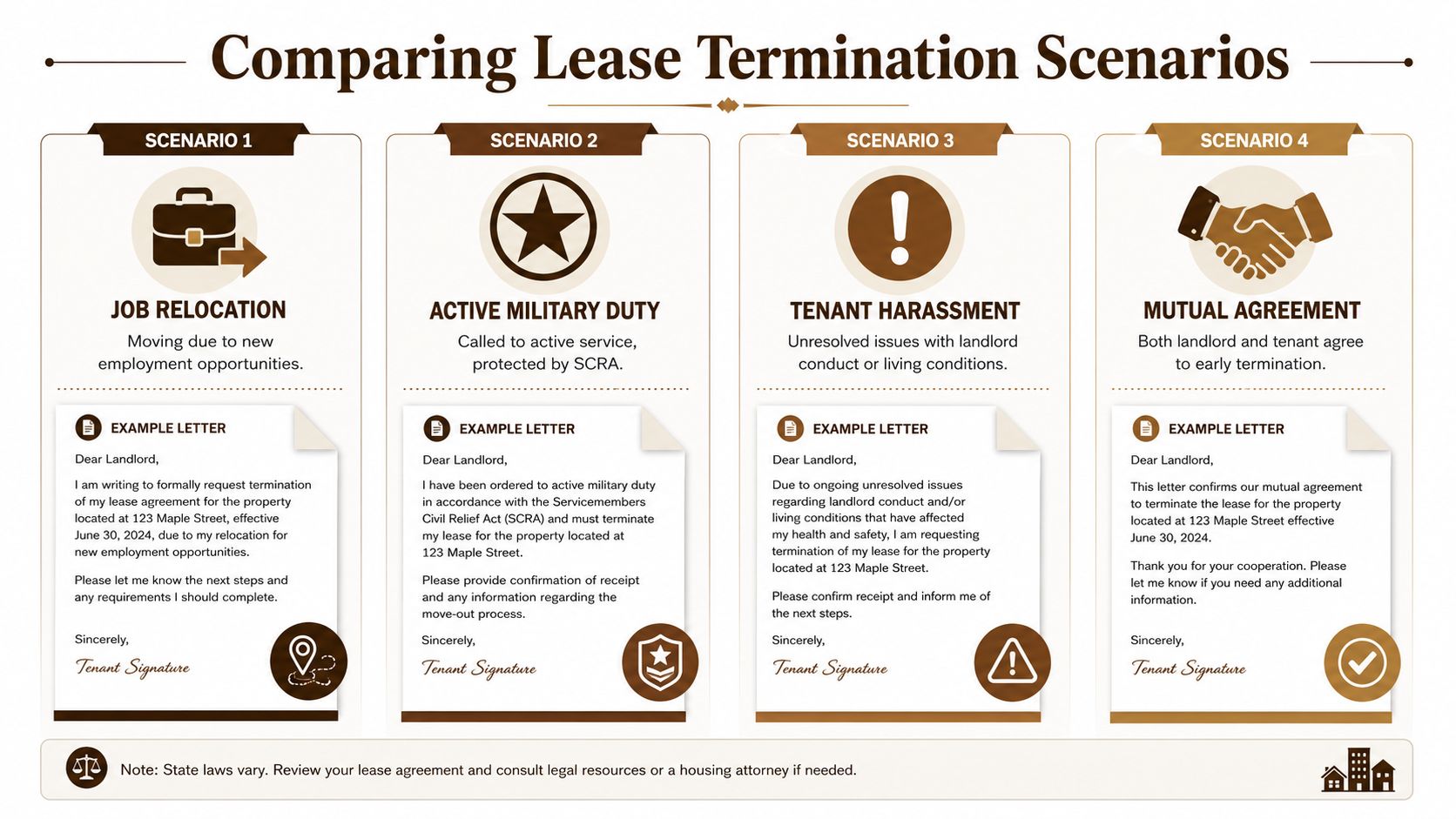
The best sample letter to cancel lease is the one that fits your actual reason for leaving. Below are four common situations, with language you can adapt. These are practical models, not magic words. The legal effect still depends on your lease, California law, and the facts you can prove.
Some readers prefer to see the issue discussed before drafting anything. This overview may help:
As a legal aid resource emphasizes, many template pages focus on format but not on whether early termination is legally justified, even though special protections such as disability-related accommodation requests or domestic-violence-related rights may require different wording and notice handling, as explained by Disability Rights North Carolina's sample early lease termination guidance.
Mutual agreement to end the lease
This is usually the cleanest scenario. The goal is to confirm that both sides agree to an early end date and to avoid later disagreement over rent, possession, or the deposit.
Dear [Landlord Name],
This letter confirms our mutual agreement to terminate the lease for [full rental address]. The tenancy will end on [exact date], and I will vacate and return possession of the premises by that date.
Please confirm in writing that no further rent will be due after the agreed termination date, except for any amounts separately agreed in writing. Please also advise regarding key return and final inspection arrangements.
My forwarding address for future correspondence and any security deposit is [forwarding address].
Sincerely,
[Tenant Name]
What makes this work is the phrase “mutual agreement” and the request for written confirmation about post-termination obligations. If the landlord agrees by signature or email acknowledgment, keep that with your lease records.
Early termination for job relocation
Job relocation is common, but it is not automatically a legal excuse to break a fixed-term lease without consequence. The letter should be honest and practical. Don't overstate your rights.
Dear [Landlord Name],
Please accept this letter as formal written notice that I am requesting early termination of my lease for [full rental address]. Due to job relocation, I intend to vacate the premises on [exact date].
I understand that early termination may be governed by the lease terms, including any applicable notice requirement or early termination provision. Please provide written confirmation of any lease-based requirements, fees, or move-out procedures that apply.
I am requesting a pre-move-out inspection and ask that future correspondence be sent to my forwarding address at [forwarding address].
Sincerely,
[Tenant Name]
This wording helps because it does not concede more than necessary, and it does not falsely claim a right that may not exist. It opens the door to negotiation while preserving a professional record.
Termination based on serious habitability problems
This situation requires care. If you're leaving because the unit has major condition problems, the letter should identify the issue, refer to prior notice if there was any, and state that the conditions have not been corrected. Stick to facts you can document.
Dear [Landlord Name],
This letter serves as formal written notice regarding the tenancy at [full rental address]. Because serious conditions affecting habitability have not been adequately corrected after notice, I am terminating the tenancy effective [exact date].
The conditions include [brief factual description]. I previously notified you of these issues on [date or approximate timing if known], and they remain unresolved. I am preserving records of the property condition and related communications.
Please direct all future correspondence and any security deposit accounting to my forwarding address at [forwarding address].
Sincerely,
[Tenant Name]
The key is restraint. Don't turn the letter into a long accusation unless your lawyer advises that level of detail. State enough to identify the basis. Save the full evidence package for later if needed.
Termination related to military service
Military-related lease termination should be handled with supporting documentation and precise dates. Use language tied to the service-related basis and include copies of orders or other required proof where appropriate.
Dear [Landlord Name],
Please accept this letter as formal notice of termination of my lease for [full rental address] based on military service obligations. I am providing notice in writing and enclosing supporting documentation.
My effective termination date is [exact date calculated under the applicable rule or instruction you are relying on]. Please confirm the procedures for possession, key return, and final account reconciliation.
My forwarding address is [forwarding address].
Sincerely,
[Tenant Name]
This letter works only if the supporting documents and timing are correct. If you're in this category, verify the exact rule before sending anything.
A final drafting point
If you need help tailoring a notice to a dispute, a lease clause, or a California-specific move-out problem, Tanner Law is one legal option that handles real estate disputes and related property matters in Orange County and Los Angeles.
How to Deliver Your Notice and Document Everything
A strong letter can still fail if the landlord later says, “I never got it.” That is why delivery matters so much. In practice, many lease disputes are not really about wording. They're about proof.
Operational guidance for lease terminations stresses that the notice period should match the lease or state law, the letter should include the move-out date, forwarding address, and inspection request, and the tenant should keep a copy and use a delivery method that creates proof of service, such as certified mail or in-person receipt, as explained in Avail's lease termination article.
Delivery methods that create a record
Some methods are plainly stronger than others.
- Certified mail: This gives you mailing records and helps establish when notice was sent.
- Personal delivery with written acknowledgment: If the landlord or manager signs and dates a copy, that can be very useful.
- Delivery allowed by the lease: If your lease permits a specific method, follow it carefully and save the evidence.
Casual text messages and informal emails are riskier unless the lease clearly allows them and the landlord confirms receipt in a way you can preserve.
What to save in your file
Create a simple move-out file, digital or paper, and keep everything in one place.
- Signed letter copy: Keep the exact version you sent.
- Mailing receipt or acknowledgment: Save the postal record or signed receipt.
- Lease excerpt: Keep the section that discusses notice or termination.
- Supporting documents: Include orders, correspondence, repair complaints, photos, or other materials relevant to your reason for leaving.
Send notice in the method you'd want to explain to a judge later. That usually leads people to choose a trackable method.
Common delivery mistakes
The avoidable errors are usually simple:
- Sending notice to the wrong address.
- Relying on a property manager conversation without written follow-up.
- Failing to keep a copy of the signed letter.
- Using a method that creates no reliable receipt.
Tenants often focus on writing the perfect sample letter to cancel lease. The better habit is to think of the letter and the proof of delivery as a single package.
What to Expect After You Send the Letter
A lot of tenants expect silence after they send notice. In practice, the next phase usually creates the actual dispute. The landlord may accept the date, question your reason for ending the lease, ask to show the unit, or start discussing cleaning, repairs, and keys.
That response matters, but your paper trail matters more. After notice goes out, the focus shifts from drafting to evidence. If the landlord later claims you left early without proper grounds, damaged the unit, or failed to return possession on time, the facts you preserved during move-out will usually decide the argument.
Expect two separate issues: possession and money
Treat move-out as two tracks.
First, there is possession. You need to leave by the date stated in your notice, remove your belongings, and return all keys, fobs, garage remotes, or parking access devices.
Second, there is money. The landlord may claim unpaid rent, cleaning charges, repair costs, or other amounts tied to the lease language and your reason for termination. Do not assume a charge is valid because it appears in an email or accounting statement. Review what the lease says, compare it to the reason you gave in your letter, and match both against what happened on the ground.
Scenario-specific wording in the notice pays off. A generic letter often leaves room for argument. A letter tied to the actual legal basis for ending the tenancy gives the landlord less room to recast the facts later.
Use the inspection process to narrow disputes
If a pre-move-out inspection is offered or available, use it well. It can surface issues you still have time to correct before you hand over possession. That is often the cheapest point to solve a deposit problem.
Do not rely on memory. If the landlord or manager identifies items during the inspection, write them down and keep any written checklist.
On move-out day, create a clean condition record:
- Photograph each room from multiple angles.
- Capture floors, walls, counters, bathrooms, and the interior of appliances.
- Show that the unit is empty.
- Record the date keys were returned and how they were delivered.
I tell clients the same thing in deposit disputes. Judges do not see the unit as you left it. They see documents, photos, timestamps, and messages.
Leave the property in a condition you can prove, not just a condition you can describe.
Be prepared for follow-up claims
A reasonable landlord may confirm the move-out and process the file. A difficult one may send a rent demand, dispute your legal basis for termination, or delay acknowledging that you surrendered possession.
Early termination cases often turn on details. The lease may impose specific obligations. California law may limit what a landlord can recover in your situation. The landlord also has a duty to act reasonably after you leave rather than letting losses pile up unchecked. That is why blanket statements like "you owe the rest of the lease" are often overstated.
If you receive deductions or a demand letter, respond with facts. Point to the notice you sent, the reason stated, the date possession ended, the condition evidence, and any communications that confirm the timeline. A calm, documented response usually puts you in a stronger position than an emotional one.
This stage is less about having the perfect sample letter to cancel lease and more about proving that you ended the tenancy the right way, for the right reason, and with records strong enough to protect your deposit and limit later claims.
When You Need to Contact a Lawyer
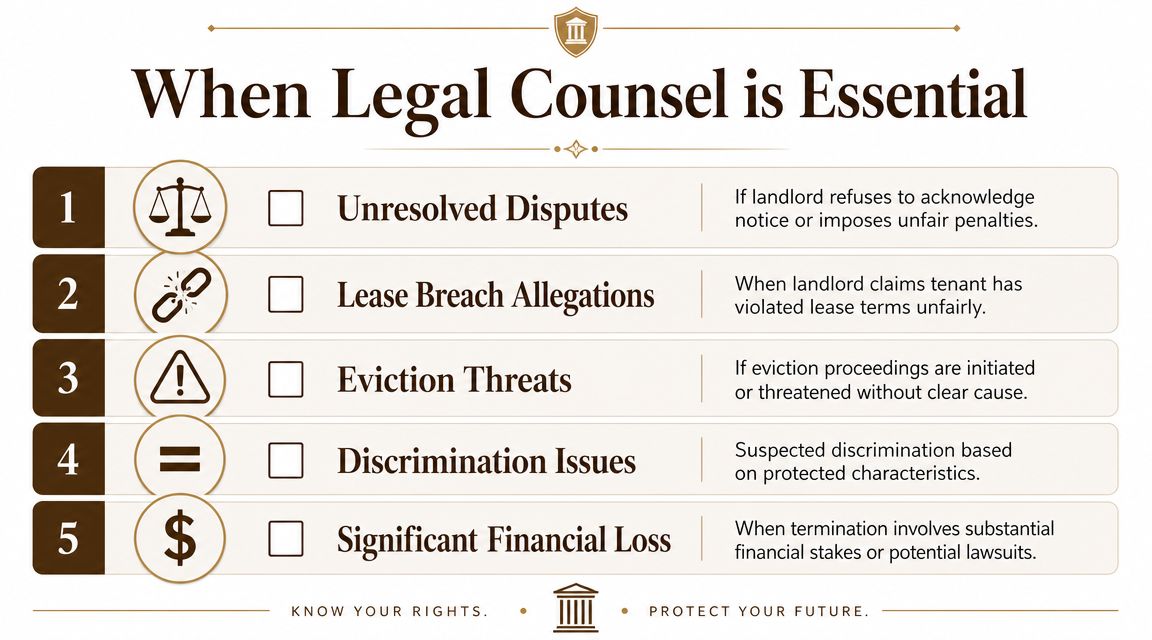
Many lease terminations can be handled without litigation. But some situations stop being a paperwork issue and turn into a legal dispute. That is when a sample letter to cancel lease is no longer enough.
Red flags that warrant legal help
You should strongly consider legal advice if any of these happen:
- The landlord refuses to accept notice: Especially if you followed the lease and can prove delivery.
- You're accused of owing large amounts after move-out: This often turns on lease interpretation and mitigation issues.
- The landlord threatens eviction after you gave notice: That can escalate quickly.
- Your termination depends on a protected legal reason: Special rights usually require more customized wording and proof.
- The security deposit dispute becomes aggressive or unsupported: A vague or inflated deduction claim deserves scrutiny.
The practical standard
If the dispute is about dates, delivery, fees, retaliation, habitability, or a claimed legal exception, stop improvising. At that point, every email and every statement can help or hurt your position.
The safest summary is simple. Write the notice clearly. Deliver it in a provable way. Document the condition of the property. Preserve every important communication. When the landlord responds reasonably, that process usually works. When the landlord doesn't, legal strategy matters.
If you're dealing with a lease termination dispute in Orange County or Los Angeles, or you want a California attorney to review your notice before you send it, schedule a free consultation with Tanner Law. You can get clear guidance on your lease, your rights, and the best next step before a manageable issue becomes a larger legal problem.