Sample Motion for Default Judgment: A California Guide
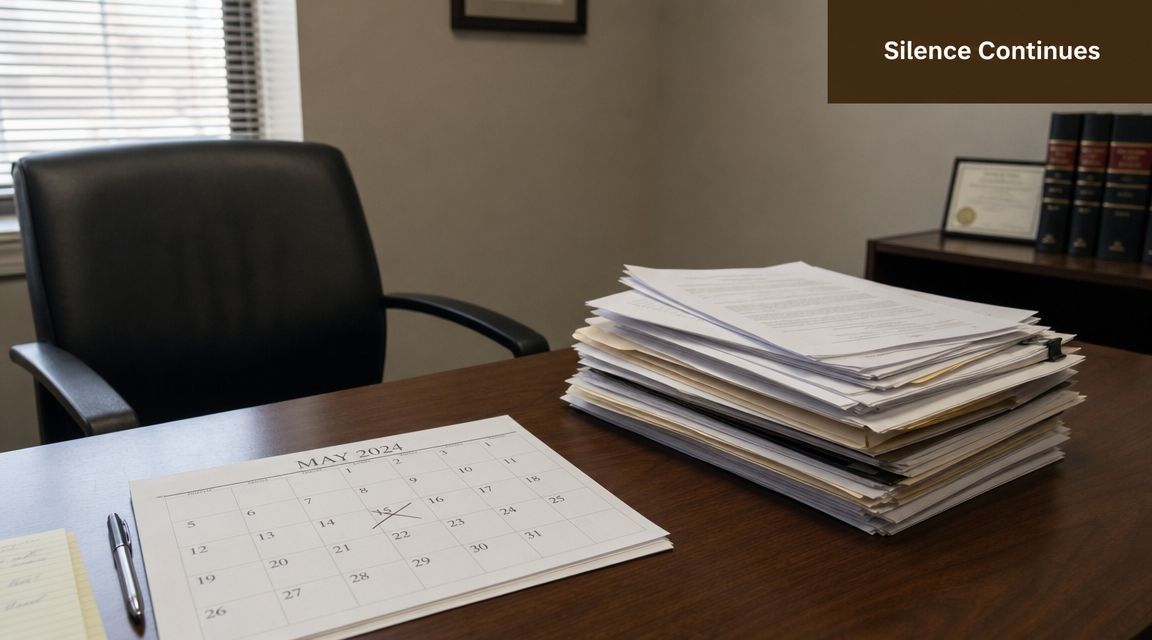
You served the lawsuit. The response deadline passed. The court docket shows nothing from the other side.
That silence is common in California real estate and probate litigation. A co-owner ignores a partition complaint. A person occupying inherited property never answers a quiet title case. A defendant in a probate-related civil action disappears after service. At that point, many clients assume the court will automatically hand them a judgment. It won't.
California treats default judgment as a formal, document-heavy process. In practice, it begins with one administrative step and ends with a judge reviewing whether your paperwork proves the relief you want. That matters in Orange County and Los Angeles because judges and clerks see many self-prepared default packets, and weak ones often fail for avoidable reasons. The issue usually isn't that the defendant stayed silent. The issue is that the plaintiff filed an incomplete record.
Table of Contents
- When the Other Side Goes Silent
- Prerequisites The Court Demands Before Filing
- Drafting Your Default Judgment Motion Package
- Proving Your Damages and Right to Relief
- Filing Serving and Avoiding Common Pitfalls
- After the Judge Signs the Judgment
When the Other Side Goes Silent
A common scene in my office looks like this. A property owner in Orange County serves the summons and complaint in a quiet title or probate-related case, waits out the response period, and hears nothing. The silence feels like the hard part is over.
It is not over yet.
In California, a defendant's failure to respond opens the door to default, but the court still expects the plaintiff to prove up the case in a way the judge can sign with confidence. While the defendant's silence is the trigger, the plaintiff's incomplete record is the most common reason for failure.
That point matters even more in real estate and probate disputes. A judge reviewing a request to quiet title, confirm an ownership interest, enforce rights tied to a deed, or resolve claims involving estate property usually wants more than a missed deadline and a proposed judgment. The court wants a clean record that shows who was served, what relief the complaint requested, and why the evidence supports that relief.
Generic online samples usually fall short. They may work as a rough starting point for a simple debt case. They often do not work well in Los Angeles or Orange County when the requested judgment affects title, possession, probate administration, or another non-monetary right. In those cases, the paperwork has to do more than recite procedure. It has to show the judge exactly how the requested order fits the pleadings and the exhibits already in the file.
Judges in these courts see many default packages. The ones that move smoothly are organized, specific, and easy to verify. The weaker ones leave gaps. Missing title documents, a vague declaration, relief that goes beyond the complaint, or an unsupported request for attorney fees can stop the process even when the defendant never appeared.
The good news is that default practice becomes manageable once you separate it into two jobs. First, get the procedural record right. Second, build an evidence package that matches the relief you want the court to grant.
Prerequisites The Court Demands Before Filing
Before asking a judge to sign anything, you need the court record to reflect that the defendant is in default. That sounds obvious, but it is where many filings go wrong.
The clerk-default step is not optional
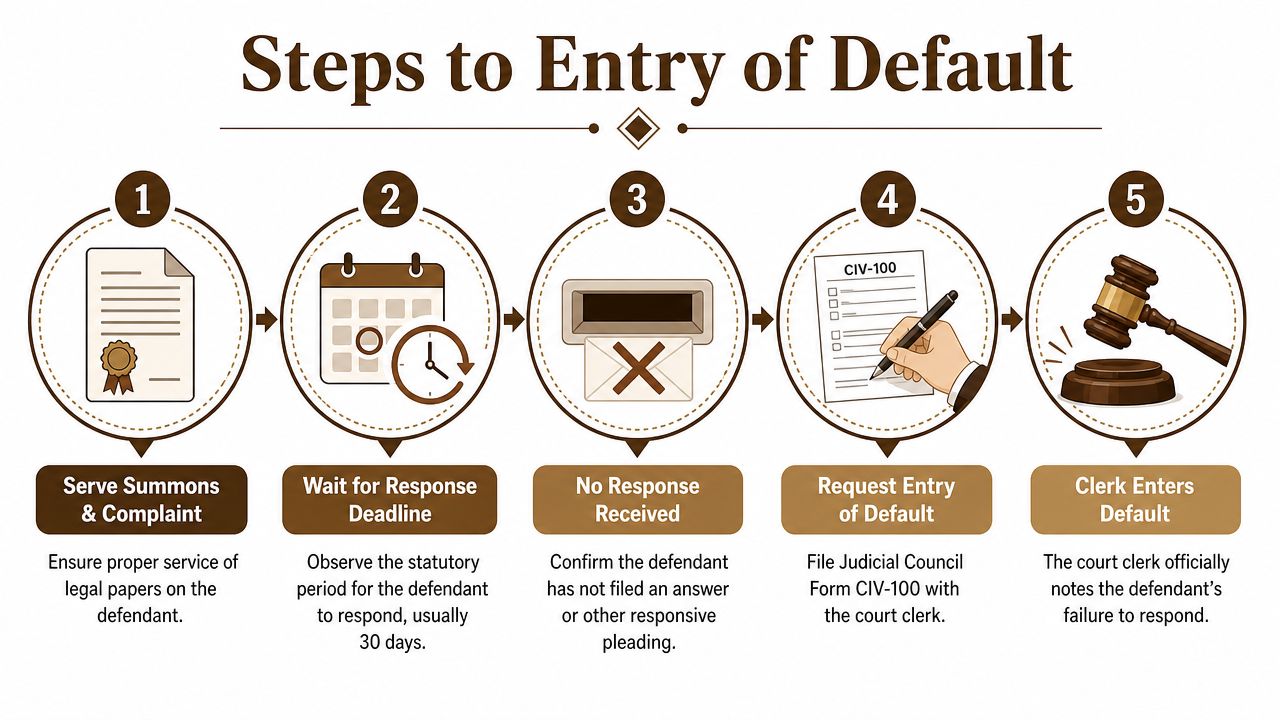
California lawyers often refer to this as obtaining the entry of default. It is the court's formal acknowledgment that the defendant did not respond in time. Without that step, the request for judgment is usually premature.
Courts in other jurisdictions say this very directly. North Carolina materials note that default judgment should not be entered without a prior default entry, and they identify common failure points such as missing proof of service, skipping the clerk-default step, or failing to include supporting affidavits, as described in the North Carolina benchbook on Rule 55 default judgment.pdf). The same practical lesson applies in California.
What the court usually expects to see
For California matters, the starting point is usually CIV-100, the Request for Entry of Default. But the form alone isn't enough. The court looks at whether service was completed correctly and whether the file supports moving the case into default status.
A careful filing package usually includes:
- Completed CIV-100: The form needs to match the complaint, the parties, and the docket. Small caption errors can create delays.
- Proof of Service of Summons: This is the court's basis for finding that the defendant had proper notice. If service is defective, default becomes vulnerable.
- Any required damages notice: In certain case types, California practice may require a statement of damages before judgment will be considered.
- A clean docket posture: If a responsive pleading was filed, even defectively, you may need to address that before pursuing default.
If the service record is weak, default judgment becomes a contest about notice instead of a decision on relief.
Why service issues matter so much in real estate and probate disputes
Property-related defendants often raise notice arguments later. That happens when someone says they were served at the wrong address, when substitute service was incomplete, or when the plaintiff sought relief broader than what the complaint fairly disclosed.
That is why experienced practice in Orange County and Los Angeles starts with a hard review of the service packet, not just the motion papers. The court wants confidence that the defendant had a real opportunity to appear. If the file doesn't show that, the judge may delay ruling, deny relief, or grant a narrower judgment than requested.
For claims involving personal injury or wrongful death, a Statement of Damages (CIV-050) can also matter. Even when that specific form is not part of your case, the underlying principle is the same. California courts want the defendant to have fair notice of what relief was sought before default locks the case into a one-sided record.
Drafting Your Default Judgment Motion Package
A default package succeeds or fails on how easily the judge can approve it from the file in front of them. In Orange County and Los Angeles, that usually means more than dropping in a sample motion for default judgment and changing the names. Judges want a packet that matches the complaint, tracks the docket, and gives them signable judgment language without forcing chambers to guess what relief is supported.

The practical question is simple. If the judge reads only your complaint, your declaration, your exhibits, and the proposed judgment, does the requested order make sense on its face?
In property and probate-related cases, that question matters more than in a routine collection matter. A request to quiet title, confirm ownership, cancel an instrument, approve a partition-related ruling, or enter declaratory relief often turns on the quality of the paper record. The defendant's silence does not fill factual gaps. Your package has to do that work.
What belongs in the package
A court judgment packet usually includes several pieces that have to fit together closely:
- Application or motion for default judgment: This tells the court what relief is being requested and under what theory.
- Attorney declaration or witness declaration: This provides the procedural history and the facts needed for judgment. In a real estate or probate dispute, that may include the chain of title, recorded documents, dates of death, heirship facts, possession history, or the reason a deed or claim is invalid.
- Declaration of nonmilitary status: Courts commonly require this before entering judgment against an individual defendant.
- Proposed judgment: The judge needs an order that can be signed as submitted or with minimal edits. If JUD-100 fits the case, use it. If the relief is more detailed, attach carefully drafted language that tracks the complaint.
- Exhibits: These are often the difference between a granted judgment and a continued hearing. Recorded deeds, probate filings, letters, contracts, accountings, and demand correspondence should be organized and authenticated.
- Caption cleanup documents if needed: If Doe defendants or unused parties remain in the case, deal with that before asking for final judgment.
The strongest packets are disciplined. They ask for no more than the pleadings support, and they prove each element of the requested relief with a declaration or exhibit the court can cite.
Court judgment versus clerk judgment
A true clerk's judgment is narrow. It works in a limited set of cases where the amount is fixed and the request is mechanical.
Most real estate and probate disputes do not fit that path. They call for a court judgment because the relief depends on documents, legal status, title history, equitable facts, or a combination of all four. In Orange County and Los Angeles, that distinction affects how you draft. Papers prepared as if the clerk can process them often come back deficient because the judge needs findings, not just totals.
That is why I treat the package as an evidence-backed proposed ruling. If the requested judgment affects title, possession, ownership shares, lien priority, or a probate-related property right, the proposed judgment should say exactly what happens after signature. Ambiguity creates delay. In title cases, it can also create recording problems later.
| Document | What it does | Why it matters |
|---|---|---|
| Request for judgment | States the relief sought | Keeps the ruling within the pleadings and gives the court a clear target |
| Declaration | Supplies facts under oath | Shows why the plaintiff is entitled to the exact order requested |
| Nonmilitary declaration | Addresses Servicemembers Civil Relief Act concerns | Removes a procedural defect that can block entry of judgment |
| Proposed judgment | Gives the judge signable language | Reduces revision requests and helps the order work in the real world |
| Exhibits | Supports the factual record | Proves title facts, probate status, damages, or other entitlement to relief |
Local practice also matters. Some judges want a package that reads cleanly from top to bottom with labeled exhibits and a proposed judgment that can be entered without rewriting. Others focus first on whether the requested relief is stated with enough precision to be enforceable or recordable. In both counties, a vague request is a common reason for delay, especially where the plaintiff wants non-monetary relief.
A short explainer can also help if you're comparing forms and procedure before drafting:
A sample motion is useful for structure. The winning package is the one that gives the court confidence to sign the judgment you need.
Proving Your Damages and Right to Relief
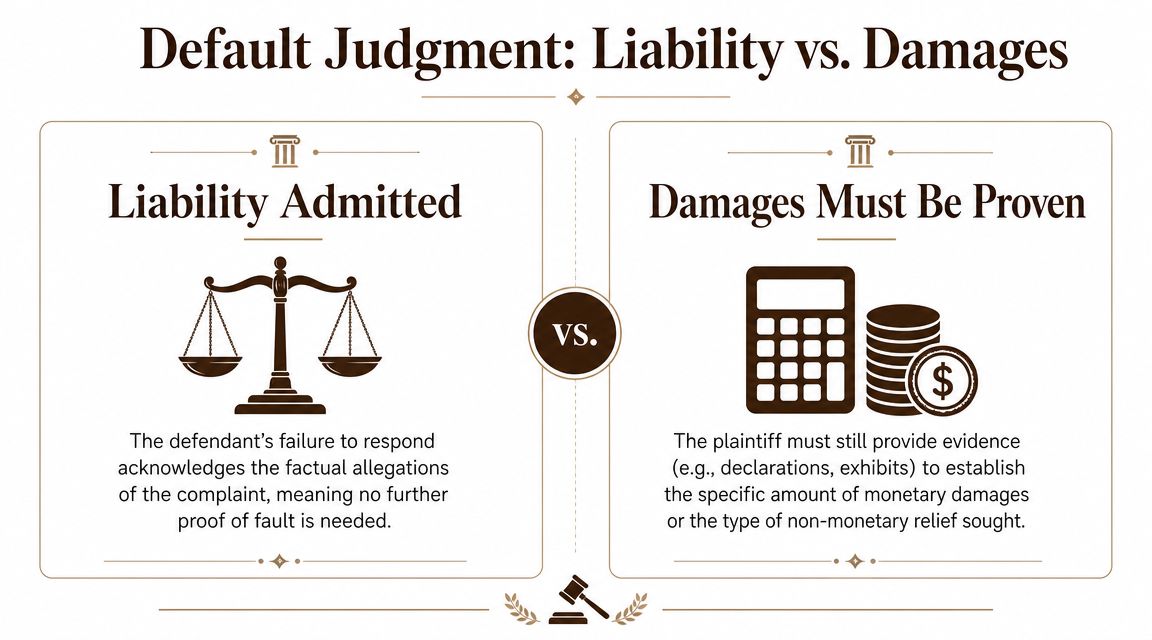
The most misunderstood part of default judgment is proof. A defendant's silence may establish liability, but it doesn't automatically establish the amount of money, the scope of title relief, or the terms of an equitable order.
A common pitfall is assuming default entitles the plaintiff to everything requested. It doesn't. For claims that are not a sum certain, the movant still has to prove the amount with admissible evidence. A federal default-judgment memorandum discussed a case seeking over $1.8 million, illustrating that even after default the court required evidentiary support, as discussed in the Lewis & Clark Law School default judgment materials.
Liability is one issue and remedy is another
This distinction becomes critical in Orange County and Los Angeles property litigation because many requests are not just about a dollar figure.
A complaint may ask the court to:
- Quiet title to remove an adverse claim
- Partition co-owned property
- Declare ownership interests after a probate-related dispute
- Award rents, reimbursements, or offsets
- Enter fees or costs if authorized
Each of those remedies requires proof appropriate for the request. A judge cannot automatically assume the correct outcome because no answer was filed.
Default admits the well-pleaded allegations of liability. It does not excuse the plaintiff from proving the remedy.
What persuasive proof looks like in property and probate cases
For a basic debt case, evidence may be straightforward. For a property or estate dispute, the evidence package should be more deliberate.
Consider the difference:
- Quiet title claim: Deeds, title reports, recorded instruments, probate orders, and a declaration explaining the chain of title can matter far more than a generic damages chart.
- Partition action: Evidence may include title documents, an explanation of ownership percentages, contributions to expenses, and supporting records for any reimbursement request.
- Probate-adjacent occupancy or ownership dispute: The court may need testamentary documents, letters, recorded transfers, written agreements, or evidence showing why a claimed interest is invalid.
A declaration by itself is often too thin when the requested relief affects ownership rights or recorded property interests. Judges want exhibits that can be reviewed against the complaint and then carried forward into a judgment.
One useful discipline is to ask whether a judicial officer unfamiliar with your case could verify every requested ruling from the documents alone. If the answer is no, the package likely needs more work.
Client-facing reality: The strongest default motions read less like a demand letter and more like a carefully indexed evidence file.
In non-monetary cases, the proposed judgment also needs precision. If the court is asked to determine title, define a percentage ownership interest, or order sale-related relief, vague language creates enforcement problems later. A technically granted judgment can still be difficult to use if the order isn't specific enough for the recorder, title company, or enforcement process.
Filing Serving and Avoiding Common Pitfalls
Otherwise solid cases frequently encounter difficulties. The papers may be substantively strong, but the filing, service, or final review is rushed.
In Orange County and Los Angeles practice, that's risky. Local procedures, e-filing rules, and department preferences can affect whether a default package is accepted cleanly or sent back for correction. Even after default, service issues still matter in many contexts, especially where the rules or the nature of the requested relief require that the motion papers be served.
What to double-check before submission
Before filing, review the packet as if you were the court clerk first and the judge second.
- Names and captions match: Party names should be identical across the complaint, proofs of service, request for default, declarations, and proposed judgment.
- Requested relief matches the complaint: Default judgment generally can't exceed or materially differ from what was pleaded.
- Every exhibit is authenticated: If a declaration refers to an attachment, label it clearly and make sure the attachment is included.
- Nonmilitary paperwork is complete: This is a routine source of preventable delay.
- Proof of service for the motion packet is handled correctly: Even when the defendant hasn't appeared, don't assume service can be ignored.
Why precision matters after default
California default practice is deadline-driven. If the procedure is mishandled, the other side may get a chance to undo the result. Materials discussing set-aside practice note that under California Code of Civil Procedure section 473(b), a motion to set aside a default or default judgment for mistake, inadvertence, surprise, or excusable neglect must typically be filed within six months, as summarized in the Texas Law Help guide discussing default-judgment timelines and California relief windows.
That means sloppy paperwork can create a judgment that looks final but remains vulnerable.
Common examples include:
- Overreaching relief: Asking for title, damages, fees, or orders that were not properly pleaded.
- Thin evidentiary support: Particularly in partition, quiet title, and probate-related disputes.
- Unresolved party issues: Forgotten Doe defendants, mislabeled entities, or inconsistent ownership descriptions.
- Interest or costs errors: Courts often correct or reject unsupported calculations.
- Incomplete service history: A weak service record invites a set-aside motion.
The practical trade-off is simple. Spending more time before filing usually means less time spent fixing the judgment later.
After the Judge Signs the Judgment
A signed judgment is a major step, but it isn't the finish line. It becomes useful only when you take the next procedural and enforcement steps correctly.
Turning judgment into action
Start by serving a Notice of Entry of Judgment if required in your case. That puts the other side on formal notice and helps trigger the timeline for post-judgment challenges or appeal-related deadlines.
Then consider enforcement tools that fit the dispute. In a money judgment case, a Writ of Execution may be the next move. In a real estate matter, recording an Abstract of Judgment can be especially important because it may create a lien against real property in the county where it is recorded. For families dealing with inherited property, co-owned homes, or estate-related ownership fights, that can turn a court order into actual power.
If the judgment includes title-related or equitable relief, make sure the signed order is in a form that can be used where it matters. That may mean recording it, presenting it to a title company, or using it in follow-up proceedings tied to sale, possession, or accounting.
The clients who fare best after default are usually the ones who treated the judgment as part of a larger strategy from the start. In California, especially in Orange County and Los Angeles property and probate disputes, success comes from building a record the court can trust and a judgment you can enforce.
If you need help preparing or reviewing a default package in a California real estate, probate, or related civil case, Tanner Law offers a free consultation. You can discuss the facts, the court forms, the evidence needed for your requested relief, and the practical steps to move your case toward an enforceable judgment.