Demurrer in California: A Strategic Legal Guide
You may have received a demurrer with the complaint papers, or your lawyer may be recommending one after reviewing a lawsuit involving a house, a trust dispute, a partition case, or a contract tied to California real estate. Either way, the word itself tends to sound more alarming than it is. In California law, a demurrer is a common procedural tool. It can be important, expensive if misused, and very effective when the problem in the pleading is legal rather than factual.
For families dealing with probate or property litigation, that distinction matters. A demurrer doesn't ask the judge to decide who is telling the truth. It asks whether the pleading, on its face, states a claim the court can legally act on. That difference often determines whether the case moves forward, gets narrowed, or comes back amended in a stronger form.
Table of Contents
- What to Do When You Face a Demurrer in California
- Understanding What a Demurrer Really Is
- Common Grounds for a Demurrer Under California Law
- The Demurrer Process From Filing to Hearing
- Demurrer vs Motion to Strike What Is the Difference
- Strategic Demurrer Guidance for Property and Probate Cases
- How Tanner Law Can Navigate Your Case Through a Demurrer
What to Do When You Face a Demurrer in California
If you're a homeowner, trustee, beneficiary, landlord, heir, or co-owner in a California dispute, getting served with a demurrer can feel like the other side is trying to end your case before it starts. Sometimes that is the goal. But a demurrer is not a trial, and it isn't a final ruling on the facts.
A demurrer in California is a challenge to the legal sufficiency of a pleading. In plain English, the other side is arguing that even if the court assumes your allegations are true, the pleading still doesn't state a valid legal claim. That can sound discouraging, but many demurrers result in the court allowing the plaintiff to amend and correct the problem.
First steps that matter
When a demurrer lands, the most useful response is a calm one.
- Read the target carefully: Find out whether the demurrer attacks the entire complaint or only particular causes of action.
- Separate law from emotion: A demurrer often says your pleading is incomplete, uncertain, or legally defective. It doesn't automatically mean the underlying events didn't happen.
- Identify the practical issue: In property and probate cases, the weak point is often standing, capacity, party alignment, or the failure to connect facts to a recognized legal claim.
- Act quickly: Demurrer practice runs on tight deadlines, and delay makes a fix harder.
A demurrer usually tells you where the pleading is vulnerable. Used correctly, that gives you a roadmap, not just a problem.
Why clients get confused
Many people assume a lawsuit moves in a straight line from filing to evidence to trial. California pleading practice doesn't work that way. The court may stop early and ask whether the legal blueprint is sound before the parties spend time and money on discovery.
That matters in disputes over title, inheritance rights, contracts for sale, trustee conduct, or partition claims. If the pleading is too thin, too broad, or aimed at the wrong defendant, the court may require a reset before the case can move forward.
Understanding What a Demurrer Really Is
A demurrer is best understood as a challenge to the case's blueprint. The court assumes the alleged facts are true for this purpose. The question isn't whether the plaintiff can prove the story. The question is whether that story, on the face of the pleading, adds up to a recognized claim under California law.
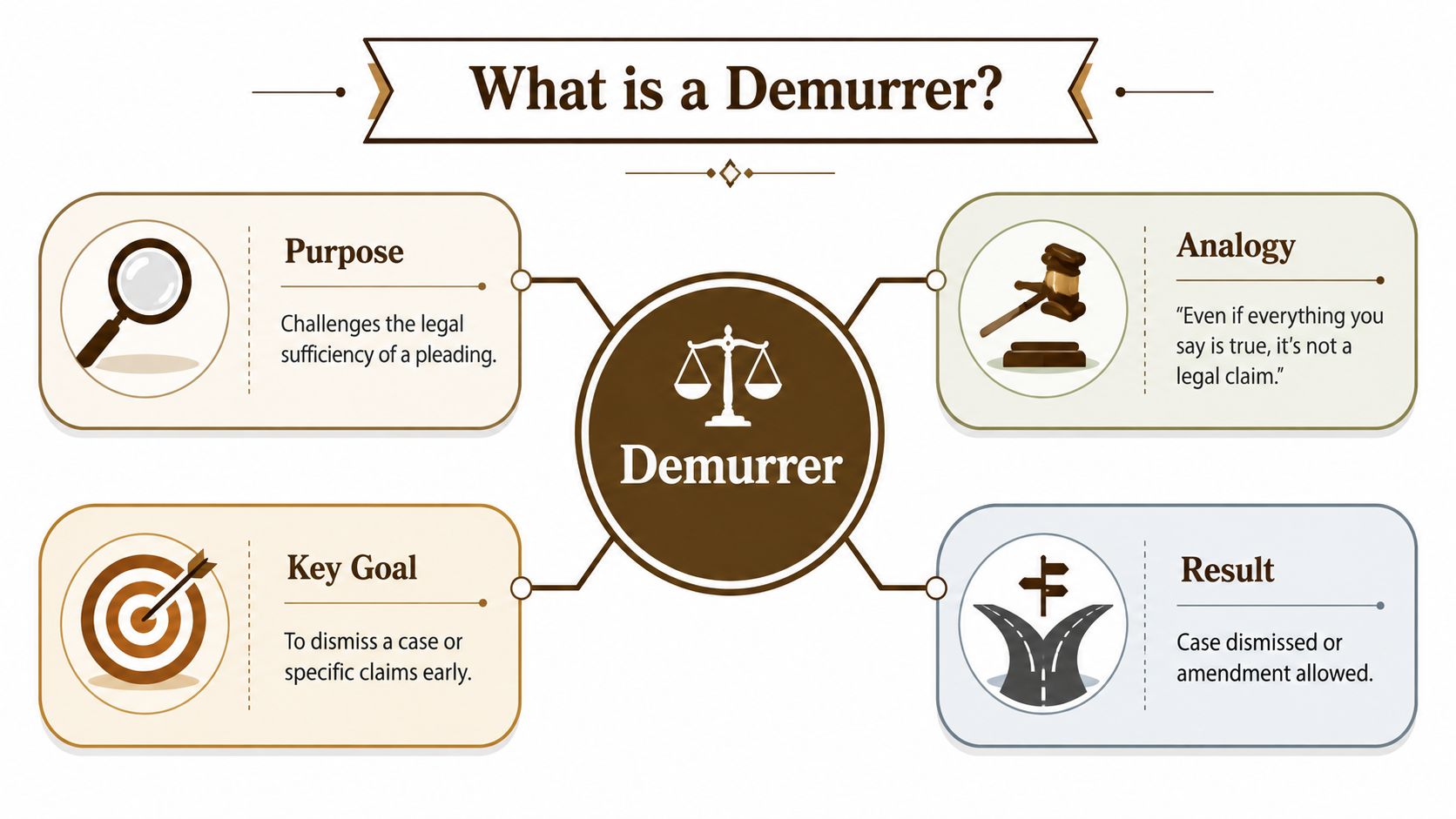
That point is central to California practice. A historical feature of demurrer procedure is that it is limited to the face of the pleading, courts accept factual allegations as true for demurrer purposes, and they do not weigh evidence. If the defect can be cured, the court generally allows amendment. If it can't, the claim or case may be dismissed, as described in this discussion of California demurrer practice as a pleading-based gatekeeping device.
What a demurrer is not
Clients often want to respond by gathering text messages, deeds, escrow records, trust documents, photographs, and witness statements. Those materials may become important later. But they usually aren't the main event on demurrer.
A demurrer is not:
- A mini trial: The judge isn't deciding credibility.
- A factual rebuttal: "That's not what happened" usually misses the point.
- A discovery motion: It doesn't force the other side to show evidence.
- A permanent loss in every case: Many sustained demurrers come with leave to amend.
A simple example
Suppose someone sues over a failed real estate deal and labels one claim "breach of contract," but the complaint never identifies the contract, never states who agreed to what, and never alleges the plaintiff performed or was excused from performance. A demurrer says the pleading is legally incomplete, even if every factual allegation is accepted as true.
Or take a probate-adjacent dispute. A person may be distraught about how family property was handled, but if the pleading doesn't clearly show why that person has the right to sue in that role, the defect may be legal at the outset.
The strongest demurrers don't argue about whose story is better. They show that the pleading, as drafted, doesn't reach a legally sufficient claim.
Common Grounds for a Demurrer Under California Law
California Code of Civil Procedure section 430.10 provides the usual grounds. In practical terms, a demurrer works best when the defect is obvious from the pleading itself. California practitioners use it to challenge issues such as jurisdiction, capacity, another action pending, misjoinder, uncertainty, or the failure to plead facts sufficient to constitute a cause of action, as summarized in this overview of demurrer grounds under California Code of Civil Procedure section 430.10.
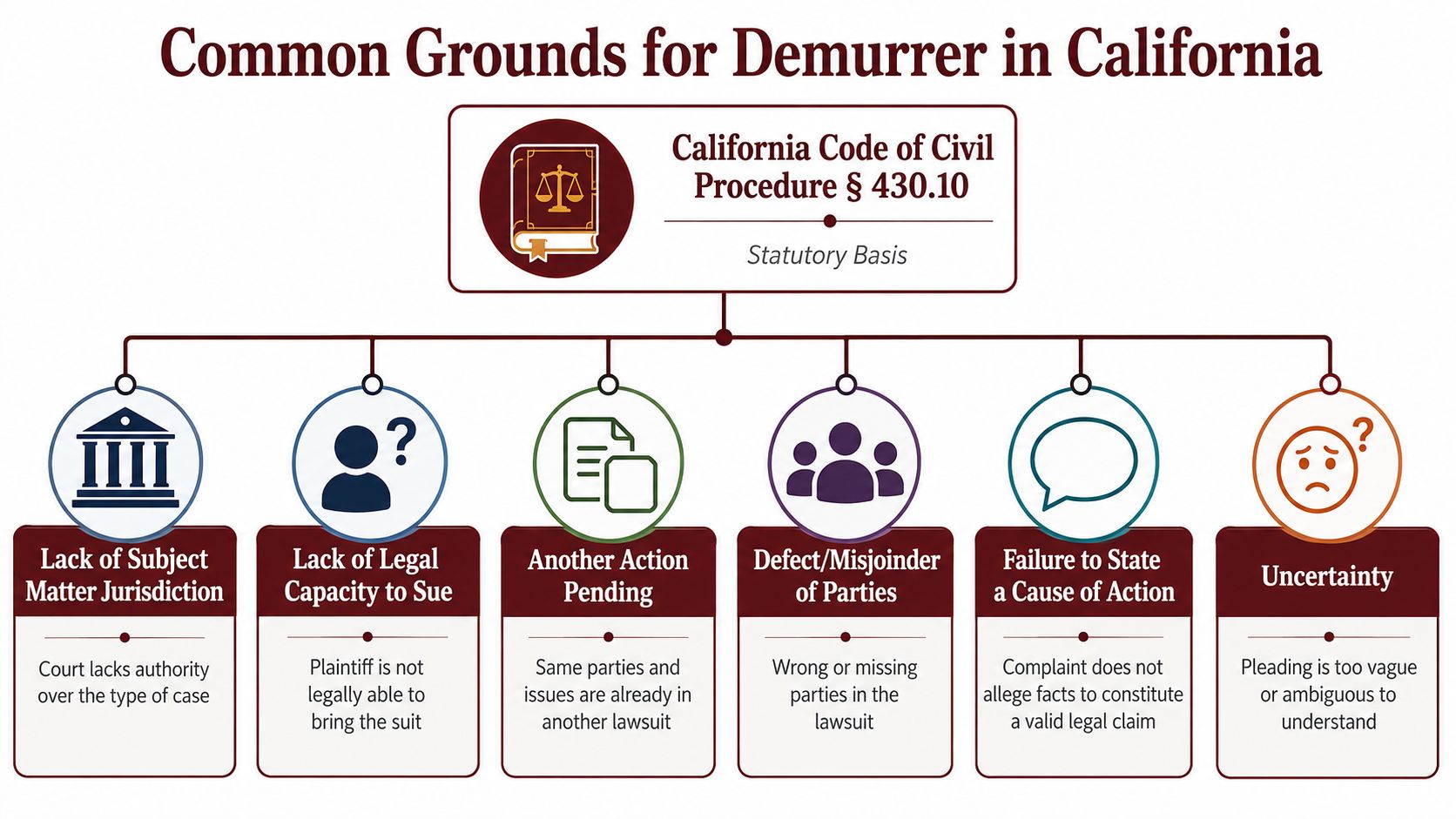
General demurrer
The most common version is the argument that the pleading fails to state facts sufficient to constitute a cause of action. This is the classic claim that the lawsuit, or a specific cause of action, doesn't meet the legal elements required.
Examples in California property and probate matters often include:
- A contract claim without core terms: The complaint says there was a deal, but doesn't allege the agreement in a way the court can evaluate.
- A quiet title style dispute without the necessary legal theory: The plaintiff describes conflict over ownership but doesn't connect the facts to a recognizable claim.
- A petition or civil complaint filed by someone without a pleaded basis for relief: The person may feel wronged, but the pleading doesn't establish a legal right to sue on that issue.
Special grounds that often matter
Some demurrers focus on more specific pleading defects. These can be powerful when used carefully.
| Ground | Plain-English meaning | Property or probate example |
|---|---|---|
| Lack of subject matter jurisdiction | The court doesn't have authority over that type of dispute | A party files in the wrong court for the relief sought |
| Lack of legal capacity to sue | The plaintiff may exist, but isn't legally in a position to bring the claim as pleaded | Someone sues in a representative role without properly alleging that role |
| Another action pending | The same dispute is already being litigated elsewhere | Co-owners are fighting over the same property in another active case |
| Defect or misjoinder of parties | Necessary parties are missing, or improper parties are included | A dispute over ownership is filed without all interests being accounted for |
| Uncertainty | The allegations are so vague or ambiguous that the defendant can't reasonably respond | A complaint references misconduct without identifying who did what |
What works and what doesn't
A good demurrer isolates a legal defect the judge can see on the face of the complaint. It is precise. It targets claims that are under-pleaded or legally unavailable.
A weak demurrer tries to disguise a factual dispute as a pleading problem. Courts usually see through that quickly. If the complaint is imperfect but understandable, and the core dispute is over what happened, the demurrer may only increase fees and delay.
Practical signals that a demurrer may be worth serious consideration
- The pleading skips elements: A cause of action is named, but essential allegations are missing.
- The wrong plaintiff is suing: Capacity or standing problems appear on the face of the pleading.
- The wrong court or procedural path was chosen: Jurisdictional issues can justify an early challenge.
- The claims are bundled too loosely: Multiple defendants are accused together without specific conduct tied to each.
The Demurrer Process From Filing to Hearing
California demurrer practice is structured and deadline-driven. The modern framework is codified in Code of Civil Procedure sections 430.10 through 430.90, and the California Rules of Court require a demurrer hearing to be set no more than 35 days after filing, or on the first available court date thereafter. The rules also give the opposing party a 10-day response window after an overruled demurrer, or after the time to amend expires when leave to amend is granted, under California Rule of Court 3.1320.
A visual overview helps most clients understand where the pressure points are.
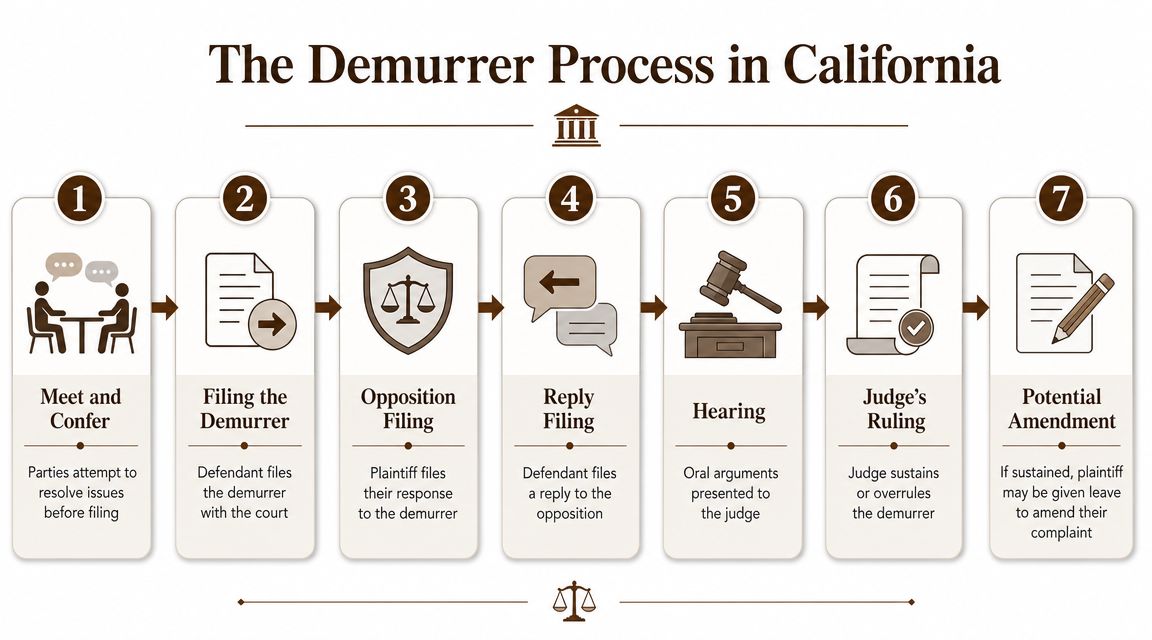
The basic sequence
The process usually unfolds in this order:
Meet and confer
Before filing, counsel typically addresses the pleading issues with the other side and asks whether amendment can solve them without court involvement.File the demurrer
The moving party identifies each ground separately and specifically. Precision matters.Set the hearing
The notice of hearing must comply with California procedure, and the hearing date must fit the court's timing rules.Opposition and reply
The plaintiff explains why the pleading is legally sufficient, or why amendment should be allowed. The defendant then replies.
A short explainer can also help if you're trying to understand the hearing stage in plain language.
What the judge can do
The ruling generally falls into one of three categories.
| Result | What it means | Practical effect |
|---|---|---|
| Overruled | The demurrer is denied | The challenged pleading stands, and the case moves forward |
| Sustained with leave to amend | The judge found a defect, but it may be fixable | The plaintiff gets a chance to revise the pleading |
| Sustained without leave to amend | The defect isn't curable as pleaded | The targeted claim, or sometimes the case, may be dismissed |
Practical rule: The hearing isn't just about winning or losing. Often the real question is whether the plaintiff can amend in a way that changes the case's leverage.
Where parties make mistakes
Plaintiffs often treat opposition papers like evidence packages. Defendants often overreach by attacking every cause of action, even when only one or two have real legal problems. Both approaches can backfire.
In property and probate litigation, the smarter approach is narrower. Challenge the claims that are facially defective. Defend the claims that are adequately pleaded. Preserve credibility with the court.
Demurrer vs Motion to Strike What Is the Difference
These tools are related, but they do different jobs. A demurrer says, in effect, this cause of action doesn't legally work. A motion to strike says, this particular allegation or request should be removed.
One useful way to think about it is a book analogy. A demurrer tries to remove a whole chapter because it doesn't belong in the book at all. A motion to strike removes specific lines that shouldn't be there.
Demurrer vs. Motion to Strike at a Glance
| Aspect | Demurrer | Motion to Strike |
|---|---|---|
| Main target | A cause of action or pleading's legal sufficiency | Particular allegations, prayers, or improper matter |
| Core argument | Even assuming the facts are true, no valid legal claim is stated | The challenged language is improper, irrelevant, or not permitted |
| Best use | Missing legal elements, capacity issues, jurisdictional defects | Narrowing remedies or removing defective portions of a pleading |
| Typical result | Claim survives, gets amended, or is dismissed | Specific allegations are removed or left in place |
Why the distinction matters
In California litigation, using the wrong tool wastes money and can signal to the court that counsel hasn't identified the actual defect. If the problem is that the claim itself fails, a demurrer is usually the cleaner choice. If the problem is that one paragraph goes too far or asks for relief not supported by the pleading, a motion to strike may fit better.
For clients, the practical takeaway is simple. Not every bad allegation calls for a demurrer, and not every flawed complaint needs a broad attack.
Strategic Demurrer Guidance for Property and Probate Cases
In real cases, the decision to file or fight a demurrer is rarely abstract. It is about strategic advantage, timing, cost, and whether the defect is worth presenting to the court. That is especially true in California disputes involving inherited homes, trust-related occupancy fights, co-owner conflicts, title problems, and contract claims tied to real estate.

For defendants deciding whether to file
A demurrer is often worth considering when the complaint has a clean legal flaw that can be isolated early. That includes a claim missing essential elements, a mismatch between the alleged facts and the legal theory, or a pleading brought by the wrong party in the wrong capacity.
It may be less attractive when the complaint is merely messy but curable. In that situation, the plaintiff may amend, tighten the pleading, and return with a stronger case while both sides spend more on motion practice.
Strategic reasons a demurrer can make sense
- Narrow the fight early: If only some causes of action are defective, a partial demurrer can reduce noise and focus discovery.
- Force clarity: In ownership or probate-related disputes, vague accusations can sometimes be turned into specific allegations the defense can answer.
- Create a record: A carefully framed pleading challenge can define the issues that matter later.
When it may not be the best move
- The defect is factual, not legal: If the core argument is about evidence, save it for later stages.
- Amendment is obvious: If the plaintiff can fix the issue with a straightforward revision, the demurrer may only delay the inevitable.
- The case calls for speed: Some disputes are better addressed through immediate factual development rather than pleading battles.
For plaintiffs responding or amending
If your complaint draws a demurrer, don't assume the case is collapsing. Often the better question is whether the pleading says enough, in the right way, against the right parties.
When amendment is allowed, use it deliberately:
- Add facts tied to elements: Don't just add background. Add allegations that satisfy the legal requirements of the claim.
- Clarify party roles: In probate and trust disputes, identify who is acting individually, as trustee, as beneficiary, or in another capacity.
- Separate theories cleanly: Don't blend contract, fraud, title, and equitable theories into one indistinct story.
If the court gives leave to amend, treat that as an opportunity to rebuild the complaint with discipline. A rushed amendment often invites a second demurrer.
The limited civil issue many people miss
One of the most important strategic distinctions in demurrer in California practice involves limited civil cases. California law bars special demurrers in limited jurisdiction matters, which means parties can't rely there on uncertainty or ambiguity arguments and often must address those concerns through defenses or later motions, as noted in this discussion of special versus general demurrers in limited jurisdiction cases.
That matters in smaller contract and property disputes. A litigant may assume the complaint is too vague and file a special demurrer anyway. In limited civil court, that can be a wasted filing. The stronger strategy may be to answer, assert affirmative defenses, and develop the record in a more suitable procedural posture.
How Tanner Law Can Navigate Your Case Through a Demurrer
A demurrer is one of those California procedures that feels obscure until it lands in your case. Then it becomes urgent. Whether you're bringing a claim involving property, probate, co-ownership, or a real estate contract, the right response depends on more than a definition. It depends on identifying the actual defect, the likely ruling, and what the next version of the case will look like if amendment is allowed.
That is where experienced California litigation judgment matters. A strong demurrer is targeted. A strong opposition is disciplined. A strong amendment fixes the actual problem instead of rewriting around it. In Orange County and Los Angeles courts, those differences can shape the entire direction of a case.
Tanner Law represents clients in property disputes, probate-related litigation, contract matters, civil defense, and related California civil cases. William T. Tanner has served clients since 1994 and brings both courtroom experience and real estate insight to disputes where ownership rights, family interests, and litigation strategy intersect.
If you're dealing with a demurrer, or you're considering filing one in a California property, probate, or contract dispute, schedule a free consultation with Tanner Law. You can discuss the facts of your case, the likely procedural options, and the strategy that best protects your position.