What Is a Mechanics Lien on Property: Your 2026 Guide
A mechanics lien is a legal claim against your property by an unpaid contractor, subcontractor, laborer, or material supplier. It's a statutory security interest that attaches to title itself, and in California it can become a serious problem fast because lien rights are tied to strict deadlines.
If you're reading this because a title company found a lien during a sale, or because you just received a notice from someone you never hired directly, take a breath. This issue is serious, but it's manageable if you act quickly and understand what the lien does. In plain terms, a mechanics lien gives someone who improved real property a legal tool to seek payment by claiming an interest in the property.
That's why homeowners in Orange County often feel blindsided by it. You may think, “I paid my contractor, so how can there be a claim against my house?” Under California law, the answer often turns on who worked on the project, who got paid, and whether the required notice and recording rules were followed. If you want the simplest answer to what is a mechanics lien on property, it's this: a lien is a powerful tool. It doesn't mean someone instantly takes your home, but it can absolutely interfere with your sale, refinance, or peace of mind.
Table of Contents
- Understanding the Mechanics Lien A Homeowners Introduction
- Who Has the Right to File a Mechanics Lien in California
- The Strict Timeline for Filing a California Mechanics Lien
- How a Mechanics Lien Affects Your Property Title
- How to Remove or Challenge a Mechanics Lien
- Practical Steps to Protect Your Property from Liens
- When to Contact a Real Estate Attorney
Understanding the Mechanics Lien A Homeowners Introduction
A common Orange County scenario goes like this. You're trying to refinance your home in Irvine, sell a rental in Anaheim, or close escrow on a property in Santa Ana, and then the title report shows a mechanics lien you didn't expect. Suddenly, a project you thought was finished is now affecting the property itself.
That surprise happens because a mechanics lien isn't just a collection letter. It's a property-based claim created by statute. As explained in this overview of mechanics liens, a mechanics lien is a statutory security interest that attaches to title, can “run with the land,” and once properly perfected can often take priority over later-recorded encumbrances.

Why the law allows this kind of claim
California law treats construction work differently from ordinary unpaid bills. The reasoning is straightforward. If someone provided labor or materials that improved your real property, the law gives that person a path to secure payment through the property that benefited from the work.
That's why the phrase what is a mechanics lien on property matters so much for homeowners. It's not just about whether a bill is owed. It's about whether a claimant used the legal process to tie that payment dispute to your title.
Practical rule: If a lien has been recorded against your property, treat it as a title problem first and a payment dispute second.
What it means for a homeowner
Most homeowners hear the word “lien” and assume foreclosure is immediate. That's not how this works. A recorded mechanics lien doesn't automatically transfer ownership, and it doesn't mean a sheriff shows up tomorrow.
It does mean you should stop guessing and start reviewing documents. In my view, the first mistake property owners make is minimizing the issue. The second is paying the wrong person without getting the right release paperwork.
Who Has the Right to File a Mechanics Lien in California
California gives lien rights to more people than many Orange County homeowners realize. A valid claimant is often anyone in the construction payment chain who provided labor, materials, equipment, or certain professional services that improved the property. In plain terms, lien rights can extend well beyond the contractor you hired.
That point matters because owners often focus only on the prime contract and miss the actual risk. A subcontractor, laborer, or supplier can assert lien rights even though you never negotiated with them, never approved their invoice, and may not have known they were on the job at all.
The list is broader than homeowners expect
The parties who may claim a mechanics lien in California commonly include:
- Direct contractors you hired for the project
- Subcontractors hired by the direct contractor
- Laborers who performed work on the improvement
- Material suppliers that furnished items used in the work
- Some design professionals, depending on the work and timing involved
For homeowners, the practical takeaway is simple. Do not assume "I only hired one contractor" means only one party can record a lien.
Your lack of a direct contract does not solve the problem
This is the mistake I see most often in Orange County disputes. The owner pays the general contractor, assumes the job is financially closed, and then receives a preliminary notice or recorded lien from a lower-tier claimant who says they were never paid.
That claim may still be legally serious.
California mechanics lien law protects parties who improved the property, not just parties who signed the main agreement with the owner. If the claimant preserved rights properly, your title can be affected by a dispute several steps down the payment chain.
Practical rule: If a subcontractor or supplier sends you a preliminary notice, treat it as an early warning that they may later claim a lien against your property.
Why this catches homeowners off guard
Owners usually believe payment should follow the contract. In construction, the lien system follows the improvement itself. That is why a payment fight between a contractor and its subcontractor can become your title problem.
The safest approach is to track the full payment chain from the start of the project. Ask for clear identification of subcontractors and suppliers. Match payment draws to conditional and unconditional lien releases. Do not release final payment just because the work appears finished.
If you own property in Orange County and a party you never hired is asserting lien rights, do not dismiss the claim as invalid without reviewing the paperwork. The answer usually turns on status, notice, and timing, not on whether you personally signed a contract with that claimant.
The Strict Timeline for Filing a California Mechanics Lien
A lien dispute often turns on one question first. Was the deadline met?
For California homeowners, that matters more than people expect. A contractor, subcontractor, or supplier may claim they are owed real money and still lose lien rights if they missed a required notice, recorded too late, or failed to file suit on time. I see Orange County owners focus on the payment argument first. That is a mistake. Start with the calendar.
California's lien process is rigid. The dates are not technical side issues. They often decide whether the claimant has any enforceable lien rights at all. That is especially important in Orange County, where a pending sale, refinance, or probate transfer can fall apart fast once a lien hits title.
The key California steps
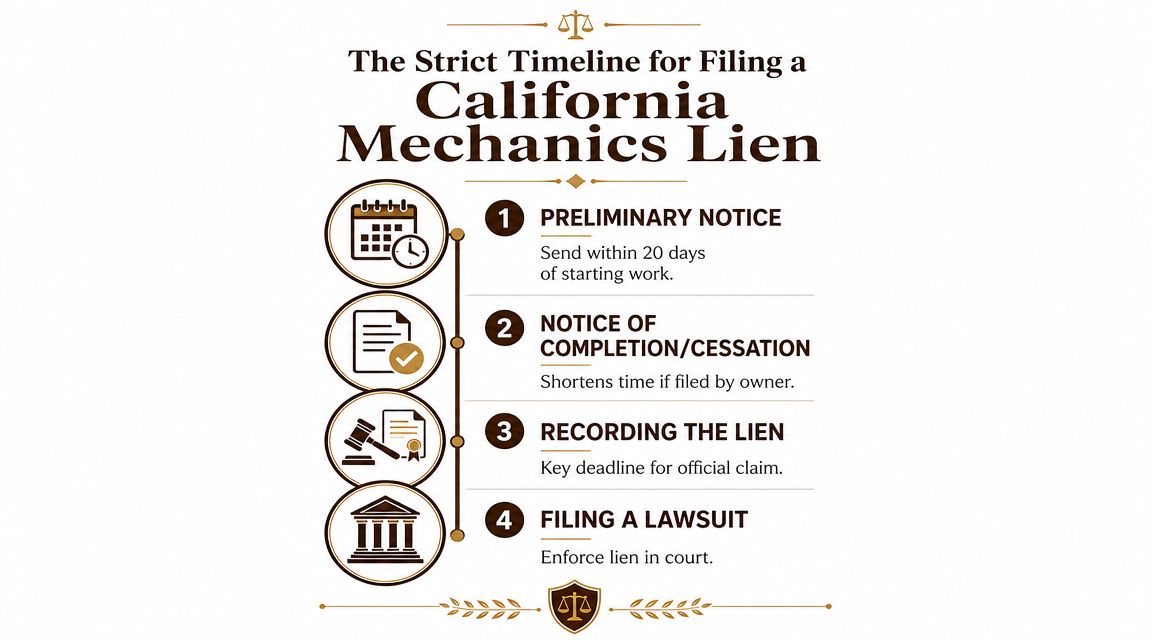
In California, lien rights usually depend on a sequence of deadlines, not one isolated filing.
Preliminary Notice
Many claimants must serve a preliminary notice early in the job to preserve lien rights. Homeowners usually hear this called the 20-day notice. If you receive one, do not panic. It does not prove the claim is valid or that you owe that party money. It means the claimant is preserving the right to assert a lien later if payment breaks down.Notice of Completion or Notice of Cessation
Owners may record one of these documents after the project ends or work stops. In California, that can shorten the claimant's deadline to record a lien. For Orange County property owners, this is not paperwork to treat casually. The recording date can change the entire timing analysis.Claim of Lien
This is the document recorded against the property. Once recorded, the dispute moves beyond a private payment fight and into your chain of title.Foreclosure Lawsuit
Recording the lien is only part of the process. To enforce it, the claimant must also file a lawsuit within the required period. If that deadline is missed, the recorded lien may become unenforceable even though it still appears in the public record until cleared.
California Mechanics Lien Key Deadlines
| Action | Who | Deadline | Notes |
|---|---|---|---|
| Preliminary Notice | Many contractors, subcontractors, and suppliers | Send within 20 days of starting work | Often called the 20-day notice. Missing it can seriously limit lien rights. |
| Notice of Completion or Cessation | Property owner | Timing depends on project completion facts | Can shorten later lien deadlines for claimants. |
| Recording the Lien | Claimant | Strict California deadline applies | Must be recorded properly with the county recorder. |
| Filing a Lawsuit | Claimant | Strict California enforcement deadline applies | A recorded lien does not enforce itself. Court action is required. |
What homeowners should check immediately
Do not argue with the claimant based on memory or a few text messages. Pull the documents and verify the timeline in order.
- Date review: Compare the last work date, preliminary notice date, lien recording date, and any owner-recorded notice of completion or cessation.
- Service review: Confirm whether required notices were served, and whether service appears legally proper.
- Recorder review: Get the recorded lien directly from the county recorder. In Orange County, I want clients reviewing the recorded document, not a screenshot from escrow or a forwarded email.
- Project scope review: Match the lien claim to the labor or materials tied to your property.
A mechanics lien case usually rises or falls on paperwork.
That is why early legal review matters. If you are an Orange County homeowner and a lien was recorded close to a sale, refinance, or loan modification, have counsel review the dates before you negotiate payment. A claimant with a weak timeline may not have the advantage they claim. A claimant who met every deadline needs to be handled differently, and fast.
How a Mechanics Lien Affects Your Property Title
A recorded mechanics lien doesn't instantly strip ownership from you. But it does something almost as disruptive. It clouds title.
Under California's Contractors State License Board explanation, the lien becomes public record and can block refinancing or sale until it is released, paid, or otherwise resolved. That practical effect is why lenders, escrow officers, and title companies take these claims seriously.
What “cloud on title” means in real life
If your title is clouded, a buyer may refuse to close. A lender may refuse to fund. A title insurer may demand resolution before issuing coverage.
For Orange County homeowners, that often surfaces at the worst possible time. You're already in escrow, rate-lock deadlines are approaching, or a probate sale needs a clean transfer, and then the lien appears on the report.
A mechanics lien provides a significant advantage because it interferes with marketability. The claimant doesn't need to seize the property immediately to pressure a resolution. The mere existence of the recorded claim can stall the transaction.
Why priority matters
Lien priority is one of the technical reasons these claims carry so much weight. As noted earlier, properly perfected mechanics liens can affect the stack of claims against the property in ways that worry lenders and title companies.
That doesn't mean every lien beats every other interest. It does mean owners shouldn't dismiss a lien as “just a contractor dispute.” Once title is involved, the consequences reach beyond the contractor relationship.
Here's the practical effect owners usually face:
- Sale problems: Escrow won't move smoothly while title remains clouded.
- Refinance problems: Lenders typically want the lien removed or addressed before closing.
- Settlement pressure: Owners often pay or negotiate to keep the transaction alive.
- Litigation risk: If the claimant files suit to enforce the lien, the dispute becomes more expensive and more urgent.
The lien's power comes from blocking options. It limits your ability to sell, refinance, or transfer the property on your schedule.
How to Remove or Challenge a Mechanics Lien
A recorded mechanics lien does not mean the claimant automatically wins. It means you need a fast, organized response. In Orange County, I often see homeowners weaken their position because they wait too long, say the wrong thing in writing, or pay without getting the right release documents signed.
Start by figuring out what kind of problem you have. Some liens are valid and should be resolved quickly. Some are legally defective and should be challenged hard. Others sit in the middle, where the smart move is to clear title first and fight about the money second.
Pay and get a signed release if the claim is valid
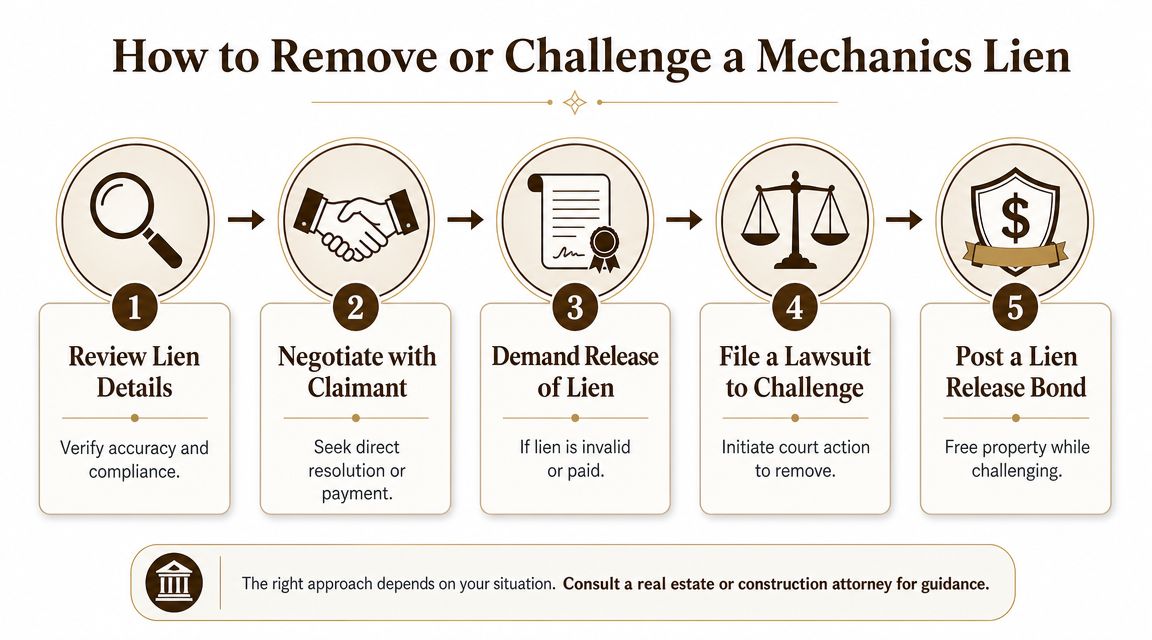
If the debt is legitimate, resolve it properly. Do not send payment based on a phone call, a text thread, or a promise that the lien will be removed later.
Get the correct signed release and confirm it matches the recorded claim. If multiple parties worked on the project, make sure you are not paying one claimant while another subcontractor or supplier still has lien rights tied to the same job. California construction payment disputes often involve more than the contractor you dealt with directly.
Challenge the lien if the claimant missed the rules
California mechanics lien law is technical. That helps homeowners when the claimant cut corners.
Review the lien for common defects:
- Preliminary notice problems: Many claimants must serve a preliminary notice to preserve lien rights.
- Recording or enforcement deadline problems: Missing a statutory deadline can kill the claim.
- Wrong property or owner information: An incorrect legal description or misidentified owner can matter.
- Inflated amounts: A lien that overreaches may give you defenses and improve your settlement prospects.
- Non-lienable work: Not every complaint about a home project supports a mechanics lien under California law.
In Orange County, title problems often surface during escrow, probate administration, or a refinance. That timing matters. If a closing date is close, your legal strategy should focus on speed first and full dispute resolution second.
Use a bond or file suit when title cannot wait
Sometimes, time is the critical factor. If a sale, refinance, or estate transfer is about to stall, a lien release bond may be the fastest way to remove the cloud from title while the underlying dispute continues.
Court action may also be necessary. If the lien is improper and the claimant refuses to release it, you may need to file a targeted lawsuit, including a quiet title claim or related real estate litigation. Tanner Law handles these property disputes in Orange County and surrounding courts.
Before deciding, it helps to understand the process visually.
A practical response plan
If a lien shows up against your property, follow this order:
- Get a copy of the recorded lien from the county recorder and read every line.
- Compare it to your project file, including the contract, change orders, invoices, proof of payment, and any preliminary notices.
- Check the deadline pressure for escrow, refinancing, or court action.
- Send a formal demand for release if the lien is defective, expired, or already paid.
- Decide quickly whether to settle, bond around the lien, or sue based on the strength of the claim and the urgency of clearing title.
Do not argue lien law by text message with a contractor. Put everything in documents. If title is blocked or a deadline is close, get a California real estate attorney involved immediately.
Practical Steps to Protect Your Property from Liens
The best mechanics lien dispute is the one you prevent before the first hammer swing. Homeowners who treat payment control as part of the project usually avoid the worst outcomes.
That starts with discipline. If you're spending serious money on improvements to a home or investment property in California, manage the project like a legal file, not just a renovation.
The five habits that matter most
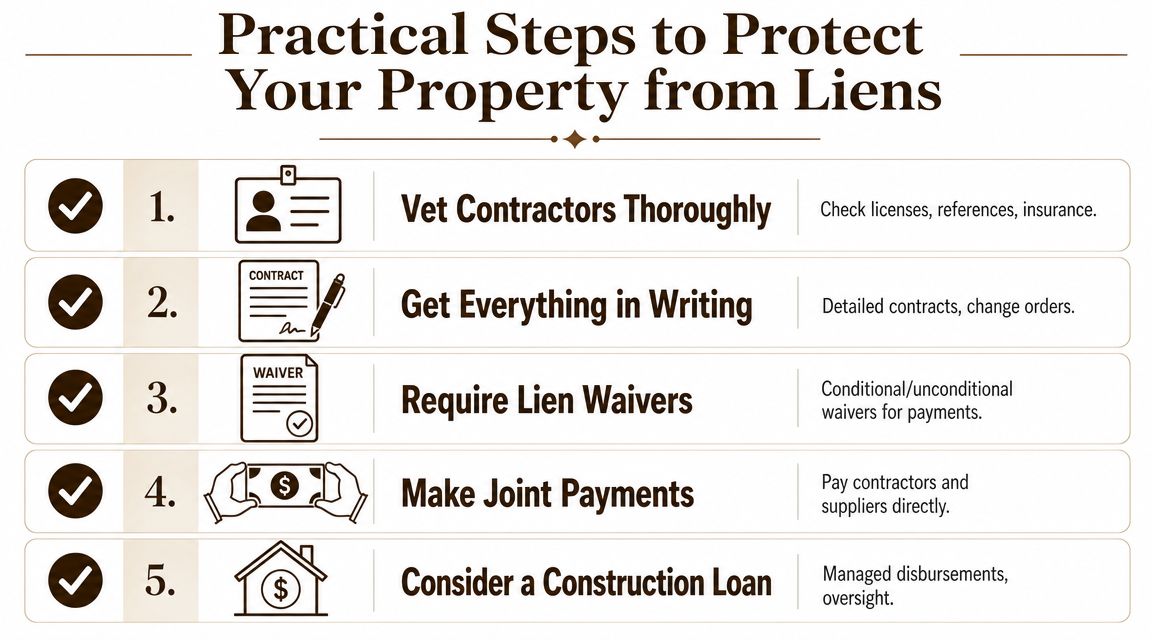
- Vet contractors carefully: Check licensing, insurance, references, and whether the contractor has a history of payment disputes.
- Use clear written contracts: Scope, price, payment schedule, and change order rules should all be in writing.
- Track every notice: If subcontractors or suppliers send notices, keep them in one project folder and don't ignore them.
- Use lien waivers and releases: Progress payments should be matched with the correct waiver paperwork.
- Consider joint checks when needed: Paying a contractor and supplier together can reduce the risk that lower-tier parties remain unpaid.
What homeowners get wrong
The most common mistake is assuming full payment to the general contractor ends the risk. It doesn't. If money doesn't flow down the chain, your property can still become the collection target.
The second mistake is sloppy paperwork. Cash payments, vague change orders, and missing releases create the exact confusion that lien disputes feed on.
A better approach is simple:
| Risky habit | Better habit |
|---|---|
| Paying without documentation | Paying only against written invoices and signed releases |
| Ignoring preliminary notices | Tracking every notice and matching it to project participants |
| Verbal change orders | Signed written change orders |
| One final lump payment | Controlled payments tied to progress and paperwork |
If you want to protect title, act like title matters from day one. That mindset saves owners a lot of money and stress later.
When to Contact a Real Estate Attorney
Some lien issues can be resolved with clean paperwork and direct negotiation. Others need legal action immediately. You should contact a California real estate attorney if any of the following is true:
- You received a preliminary notice and don't understand who sent it
- A mechanics lien has already been recorded
- You're selling or refinancing and title is now clouded
- You believe the lien is false, overstated, or expired
- A foreclosure lawsuit has been filed or threatened
- The property is part of a probate, trust, partition, or co-ownership dispute
In Orange County, timing matters because real estate transactions move quickly and title problems don't fix themselves. A lawyer can review whether the claimant followed California procedure, identify available defenses, and help you choose the right strategy. That may be negotiation, demand for release, a bond, or litigation to clear title.
My direct advice is this: if a lien is affecting your property rights, don't try to solve it by trading accusations with the contractor. Get a legal review early. It's usually cheaper to challenge a lien promptly than to clean up the damage after escrow falls apart.
If you're dealing with a mechanics lien, a title problem, or a payment dispute tied to your California property, contact Tanner Law to schedule a free consultation. We can review the recorded documents, explain your options under California law, and help you protect your home, investment, or pending real estate transaction.