Right of Survivorship in California Explained
A parent dies, and the family assumes the house will pass to the surviving child or spouse. Then someone reads the deed and discovers that the property was held as tenancy in common, not with a right of survivorship. The deceased owner's share may now belong to the estate, creating a probate matter, possible disagreement among heirs, and delays for the people still living in the home.
This situation is familiar to families in Orange County and Los Angeles. The question usually isn't whether the family intended to avoid conflict. The question is whether the title language carries out that intention under California law.
Table of Contents
- Introduction to Right of Survivorship for California Families
- What Right of Survivorship Means and How It Works
- Joint Tenancy vs Tenancy in Common Under California Law
- Community Property With Right of Survivorship in California
- How Right of Survivorship Is Created and Severed in California
- Common Pitfalls and Sample Clause Language to Get Right
- Protect Your Property and Plan Ahead With Tanner Law
Introduction to Right of Survivorship for California Families
The right of survivorship determines what happens to a co-owner's interest when that owner dies. In the right arrangement, the deceased owner's interest passes automatically to the surviving owner or owners. In another arrangement, the interest becomes part of the deceased owner's estate and may pass under a will, trust, or intestacy law.
That difference can turn on a few words in a deed. A family may believe that because two people bought a home together, the survivor will automatically own it. California law doesn't allow families to rely on that assumption. The deed or other title document must establish the ownership form that creates survivorship.
Practical rule: Don't decide what happens at death by looking only at who paid for the property or who occupies it. Read the vesting language on the recorded title document.
Consider a married couple who owns a home in Santa Ana. If the deed expressly creates a survivorship arrangement recognized by California law, the surviving spouse may obtain the deceased spouse's interest without ordinary administration of that property. If the deed instead creates tenancy in common, the deceased spouse's share remains available for disposition through the estate.
The same issue arises when siblings, unmarried partners, parents and children, or investment partners buy real estate together. Survivorship may produce a simple transfer to the people who remain on title, but it can also defeat a carefully intended inheritance plan if the deceased owner wanted the property to go to children or another beneficiary.
Why title matters more than family expectations
A will generally controls property that belongs to the decedent at death. Survivorship property works differently. The deceased owner's interest is extinguished at death, so that specific interest isn't available for the will to redirect. The result can surprise a family that prepared a will but never reviewed the deed.
California has also created a special form for married couples, community property with right of survivorship. It combines community property ownership with an automatic transfer feature, but it must be created through compliant deed language and written acceptance.
By the end of this guide, you'll understand how joint tenancy, tenancy in common, and community property with right of survivorship differ. You'll also know what language to look for, how survivorship can be severed, and why a deed review should be part of any California estate plan.
What Right of Survivorship Means and How It Works
The right of survivorship is a legal feature of certain co-ownership arrangements. It isn't a separate inheritance document, and it isn't something a will automatically creates. For real estate, the controlling language usually appears in the deed or another legally effective transfer document.
The easiest way to understand the concept is to think of ownership interests as streams flowing into a shared channel. During life, each joint tenant has an interest in the property. At death, the deceased owner's stream doesn't flow into the estate. It ends, and the surviving owner's or owners' interests enlarge by operation of law.
In a joint tenancy, the deceased co-owner's interest is extinguished at death, while the surviving co-owner or co-owners receive the enlarged interest automatically. Because the asset passes outside probate, the deceased owner's will can't redirect that specific property interest. Cornell Law School's explanation of the right of survivorship describes this operation and its effect on the deceased tenant's estate.

The transfer happens by law, not by the will
Suppose two people hold a California property as joint tenants with right of survivorship. When one dies, the survivor doesn't receive a transferable share under the deceased owner's will. Instead, the deceased owner's title interest has ended, and the survivor's interest has expanded.
That distinction explains why a will may be ineffective for this particular asset. A will can direct property that remains in the decedent's estate. It can't redirect an interest that no longer exists in that estate at death.
The surviving owner still needs to complete practical title steps. Those steps can include providing proof of death and recording or registering documents required for the property and the title company. Administrative paperwork isn't the same as probate administration. The legal transfer may be automatic even though the public record must be updated.
Survivorship can simplify ownership, but it isn't always appropriate
Survivorship can reduce the need for probate administration of the property, but simplicity isn't the only estate-planning goal. A parent who adds a child to title may unintentionally direct the entire property to that child, rather than sharing it among all children. An unmarried couple may want each person to control a share for separate beneficiaries instead of having the survivor take everything.
The correct question isn't, “How do we avoid probate?” It's, “Who should own this property after each possible death, and does the title document produce that result?”
Joint Tenancy vs Tenancy in Common Under California Law
California families most often confuse joint tenancy and tenancy in common because both allow multiple people to own the same property. Their consequences at death are different.
Joint tenancy includes the right of survivorship when the title is properly created. Tenancy in common doesn't include automatic survivorship. Each tenant in common owns an interest that can remain part of the owner's estate at death.
| Feature | Joint Tenancy with Right of Survivorship | Tenancy in Common |
|---|---|---|
| What happens at death | The deceased owner's interest is extinguished and enlarges the surviving owners' interests | The deceased owner's interest remains part of the estate |
| Probate effect | The property can pass outside probate, subject to required title documentation | The deceased owner's share may require estate administration |
| Will control | The will can't redirect the specific interest that disappears at death | The owner's share may pass under a will or applicable succession law |
| Ownership planning | Suited to owners who want the survivor or survivors to receive the interest | Suited to owners who want separate inheritance control |
| Multiple owners | Each death leaves the remaining joint tenants with enlarged undivided interests | Each owner's separate interest continues for heirs or beneficiaries |
Two owners and three or more owners
With two joint tenants, the surviving owner becomes the sole owner after the other owner's death. With three or more joint tenants, each death collapses the decedent's slice into the remaining owners' undivided interests until only one survivor remains. The Australian Taxation Office's explanation of co-ownership and survivorship describes this binary operation for multiple owners.
That outcome may be desirable for a married couple who want the survivor to control the home. It may be unsuitable for siblings who want each person's share to pass to that person's own family. A sibling who dies first in a joint tenancy doesn't leave a survivable slice to children. The remaining joint tenants receive the enlarged interests instead.
Choosing based on the family's actual objective
Joint tenancy may fit owners who want automatic transfer to the surviving co-owner and who understand that the survivor will control the property. Tenancy in common may fit owners who need unequal economic arrangements, separate beneficiary designations, or the ability to leave each share to a chosen heir.
Neither form is universally superior. A family should evaluate the relationship among the owners, financial contributions, creditor concerns, future sale plans, and intended beneficiaries before selecting title. The same form can be sensible for one family and harmful for another.
Community Property With Right of Survivorship in California
California gives married couples another title option, community property with right of survivorship. This form was created by statute on or after July 1, 2001, and combines community property treatment with automatic transfer to the surviving spouse. California legal commentary on community property with right of survivorship identifies the form as a distinct statutory ownership arrangement rather than ordinary joint tenancy.
The choice matters because community property and joint tenancy can carry different estate-planning and tax consequences. Community property ownership is often considered when spouses want community property treatment, while survivorship addresses the transfer at the first spouse's death. The deed must still express the couple's decision clearly.
California Civil Code section 682.1 requires the transfer document to expressly state that the property is held as community property with right of survivorship. The spouses must also accept that form in writing by signing or initialing on the face of the document. When one spouse dies, the property passes to the survivor without administration, using procedures applicable to joint tenancy property. California Civil Code section 682.1 provides the statutory language and requirements.

Silence on the deed isn't enough
A deed that merely identifies a married couple doesn't automatically create community property with right of survivorship. The instrument must use the required survivorship language, and the spouses must complete the written acceptance required by statute.
Families can make an expensive mistake. They may remember asking for “community property” and later assume that the survivor will receive the property automatically. Standard community property and community property with right of survivorship aren't interchangeable labels.
California's approach reflects an active legislative policy choice. Florida provides a useful contrast. Florida Statutes section 689.15 says survivorship in joint tenancies “shall not prevail” unless the instrument expressly provides for it, and the statute's history reaches back to November 17, 1829, with major revisions in 1941 and 1973. Florida Statutes section 689.15 illustrates the broader principle that survivorship generally must be affirmatively created rather than assumed.
A decision for married couples, not a default shortcut
Community property with right of survivorship can be appropriate when spouses want the survivor to receive the property automatically and want to preserve the intended community property structure. It still must be coordinated with the couple's will, trust, beneficiary designations, debts, and overall estate plan.
A deed review should answer three separate questions. What ownership form does the current document create? Does that form match the spouses' intended transfer at the first death? Does the rest of the estate plan use consistent language?
How Right of Survivorship Is Created and Severed in California
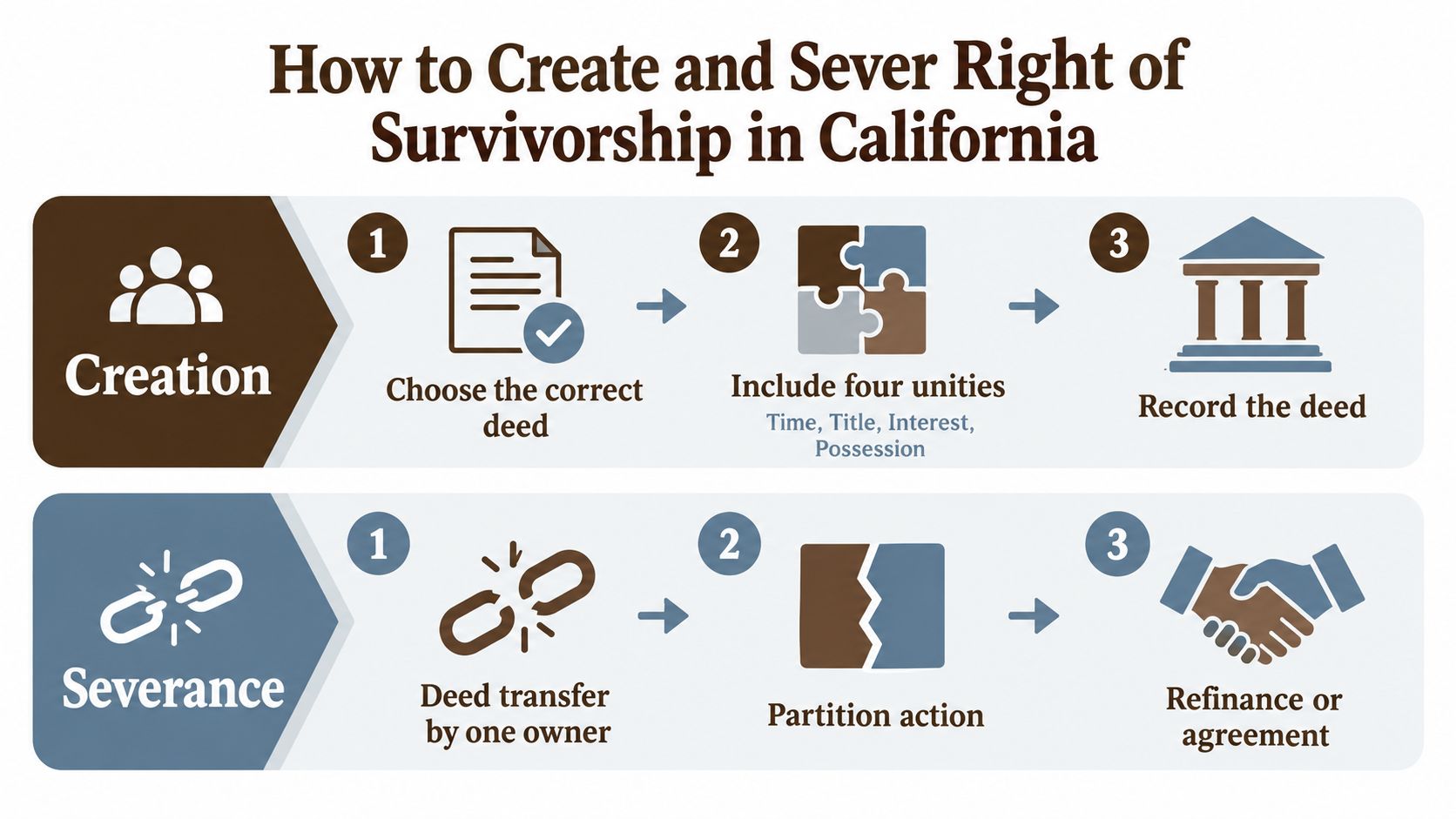
Creating survivorship requires more than placing two names on a deed. The document must establish a legally recognized ownership form, and the language must accurately express the intended result.
For joint tenancy, lawyers commonly discuss the four unities. The owners must generally receive their interests through the same title instrument, at the same time, with the same type and extent of interest, and with equal rights to possess the property. A deed that doesn't satisfy the required structure can create tenancy in common or another ownership arrangement instead.
Creation requires deliberate title language
A deed should identify the co-owners and state the intended vesting clearly. Language such as “as joint tenants with right of survivorship” communicates a survivorship intention for joint tenancy, but the complete deed must still comply with California law and recording requirements.
For a married couple selecting community property with right of survivorship, the deed needs the statutory form and written acceptance required by California Civil Code section 682.1. A casual reference to “community property” doesn't accomplish the same thing.
The following video provides another visual explanation of the title concepts involved:
Severance changes the result
Survivorship can be defeated or severed. Recognized events include:
- Unilateral conveyance: One joint tenant may transfer an interest in a way that disrupts the joint tenancy.
- Partition: A partition action can divide or end the shared ownership structure.
- Agreement: The co-owners can agree to change how they hold title.
- Murder: The law can prevent a wrongdoer from benefiting through survivorship.
- Simultaneous death: If the owners die in circumstances that prevent reliable survivorship determination, the expected result may fail.
A refinance, transfer, divorce-related transaction, or estate-planning change can create title complications. Before signing a new deed or restructuring ownership, the owners should determine whether the transaction will preserve or sever survivorship.
Death does not end the paperwork
Even when survivorship operates automatically, the surviving owner usually must prove the death and update the record. A title company or recorder may require a death certificate, an affidavit of death, and other documents tied to the property. Those steps establish the surviving owner's record title and help support a later sale or refinance.
The legal question and the administrative question are separate. Survivorship may keep the property outside probate, but the survivor still needs accurate records.
Common Pitfalls and Sample Clause Language to Get Right
A deed can defeat a family's expectations without anyone intending harm. The most common problem is treating ownership as a matter of relationship rather than a matter of title.
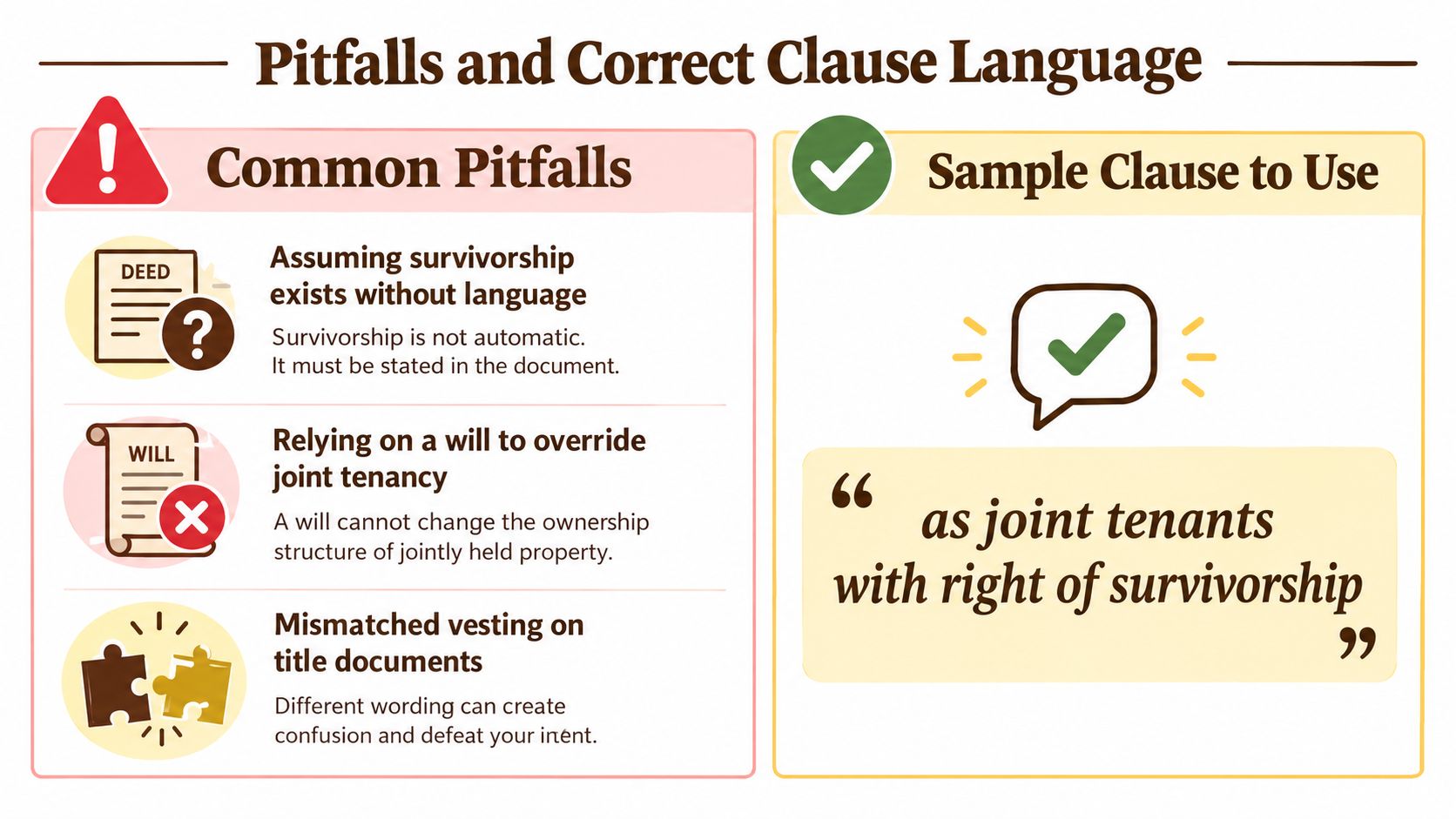
A married couple may assume marriage creates survivorship. Siblings may assume equal ownership means that the survivor receives the whole property. A child may believe a parent's will controls a house held in joint tenancy. Each assumption can be wrong under California law.
Language that creates a different outcome
A phrase such as “as joint tenants with right of survivorship” is designed to express automatic transfer to the surviving joint tenant or tenants. By contrast, “as tenants in common” identifies an ownership form without automatic survivorship. A deed that says only that people own property together may require careful legal interpretation rather than producing the result the family expects.
California law treats joint tenancy survivorship as automatic at death. The surviving joint tenant becomes sole owner, and the deceased owner's interest doesn't pass by will or intestate succession. The California Law Revision Commission materials on joint tenancy describe survivorship as a defining feature of joint tenancy and distinguish it from ordinary community property.
Read the deed, not the family story. The names and relationships explain who owns property during life. The vesting language helps determine who owns it after death.
Review these documents before a crisis
- Recorded deed: Confirm the exact vesting language, including whether it says joint tenancy, tenancy in common, or community property.
- Later deeds: Look for transfers, quitclaim deeds, refinancing documents, or agreements that may have changed the title.
- Estate plan: Compare the deed with the will and trust. A trust cannot override a survivorship arrangement that transfers outside the estate.
- Death-transfer records: If an owner has died, ask what affidavit, death certificate, or recorder documentation is needed to update title.
- Family objective: Identify whether the intended recipient is the surviving owner, the deceased owner's children, or another beneficiary.
One owner should also avoid adding another person to title merely for convenience. If the goal is help with finances or management, an estate-planning attorney can discuss alternatives that don't automatically give the added person the entire property at death.
Protect Your Property and Plan Ahead With Tanner Law
Right of survivorship is powerful because it can make a transfer direct. It also deserves caution because the same mechanism can bypass the inheritance plan a family thought it had created.
A sound California title review starts with the recorded deed and then compares it with the will, trust, beneficiary designations, marital property objectives, and current family circumstances. That review can reveal whether the property will pass to the survivor, become part of an estate, or require a change before the next transfer.
Questions to bring to a legal review
- Does the current deed create joint tenancy, tenancy in common, or community property with right of survivorship?
- Does the title language match the owners' intended beneficiaries?
- Has any later conveyance or agreement severed survivorship?
- Will the surviving owner need an affidavit or other recorded documentation?
- Should the property be coordinated with a trust or broader estate plan?
Families in Orange County and Los Angeles often need advice that connects real estate title with probate and estate planning. Tanner Law provides legal guidance in those areas, along with assistance involving property disputes, partition matters, quiet title issues, and related civil concerns. A review before a death, sale, refinance, or family transfer can help identify problems while the owners still have the ability to correct them.
Tanner Law can review your California deed, explain whether the right of survivorship matches your estate plan, and advise on title changes or probate-related property issues. Schedule a free consultation by visiting Tanner Law and bring your current deed and estate-planning documents for a focused discussion.