Accounting for Estates in California: A Practical Guide
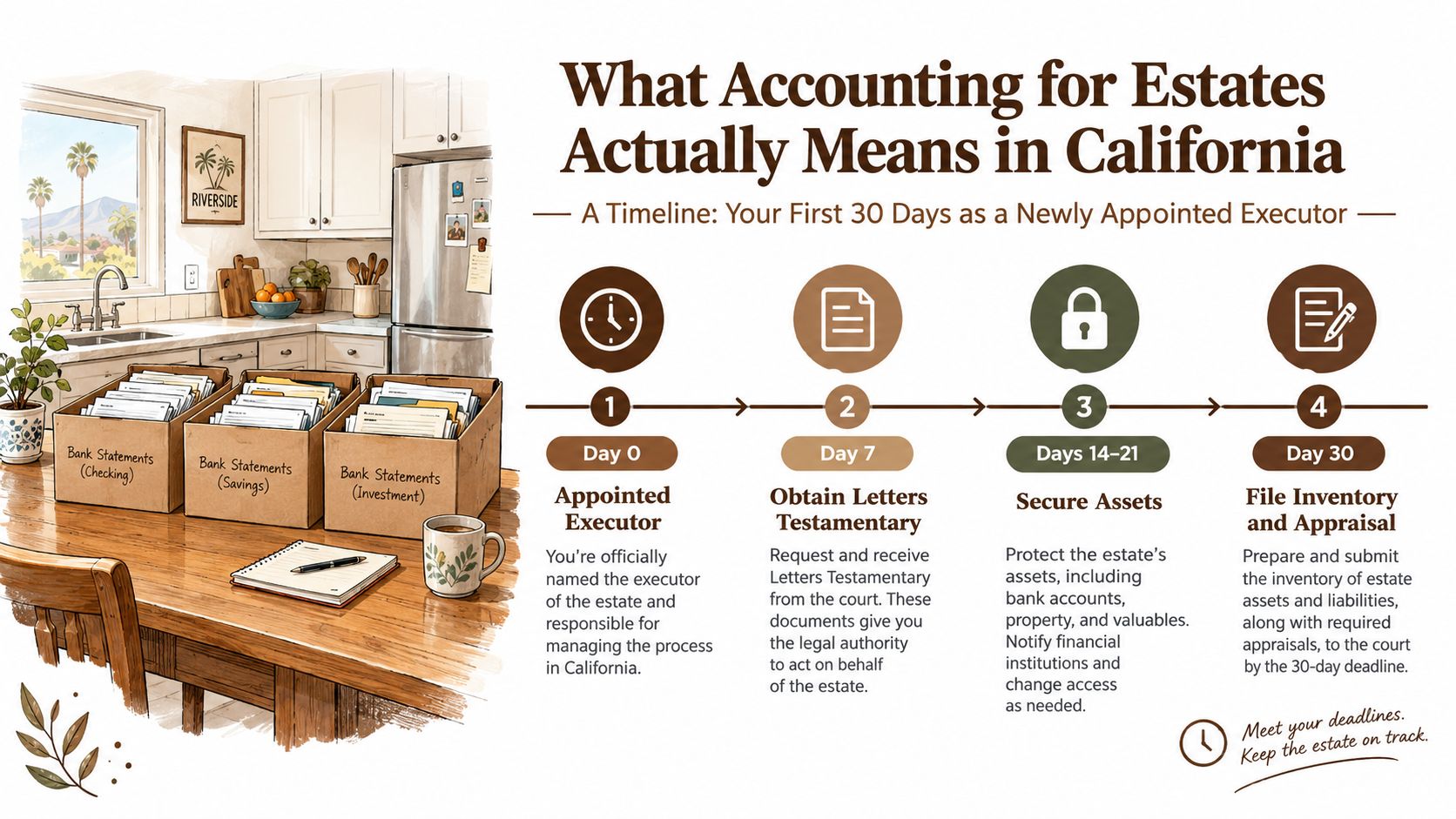
A newly appointed executor often starts with the same uncomfortable discovery: the will identifies the beneficiaries, but it doesn't explain how to prove every dollar, property interest, expense, and distribution. In a Riverside kitchen, that can mean three shoeboxes of bank statements on the table, unfamiliar brokerage records beside them, and a deadline already approaching after the court issues Letters Testamentary.
Accounting for estates in California is the process of creating that proof. It combines a reliable inventory of what the decedent owned with a running record showing what the estate received, paid, and distributed. The work is detailed, but a disciplined system makes it manageable and protects you from avoidable disputes.
Table of Contents
- What Accounting for Estates Means in California
- Preparing the Inventory and Appraisal
- Building the Cash-Basis Accounting Ledger
- Supervised Versus Informal Administration Reporting
- Handling Supplemental Inventories and Late-Discovered Assets
- Tracing Separate-Property Contributions in the Accounting
- Final Accounting Checklist and Next Steps
What Accounting for Estates Means in California
A newly appointed executor may have a filing deadline, several bank accounts, and no reliable explanation of how the decedent's property should be tracked. Accounting for estates creates that explanation through two connected records.
The first is the Inventory and Appraisal, a point-in-time record of probate assets and their fair market values on the decedent's date of death. The second is the cash-basis accounting ledger, which records administration activity from the opening balance through receipts, payments, and the amount available for distribution.
Under California Probate Code § 8800, the personal representative must file the Inventory and Appraisal within four months after Letters Testamentary or Letters of Administration are issued, as confirmed by the California probate guidance from the Orange County Superior Court. California uses forms DE-160, Inventory and Appraisal, and DE-161, Inventory and Appraisal Attachment, to identify and value property administered through probate.
Why the two records must agree
The inventory answers, “What did the decedent own at death?” The ledger answers, “What did the estate receive or pay after death, and where is the money now?” Those records should connect even when an asset is sold, transferred between accounts, or used to pay an approved expense.
That connection matters in a final accounting or report under California Probate Code §§ 10950-10954. A bank balance cannot show whether an asset was omitted, whether sale proceeds were deposited, or whether an expense was a proper administration cost.
Practical rule: Treat every estate transaction as evidence. A bank statement shows movement, while the invoice, closing statement, receipt, or court order explains why the movement was proper.
Creditor administration also belongs on the executor's calendar. The creditor-claim process operates under Probate Code § 9000, including applicable claim periods and notice requirements. Track creditor notices, claims, tax matters, inventory filings, and distributions in one system rather than relying on memory.
A complete accounting can help defend against surcharge allegations, support review of fiduciary compensation and bond issues, and give beneficiaries a usable financial history. It connects date-of-death values with later realizations, expenses, taxes, and distributions.
Preparing the Inventory and Appraisal
A newly appointed executor may find three bank accounts, a rental property, and a brokerage statement before locating the deed or confirming whether an account passed outside probate. Start with an asset search, not the court forms. Review income-tax records, bank and brokerage statements, deeds, vehicle records, business documents, loan files, safe-deposit information, and digital accounts. Confirm whether each asset was owned individually, jointly, through a business, or through an entity with separate records.
California uses DE-160, Inventory and Appraisal, and DE-161, Inventory and Appraisal Attachment, to identify and value property administered through probate. The California State Controller's probate guide provides practical filing guidance, including how referee-assignment information and attachment formatting support the DE-161. Follow the court's accepted filing requirements and keep a complete copy of what was submitted.
Build the asset list before assigning values
Organize the working list by asset type:
- Real property: Include the legal description, address, ownership interest, and date-of-death value.
- Financial accounts: Identify the institution, account type, registration, and balance at death.
- Brokerage assets: List securities and investments with enough detail to support the valuation.
- Vehicles and tangible property: Record vehicles, collections, jewelry, equipment, and other property requiring administration.
- Business interests and notes: Include ownership interests, promissory notes, loans receivable, and contract rights.
- Personal property: Describe material items instead of using an unexplained lump sum.
A probate referee generally appraises property assigned for referee valuation. The personal representative may value other property at fair market value when permitted by California probate requirements. Under California Probate Code §§ 8800-8801, the referee completes the assigned appraisal after receiving the assignment, but the personal representative remains responsible for a complete and accurate filing.
| Asset Category | Valued By | Reference |
|---|---|---|
| Real property requiring referee appraisal | Probate referee | California Probate Code §§ 8800-8801 |
| Publicly traded financial assets | Personal representative or other permitted valuation process | California Probate Code §§ 8800-8801 |
| Vehicles and tangible personal property | Personal representative or probate referee, depending on assignment | California Probate Code §§ 8800-8801 |
| Business interests, notes, and unusual assets | Often probate referee, with supporting records | California Probate Code §§ 8800-8801 |
Attach schedules and valuation support so a beneficiary, court investigator, or judge can follow each conclusion. For a rental property, retain the deed, ownership records, appraisal materials, and any later sale documents. For an account, preserve the statement showing the balance at death and records explaining any transfer or liquidation.
Sign the forms under penalty of perjury, file them through the court's accepted system, including eFileCalifornia where available, and retain filed copies and original appraisal materials in the estate case file. The form is only the court filing. Supporting schedules, statements, valuation correspondence, and notes make the inventory defensible.
Building the Cash-Basis Accounting Ledger
A usable ledger starts with a verified opening position. Reconcile the estate bank account to the balance transferred into estate control, then record each receipt and disbursement in chronological order. Keep the ledger on a cash basis, so it reflects money received or paid rather than estimates or unpaid obligations.
Use three core columns:
- Receipts, including the source and date of every deposit.
- Disbursements, including the payee, purpose, date, and supporting document.
- Running balance, recalculated after every entry.
A practical ledger might contain entries such as these:
| Transaction | Ledger treatment | Supporting record |
|---|---|---|
| Decedent's final paycheck | Receipt from employer | Payroll statement and deposit record |
| Brokerage account sale | Receipt of net sale proceeds | Brokerage statement and trade confirmation |
| Federal EIN application cost | Disbursement for administration | Invoice or receipt |
| Mortgage payment on estate real property | Disbursement | Mortgage statement and cancelled check |
| Utility bill | Disbursement tied to property preservation | Utility invoice and payment proof |
| Executor's statutory commission under Probate Code § 10800 | Disbursement only when properly calculated and allowed | Calculation, agreement, or court authority |
Don't combine unrelated payments into “miscellaneous expenses.” A beneficiary should be able to understand why the estate paid a vendor, which property benefited, and whether the payment preserved or increased estate value.
Preserve the document trail
Create a file structure that matches the ledger. For example, receipts can be stored by month, while disbursements can be organized by category such as property, taxes, insurance, professional fees, and distribution. Each entry should point to a statement, cancelled check, invoice, closing statement, receipt, or written explanation.
Keep probate and non-probate assets separate. Life insurance paid directly to a beneficiary, jointly held accounts, and certain trust assets may not belong in the probate ledger, although they can still matter when analyzing the decedent's overall financial picture.
A claimed reimbursement under California Family Code § 2640 needs special care. Record the underlying contribution as a memorandum entry, not as an estate receipt, unless the estate receives funds. The accounting should show the claim, the tracing evidence, the amount accepted or disputed, and the effect on the appropriate property share without falsely inflating estate cash.
Supervised Versus Informal Administration Reporting
California probate administration follows different reporting paths depending on the court's order, the will, and the authority granted to the personal representative. The label matters because it affects whether the executor can act independently or must return to court for approval.
In a supervised administration, the court retains continuing oversight. Sales, distributions, accountings, and other significant actions may require petitions, notice, and hearings. A final accounting or report generally must address the estate's receipts, disbursements, remaining property, compensation, and proposed distribution unless the interested persons properly waive the accounting under applicable law.
An independent or informal administration gives the personal representative greater practical control under California Probate Code §§ 10400-10580. That authority reduces routine court involvement, but it doesn't eliminate the fiduciary duty to keep accurate records. Beneficiaries may request an accounting, and the court can require a formal presentation when the circumstances justify it.
Compare the reporting obligations
| Factor | Supervised Administration | Informal Administration |
|---|---|---|
| Court involvement | Ongoing court oversight is central | The executor handles many tasks without prior approval |
| Asset sales | May require petition and hearing | May proceed under granted independent authority |
| Accounting | Usually prepared for court review unless properly waived | Must still be maintained and may be delivered to beneficiaries or filed if required |
| Distributions | Typically require court authority or an approved process | Must follow the will, court order, and statutory authority |
| Objections | Often resolved through noticed hearings | Can convert a routine administration into contested court proceedings |
| Executor risk | Greater procedural oversight, but more filings | More flexibility, with greater responsibility for documentation |
Probate Code § 10954 provides waiver mechanisms for an accounting in appropriate circumstances. A waiver isn't a substitute for records. It should be supported by clear disclosures, signed consents from the necessary interested persons, and a report that explains what occurred.
Unresolved objections, disputes over creditor claims, questions about compensation, missing assets, or potential surcharge exposure can require a formal accounting hearing. Before choosing a waiver, confirm the estate's authority, beneficiary status, notice requirements, and whether any person entitled to protection has not consented.
Handling Supplemental Inventories and Late-Discovered Assets
Six months after filing the Inventory and Appraisal, an executor discovers a forgotten brokerage account in an old statement. The account was open at death, but no one found it during the initial search. The correct response isn't to deposit the proceeds and hope the final accounting absorbs the omission.
California Probate Code § 8801 addresses supplemental inventories when additional property is discovered. The California probate inventory guidance on supplemental filings explains that a supplemental Inventory and Appraisal is generally filed within four months after the personal representative learns of the property.

Correct the record promptly
The supplemental filing can apply to property omitted from the original inventory, newly identified interests, and later-discovered changes requiring an updated description or value. A post-death stock split, for example, may require careful treatment so the record reflects what was owned at death and what occurred during administration.
Use the applicable DE-160 and DE-161 process, identify the discovery date, describe the asset, obtain the required valuation, and update the accounting ledger. If a probate referee must value the property, preserve the assignment and completed appraisal with the supplemental filing materials.
The paper trail should include:
- Discovery memorandum: State when and how the asset was found.
- Source records: Keep the statement, title document, account confirmation, or correspondence that established ownership.
- Valuation support: Preserve the date-of-death value and any referee materials.
- Ledger entry: Record the asset proceeds or income when received.
- Service and filing proof: Retain evidence that the court and interested persons received the required documents.
A late-discovered asset is a problem to correct, not a reason to hide. Prompt disclosure demonstrates that the executor is protecting the estate and beneficiaries.
Tracing Separate-Property Contributions in the Accounting
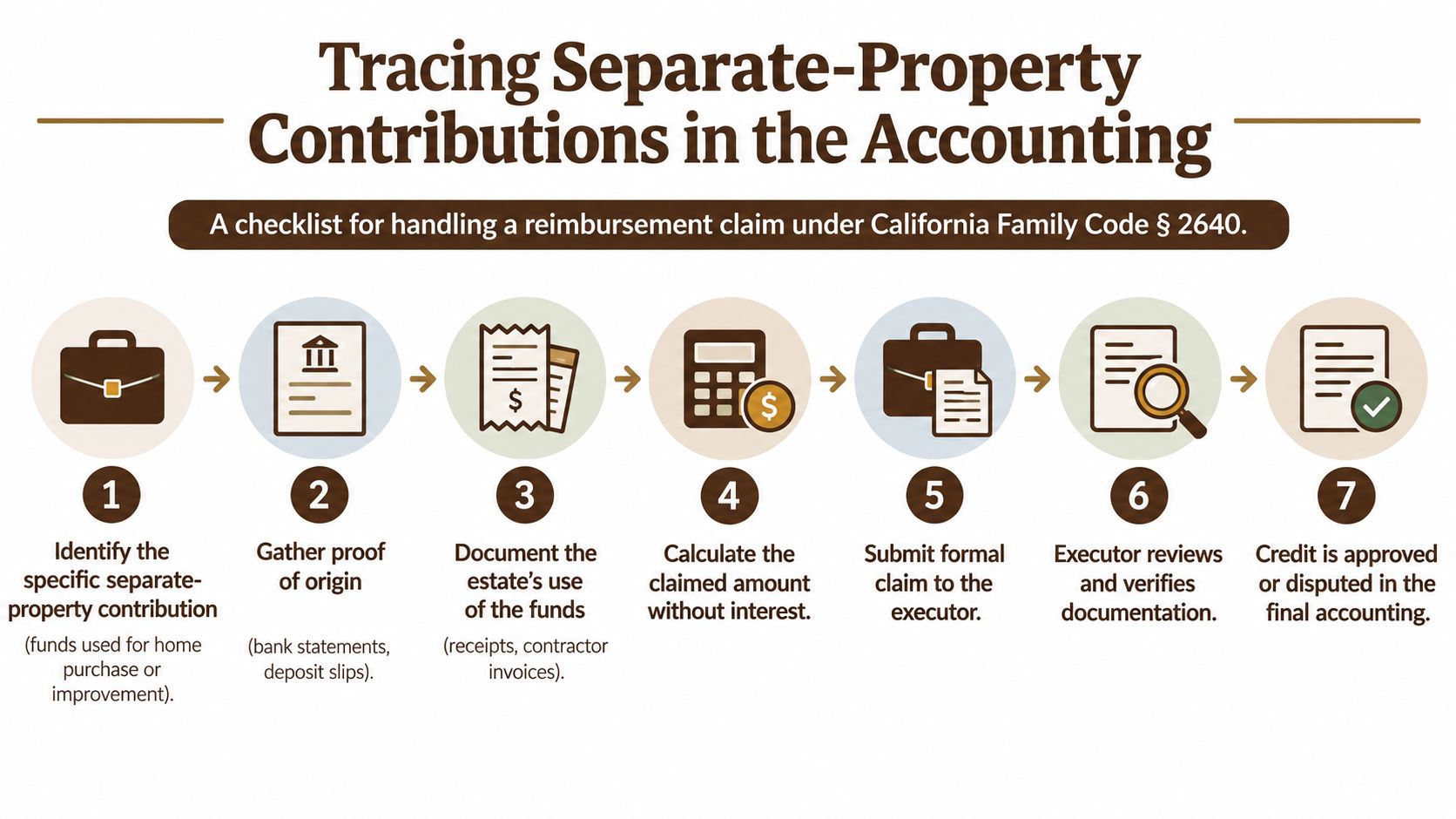
A surviving spouse may claim reimbursement under California Family Code § 2640 when separate-property funds were used to acquire, improve, or pay down community property. The statute limits reimbursement to the amount contributed, without interest or adjustment for changes in value, and the reimbursement can't exceed the property's net value at division, as described in California Family Code § 2640.
The accounting challenge is tracing. The claimant should identify the specific contribution, its source, the date it entered the transaction, and the property benefit received. Useful records include bank statements, deposit slips, escrow instructions, settlement statements, title documents, loan records, contractor invoices, and cancelled checks.
Separate a valid credit from an estate receipt
A reimbursement claim usually affects how property or sale proceeds are allocated. It shouldn't be recorded as estate income unless the estate receives money. Instead, identify it as a memorandum claim, show the evidence reviewed, and reflect the accepted credit as a charge against the relevant community-property share.
Direct tracing is easier when the contribution moved from a separate account into a specific escrow or loan payment. Commingling creates a factual dispute because the claimant must show that separate funds, rather than community funds, paid the expense.
Before responding to a demand, gather:
- The account statements showing the funds' origin.
- The transfer records or escrow statement connecting funds to the property.
- Title and loan documents identifying the property interest.
- Invoices or receipts supporting improvements.
- A calculation limited to the contributed amount and the statutory rule.
- A written position stating whether the estate accepts, rejects, or needs more proof.
Undocumented improvements, unexplained withdrawals, and claims raised after the accounting process has advanced can make resolution harder. Address the issue before final distribution and preserve the analysis in the accounting file.
Final Accounting Checklist and Next Steps
A final accounting packet should allow someone unfamiliar with the estate to trace the path from date-of-death assets to the proposed distribution. Before filing or requesting approval, compare the inventory, ledger, tax records, creditor materials, and distribution schedule line by line.
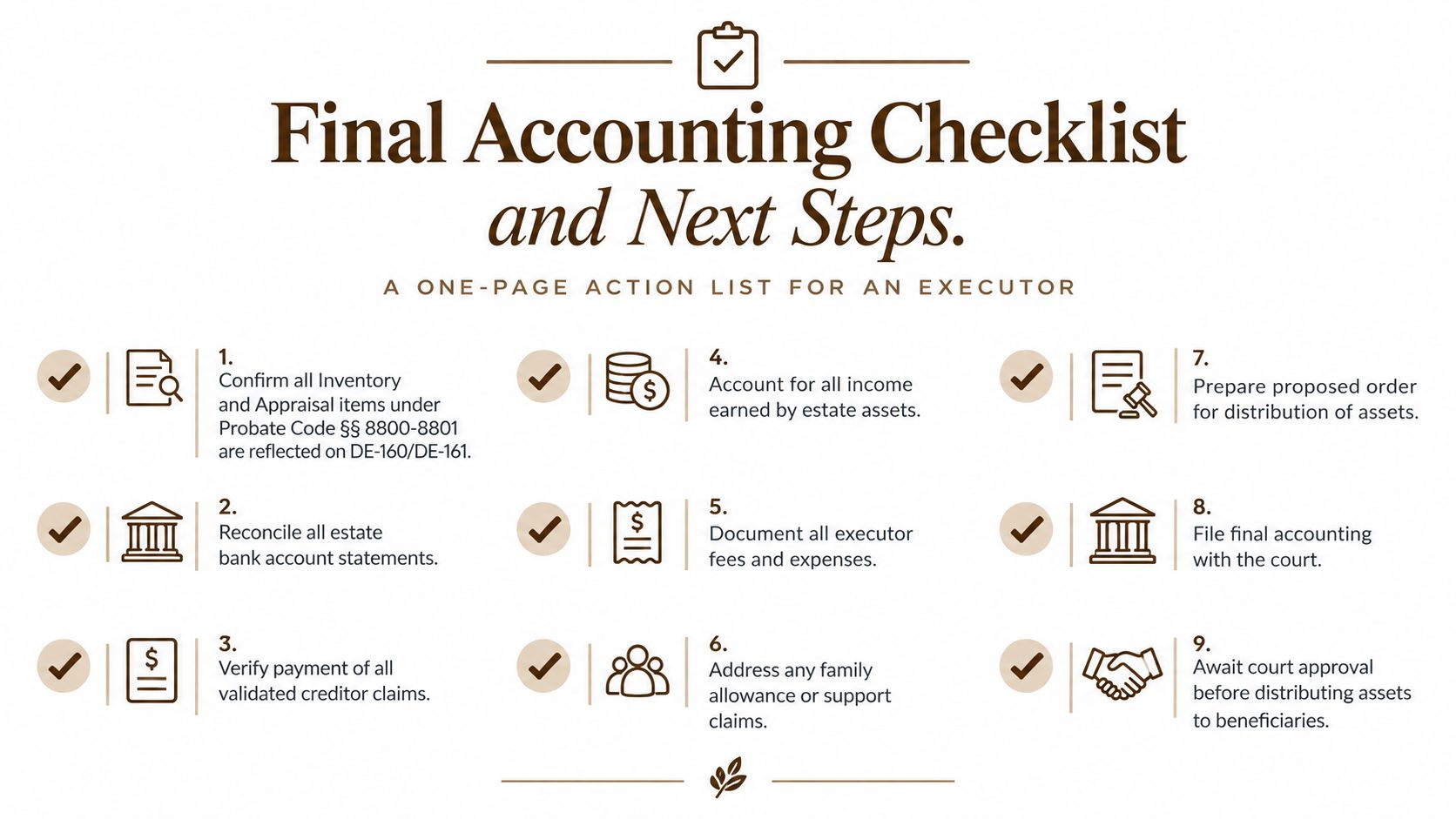
Use this practical checklist:
- Confirm the inventory: Make sure all property under Probate Code §§ 8800-8801 appears on DE-160 and DE-161, including supplemental filings.
- Reconcile the cash: Tie the ledger's receipts, disbursements, and ending balance to estate bank statements.
- Support every transaction: Attach schedules, invoices, statements, cancelled checks, closing documents, and distribution receipts.
- Review creditor administration: Confirm that notices, claims, approvals, rejections, and payments are documented under the applicable California probate procedures.
- Account for income: Include interest, rent, dividends, sale proceeds, and other income received during administration.
- Verify fees and expenses: Explain executor compensation, attorney fees, appraisal charges, maintenance costs, and other payments.
- Resolve property claims: Address Family Code § 2640 reimbursement requests and other ownership disputes before distribution.
- Choose the reporting route: Determine whether a waiver under Probate Code § 10954 is appropriate or whether a court-filed accounting is safer.
- Prepare the closing documents: Depending on the estate, these may include the Petition for Final Distribution, form DE-260, Final Account and Report, Report of Action, proof of publication, and receipts for distribution.
California Probate Code §§ 1100-1101 can become relevant when the personal representative seeks court review and approval of the account and proposed distribution. The proper filing depends on the estate's procedural posture, the court's orders, beneficiary consent, and any unresolved dispute.
Courts and beneficiaries commonly question packets with missing probate referee signatures, unallocated receipts, unexplained balance changes, unsupported expenses, or unsigned waiver consents. Don't distribute property merely because the ledger appears to reach zero. Confirm that the authority for distribution exists and that the closing record proves what each beneficiary received.
Schedule a free consultation with Tanner Law for a personalized review of your California estate accounting packet, including DE-160 and DE-161 filings, supplemental inventory issues, ledger reconciliation, and proposed distributions. Visit Tanner Law to discuss the records you have, the deadlines approaching, and the safest next step before lodging documents with the court.