Title Search Attorney Services and Costs in California
A home purchase in Orange County can appear ready to close until a title report reveals an old lien. A family selling inherited property may discover that a prior owner's estate never transferred the property correctly. A co-owner may learn that the deed description doesn't match the parcel everyone believed the family owned. These problems can delay a transaction, complicate financing, or force the parties into court.
That's where a title search attorney can make a meaningful difference under California law. A title search isn't merely a request for a stack of recorded documents. It's a legal review of whether the documents create a reliable chain of ownership, whether liens and encumbrances were released, and whether someone else may have a claim to the property. The attorney also helps determine what should happen after a problem appears, whether the answer is a curative deed, a probate proceeding, a release, or a quiet title action.
For families in Orange County and Los Angeles dealing with a purchase, sale, inheritance, trust administration, or ownership dispute, early review can preserve options. The following guide explains what title search attorneys do, how searches uncover defects, how attorney services compare with title-company services, what affects timing and fees, and how California procedures shape title-clearing lawsuits.
Table of Contents
- Introduction Why Title Issues Can Derail Your California Property Plans
- What a Title Search Attorney Does Under California Law
- How a Title Search Works and What It Can Uncover
- Title Search Attorney Versus Title Company How to Choose
- Timelines Costs and Red Flags to Watch For
- Orange County and California Considerations for Clearing Title
- Take the Next Step Toward Clear Title With Tanner Law
Introduction Why Title Issues Can Derail Your California Property Plans
A family inherits a home after a parent dies and expects to sell it. Then the title history shows that an earlier deed was signed by only one of several heirs. The lender will not accept the ownership record, so the sale pauses while the family reviews probate records, earlier deeds, and possible claims by people omitted from the transfer.
A buyer can face the same problem without knowing anything about the property's prior owners. The seller may appear to own the home, while the public record contains an unreleased mortgage, an unknown lien, an easement, a boundary dispute, or a deed signed by someone without legal authority. The California Department of Insurance identifies errors in public records, unknown liens, missing heirs, forgeries, undiscovered encumbrances, unknown easements, boundary disputes, undiscovered wills, and false impersonation as possible title defects in its consumer guidance.
Why the risk is routine
Title defects can arise in ordinary residential transactions, not only in unusual properties. Independent coverage citing the American Land Title Association reports that about 25% of residential real estate transactions encounter some type of title issue during the search process. Other industry analyses place transactions needing defect curing at more than one-third in some datasets. The cited title-search overview explains why a title search serves as a routine risk screen before closing.
The financial consequences can also be serious. A Milliman analysis reported by ALTA found that from 2013 through 2022, title insurers recorded 203,181 claims and paid $4.4 billion in losses and loss expenses. Fraud and forgery represented 21% of dollars spent on claims, and the average claim cost exceeded $143,000.
Practical rule: If a title issue appears before closing, the parties may still have time to investigate, negotiate, cure the defect, or reconsider the transaction. After closing, the dispute may become a lawsuit or an insurance claim.
A title search attorney connects the records review to litigation prevention. The attorney examines the legal effect of a suspicious document, identifies people who may need to participate, and selects a curative solution. Depending on the defect, that solution may involve a corrective deed, a release, probate proceedings, or a quiet title action, a lawsuit used to obtain a court determination of ownership and competing claims.
For an Orange County purchase, sale, inheritance, trust administration, or ownership dispute, early legal review can preserve options. If a closing is blocked or inherited property has a questionable chain of title, a free consultation with Tanner Law can help identify the next step before the problem becomes more expensive.
What a Title Search Attorney Does Under California Law
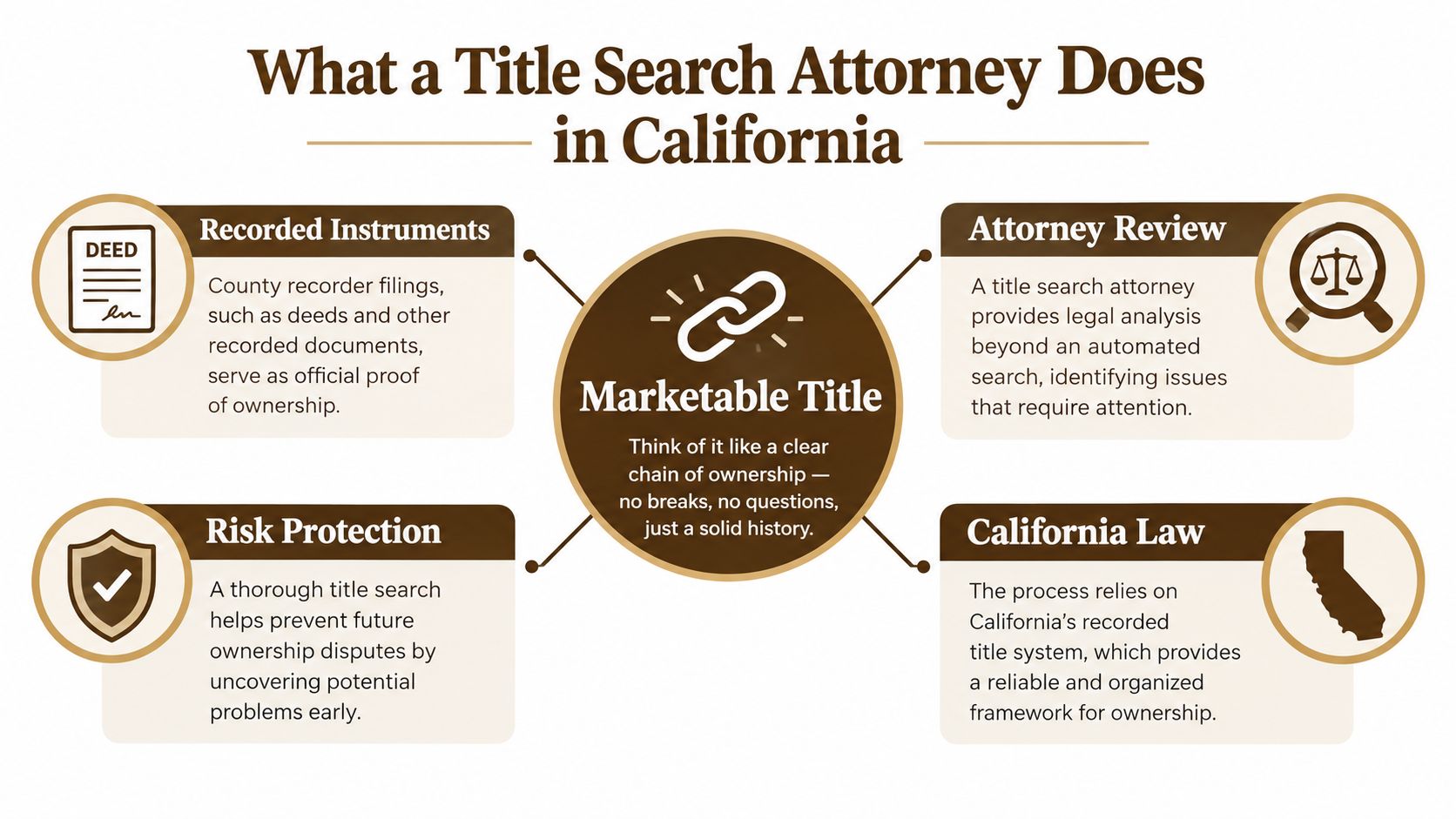
Think of marketable title as a clear chain of ownership. Each link represents a transfer or legal event, and the chain should show why the current owner has the right to sell, mortgage, transfer, or defend the property. A title search attorney tests that chain instead of assuming that a document's appearance proves its legal effectiveness.
California's property system relies heavily on recorded instruments. Deeds, deeds of trust, court judgments, liens, probate-related documents, and other instruments create the public record used to evaluate ownership and competing claims. The historical development of American title practice grew from land-record systems designed to support taxation and property markets, with registries becoming central to conveyancing rather than relying solely on a state guarantee of title. The Yale Law Journal analysis of title registration and title insurance explains that background and its continuing importance.
The documents aren't self-explanatory
A California grant deed contains implied warranties that the grantor hasn't previously conveyed the estate and that the property is free from undisclosed encumbrances made by the grantor. A deed of trust is the standard security instrument for a real estate loan and is recorded to secure repayment against the property. California deed and deed-of-trust provisions show why the language and recording history matter.
An automated records search may locate both instruments. It may not determine whether the grantor had authority, whether a prior conveyance was missed, whether a deed of trust was properly reconveyed, or whether a probate transfer vested title in the person now claiming ownership. A title search attorney reads the documents together and considers the surrounding facts.
What the attorney protects
The attorney's work typically includes:
- Ownership authority: Determining whether the person signing a deed can legally transfer the property.
- Lien exposure: Reviewing mortgages, judgments, tax records, and other claims that may affect title.
- Probate consistency: Checking whether a deceased owner's interest passed through the correct estate process.
- Legal remedies: Advising whether a release, affidavit, curative deed, probate filing, or lawsuit is appropriate.
The central benefit is judgment. A title company may identify requirements for issuing insurance, while an attorney can explain what a defect means for your rights and what legal action may resolve it.
How a Title Search Works and What It Can Uncover
A thorough title search follows the property, the people connected to it, and the legal events that may affect it. The attorney starts by confirming the correct parcel and legal description. A street address alone may be insufficient, especially where parcels were divided, combined, reconfigured, or described differently in older instruments.

The records review
The search generally draws from several record categories:
- Deeds and conveyances: The attorney traces transfers and checks names, signatures, dates, notarization, recording details, and legal descriptions.
- Mortgages and deeds of trust: The review looks for recorded loans and evidence that earlier security interests were released or reconveyed.
- Liens and judgments: Tax records, judgment records, and other lien filings may create claims that must be paid, released, challenged, or addressed through closing documents.
- Court and family records: Divorce decrees, probate files, wills, conservatorship matters, and related court orders may determine who had authority to transfer an interest.
- Maps and parcel materials: Maps and surveys help compare boundary information, easements, and legal descriptions with the deed chain.
The attorney then correlates the records. A name may be indexed under a variation. A parcel may have an old legal description. A probate file may identify heirs who don't appear in a later deed. A lien may be recorded in a way that requires further investigation before anyone can conclude that it affects the property.
Defects beyond a broken deed chain
The California Department of Insurance's defect categories include unknown liens, missing heirs, forgeries, illegal records, undiscovered wills, false impersonation, unknown easements, and boundary or survey disputes, among other problems. These issues matter because a clean-looking chain of deeds doesn't necessarily answer every ownership question.
A defect found before closing may be addressed through a curative deed, which corrects or confirms an earlier transfer; a release, which removes a satisfied lien; or an affidavit, which supplies legally relevant facts about identity, marital status, possession, or other circumstances. If the evidence conflicts or an adverse claimant won't cooperate, litigation may be necessary.
A post-closing discovery can place the owner in a different position. The owner may need to make a title-insurance claim, pursue a quiet title action, complete a probate step, or defend against someone asserting an interest. The search therefore serves as litigation prevention, not merely paperwork.
A short video can help visualize why each record category matters:
Title Search Attorney Versus Title Company How to Choose
A title company and a title search attorney can both play important roles, but they don't perform the same function. A title company evaluates whether it can issue a title commitment and policy under its underwriting standards. A title search attorney analyzes legal rights, explains consequences, and may represent a client in the process of curing or litigating a defect.
| Feature | Title Search Attorney | Title Company |
|---|---|---|
| Primary focus | Legal interpretation, ownership rights, and remedies | Title examination and title-insurance underwriting |
| Records review | Can review deeds, liens, court records, probate materials, and related evidence in context | Searches records needed for its title commitment and policy |
| Legal advice | Can explain rights, risks, claims, and litigation options | Can explain underwriting requirements and policy terms, subject to its role |
| Complex ownership issues | Can address probate gaps, co-owner disputes, partition matters, and quiet title strategy | May identify requirements or exceptions but generally doesn't act as litigation counsel for the owner |
| Defect resolution | Can prepare or pursue legal remedies, including court proceedings when appropriate | Can coordinate releases, payoffs, endorsements, and underwriting conditions |
| Insurance role | May advise on the relationship between the defect and coverage | Issues and administers title insurance subject to the policy |
Match the provider to the problem
A straightforward refinance involving a consistent ownership history may primarily require title-company services and lender coordination. An inherited property with missing heirs or incomplete estate documents calls for legal analysis because the question is not only whether a document exists, but whether the right people received and transferred the interest.
A suspected forgery, a dispute between co-owners, or a recorded claim from someone asserting ownership presents a stronger reason to involve an attorney early. A quiet title action may be necessary when the parties need a court judgment that establishes the rights of the competing claimants and clears the cloud from the record. A partition action may be relevant when co-owners cannot agree whether to sell or how to divide the property, although partition and quiet title address different problems.
A title policy can provide financial protection under its terms, but it doesn't replace advice about whether you own the property or how to obtain a court order.
Many transactions need both professionals. The title company can identify underwriting requirements and issue coverage, while the attorney evaluates objections, negotiates cures, and protects the client's legal position. Ask who will explain the legal effect of an irregular deed, who will identify missing claimants, and who will handle the matter if a court filing becomes necessary.
Timelines Costs and Red Flags to Watch For
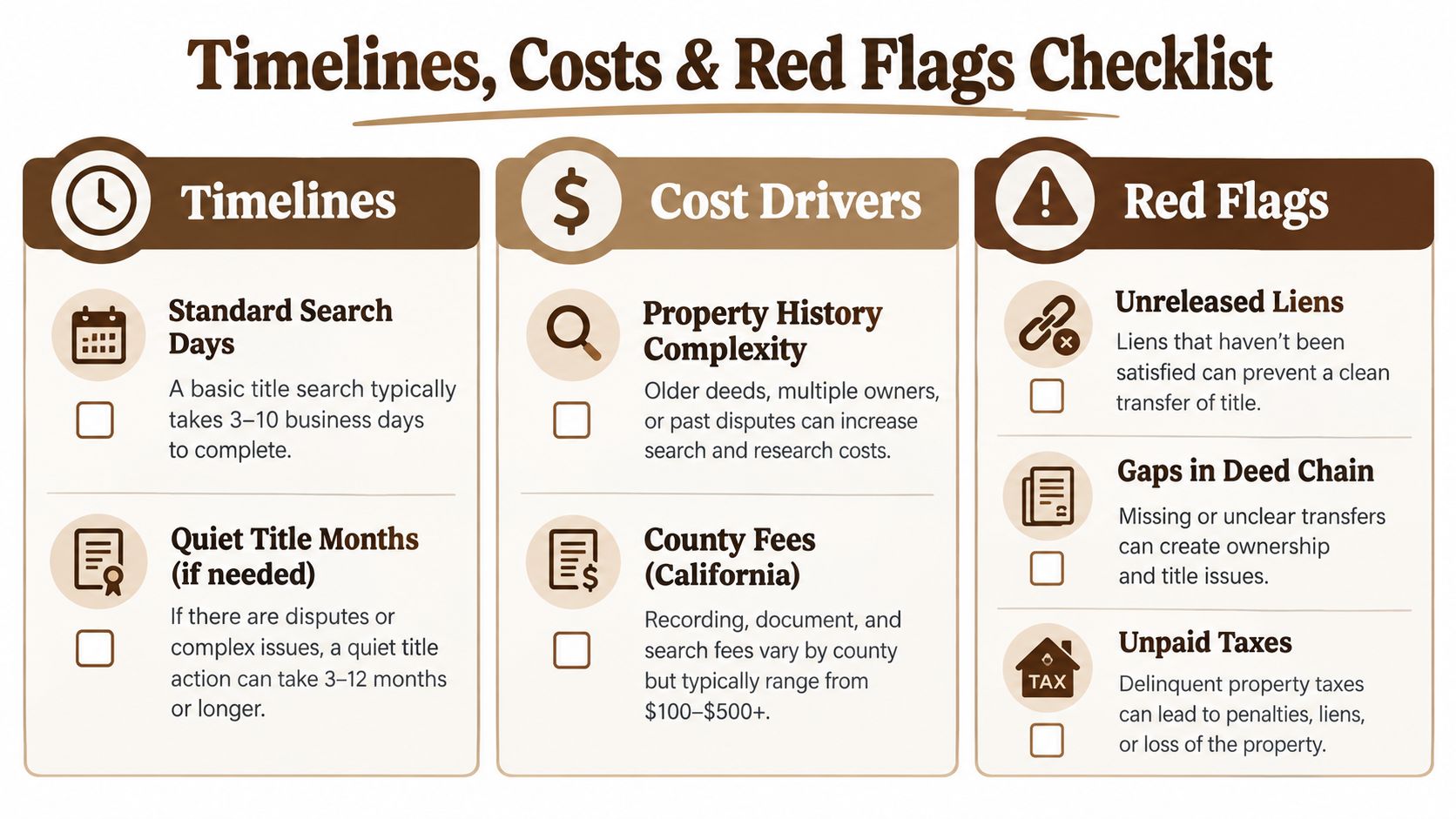
The right budget depends on the property and the problem. A title search involving a consistent chain, cooperative parties, and easily located records differs substantially from a search involving probate, multiple jurisdictions, conflicting legal descriptions, or a suspected fraudulent transfer. California attorneys and title companies may structure charges differently, so ask for a written explanation of what the quoted fee includes.
What affects timing and cost
Common cost drivers include:
- History complexity: Multiple transfers, trusts, estates, divorces, and co-ownership arrangements require more legal review.
- Record fragmentation: Mis-indexed names, incomplete retrieval, and records spread across county and court systems can increase research time.
- Defect severity: A release or corrected deed may be less involved than a contested lawsuit.
- Court involvement: Filing fees, service, recording, discovery, and hearing preparation can add expenses when a quiet title or related action becomes necessary.
- Local requirements: Recorder and court procedures vary in their practical administration, even though California statutes govern the legal framework.
Published guidance for uncontested quiet title matters commonly places the timeline at about 60 to 180 days, while contested cases can extend 6 to 12 or more months. The quiet title process guide describes why identifying every potential claimant, serving known parties, recording a lis pendens, and obtaining and recording the judgment affect the schedule.
Red flags that deserve direct questions
A provider should be able to explain the search depth and the reason for any unresolved item. Be cautious if you receive only a document list without a legal explanation, if an old lien is dismissed without proof of release, or if the search doesn't address probate and court records when a prior owner died or divorced.
Before hiring, ask:
- What records will you review? Request confirmation that deeds, mortgages, judgments, taxes, liens, divorce decrees, wills, probate materials, and maps are within the planned scope when relevant.
- How will you verify the parcel? Ask how the legal description and parcel number will be compared across records.
- Who identifies claimants? This matters when heirs, lienholders, mortgagees, judgment creditors, or co-owners may have an interest.
- What happens after a defect appears? The answer should distinguish a curative document, negotiation, probate work, an insurer claim, and litigation.
- How are fees calculated? Clarify whether the quote covers review only or includes drafting, recording, correspondence, and court work.
The biggest warning sign is false certainty. A careful professional should tell you what the records establish, what remains uncertain, and what evidence would resolve the uncertainty.
Orange County and California Considerations for Clearing Title
California procedure matters when a records problem becomes a lawsuit. A quiet title action is filed in the superior court of the county where the property is located, so an Orange County property generally belongs in Orange County Superior Court rather than a court selected for convenience. California Code of Civil Procedure sections 760.010 through 764.060 govern quiet title actions, and the complaint must be verified, meaning the plaintiff confirms the truth of its allegations under penalty of perjury.
The pleading must identify the property's legal description, state the plaintiff's title, describe adverse claims, and identify the date as of which title should be determined. Those requirements force the plaintiff to define the dispute precisely instead of asking the court for a vague declaration.
Procedure that can surprise property owners
California Code of Civil Procedure section 761.010(b) makes recording a lis pendens mandatory in quiet title practice. A lis pendens is a recorded notice that litigation may affect the property. It alerts future buyers, lenders, and other interested parties that the property's title is involved in a pending case. A California quiet title practice guide also explains that section 764.010 doesn't permit a quiet title judgment by default. Even if a defendant fails to respond, the plaintiff still must prove the case.
That rule makes the initial title search especially important. Omitting a potential claimant can undermine the finality of the judgment, so the attorney must investigate heirs, lienholders, mortgagees, judgment creditors, and others whose interests appear in the record.
Probate and deed mechanics
Probate issues often overlap with title work. California's small-estate procedure allows certain personal property to transfer without full probate when the decedent's California personal property subject to administration is $184,500 or less, and a small-estate affidavit may be used to collect qualifying property from holders such as banks or stock transfer agents. California Courts' small-estate guidance concerns personal property and shouldn't automatically be treated as a shortcut for transferring real property.
A California grant deed's implied warranties and a recorded deed of trust also require careful review, particularly when a family's property history includes old loans, estate transfers, or multiple conveyances. Tanner Law works with families and property owners in Orange County and Los Angeles, as well as matters involving Riverside and San Bernardino courts, where local filing and recording practices affect how a title problem is handled.
Take the Next Step Toward Clear Title With Tanner Law
A title search attorney can help before a transaction closes, while the parties still have negotiating power and time to obtain missing documents. The same attorney may later help with a curative deed, probate-related transfer, quiet title action, partition dispute, or title-insurance claim when the records reveal a deeper problem.
The practical question isn't whether every property history will be perfectly simple. It's whether you understand the risks before you sign, close, refinance, sell, or distribute inherited property. A careful review should identify the legal description, trace the ownership history, evaluate liens and encumbrances, and explain the remedy when the record doesn't tell a complete story.
William T. Tanner is a California attorney and licensed real estate broker who has served clients since 1994 and teaches property law at colleges and universities. Tanner Law provides direct attorney access for real estate disputes, probate matters, estate planning concerns, trust litigation, and related ownership issues. The office is located at 1913 E. 17th Street, Suite 212, Santa Ana, CA 92705, and free initial consultations are available by phone or email.
If a lien has stalled your closing, an heir is missing from the deed chain, a co-owner disagrees about the property, or a recorded instrument appears unreliable, don't wait for the problem to grow. Gather your deed, title report, probate documents, loan records, and correspondence, then schedule a free consultation to discuss a focused California title strategy.
Tanner Law offers attorney-led title review and practical guidance for families facing clouded title, probate-related ownership questions, quiet title matters, and real estate disputes in Orange County and Los Angeles. Visit Tanner Law to schedule a free consultation by phone or email and discuss the records affecting your property.