How to Contest a Will in California
You receive a copy of a newly filed will and recognize the signature, but not the beneficiaries. A relative who depended on the deceased has been excluded. A person who controlled the decedent's care now stands to receive valuable property. Grief quickly becomes suspicion, and suspicion creates pressure to act.
In California, a will contest isn't decided because a distribution feels unfair. The case turns on standing, a recognized statutory ground, admissible evidence, and an unforgiving filing deadline. For families in Orange County and Los Angeles, the first practical task is to stop treating the dispute as an informal family disagreement and determine whether California probate law gives you a viable path to challenge the will.
Table of Contents
- Determining Your Legal Standing to Challenge the Estate
- Valid Statutory Grounds for a Direct Will Contest
- Navigating the Strict 120-Day Filing Deadline
- Building an Evidentiary Record That Survives Scrutiny
- Evaluating Courtroom Litigation Versus Settlement Options
- Protecting Your Inheritance with Experienced Legal Counsel
Determining Your Legal Standing to Challenge the Estate
A later will leaves an adult child with nothing, while a nonrelative receives the estate. The family history may justify an investigation, but the relationship alone does not create the right to contest. California probate courts require the challenger to qualify as an interested person, someone whose legal or financial position could change if the will is rejected. The California will-contest standing rules identify the categories that commonly satisfy this requirement.
An interested person may be:
- An heir: Someone who could inherit under California intestate succession if no valid will controls.
- A devisee or beneficiary: Someone named in the challenged will, an earlier will, or another estate document whose expected rights could change.
- A creditor: Someone with a legally recognized claim against the estate that probate may affect.
- Another person with a property interest: Someone whose legal or financial position could change if the will is set aside.
A close friend, caregiver, neighbor, or concerned relative usually cannot proceed solely because the circumstances seem troubling. The court needs a concrete answer to one question: what would the challenger gain or lose if the document were invalidated? Without that connection, even credible concerns about pressure, deception, or a sudden change may not support a contest.
Start with the estate documents
Obtain the will admitted to probate, earlier wills, the petition for probate, and the probate docket before accusing anyone of wrongdoing. Compare the beneficiaries, signatures, dates, witnesses, and distribution changes. An earlier will may show what you would receive if the later document fails. It may also show that the disputed distribution followed a consistent plan, weakening an inference based only on timing or family conflict.
Review the estate's assets as well. Real property, business interests, debts, and pending claims can materially affect the value of a potential inheritance. Winning a contest does not always mean receiving the result the challenger expects. The court may admit an earlier will, or California intestate succession may determine distribution if no earlier instrument controls.
The filing calendar matters at the same time. A person who has standing can still lose the opportunity to act by missing California's strict statutory deadline. Standing is the court's entry requirement, not a substitute for investigating the deadline, the available evidence, and the likely result.
Practical rule: Establish your legal stake before investing in a theory of wrongdoing. Standing is the gate the court requires you to pass through.
Promises made during the decedent's life also require careful analysis. A relative who was told to expect an inheritance may have a serious personal grievance, but an oral promise alone does not necessarily create standing or invalidate a properly executed will. Counsel should trace the competing documents, identify the interest that would change, and assess whether a contest would produce a legally meaningful result before the filing window closes.
Valid Statutory Grounds for a Direct Will Contest
California Probate Code § 21310 limits a direct contest to specific legal grounds. The statute includes forgery, lack of due execution, lack of capacity, menace, duress, fraud, undue influence, revocation, and beneficiary disqualification. Probate Code section 21310 Unequal treatment, a family falling-out, or disappointment about the inheritance does not establish a statutory claim by itself.
The evidence must match the theory. A contest filed on suspicion alone can fail before discovery develops the record.
- Forgery asks whether the will or signature is authentic. Handwriting comparisons, drafting files, and testimony from people familiar with the decedent's signature may support or undermine that claim.
- Lack of due execution concerns California's formal signing and witnessing requirements. A defect involving signatures, witnesses, or the execution ceremony can matter, but the court will examine what occurred rather than rely on family recollections.
- Lack of testamentary capacity requires proof that the decedent could not understand the will, the property being disposed of, or the people who might naturally expect to benefit. Memory loss or a medical diagnosis, standing alone, does not automatically invalidate the document. The evidence must connect the condition to the decision-making process.
- Menace or duress concerns threats or coercive pressure that overcame the decedent's free choice.
- Fraud may involve deception about the document itself, the estate's property, or the people affected by the distribution plan.
- Undue influence involves pressure that replaced the decedent's independent judgment with another person's wishes. Isolation, dependency, control of information, and an unusual benefit can support an inference, but those circumstances still must connect to the will and be supported by evidence.
- Revocation asks whether the decedent later revoked the instrument or executed another legally controlling document.
- Beneficiary disqualification applies when California law bars a person from receiving the benefit.
No-contest clauses require probable cause
A no-contest clause does not automatically prevent a direct challenge. Under California Probate Code section 21311, the clause is enforced against a direct contest when the contestant brought it without probable cause.
Probable cause requires a factual and legal basis for a reasonable belief that the claim has a reasonable likelihood of succeeding after investigation or discovery. The contestant need not possess every document or witness statement at filing. Family conflict, rumor, resentment, or an unequal inheritance is not enough.
Counsel should assess the no-contest language, select the precise statutory theory, and preserve the facts supporting probable cause before filing. That review has to occur quickly because the separate statutory filing deadline can end while the family is still arguing about what happened.
A documented claim may create room for settlement. A weak filing can expose an intended beneficiary to consequences under the clause and damage credibility with the court. The practical question is not whether the result feels unfair. It is whether admissible evidence supports a recognized ground strongly enough to justify entering a statute-driven filing race.
Navigating the Strict 120-Day Filing Deadline
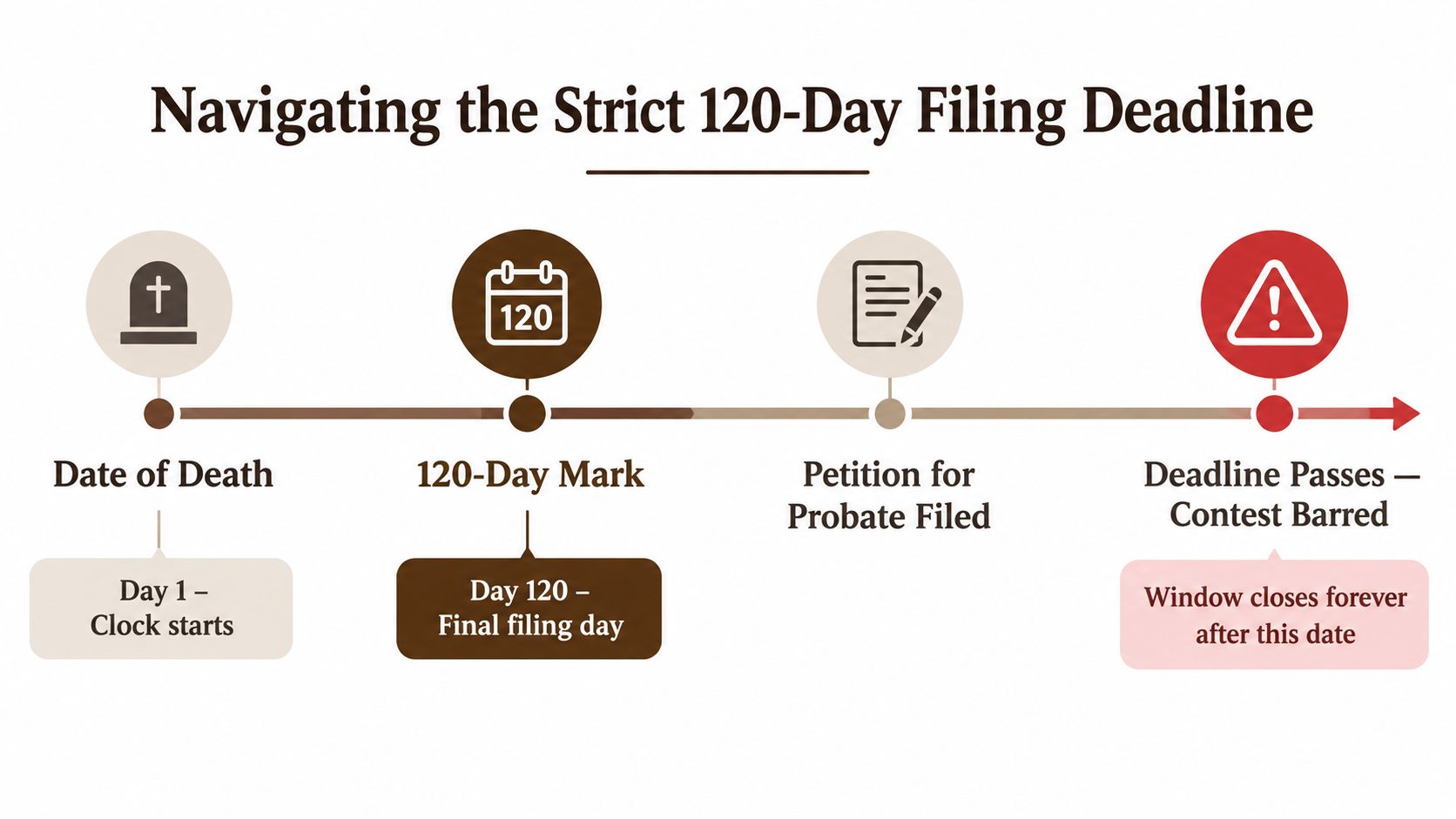
A beneficiary may learn about an admitted will only after family discussions have already consumed valuable time. In California, that delay can end the case before anyone examines the evidence. Probate Code § 8270 generally gives an interested person 120 days after the will is admitted to probate to petition to revoke probate. The clock runs from the admission date, not the death date, estate-closing date, asset-distribution date, or the day you first learn what the will provides. Counsel should verify that date through The statutory deadline under Probate Code section 8270.
This creates a statute-driven filing race. Requests for records, family meetings, and settlement discussions may help, but they do not preserve the contest by themselves. If negotiations continue as the deadline approaches, the right to challenge can expire before the parties reach an agreement.
Confirm the date from the court record
Do not rely on an executor's recollection or a family member's calendar. Obtain the probate docket and the order admitting the will. The practical sequence is:
- Confirm standing. Identify how revoking the will could affect your inheritance, beneficiary rights, or creditor claim.
- Verify the admission date. Locate the order admitting the will to probate and calculate the filing window from that date.
- Choose the proper pleading. A will contest proceeds as formal litigation. The objection or petition must identify a recognized legal ground for challenging probate.
- File before the cutoff. An attorney letter, informal objection, or family conversation does not substitute for the required court filing.
- Serve the required parties. Improper or delayed service can create procedural problems even after a timely filing.
The responding parties must also participate through formal pleadings. Under California's probate contest procedure, the summons directs them to file a written pleading within 30 days after service. That response period is separate from the contestant's 120-day filing period. A will contest is therefore not an informal note placed in the probate file. It is a case with specific filing and service requirements.

The statute also restricts the petition route for people who were already parties to the contest or had actual notice soon enough to join it. Notice history matters. Waiting for another reminder from the executor can leave an otherwise viable claim outside the available procedure.
Timing is a legal issue, not an administrative detail. A strong theory filed late may never receive a hearing on its merits.
Counsel should review the docket as soon as you learn that the will has been admitted. In Orange County and Los Angeles probate courts, that review helps identify the operative date, the appropriate filing, and every party requiring service before informal resolution efforts consume the remaining time.
Building an Evidentiary Record That Survives Scrutiny
A will contest is decided through admissible proof, not the intensity of a family dispute. The petition identifies the legal theory, but the evidence must connect specific events to a recognized ground for invalidating the will.
The will's proponent generally must establish proper execution. The contestant bears the burden on substantive allegations such as incapacity, fraud, or undue influence. Evidence should therefore address the required elements of the claim, not show that relatives disagreed with the decedent's decision. California will-contest evidence and burden guidance explains why records and testimony must be tied to a legally recognized basis for contest.
Build the proof around the theory
For lack of capacity, collect medical records from around the signing date, documents showing cognitive or physical decline, and testimony from people who observed the decedent's functioning. A diagnosis alone does not resolve the issue. The question is whether the condition affected the decedent's ability to understand the testamentary decision when the will was executed.
An undue-influence claim requires a closer examination of the relationship between the decedent and the beneficiary. Investigate access to the decedent, isolation from family, control of communications, caregiving changes, appointment arrangements, and unusual instructions. A sudden or suspicious change may justify further investigation. It does not, by itself, prove coercion. The record must explain how the beneficiary's conduct overcame the decedent's independent judgment.
Financial records can supply details that recollections cannot. Account statements, transfers, property records, loan documents, and communications may show transactions or decisions connected to the disputed estate plan. For real property, title history and escrow records can indicate whether the beneficiary's influence extended beyond the will.
Useful sources include:
- Medical records: These may show the decedent's condition and functioning near the signing date.
- Financial records: These can trace transfers, benefits, and changes in control.
- Witness testimony: Caregivers, neighbors, relatives, drafting professionals, and signing witnesses may describe events they personally observed.
- Drafting records: The attorney's file, intake materials, notes, correspondence, and billing records may explain how the document was prepared.
- Deposition discovery: After filing, sworn testimony can test conflicting accounts and identify additional documents.
Preserve evidence before memories fade
Preserve original text messages, emails, photographs, calendars, voicemails, financial statements, and communications with care facilities or professionals. Do not edit or delete messages in a way that removes context. Write down firsthand observations with dates and specific details, and identify clearly when information came from someone else.
A smaller, organized record is more useful than an unsorted file. Each item should help answer whether forgery, defective execution, incapacity, fraud, undue influence, or another recognized ground is present. Depositions and subpoenas can expand the evidence after filing, but discovery cannot repair a petition based only on generalized accusations.
Evidence should answer three questions: What happened, when did it happen, and how does it invalidate this specific will?
The preliminary record also matters if the will contains a no-contest clause. A contestant may need probable cause for the challenge, so counsel should assess the available facts before filing, while recognizing that additional evidence may emerge through discovery. That assessment affects both the risk of the clause and the parties' willingness to resolve the dispute.
Evaluating Courtroom Litigation Versus Settlement Options
A will contest may end with a judge's ruling, but trial is only one path. California probate disputes often involve a settlement conference before trial, so the parties' preparation and assessment of risk can shape the result long before testimony begins. The question is whether the available record justifies the cost and uncertainty of litigation, or whether a negotiated resolution better protects the estate and the family.
The two paths carry different trade-offs:
| Courtroom litigation | Settlement |
|---|---|
| A judge decides whether the will is valid under California law and the evidence presented. | The parties agree to terms rather than leaving the outcome entirely to the court. |
| Witness credibility is tested through testimony and cross-examination. | The parties can account for uncertainty, family priorities, and practical property concerns. |
| Formal proceedings may disclose private family and financial information. | An agreement may provide more privacy and control over implementation. |
| A ruling can resolve the legal issue, but the result remains uncertain until the evidence is heard. | The parties control the terms, while giving up a judicial determination of the dispute. |
What creates settlement leverage
A persuasive settlement position does not rest on the claim that the will feels unfair. It rests on proof that the contestant has standing, identified a recognized statutory ground, complied with filing requirements, and can present admissible supporting evidence. A medical timeline, records concerning the execution ceremony, financial documents, and sworn testimony may materially change the negotiation.
The 120-day filing deadline also affects settlement strategy. A family cannot safely postpone filing while hoping discussions succeed. Missing the deadline can end a direct challenge before the merits are considered. Counsel may need to preserve the claim first, then negotiate from a position that accounts for the no-contest clause and the probable-cause standard.
Settlement can be especially useful when the estate includes a home or other property that relatives need to preserve, sell, or divide. An agreement can address possession, sale procedures, title transfers, payment obligations, and releases in one document. A narrow probate ruling may not resolve every ownership or control issue. Tanner Law handles probate matters alongside property disputes, so counsel familiar with both areas may be useful when the contest affects real estate.
Litigation remains appropriate when the evidence is strong, the opposing party will not negotiate fairly, or the legal issue requires a ruling. A settlement conference should test the case against the evidence and the risks on both sides, not force a family to abandon a valid claim.
The decision should reflect the record, the deadline, and the likely cost of proving the case. Families should ask what a court can realistically decide, what uncertainty they are willing to accept, and whether the proposed terms protect the inheritance and property interests that prompted the contest.
Protecting Your Inheritance with Experienced Legal Counsel
Contesting a will in California isn't a do-it-yourself project. A missed statutory deadline, an unsupported direct-contest theory, an incomplete service process, or a failure to preserve evidence can permanently damage a claim before the court evaluates the family's underlying concerns.
The practical priorities are clear:
- Confirm your standing. Establish that you're an interested person whose legal position could change.
- Identify the statutory ground. Focus on facts supporting forgery, improper execution, incapacity, fraud, undue influence, or another recognized theory.
- Verify the probate date. The 120-day period under Probate Code § 8270 is measured from admission of the will to probate, so obtain the docket rather than relying on family recollection.
- Assess probable cause. If the will contains a no-contest clause, evaluate whether the known facts would lead a reasonable person to see a reasonable likelihood of success after investigation or discovery.
- Build the record. Preserve medical, financial, digital, witness, and drafting evidence before it disappears.
- Choose the dispute strategy. Prepare for litigation while evaluating whether settlement can protect your interests with less uncertainty.
Families in Orange County and Los Angeles often face these decisions while grieving, managing a residence, and trying to understand unfamiliar court filings. You don't need to decide the entire case on the first day, but you do need a prompt legal assessment of standing, timing, and evidence. California probate litigation rewards preparation and punishes delay.
Tanner Law provides probate and estate-planning guidance, with direct attorney access and experience addressing related property disputes. A consultation can help clarify whether your concern is legally actionable, what records should be preserved, and what cost-conscious strategy may protect your inheritance and property rights.
Schedule a free consultation with Tanner Law to review the probate docket, assess your standing and evidence, and determine whether a California will contest should be filed. If you're in Orange County, Los Angeles, or a surrounding Southern California community, contact the firm promptly because the filing window may be running now.