Quiet Title Action Cost in California: A Full Breakdown
A homeowner in Long Beach receives a title commitment just before refinancing and sees an exception for an unrecorded deed from 1987. The sale or loan is now uncertain, and the first question is immediate: How much will a quiet title action cost in California?
That question has two parts. One is the attorney's fee for investigating the title, filing the lawsuit, handling service, and obtaining a judgment. The other is the total amount paid out of pocket, including court fees, process servers, publication, title research, recording, and any experts needed to prove the claim.
No responsible California real estate attorney can give one statewide number without reviewing the title history and identifying the people or entities who may claim an interest. The budget changes depending on whether every defendant defaults, whether an unknown heir appears, and whether the underlying problem is a simple paperwork error or an evidence-heavy ownership dispute. This guide explains the line items that matter, the difference between a case that stays uncontested and one that becomes contested, and the warning signs that commonly cause a budget to expand.
Table of Contents
- When Property Owners First Ask About the Cost
- What a Quiet Title Action Actually Does
- Every Cost Line Item Explained
- Uncontested Versus Contested Cost Ranges
- How the Timeline Adds to the Total Bill
- Two Realistic California Budget Examples
- Smart Ways to Keep Costs Under Control
- Planning Your Next Move With Confidence
When Property Owners First Ask About the Cost
The homeowner with the 1987 deed exception may be dealing with a refinance deadline, a pending sale, or an inheritance that cannot be distributed until the title is marketable. A title company may identify the defect in a preliminary report or title commitment, but the report usually doesn't answer the practical question of what it will take to remove the cloud. It identifies the problem. The quiet title action is the legal process used to resolve it.
In Orange County and Los Angeles County, the first conversation should focus on the title history rather than an attractive flat-fee number. The attorney needs to know what the disputed deed says, whether the grantor or grantee is living, whether successors can be located, and whether any lender, lienholder, neighbor, or former co-owner could assert a competing claim.
Practical rule: The cheapest quote isn't necessarily the cheapest outcome. A quote that excludes publication, difficult service, title research, or litigation may become more expensive once those tasks arise.
A useful initial review normally includes the recorded documents, the legal description, the preliminary title report, and the circumstances that created the defect. It should also identify whether the case is likely to proceed by default or whether someone has a reason to defend the claim. Those facts determine both the attorney's work and the outside expenses.
California quiet title actions can involve modest procedural costs when the parties are known and cooperative. They can also become costly when defendants are difficult to find, deceased parties require additional investigation, or a neighbor or heir disputes the ownership evidence. The sections below provide planning ranges and explain what those ranges include. They can't promise a result or replace a case-specific review, but they can help a property owner ask better questions before signing a fee agreement.
What a Quiet Title Action Actually Does
A quiet title action is a civil lawsuit asking a California court to determine the parties' rights in real property and eliminate competing claims. California law places these actions within Code of Civil Procedure sections 760.010 through 764.010. In plain English, the plaintiff asks the court to decide who owns the parcel, or what interest each party has, so the title no longer carries an unresolved cloud.
The remedy can address an incorrect legal description, an unrecorded or defective deed, an old lien, a disputed easement, a boundary issue, or an ownership conflict involving heirs or former co-owners. These issues can interfere with a sale, refinance, estate distribution, or title insurance. A recorded judgment gives the title company and future purchasers a formal court determination to evaluate.
The basic procedure
The plaintiff generally must identify and name people or entities with a possible interest. That can include prior owners, heirs, lenders, lienholders, neighboring owners, or unknown claimants. The complaint describes the property, explains the plaintiff's claimed interest, identifies the competing claim, and asks the court to quiet title.
Defendants must receive legally sufficient notice. Personal service is often used when a defendant can be located. If a defendant can't be found, California law imposes additional requirements before publication is allowed. Under California Code of Civil Procedure section 763.010, the court must find, based on an affidavit, that the plaintiff used reasonable diligence to locate and serve the named defendants and people identified as unknown heirs or successors.
When publication is ordered, California Code of Civil Procedure section 763.020 requires the plaintiff to post a copy of the summons and complaint on the property within 10 days, record a notice of pendency of the action if one hasn't already been recorded, and ensure the publication describes the property.
Why the procedure controls the budget
If no defendant answers, the matter may proceed toward a default judgment, subject to the court's requirements and the sufficiency of the evidence. If a defendant appears, the case can involve discovery, motions, settlement discussions, expert testimony, and trial under California's quiet title procedures.
That structure explains why the quiet title action cost varies so widely. The lawsuit itself is only one step. The number of claimants, the method of service, the title history, and the level of opposition determine how much work is required before a judgment can be recorded.
A quiet title action also isn't the same as a partition action. Partition divides or sells co-owned property, while quiet title determines the parties' rights and removes competing claims. Declaratory relief is broader, but a quiet title action is usually the more direct tool when the central problem is a recorded or threatened claim affecting title.
Every Cost Line Item Explained
A California property owner should budget for more than attorney time. In Orange and Los Angeles County cases, the budget often breaks on procedure: locating and serving every interested party, obtaining publication when necessary, reconstructing an old chain of title, and collecting enough evidence to support the requested judgment.
The table below separates the main cost categories. Some figures come from California cost guidance. Others depend so heavily on the property and the opposing parties that they are planning categories, not guaranteed prices.
| Cost Item | Typical Range | Notes |
|---|---|---|
| Court filing fee | $435 to $450 | California quiet title filing fees commonly fall in this range. Check the current California Superior Court filing fee schedule before filing. |
| Service of process | About $75 to $200 per defendant | The amount changes with location, repeated attempts, and difficulty locating a defendant. |
| Publication | About $300 to $800 | Applies when the court orders notice by publication. |
| Title search and preliminary report | About $150 to $500 | A useful quiet title cost overview, although the actual cost rises when the chain is old, incomplete, or unusually complicated. |
| Recording and related title work | Varies by document and county | The judgment generally must be recorded, and the title company may request endorsements or additional documentation. |
| Survey or boundary evidence | Varies by scope | A licensed surveyor may be necessary when the dispute concerns a line, easement, or legal description. |
| Expert testimony | Varies by expert and preparation | Potential experts include surveyors, title professionals, historians, appraisers, or other specialists. |
| Mediation and court reporter expenses | Varies by proceeding | These costs arise more often after a defendant contests the action or the court requires evidentiary proceedings. |
Filing, service, and publication
The court filing fee is the first required out-of-pocket charge. Service then adds approximately $75 to $200 per defendant. A routine local service may stay near the lower end, while a defendant who has moved, avoids service, or requires several attempts can increase the bill quickly.
Publication creates a separate expense when the court permits notice by newspaper after the plaintiff shows reasonable diligence. Newspaper publication can add approximately $300 to $800. The owner must also satisfy the related procedural requirements, including the affidavit and the property posting and recording steps described in California Code of Civil Procedure section 763.020.
An uncontested case with a small number of cooperative defendants may stop here, apart from attorney work. A case involving unknown heirs, former owners, lien claimants, or difficult addresses can require repeated service efforts and more court supervision before the matter is ready for judgment.
Title research and recording
A title search or preliminary report identifies the chain of title and the people or entities who may need to be named. The planning range is $150 to $500, but that figure does not cover every hour an attorney may spend reviewing deeds, probate records, liens, releases, or inconsistent legal descriptions. Older properties often require more records research than the initial title report suggests.
After judgment, the final order generally must be recorded in the county where the property sits. The owner should ask the title company whether it requires a particular judgment format, certified copies, an endorsement, or additional curative documents. Recording charges depend on the document and county. Documentary transfer tax issues can also arise based on what the judgment accomplishes and how the transaction is characterized, so the recording plan should be reviewed before submission.
Surveys, experts, mediation, and reporters
A boundary dispute may require a licensed surveyor, historical deed analysis, or testimony about an easement's location. Experts do more than prepare a report. Counsel may need to prepare them, exchange their opinions, take depositions, and present their testimony at a hearing or trial.
Mediation and court reporters become realistic budget items once a defendant contests the claim or the court requires an evidentiary hearing. They are not automatic in every quiet title action. Their cost depends on the evidence, the number of disputed issues, and the opposing party's conduct, not merely on the title company's initial identification of a defect.
Uncontested Versus Contested Cost Ranges
A former co-owner may ignore early calls, then file an answer after service. An heir may appear only after publication. A lender may object to the judgment's effect, or a neighbor may challenge an easement shown in the legal description. The budget turns on whether a potentially interested party contests the case after receiving legally sufficient notice.
In California practice, an uncontested matter commonly stays within a lower planning range, while opposition can multiply attorney time and evidence costs. A practical range for an uncontested case is $3,500 to $10,000. A matter that becomes contested can reach $10,000 to $25,000 or more, depending on the number of parties, disputed documents, motions, and hearing or trial preparation. These figures are planning ranges, not fixed quotes. Filing, service, publication, title work, and recorded-document research still apply when no one appears.
| Cost Component | Uncontested | Contested |
|---|---|---|
| Attorney work | Investigation, pleadings, service coordination, and default preparation | Additional pleadings, discovery, motions, negotiations, experts, and trial preparation |
| Court and service costs | Filing, ordinary service, and possible publication | The same categories, often involving more parties or repeated attempts |
| Evidence | Recorded documents and title materials may be sufficient | Survey, historical records, witness testimony, or other expert evidence may be needed |
| Overall planning range | About $3,500 to $10,000 | About $10,000 to $25,000 or more |
| Main risk | An overlooked claimant or defective service | A formal defense, counterclaim, motion, or trial |
A case can be initially non-adversarial without being safely uncontested. Silence is not the same as consent. A defendant can wait until service is complete before responding, and an absent heir can become involved after publication. The court may also require additional proof if the proposed judgment affects a lender's lien, a boundary, or an easement.
Common escalation triggers
- An unknown heir appears: Counsel may need to investigate family records, amend pleadings, arrange service, and address the new claim.
- A former co-owner refuses to cooperate: The case may shift from correcting the record to resolving competing ownership positions.
- A lender contests the record: The parties may need to analyze the validity, priority, or effect of a lien-related instrument.
- A neighbor asserts an easement or boundary claim: Survey evidence, historical deeds, and witness testimony may become necessary.
- A defendant files a response: Discovery, motion practice, settlement discussions, and trial preparation can replace a straightforward default process.
For property owners in Orange and Los Angeles counties, the practical question is whether a known claimant has a reason to fight. A deed correction involving a deceased or unreachable party may require careful notice and still remain manageable. A dispute between former spouses, co-tenants, lenders, or neighboring owners can become expensive because each side may present conflicting documents and legal theories. The earlier the likely opponents and disputed issues are identified, the more useful the initial budget becomes.
How the Timeline Adds to the Total Bill
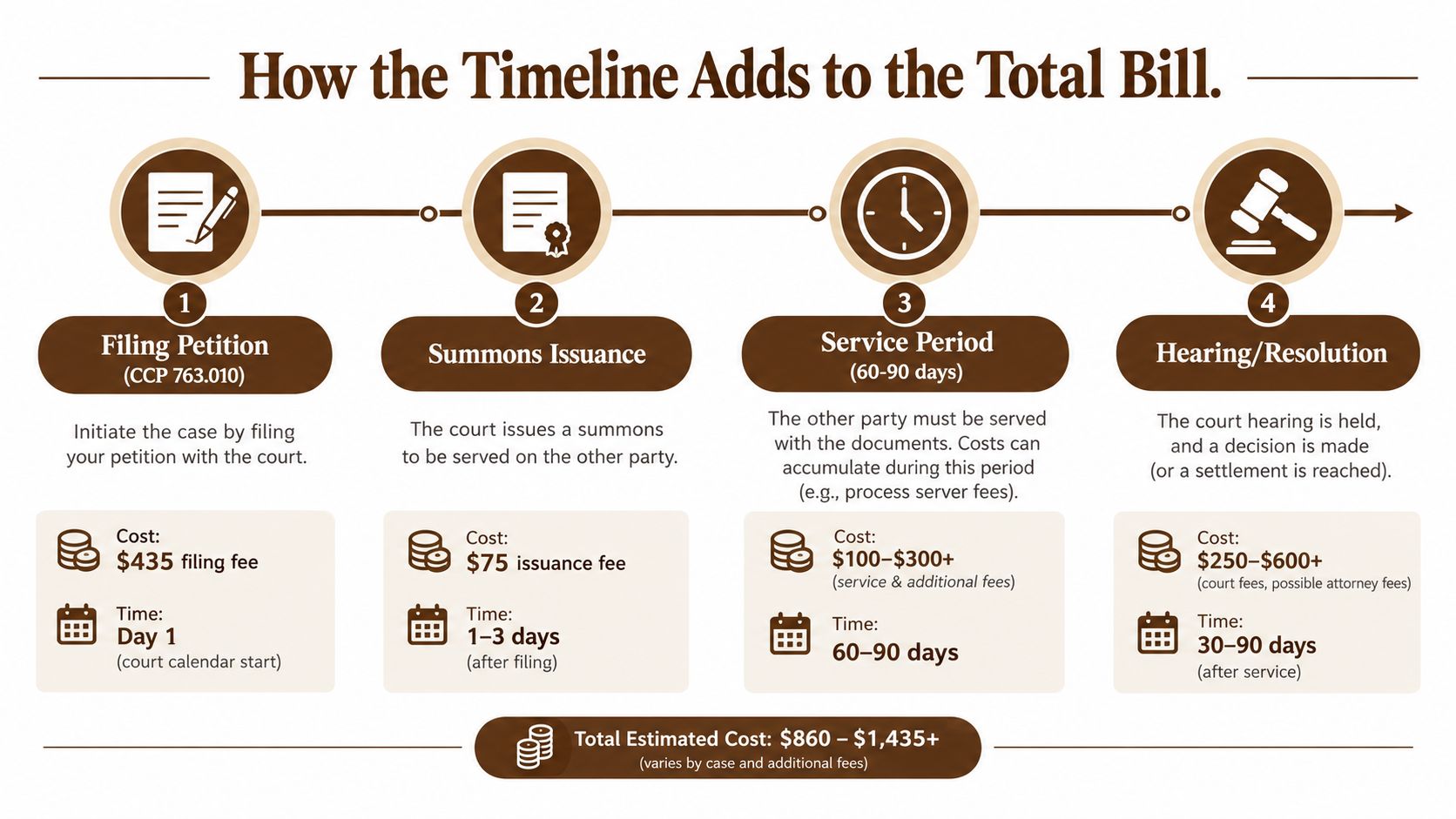
Time and money move together in quiet title litigation. Each additional service attempt, motion, hearing, or evidentiary dispute creates both calendar delay and attorney work.
The filing and summons process begins the case. Personal service may take 60 to 90 days in a difficult matter, particularly when addresses are outdated or a defendant avoids service. If publication becomes necessary, the publication period can take approximately four weeks, while the plaintiff must satisfy the reasonable-diligence requirements under California Code of Civil Procedure sections 763.010 and 763.020.
Where calendar delays become invoices
A default prove-up hearing may occur around 90 to 120 days into a straightforward case, depending on service, court availability, and whether the submitted evidence satisfies the judge. A contested matter can move into standard setting and trial scheduling, pushing the case beyond 12 to 18 months.
A missed service attempt can add $400 to $800 in process-server fees and reset the service schedule, according to the planning assumptions commonly used for this type of California matter. A contested motion can add $3,000 to $7,000 in attorney time and another 60 to 90 days to the calendar when briefing and hearing dates are required.
The faster path isn't always the one with the lowest initial invoice. Paying for a reliable title investigation and a well-planned service strategy may prevent rework. Conversely, trying to force a default without properly identifying or notifying a potential claimant can create a judgment that a title company won't accept, requiring more litigation later.
Two Realistic California Budget Examples
A Long Beach homeowner finds that an old deed lists the wrong lot number. The current owner has possession, the title company identifies the defect, and the people connected to the deed can be identified and served. No one has indicated an intention to dispute the owner's claim.
For that kind of Orange County style matter, a practical planning budget is $5,500 to $7,500. That figure may include the filing fee, service on two people, title research and an endorsement, recording, and a $3,500 to $5,000 flat attorney fee. If every defendant defaults and the court accepts the evidence, the matter may conclude with a default judgment within four to six months.
A defective legal description can be procedurally simple, but only after the title documents establish exactly what was intended.
The second scenario is different. An Anaheim property owner discovers that a former co-owner recorded a quitclaim deed after a divorce. The former co-owner disputes the owner's position, and the case develops an easement-related counterclaim. The attorney must address contested pleadings, a motion to set aside, depositions, expert survey work near $2,500, and a multi-day bench trial.
That matter may require a budget of $18,000 to $32,000 and a 14 to 20 month runway. The statutory remedy is still a quiet title action, but the work is no longer limited to filing papers and proving a default. The court must evaluate competing evidence, and each disputed issue gives the opposing party another reason to demand discovery, briefing, testimony, or negotiation.
These examples aren't promises or quotes. They show why the person who appears after service often matters more than the age of the deed. A title defect can sit undetected for decades, then become expensive when a claimant decides to defend an ownership position.
Smart Ways to Keep Costs Under Control
Cost control starts before the complaint is filed. A low flat-fee quote may look appealing, but if it excludes title research, difficult service, publication, amendments, or contested work, the owner may pay more overall than with a broader engagement.
A flat fee can work well for a clean uncontested file with a defined claimant list and a predictable evidentiary record. Hourly billing may be more appropriate when unknown heirs, a disputed deed, a boundary issue, or a likely defense makes the scope uncertain. Neither structure is automatically better. The written exclusions and assumptions matter more than the label.

Practical preparation before the retainer
- Order a focused title search: Use a reputable Orange County or Los Angeles County abstractor and ask for the recorded deeds, tax records, and a 40-year chain review before counsel begins extensive investigation.
- Organize the file: Bring deeds, probate records, divorce judgments, trust documents, title reports, surveys, lender correspondence, and any communications with potential claimants.
- Define the claimant list: Confirm whether the case involves a single known owner, several heirs, a lender, a neighbor, or unknown parties.
- Negotiate spending controls: Ask for hourly rate caps, approval thresholds, or a not-to-exceed amount for defined phases.
- Review exclusions: Make sure the agreement addresses filing, service, publication, recording, experts, mediation, court reporters, amendments, motions, and trial.
The attorney should also explain whether routine drafting or document review can be handled by a paralegal at a lower rate, while preserving attorney supervision. Ask whether the firm carries malpractice coverage and has taken California quiet title actions through judgment in Superior Court.
The right lawyer should be able to explain what works for a default case and what changes if a claimant appears. Avoid a quote that treats publication, heirs, or a boundary dispute as an afterthought. Those facts should appear in the scope analysis before the first filing.
Planning Your Next Move With Confidence
A California quiet title budget turns on five items: the filing posture, potential claimants, service method, expert work, and whether the matter remains uncontested or moves into motions and trial.
For an uncontested case, earlier planning ranges in this article place total out-of-pocket costs around $3,500 to $10,000. A defended matter may reach $10,000 to $25,000 or more, depending on attorney time and litigation work. A surveyor-published breakdown of quiet title escalation factors highlights publication, unknown heirs, deceased owners, multiple defendants, and boundary or survey disputes. Those figures are planning ranges, not quotes. A title review must come first, because a case that appears routine can become contested after service.

Prepare for a title-specific consultation with the title commitment, recorded deeds, probate or divorce documents, surveys, and information about possible claimants. Counsel can then identify the likely procedure, separate predictable charges from conditional ones, and estimate the timeline for clearing title in Orange County or elsewhere in California.
Tanner Law provides California quiet title representation for homeowners, families, investors, and property owners facing clouded title, probate-related ownership questions, and real estate disputes. Schedule a free consultation through Tanner Law to discuss your documents and receive a scope-specific fee assessment.