How Long Does a Partition Action Take in California
An uncontested California partition action typically takes 6 to 12 months from filing to cash distribution, while contested cases commonly run 18 months to 3 years or longer when valuation, buyouts, multiple heirs, or other disputes complicate the case. The court's judgment may arrive before the property is sold and the proceeds are distributed.
You may be dealing with a family home inherited after a parent's death, an investment property owned with a former partner, or a house that several siblings can't agree how to manage. One co-owner wants to sell. Another refuses to move, won't sign a listing agreement, or insists the property is worth far more than an appraisal supports. Meanwhile, taxes, mortgage payments, repairs, probate paperwork, and family tensions continue.
That's when people ask, “How long does a partition action take?” The honest answer under California law depends on which clock you're asking about. The court timeline measures how long it takes to establish the right to partition and obtain an order for division or sale. The cash-out timeline measures how long it takes to appoint a referee, value and market the property, complete the sale, resolve accounting issues, and distribute the net proceeds.
A relatively cooperative case can fall near the shorter end of the range. A contested case can take substantially longer, especially in Orange County or Los Angeles when multiple parties, title questions, disputed reimbursements, or court scheduling problems are involved. The procedure is predictable. The delays usually come from people, property records, valuation disputes, and the steps that follow judgment.
Table of Contents
- What to Expect When Filing a Partition Action
- The Step-by-Step California Partition Timeline
- The Two Clocks That Determine When You Get Paid
- Factors That Speed Up or Slow Down Your Case
- Estimating Your Own Partition Action Timeline
- How to Protect Your Interests and Shorten the Process
What to Expect When Filing a Partition Action
Consider a common situation. Two siblings inherit a California residence, but only one sibling lives there. The occupying sibling wants to keep the property and believes the other sibling should wait. The nonoccupying sibling needs liquidity and wants the house sold. Months of family conversations produce no agreement.
A partition action gives the co-owner who wants to end the stalemate a court process for resolving the ownership dispute. In California, the usual baseline is about 6 to 12 months for an uncontested matter, while a contested action commonly takes 18 months to 3 years to reach final resolution, according to this California partition action timeline guide.
The difference isn't arbitrary. An uncontested case may move through filing, service, ownership confirmation, sale preparation, and distribution without major motion practice or trial disputes. A contested case can require discovery, hearings, competing appraisals, arguments over credits and expenses, and repeated court involvement.
Cooperation determines the starting point
A cooperative co-owner can help identify the property, confirm ownership shares, agree on a sale strategy, and provide records promptly. A resistant co-owner can delay service, dispute the ownership interest, challenge the property's value, oppose the proposed sale process, or demand reimbursement for expenses.
California partition cases also involve a sequence of legal decisions. The court must identify the parties and their interests, determine whether partition is available, and decide whether the property should be divided physically or sold. A court order doesn't automatically put money in your account.
Practical rule: If your real question is when you'll receive your share, ask your attorney for a cash-distribution estimate, not just an estimated judgment date.
Families handling probate or inherited property should also account for title and service issues. The person listed in a family understanding may not be the person shown in recorded title. An estate, trust, lienholder, or additional heir may need to be addressed before the court can safely move forward.
Your likely timeline therefore depends on three early questions:
- Do all co-owners agree about ownership? If not, ownership disputes can push the case beyond the straightforward range.
- Will the property be sold or divided? A physical division may not be practical, and the court must decide the proper remedy.
- Will the sale and accounting be contested? Disputes after judgment can delay the point at which proceeds are distributed.
The rest of the process becomes easier to evaluate once you separate these issues instead of treating “the partition action” as one event.
The Step-by-Step California Partition Timeline
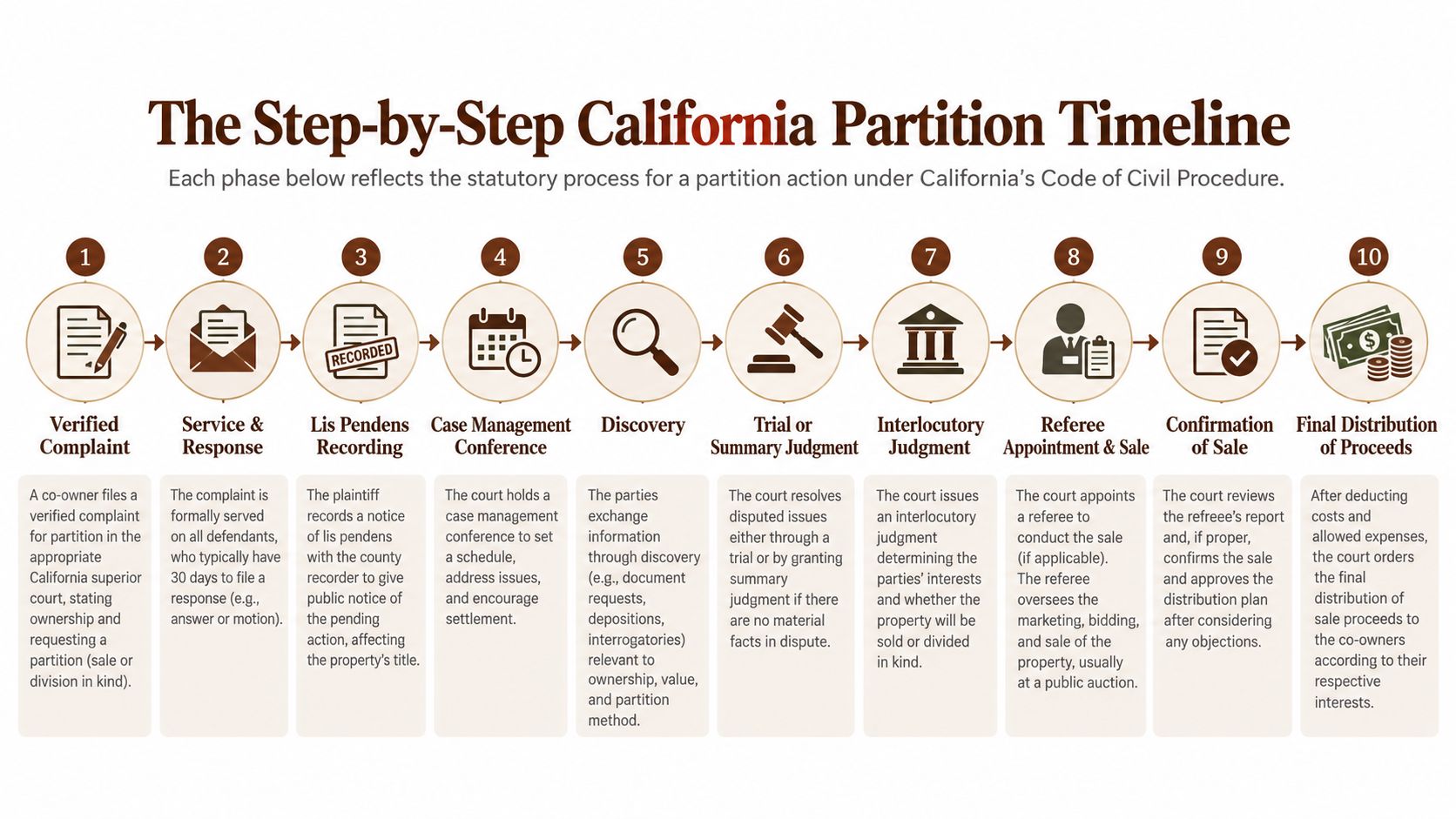
A family may agree that a property should be sold, yet the case can still take months. California partition actions follow statutory steps, and each step can create a separate delay. The timeline also has two endpoints: the court's judgment and the date the sale proceeds are distributed.
Filing and service
The case generally starts when one co-owner files a verified complaint in California Superior Court. The complaint identifies the property, the ownership interests, and every party entitled to notice. Filing and service commonly take 1 to 4 weeks, based on the California partition lawsuit process.
Every co-owner must receive the summons and complaint. If service is defective or a co-owner cannot be located, the response period and later hearings may be pushed back.
The response period
After service, defendants generally have 30 days to respond. A defendant may answer the complaint, challenge the alleged ownership interests, raise reimbursement issues, or begin settlement discussions. This deadline marks the start of the contested phase, not the end of the case.
Discovery and motions
Discovery and motions commonly take 2 to 6 months. The parties may exchange deeds, probate documents, mortgage records, tax information, repair receipts, rental records, communications, and valuation materials.
Partition disputes often turn on records rather than family history. One co-owner may claim unequal contributions, another may argue that exclusive occupancy reduced the property's value, and a third may challenge the ownership percentage stated in the complaint. Those issues can require document requests, depositions, motions, or a court ruling before the case can proceed.
Trial or settlement
Trial or settlement activity can add 3 to 12 months. A partition settlement should identify the property's listing price range, broker selection, access dates, repair responsibilities, credits for expenses or occupancy, sale costs, and allocation of the closing proceeds. It should also state how disagreements will be resolved and when each party will receive funds.
A promise to “sell later” does not finish a partition case. Without concrete sale and accounting terms, the co-owners may create a second dispute over the property's marketing, expenses, or distribution.
Interlocutory judgment
California law requires an interlocutory judgment before final division or sale. The court determines each party's right to partition and ownership interest, then decides whether the property will be partitioned in kind, meaning physically divided, or sold and converted into proceeds.
The order establishes the legal path, but it does not place money in a co-owner's account. The court must set the foundation for the property's disposition before the matter reaches the referee stage, as explained in this overview of California partition referee statutes.
Referee appointment and sale
Referee appointment and sale commonly take 3 to 9 months. The referee may oversee an appraisal, select or coordinate marketing, review offers, arrange sale procedures, and report to the court. Depending on the order and the property, the process may require hearings, approval of sale terms, and coordination with brokers, buyers, lenders, and title professionals.
A signed sale contract still may not equal immediate payment. Closing, required confirmation, liens, and unresolved accounting issues can keep the proceeds from being distributed.
Final accounting and distribution
The final stage accounts for sale proceeds and allowable deductions. The court may address costs, fees, liens, credits, and reimbursement claims before dividing the remaining funds according to the established ownership interests.
That accounting separates the judgment timeline from the cash-out timeline. A sale date is not necessarily a payment date. The case reaches its economic endpoint only after approved deductions and distribution are complete.
The Two Clocks That Determine When You Get Paid
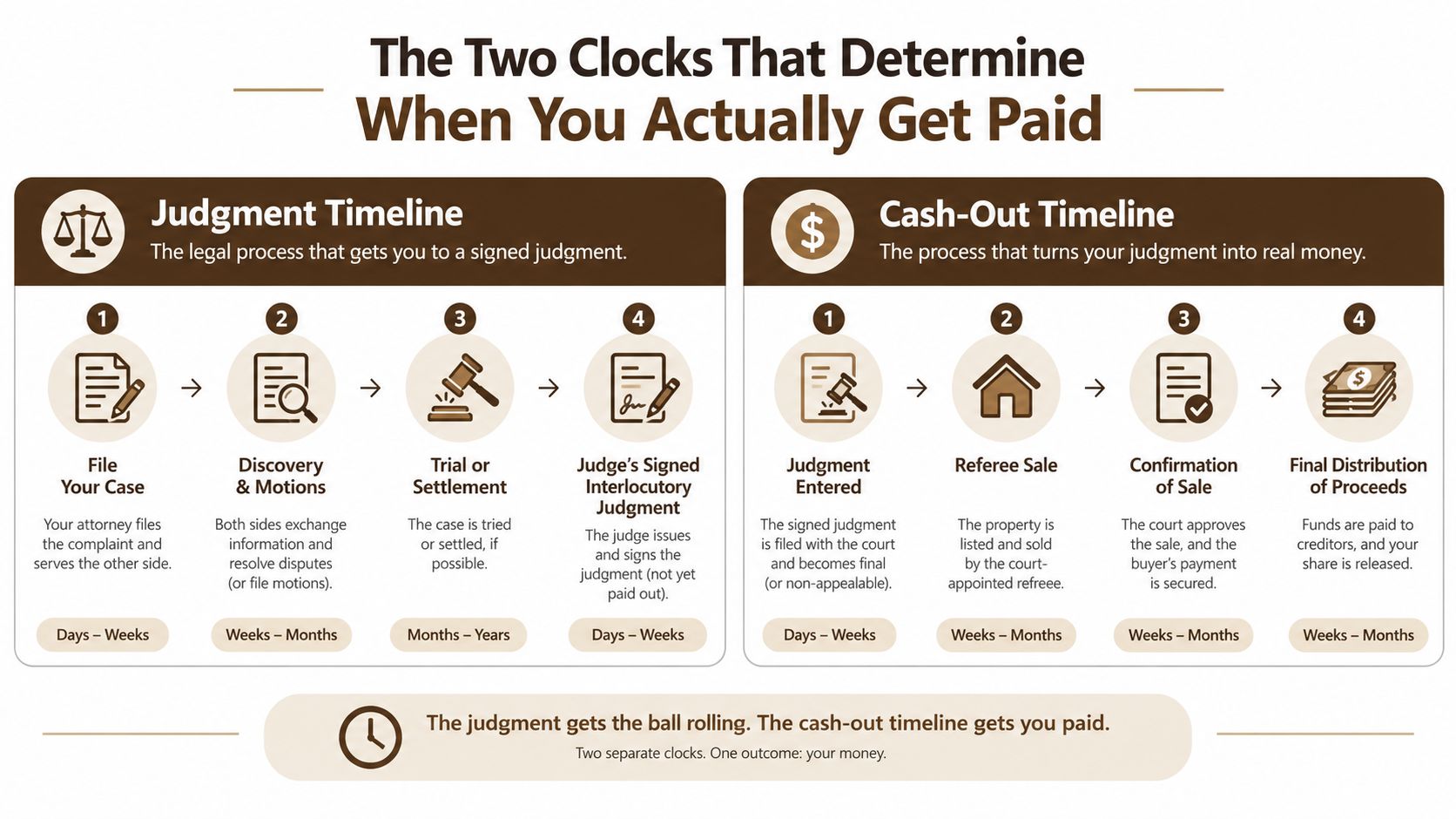
A judge can order a sale while the property remains months away from producing cash. For a co-owner planning housing, debt repayment, or probate administration, that distinction matters more than the date the complaint was filed.
The first clock is the judgment timeline. It covers filing, service, discovery, motions, and the court's decision on ownership, the right to partition, and the method of sale or division.
The second is the cash-out timeline. It begins after the court authorizes the next step and continues through referee appointment, appraisal, marketing, contract acceptance, closing, any required sale confirmation, final accounting, and distribution.
Judgment is not the same as cash
An order establishing a right to partition or directing a sale changes the legal position. It does not convert the property into distributable funds. The referee may still need to evaluate an appraisal, coordinate listing and marketing, review offers, and submit reports to the court.
A sale contract also does not guarantee immediate payment. Closing requirements, liens, sale confirmation, and unresolved accounting issues can delay distribution after the parties accept an offer.
For a probate property, the cash-out clock may also include occupancy decisions, personal property, repairs, insurance, taxes, and buyer access. If one heir controls the property, disputes over access or expenses can affect both the sale and the final accounting.
Court scheduling adds uncertainty
Hearings, referee appointments, appraisals, marketing, and final accounting can extend the process after judgment. California matters may take 6 to 12 months when simple, while contested sale and post-judgment proceedings can reach 18 to 36 months or more, as described in this analysis of the partition lawsuit timeline for real property.
Referee reporting creates a separate checkpoint. The referee may need to report appraisal results, marketing activity, offers, and proposed sale terms before the court can address the next issue. A required confirmation hearing can add another scheduling interval, even after a buyer and seller have agreed on terms.
For families in Orange County and Los Angeles, ask counsel to estimate both clocks:
- Court resolution: When might the court decide ownership, the right to partition, and the sale or division method?
- Cash distribution: When might the property close, the final accounting finish, and net proceeds reach the owners?
The order puts the case on the path to payment. It does not mark the payment date.
Use both estimates when planning housing, debt, probate administration, taxes, and reinvestment.
Factors That Speed Up or Slow Down Your Case
The fastest and slowest partition actions usually differ in the same ways. Cooperation, clean title, a defensible valuation, and organized records move a case forward. Resistance, multiple heirs, unclear ownership, and financial disputes create additional work.
| Case Type | Typical Timeline | Key Delay Factors |
|---|---|---|
| Relatively straightforward matter | 6 to 12 months | Cooperative co-owners, clear title, limited valuation disagreement |
| Contested ownership or valuation case | Longer than the straightforward range | Discovery, motions, competing positions about ownership or property value |
| Multiple-heir or financially complicated case | 24 to 36 months or longer | Multiple heirs, disputed appraisals, liens, reimbursement claims, or appeals |
The timeline ranges in the table reflect reported partition case durations. The cited material discusses partition matters across jurisdictions, so California cases must still be evaluated under California procedure and local court conditions.
Co-owner behavior
A co-owner who communicates, provides documents, permits inspections, and negotiates in good faith can reduce avoidable conflict. A co-owner who refuses access, contests every filing, or changes positions can force additional hearings and motion practice.
That doesn't mean you should accept an unfair deal just to move quickly. It means you should distinguish legitimate legal disagreements from delay for its own sake. Your attorney can address the first and seek procedural solutions to the second.
Heirs and title structure
A dispute between two siblings with recorded ownership may be manageable. A property involving several heirs, a trust, a probate estate, or conflicting title documents demands more investigation and service work.
Inherited property often carries another complication. Family members may remember an agreement that was never recorded, while the deed or probate documents show a different ownership structure. Until the court knows who owns what, negotiations about sale proceeds rest on an unstable foundation.
Valuation, liens, and the buyout window
A court-ordered appraisal can lead to a buyout opportunity. After the appraisal, defendants generally have a 45-day buyout period. If no buyout occurs, the court can order a referee sale, as described in this California forced-sale timeline.
The appraisal itself may not end the valuation dispute. One owner may challenge the methodology, condition assessment, comparable properties, or treatment of improvements. Liens and reimbursement claims can create a separate disagreement about what should be paid before the remaining funds are divided.
Appeals can extend the case well beyond the ordinary sale path. If a party challenges a ruling, the case may require additional briefing, hearings, and attention before the proceeds can be finalized.
Estimating Your Own Partition Action Timeline
Start with the right baseline. For a relatively straightforward California case, use 6 to 12 months as the general range, not as a guaranteed deadline. Then examine the facts that could move your matter toward the longer end.
First, identify the ownership structure. One recorded owner against another is easier to administer than a property involving several heirs, a trust, an estate, or unresolved title issues. Count every person who may claim an interest, because each additional party can create service, documentation, and negotiation problems.
Next, assess cooperation. Don't base your estimate on what the other owner promised during a family conversation. Base it on whether that person has signed documents, shared records, allowed access, and agreed on a valuation or sale plan.
Use a practical risk check
Ask these questions before filing:
- Is ownership clear? If deeds, probate orders, trust documents, or other records conflict, expect additional legal work.
- Is the property's value disputed? A valuation challenge can delay a buyout or sale decision.
- Are there liens or shared expenses? Mortgage obligations, taxes, repairs, insurance, and other property charges may require documentation and allocation.
- Are reimbursement claims likely? One owner may seek credit for payments, improvements, or expenses, while another may dispute those claims.
- Is an appeal possible? A party committed to challenging court decisions can extend both the judgment and distribution clocks.
Local conditions matter too. Orange County Superior Court and Los Angeles Superior Court scheduling can affect hearing dates and post-judgment work, but your lawyer shouldn't promise a precise court date before reviewing the case.
The final payout requires its own estimate. California partition proceeds aren't divided by title percentage without adjustment. Attorney fees, referee fees, court costs, and reimbursement claims or offsets may be deducted before the remainder is distributed according to ownership shares, under the statutory framework summarized in California Code of Civil Procedure sections 873.810 through 873.850.
Planning advice: Build your personal estimate around the cash-out date, and keep a separate estimate for the court judgment.
You can influence preparation, document quality, settlement strategy, and communication. You can't control every hearing slot, court backlog, buyer delay, or objection. A realistic estimate accounts for both.
How to Protect Your Interests and Shorten the Process
If a co-owner refuses to sell or buy you out, delay starts before anyone enters a courtroom. Prepare the file and define the outcome before filing. Gather the deed, trust or probate records, mortgage information, tax statements, insurance records, repair invoices, rental information, and proof of payments. Preserve messages about buyouts, sale discussions, access arrangements, and refusals to cooperate.
Set a specific objective. You may want a sale, a buyout, a ruling on ownership shares, or an accounting of contributions. Counsel cannot build an efficient strategy around an undefined goal.
Build a usable property file
Give your attorney a concise chronology and an organized document folder containing:
- Ownership records: Deeds, probate orders, trust documents, and written ownership agreements.
- Financial records: Mortgage statements, taxes, insurance, utilities, repairs, and improvement expenses.
- Property information: Current occupancy, leases, known liens, condition concerns, and prior valuations.
- Co-owner communications: Written proposals, responses, missed commitments, and access disputes.
A complete file lets counsel prepare the verified complaint, identify every required party, and address service problems early. In California, a partition case generally starts with a verified Superior Court complaint and service on the co-owners, who generally have 30 days to respond. Confirm the response deadline and service plan with your attorney rather than relying on an informal assumption.
Early communication can also resolve a buyout or voluntary sale before litigation expands. If settlement fails, counsel familiar with Orange County, Los Angeles, Riverside, and San Bernardino courts can plan for local procedures and issues involving title, service, appraisal, referee administration, and final accounting. That preparation cannot control court availability or buyer conduct, but it can prevent avoidable delay.
Keep the two clocks separate. Ask for one estimate of when the court may enter judgment and another for when a sale, accounting, deductions, and distribution may put money in your account. Those dates can differ substantially.
Tanner Law provides guidance on California real estate disputes, including partition-related ownership and division issues. Schedule a free consultation through Tanner Law to review your records and obtain separate estimates for the judgment date and the cash-distribution date.