Breach of Contract in California: A Complete Legal Guide
You signed a purchase agreement for a home in Orange County, paid what you were required to pay, and expected the seller to complete the promised repairs. Instead, the seller stopped responding, the repair work never happened, and the property now carries costs you didn't anticipate. A similar problem can arise when a service provider abandons a project, a co-owner refuses to follow a written property agreement, or a family member disregards an inheritance arrangement.
These disputes are not resolved by proving that someone broke a promise. Under California law, the person bringing a claim must prove a valid contract, performance or a valid excuse, nonperformance, harm, and a legally sufficient connection between the breach and the loss. Timing creates another serious risk. A written contract generally receives a longer filing period than an oral contract, but the difficult question is often identifying the date of the breach.
For families handling probate or trust disputes, and for owners involved in real estate transactions in Orange County and Los Angeles, early legal analysis can protect rights that disappear with delay. The contract language, the parties' conduct, the type of obligation, and the evidence of loss all matter.
Table of Contents
- When a Contract Breaks Down in California
- The Five Elements You Must Prove
- Statute of Limitations and Timing Traps
- Remedies Available Under California Law
- Common Defenses and Liability Limitations
- Practical Steps for Plaintiffs and Defendants
- Schedule Your Free Consultation with Tanner Law
When a Contract Breaks Down in California
A real estate contract can unravel in several ways. A seller may fail to deliver marketable title, remove fixtures that were included in the agreement, or refuse to complete repairs promised before closing. A buyer may fail to pay, reject a transaction without a contractual basis, or impose conditions the agreement doesn't allow. In a family setting, a written agreement concerning property or an estate may be ignored after a loved one dies, creating a dispute among beneficiaries or co-owners.
The first question is whether the parties made an enforceable agreement. The second is whether one party failed to perform a contractual obligation. The third, and often most contested, is whether that failure caused recoverable harm. California contract litigation focuses on that connection rather than on frustration or unfairness alone.
Practical rule: A broken promise becomes a strong legal claim only when the contract, the breach, and the resulting loss can be proved with admissible evidence.
That evidence may include the signed agreement, amendments, escrow records, invoices, payment confirmations, inspection reports, photographs, text messages, emails, and a clear timeline. Oral discussions can matter, but they create avoidable disputes about what was promised and when. For that reason, written documentation is more than an administrative convenience. It can determine the filing window and make the parties' obligations easier to prove.
Real estate and probate-related disputes also tend to involve layered obligations. A purchase agreement may address repairs, title, possession, and closing conditions. An estate agreement may intersect with ownership records, fiduciary conduct, or a later transfer. One missed obligation can produce several theories of liability, but each theory must be evaluated under its own facts and legal requirements.
California law also limits recovery to losses supported by the contract and the evidence. A claimant can't automatically recover every expense that followed a breach. The loss must be connected to the breach, and the claimed damages must have been foreseeable when the parties made the agreement, as reflected in the California Civil Jury Instructions.
The right response depends on the situation. A demand letter may resolve a repair dispute. Negotiation or mediation may preserve a family relationship while protecting ownership rights. Litigation may be necessary when the other party denies the agreement, threatens a transfer, or refuses meaningful resolution.
The Five Elements You Must Prove
California breach-of-contract claims follow a defined proof structure. The plaintiff must establish contract formation, performance or excuse, breach, harm, and causation, including the foreseeability of the claimed damages under California's jury instructions.
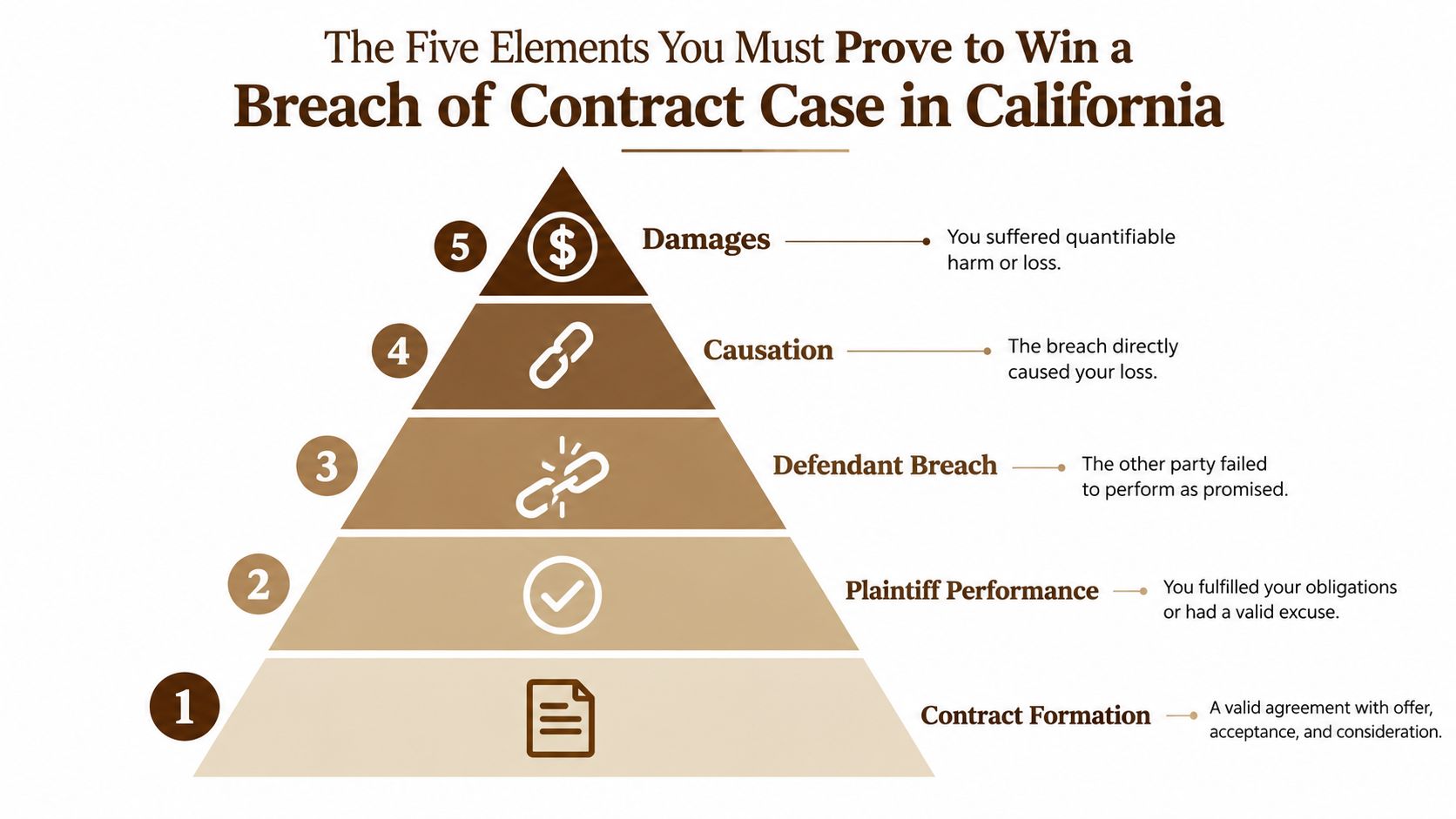
Contract formation
Start with the agreement itself. The plaintiff must show that the parties reached a contract with identifiable obligations. A signed purchase agreement is usually easier to analyze than a series of conversations between relatives about future ownership. Emails, payment records, drafts, and conduct can help, but they may also create competing interpretations.
Formation disputes often focus on whether essential terms were settled, whether a person had authority to sign, or whether later changes replaced the original agreement. In probate and real estate matters, ownership records and authority documents can become just as important as the contract language.
Plaintiff performance or valid excuse
The plaintiff must show that they performed their own obligations or had a legally valid reason for not doing so. A buyer seeking enforcement may need to show that the buyer was ready and able to close. A service customer may need payment records demonstrating compliance with the agreed payment schedule.
A party who failed to perform first may face a serious obstacle. That doesn't mean every missed act defeats a claim, because the contract may make one obligation dependent on another or the other party's conduct may provide an excuse. The facts and the agreement control.
Defendant nonperformance
The plaintiff must identify the specific promise the defendant failed to keep. “The deal went badly” isn't enough. The claim should identify the required act, the deadline or condition attached to it, and what the defendant did.
For example, a seller's failure to complete a promised repair is different from a buyer's dissatisfaction with the quality of work. The contract, inspection evidence, communications, and expert opinions may determine whether the conduct amounted to nonperformance.
Harm and causation
A breach without provable harm may not support meaningful damages. The plaintiff must show that the defendant's failure caused a loss and that the breach was a substantial factor in producing it. Repair invoices, replacement-service costs, property records, payment histories, and other business or family financial records can help establish that connection.
The analysis becomes harder when several events contributed to the loss. A property dispute may involve a contractor, seller, lender, title issue, and later market decision. The plaintiff must separate losses caused by the contract breach from losses caused by independent events.
Finally, the claimed damages must have been foreseeable when the contract was made. California's jury instructions require that the loss be tied to the breach in a legally sufficient way, not merely asserted after the dispute arises. That requirement is especially important where a party claims downstream losses involving an estate, a property investment, or a business arrangement.
Statute of Limitations and Timing Traps
Waiting can destroy an otherwise viable breach claim. California generally gives a plaintiff 4 years to sue on a written contract and 2 years to sue on an oral contract, with the period generally beginning when the contract is broken rather than when it was signed, as explained in the California courts' statute of limitations guidance.
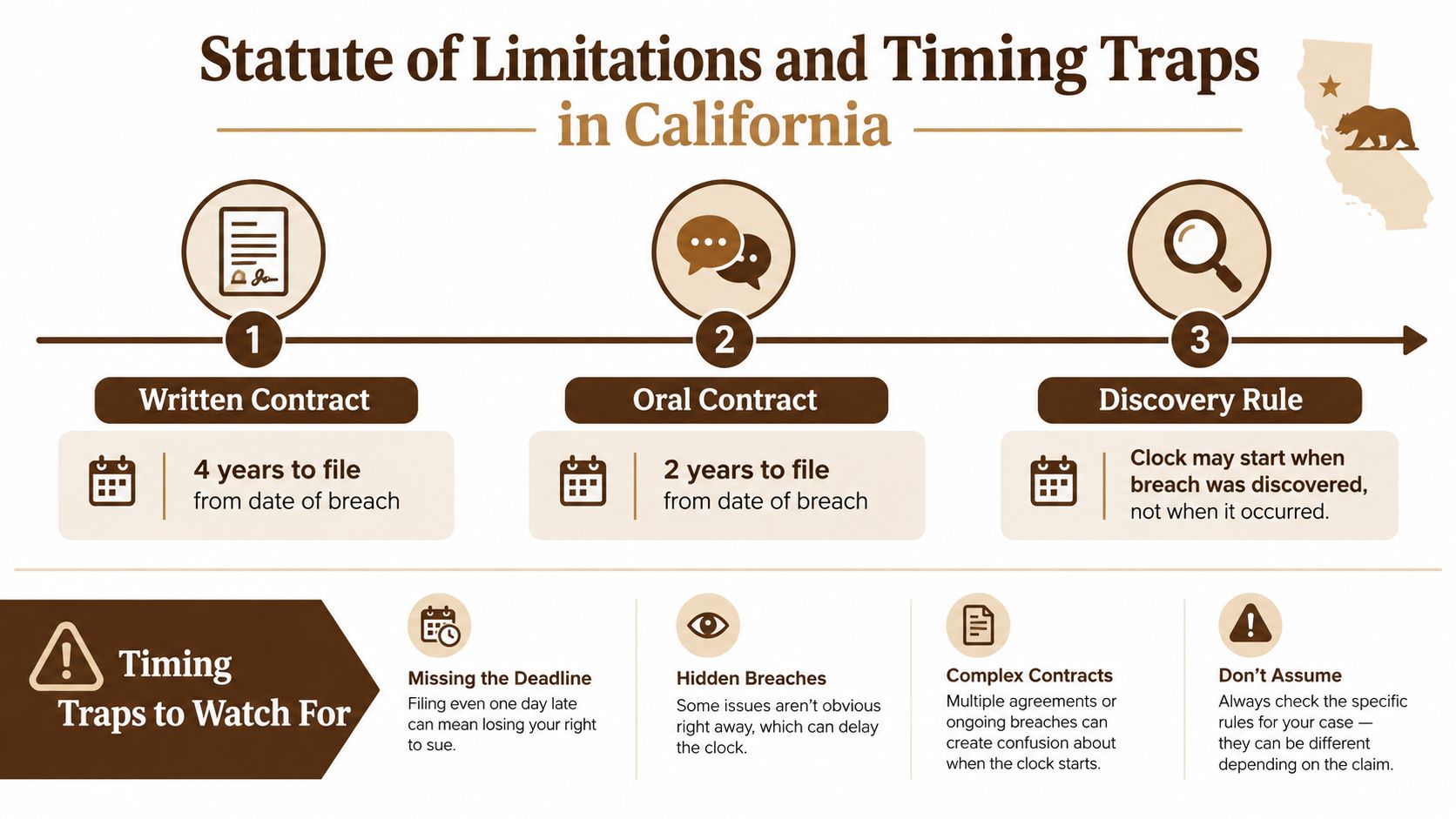
The simple rule becomes difficult when the contract requires performance over time. A missed installment payment, a continuing service obligation, and a single refusal to perform may produce different accrual questions. Separate breaches can create separate filing windows, while one underlying obligation may be treated as a single breach depending on the contract and the parties' conduct. Treating every dispute as though it has one obvious start date is a dangerous mistake.
The date of breach matters
The signature date usually isn't the filing date. The question is when the defendant failed to do what the agreement required. If a seller refuses to complete an agreed repair, the relevant date may relate to that refusal or the deadline for performance. If a party misses recurring payments, each missed payment may require separate analysis.
Continuing performance creates another trap. A contract may require repeated acts, ongoing maintenance, periodic payments, or continued cooperation. A plaintiff shouldn't assume that a later performance resets every earlier deadline. The correct analysis depends on whether the later conduct represents a new breach, continued performance of the same duty, or an acknowledgment that changes the legal picture.
Sales-of-goods contracts also require separate attention. California's Commercial Code provides a 4-year rule for sale-of-goods contracts, but identifying when a particular breach occurred can still be difficult when delivery, acceptance, warranty, and payment issues overlap. The California courts' breach-of-contract materials provide the basic framework, but they don't resolve every accrual question for a particular agreement.
Don't rely on delayed discovery assumptions
People often assume the deadline begins when they discover the problem. That assumption can be wrong in contract cases. Concealed facts, continuing obligations, partial performance, and separate breaches may affect the analysis, but a plaintiff must identify a legally supported basis rather than point to a late discovery.
A missed deadline by even one day may bar recovery. Preserve the contract and consult counsel as soon as a breach becomes apparent, particularly after a real estate closing or the death of a contracting party.
Use the embedded video as a general educational resource, not as a substitute for a case-specific deadline analysis.
Remedies Available Under California Law
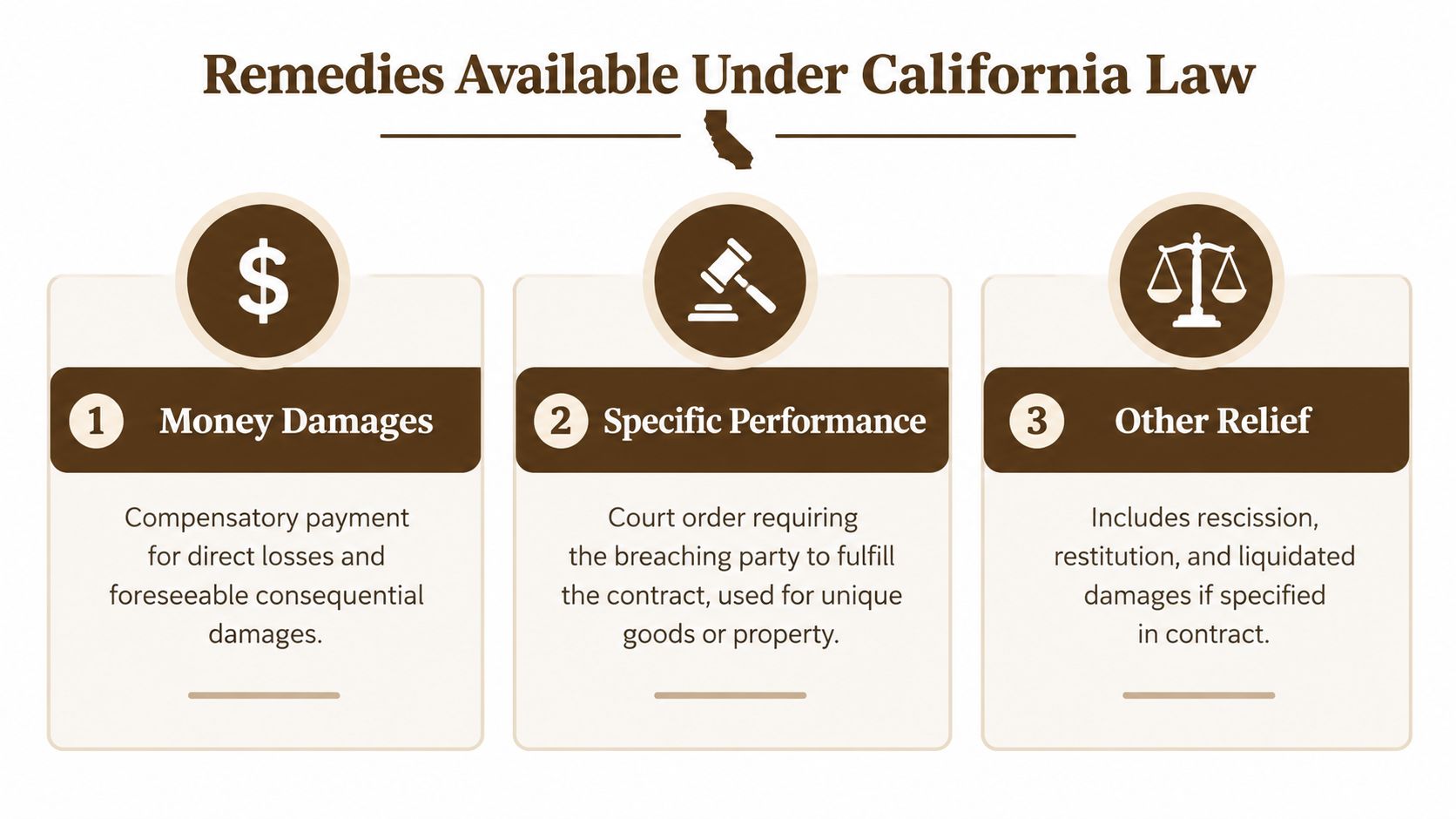
The remedy should match the injury and the contract. Most claims seek money, but money isn't always enough. A buyer may want the promised property or performance, while a seller may need protection from an overstated damages demand.
Money damages
Compensatory damages aim to address losses caused by the breach. Direct losses are tied closely to the promised performance, while consequential losses arise from the broader effects of the breach. Incidental expenses may also matter when they are connected to responding to the failure.
Foreseeability limits the claim. A party can't impose unexpected, remote losses on the other side unless the contract and circumstances support that exposure. The plaintiff must also prove the amount with reliable records rather than estimates built only on suspicion.
| Remedy | Typical purpose | Main limitation |
|---|---|---|
| Money damages | Compensate for proven direct and foreseeable losses | The loss must be caused by the breach and supported by evidence |
| Specific performance | Require the promised performance | A legal exception may prevent the order |
| Rescission or restitution | Undo the transaction or restore exchanged value where available | The facts and contract must support that relief |
Specific performance
California Civil Code section 3384 provides that specific performance may be compelled unless an exception applies, as described in this California Civil Code section on specific performance. This remedy asks the court to order the breaching party to perform rather than pay compensation.
Specific performance is particularly important in real estate disputes because a particular parcel may have qualities that money can't replace. A buyer seeking a unique property, or a co-owner seeking enforcement of a property agreement, may have a stronger reason to request performance than someone seeking replacement services that are readily available.
The remedy isn't automatic. The court will examine the agreement, the parties' performance, the available defenses, and whether an order can be enforced fairly. A plaintiff should plead a realistic alternative remedy instead of assuming the court will order the exact result requested.
Other relief
Depending on the facts, a party may pursue rescission, restitution, or contract-based relief such as liquidated damages. The agreement may also contain an arbitration or mediation requirement that affects the path to resolution. Review the remedy provisions before sending a demand, because an aggressive demand that ignores the contract can weaken credibility.
Common Defenses and Liability Limitations
A liability cap isn't automatically enforceable, and a deliberate breach doesn't automatically invalidate every limitation clause. The California Supreme Court's 2025 decision in New England Country Foods v. VanLaw Food Products drew an important distinction. California Civil Code section 1668 bars contractual limits on liability for willful injury, but it doesn't generally prohibit limits on pure breach-of-contract liability merely because the breach was intentional, as discussed in this analysis of the California Supreme Court ruling.
That distinction matters in high-conflict disputes. A consequential-damages waiver or liability cap may survive when it addresses contractual risk in a proper setting. A clause may face greater difficulty when the alleged conduct involves willful injury, independent misconduct, public policy concerns, or language that doesn't clearly cover the claimed loss.
Defenses that can change the result
A defendant may argue that no contract formed, the plaintiff didn't perform, the alleged obligation was never triggered, or the parties modified or waived the requirement. Impossibility or other performance problems may also matter, but the defense must fit the facts and the contract.
The defendant should examine the entire relationship, not just the plaintiff's preferred document. Payment history, change orders, text messages, inspection records, and prior conduct can show that the parties understood the agreement differently or that the plaintiff accepted a different performance.
Mitigation limits recovery
California law imposes a duty to mitigate damages. A plaintiff can't recover losses that reasonable efforts could have avoided, as reflected in the California jury instruction on mitigation. A property owner who allows preventable damage to continue, or a business that makes no reasonable effort to replace an abandoned service, may face a reduction in recovery.
Mitigation doesn't require reckless spending or acceptance of an inferior substitute. It requires ordinary care and reasonable action under the circumstances. Keep records of repair requests, replacement bids, temporary measures, and communications showing why a particular response was reasonable.
Practical Steps for Plaintiffs and Defendants
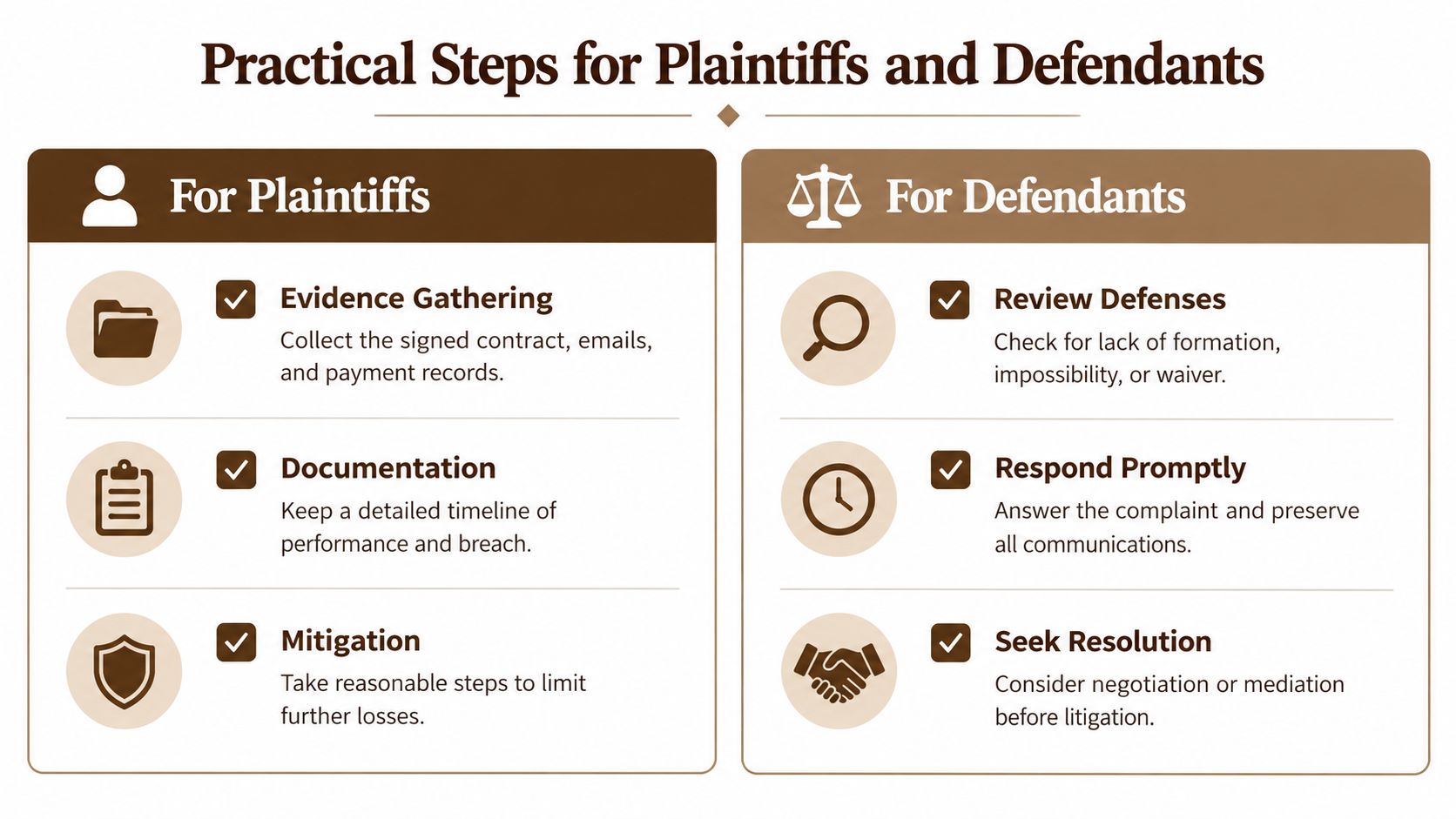
A contract dispute should be managed like an evidence problem before it becomes a courtroom problem. Both sides need a reliable chronology, the operative agreement, and a realistic assessment of loss.
If you're pursuing a claim
- Collect the agreement: Preserve the signed contract, amendments, emails, payment records, disclosures, inspection reports, and related documents in their original form.
- Build the timeline: List each obligation, performance date, missed act, notice, payment, and response. Don't rely on memory, especially in a probate or property dispute that developed over time.
- Measure the loss: Separate direct expenses from broader claimed losses. Gather invoices, estimates, appraisals, payment evidence, and records showing how the breach affected the property or transaction.
- Mitigate responsibly: Take reasonable steps to limit further loss, while documenting why each step was necessary and what alternatives you considered.
- Protect the deadline: Identify whether the agreement is written or oral and analyze the actual accrual date before negotiating for an extended period.
A demand letter can be useful when the other party is willing to engage and the facts are organized. It can be counterproductive if it makes unsupported accusations, reveals strategy, or allows a filing deadline to pass.
If you're defending a claim
- Review formation: Check signatures, authority, essential terms, modifications, conditions, and any integration clause.
- Preserve communications: Keep emails, texts, payment records, project files, photographs, and notices. Don't delete unfavorable material or communicate carelessly after receiving a demand.
- Test causation: Ask whether the alleged loss came from the claimed breach, an independent event, or the plaintiff's own decision.
- Check limitations: Examine liability caps, damage waivers, arbitration provisions, notice requirements, cure periods, and attorney-fee language.
- Consider resolution: Negotiation or mediation may control cost and uncertainty, particularly when the relationship involves relatives, co-owners, or a continuing business arrangement.
A focused consultation can clarify whether early settlement, targeted discovery, or immediate court action best protects the client. Tanner Law handles contract-related civil disputes, including complex property matters, with direct attorney access and practical guidance.
Schedule Your Free Consultation with Tanner Law
A viable breach claim usually turns on three decisions: whether a contract can be proved, whether the breach caused recoverable harm, and whether the claim is still timely. The remedy then shapes the strategy. A property buyer may seek performance or damages, while a defendant may rely on contract limitations, causation defenses, mitigation arguments, or proof that the plaintiff failed to perform.
Probate and real estate disputes deserve early review because documents may be scattered among family members, escrow agents, brokers, contractors, trustees, and property managers. A lawyer can organize the record, identify the operative agreement, evaluate the accrual date, and determine whether negotiation, mediation, arbitration, or litigation makes sense.
Tanner Law represents clients in Orange County and Los Angeles on property disputes, quiet title actions, partition suits, real estate contract breaches, probate-related conflicts, and related civil matters. The practice combines transactional insight with courtroom advocacy and offers free initial consultations by phone or email.
If a contract dispute is threatening your property, inheritance, business relationship, or financial recovery, visit Tanner Law to schedule a free consultation. Bring the contract, key communications, payment records, and a clear timeline so counsel can evaluate your rights, deadlines, defenses, and available remedies.