8 Key Questions to Ask Estate Planning Lawyer in 2026
You're probably reading this before a first consultation, or after a conversation with family that made the need feel immediate. Maybe you own a home in Orange County, have aging parents in Los Angeles, have children from a prior marriage, or want to make sure your assets pass smoothly without putting your family through court. Those are exactly the moments when good questions matter.
Preparing for your first meeting with an estate planning lawyer isn't about trying to sound impressive. It's about making sure the lawyer understands your life, your property, and the risks that apply under California law. California has its own probate rules, its own property rules, and real estate issues that can completely change what a sound plan looks like. A plan that works on paper in another state can fail badly when California real property, community property concerns, or local probate procedures enter the picture.
That's why the best questions to ask an estate planning lawyer go beyond “Do I need a will?” You also want to know who will draft your documents, how your trust will be funded, what happens if you become incapacitated, and how the lawyer handles family conflict before it becomes litigation.
This guide gives you a practical list to use in Orange County and Los Angeles. It focuses on what effectively protects families, what often gets missed, and which follow-up questions reveal whether the attorney is giving personalized California advice or a generic package.
Table of Contents
- 1. What Experience Do You Have With California Estate Planning and Probate Law?
- 2. Do You Recommend a Will, Trust, or Both for My Situation?
- 3. How Do You Help Clients Avoid or Minimize Probate in California?
- 4. What Are Your Fees, How Do You Structure Billing, and Do You Provide Ongoing Support After Execution?
- 5. How Will We Handle Asset Funding and Title Transfers for My Trust?
- 6. What Happens to My Estate Plan if I Become Incapacitated?
- 7. How Do You Address Tax Planning and Minimize Estate Taxes for My Beneficiaries?
- 8. What Happens if There Are Family Disputes or Challenges to My Estate Plan?
- 8-Point Comparison: Estate Planning Lawyer Questions
- Take the Next Step: Secure Your Family's Future
1. What Experience Do You Have With California Estate Planning and Probate Law?
California experience isn't a nice extra. It's the baseline. Probate procedure, community property treatment, trust administration, and local court practice all affect how an estate plan should be drafted and how it will function later.
A lawyer may be generally competent and still be the wrong fit if estate planning is only a small part of the practice. FindLaw's discussion of estate planning questions notes that you should ask what percentage of the attorney's work is devoted to estate planning, trusts, and probate, and it describes firms with roughly 70 to 90 percent of their business in trust and probate work as operating at a high specialization level. In practice, that question tells you whether the attorney lives in this area of law or visits it occasionally.
What a strong answer sounds like
A strong California-focused answer should include more than years in practice. It should sound specific. The attorney should be able to explain how they handle Orange County or Los Angeles probate matters, whether they work with both uncontested and contested estates, and how California community property issues affect married couples, blended families, and real estate held in different forms of title.
If you own a home, ask how often the lawyer deals with deeds, title questions, and trust transfers involving California real property. Real estate is where many estate plans fail. The documents may look polished, but title was never fixed.
Practical rule: If the lawyer answers in general terms but avoids California-specific examples, keep asking.
Red flags and follow-up prompts
Use follow-up questions that force precision:
- Ask about court familiarity: “How often do you handle matters in Orange County Superior Court or Los Angeles County cases involving probate or trust administration?”
- Ask about specialization: “What percentage of your practice is estate planning, trusts, and probate?”
- Ask about who does the work: “Will you personally advise me and review the final plan?”
- Ask about staying current: “How do you keep up with California law changes that affect wills, trusts, probate, and property transfers?”
One more point matters here. Many clients assume the attorney they meet is the person drafting the documents. That assumption can be wrong. A recurring concern raised in estate-planning discussions is that firms may delegate drafting without making that clear up front, which is why asking who drafts the plan is one of the smartest questions to ask an estate planning lawyer.
2. Do You Recommend a Will, Trust, or Both for My Situation?
This question separates personalized advice from package selling. In California, a will and a revocable living trust do different jobs. A will can nominate guardians for minor children and direct distribution, but assets passing under a will typically go through probate. A trust can help avoid probate and provide smoother management during incapacity, but only if it's properly funded.

A lawyer should start with your facts. Do you own California real estate? Are you remarried? Do you have children from different relationships? Are there retirement accounts with beneficiary designations? Do you want privacy, incapacity protection, or control over how and when children inherit? The right answer may be a will, a trust, or both.
What works and what doesn't
For many California families, especially those who own a home in Orange County or Los Angeles, a trust-based plan is often more practical than relying on a will alone. Real estate pushes the analysis quickly because probate can be time-consuming, public, and expensive. By contrast, a simple will-only plan may work for a person with limited assets, no real property, and straightforward family circumstances, but that should be an informed choice, not the default.
California clients also need to ask whether a revocable trust package includes the other documents that make the plan usable during life. Clark Allison's California estate planning checklist explains that a revocable trust estate plan should include four core components: the trust, a pour-over will, a durable power of attorney for finances, and an advance health care directive with HIPAA provisions. If any of those pieces are missing, the plan is incomplete.
A trust without funding, or a trust without incapacity documents, often creates false confidence instead of protection.
Red flags and follow-up prompts
- Ask for the recommendation in writing: “Why are you recommending this structure for my family and assets?”
- Ask about real estate: “How does my house or rental property affect whether I need a trust?”
- Ask about blended families: “How would this plan protect my spouse while preserving inheritances for my children?”
- Ask about minors: “If I have young children, how does the plan handle guardianship and inherited property?”
A lawyer who gives the same answer to every client usually isn't doing careful planning.
3. How Do You Help Clients Avoid or Minimize Probate in California?
A common California scenario looks like this. A parent dies owning a house in Orange County, one checking account, and a brokerage account. The family assumes a will is enough, then learns the house is still titled in the decedent's individual name and a court proceeding may be required before anyone can sell, refinance, or distribute it.
That is why this question matters. A good estate planning lawyer should be able to tell you, asset by asset, what stays out of probate, what does not, and what work needs to be done now to keep your family out of court later.
In practice, probate avoidance is not just about signing a trust. It is about matching the plan to the assets. For many California families, the main trigger is real estate. If a home, rental, or vacant parcel is still held individually at death, the plan may fail on the asset that matters most. In Orange County, where property values are high, families often cross California probate thresholds faster than they expect.
Your lawyer should explain the mechanics in plain English. Assets titled in a revocable trust usually avoid probate. Accounts with valid beneficiary designations often avoid probate. Some jointly held assets may avoid probate, but the details matter, especially if there are blended families, separate property issues, or questions about whether title was set up correctly in the first place.
California residents should also ask about the state's small-estate rules. Attorney Review's California estate planning article notes that, effective April 1, 2025, the threshold for simplified small estate transfer procedures for personal property is $208,850. That rule helps in limited situations. It does not solve every probate problem, and it does not make a house pass automatically outside of court.
Community property adds another layer. A lawyer who regularly handles California matters should be able to explain whether an asset is community property, separate property, or mixed, and how that affects transfer planning at death. That issue comes up often with homes bought before marriage, refinanced during marriage, or held in one spouse's name even though both spouses contributed.
Ask the lawyer to review your current title and beneficiary setup, not just your goals. I would want to know how each parcel of real estate is titled, whether there are loans, whether a rental sits in an LLC, and whether transfer tax, reassessment, or due-on-sale concerns need to be addressed as part of the funding plan. Probate avoidance in California is often won or lost in those details.
Red flags and follow-up prompts
Ask for a current asset map with two columns: avoids probate now, and goes through probate now. That exercise exposes gaps quickly.
- Ask for a title-based review: “If I died today, which of my assets would still require a probate proceeding?”
- Ask about real estate specifically: “Will my residence, rental property, or out-of-state property be retitled, and who prepares the deeds?”
- Ask about California procedure: “If probate cannot be avoided, what would filing in Orange County look like for my family?”
- Ask about community property: “Does the way my spouse and I hold title create any probate or administration issues?”
- Ask about unfinished implementation: “What happens if I sign the trust but never transfer the house into it?”
A lawyer who answers in generalities may be selling documents. A lawyer who walks through title, beneficiary designations, and funding steps is usually doing planning that will hold up when your family needs it.
4. What Are Your Fees, How Do You Structure Billing, and Do You Provide Ongoing Support After Execution?
A client signs a trust package, feels relieved, and assumes the hard part is over. Two years later, they buy a new home, refinance a rental, or want to add a child as a contingent beneficiary. They call the drafting attorney and learn the original fee covered only the initial documents. Amendments, deed work, and follow-up advice are all billed separately.
That is not always improper. It does mean you should know the billing structure before you hire anyone.
In my view, fee questions are really service questions. A lower flat fee may be perfectly reasonable if you only need basic documents and you are prepared to handle follow-up tasks yourself. A higher fee may be the better value if it includes deed preparation, signing support, funding instructions, and later review meetings. The right choice depends on your assets, your family dynamics, and how much implementation work will be needed after the signing appointment.
California clients should ask this directly because estate plans often need attention after execution. Marriage, divorce, a birth, a death, a home purchase, a move, a business change, or a change in California law can all justify a review. I generally tell clients to revisit their plan periodically and sooner after any major life or asset change.
What to pin down before you sign
Get clear answers on the front end.
Ask whether the engagement is flat fee, hourly, or a combination of both. Ask what documents are included. Ask whether trust funding instructions are part of the package or whether the firm also prepares deeds, assignments, and beneficiary coordination. If you own Orange County real estate, ask who handles the recording process and whether that work is included or quoted separately.
Then ask about post-signing support. Some firms offer a one-time drafting service. Others keep clients on a maintenance plan or charge as needed for updates. Neither model is automatically better, but the difference matters if you expect your plan to change.
Read the fee agreement before you pay a deposit.
A careful fee discussion also tells you something about the lawyer's practice style. Clear scope, clear pricing, and clear follow-up procedures usually signal an organized office. Vague answers often lead to frustration later, especially where trusts, real estate transfers, and family updates overlap.
Red flags and follow-up prompts
- Ask what the quoted fee covers: “Does your fee include the will, trust, financial power of attorney, advance health care directive, and the signing meeting?”
- Ask about real estate work: “If I need a deed for my residence or rental property, is that included, or billed separately?”
- Ask about implementation support: “Will your office help with beneficiary designations, asset summaries, and funding instructions after I sign?”
- Ask about future changes: “How do you charge for amendments, trust restatements, or updates after a marriage, death, or new property purchase?”
- Ask about ongoing review: “Do you offer periodic plan reviews, and if so, what does that service include?”
- Ask about probate and administration work: “If my family later needs probate or trust administration in Orange County, would that be a separate engagement?”
Be careful with bargain pricing that sounds good until you ask follow-up questions. If the quoted fee excludes deed work, excludes funding help, excludes amendments, and ends the relationship at signing, you may be paying for documents rather than a functioning plan.
A good answer is specific. You should know the number, the scope, the likely extra charges, and who in the office will help after execution.
5. How Will We Handle Asset Funding and Title Transfers for My Trust?
Many estate plans fail after the signing appointment, not during it. The documents are drafted, the binder goes on a shelf, and the assets never get transferred. Then the family discovers that the trust exists, but the house, brokerage account, or other major assets are still outside it.
For California families, funding is especially important because real estate drives so many probate problems. If you own a residence, rental property, or vacant land in Orange County or Los Angeles, you need to know exactly how title will be transferred and who is responsible for doing it.

Real estate is where details matter
The lawyer should explain whether they will prepare the deed, whether they will coordinate recording, and whether there are title or lender issues to consider. They should also ask how title is currently held. In California, title can reflect separate property, community property, joint tenancy, or trust ownership, and those distinctions matter.
A practical example: a married couple may think their family home is already “covered,” but the deed still shows ownership in individual names from decades ago. If the trust is never funded, the probate risk remains.
Red flags and follow-up prompts
Ask for a written funding checklist. If the attorney doesn't provide one, that's a warning sign.
- Ask who handles transfers: “Do you prepare deeds and transfer documents, or do I need to do that myself?”
- Ask about financial accounts: “Will you give me institution-specific instructions for banks and brokerage firms?”
- Ask about trust proof: “When should I use a certification of trust instead of the full trust document?”
- Ask about timing: “Should all transfers happen immediately after signing?”
Clients also need to ask whether anyone other than the lead attorney drafts the funding documents. That question has real value. Consumers often assume the attorney they hired is doing the drafting personally, but that isn't always how firms operate. If a paralegal or junior lawyer handles the deed work, you want to know who reviews it before anything gets recorded.
6. What Happens to My Estate Plan if I Become Incapacitated?
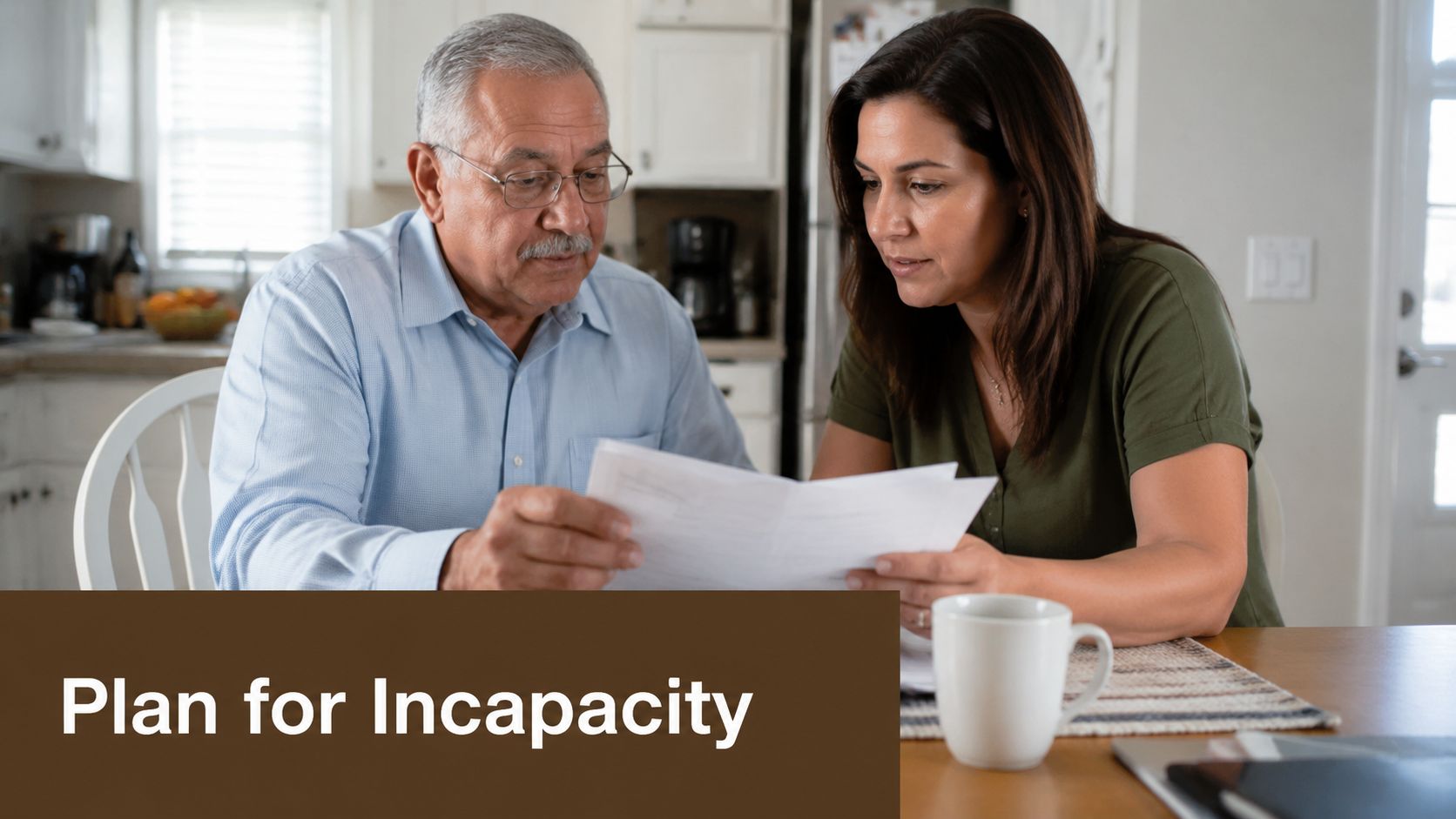
A complete estate plan isn't only about death. It has to work if you're alive but unable to manage your affairs. That may happen because of illness, injury, or cognitive decline, and in California the right documents can help your family avoid a conservatorship fight.
Many people discover the difference between a document package and a working plan. You need to know who can pay bills, manage property, speak with doctors, and step in for trust management if you can't.
The documents that usually matter most
In California, incapacity planning typically relies on a durable power of attorney for finances, an advance health care directive, HIPAA language so decision-makers can access medical information, and successor trustee provisions inside the trust. These documents serve different functions, and your lawyer should explain the limits of each one in plain English.
A common real-world scenario is an older parent with a house and bank accounts who suffers a stroke. If the trust names a successor trustee and the incapacity documents are valid and accessible, the family can often manage bills, property, and care decisions much more smoothly than if nothing was signed.
Choose decision-makers for reliability, not to avoid hurt feelings. The wrong agent creates problems faster than no agent.
Red flags and follow-up prompts
- Ask who has authority over what: “What can my agent do under the power of attorney, and what can only a trustee do?”
- Ask about backups: “How many alternate agents or successor trustees do you recommend?”
- Ask about access: “Where should originals and copies be stored so my family can use them?”
- Ask about incapacity standards: “How does the trust determine that I'm unable to act for myself?”
The lawyer should also explain when these documents should be reviewed. Health changes, family conflict, relocation, and changes in California law can all make old incapacity documents less reliable than people assume.
7. How Do You Address Tax Planning and Minimize Estate Taxes for My Beneficiaries?
A common Orange County scenario looks simple until the tax piece shows up later. Parents hold a house bought decades ago, one rental property, retirement accounts, and a trust that says who gets what. The distribution plan may be clear, but the tax result can still be poor if no one addressed basis, property tax reassessment risks, or the income tax treatment of inherited retirement assets.
This question matters because "tax planning" means different things in different estates. For one family, the issue is federal estate tax exposure if the exemption drops. For another, the primary issue is avoiding unnecessary capital gains when children later sell appreciated California real estate. In my practice, real property often drives the discussion. A plan that transfers the house cleanly but ignores tax basis can cost beneficiaries far more than the legal fee saved on the front end.
Your lawyer should be able to explain which taxes are relevant to your estate and which are not. That includes federal estate tax, capital gains exposure tied to basis, and income tax issues for IRAs and other deferred accounts. California does not impose a state estate tax, but that does not mean California families are free from tax-sensitive planning choices.
For larger estates, ask whether the current federal exemption affects your timing. The exemption has been historically high in recent years, and many attorneys are discussing the possibility of a lower exemption after the current law sunsets. Families with closely held businesses, multiple properties, or highly appreciated assets should get a direct answer on whether waiting creates risk.
Real estate needs its own analysis.
A house, rental, or commercial property may raise questions about stepped-up basis at death, community property treatment for married couples, trust design, and whether a proposed transfer could trigger avoidable tax or title problems. In California, those issues often overlap. A lawyer who also understands real estate can usually spot planning problems earlier, especially where title is inconsistent with the trust or separate and community property have been mixed over time.
Red flags and follow-up prompts
- Ask what taxes apply: “Which tax issues matter in my estate, and which ones do not?”
- Ask about California real estate specifically: “How would my plan affect basis for my residence, rental property, or inherited family home?”
- Ask about community property: “If I'm married, how does community property treatment affect the tax result for our beneficiaries?”
- Ask about retirement accounts: “How are inherited IRAs or 401(k)s handled under this plan, and should my beneficiary designations be updated?”
- Ask about coordination with other advisors: “At what point do you bring in a CPA or tax specialist?”
A careful attorney will not sell tax strategies before reviewing the asset list, titles, and beneficiary designations. The better answer is usually more grounded. Here are the tax issues I see, here is what we can improve, and here is where a CPA should be involved. That is the level of clarity clients should expect.
8. What Happens if There Are Family Disputes or Challenges to My Estate Plan?
A fight over an estate usually starts long before anyone files papers in court. In my experience, the warning signs are familiar. A second marriage. Children from different relationships. One child living in the family home. A beneficiary who expects equal treatment and will feel blindsided if the plan says otherwise. In Orange County probate and trust litigation, those facts matter because they shape both the drafting strategy and the evidence a judge will later review if someone challenges the plan.
The right question is not whether conflict is possible. It is how the lawyer plans for it.
A careful estate planning attorney should explain how your documents will be executed under California law, who should and should not be present at signing, and what steps will be taken to create a clear record of capacity, intent, and freedom from undue influence. Those details become more important when an adult child is heavily involved in a parent's finances, when one beneficiary receives substantially more than another, or when the plan changes shortly before death.
Real estate often sits at the center of these disputes. The family home may be the largest asset and the most emotional one. If one child has been promised the house, if a surviving spouse has occupancy rights, or if separate and community property interests were never clearly sorted out, the trust needs to address that directly. Vague language around sale rights, expense sharing, buyouts, or use of the property is a common source of litigation.
Disinheriting someone, making unequal gifts, or favoring a spouse over children from a prior relationship can be entirely valid. It just needs to be done with precision. Clear terms, a consistent asset schedule, properly updated beneficiary designations, and a signing process that can withstand scrutiny all help reduce the chance that a disappointed heir gains traction.
If you already know who is likely to object, tell the lawyer in the first meeting. That changes how the plan should be drafted and documented.
Red flags and follow-up prompts
- Ask where the plan is vulnerable: “Based on my family history, what facts make this plan easier to challenge?”
- Ask how signing will be documented: “What do you do to show I had capacity and was acting voluntarily when I signed?”
- Ask about court experience: “Have you handled trust contests or probate litigation in California, including Orange County, or only estate plan drafting?”
- Ask about property-specific conflict points: “If my house is going to one beneficiary or held for someone's use, how do we spell out sale rights, expenses, and timing?”
- Ask what should trigger a review: “Which family or title changes should prompt an immediate amendment?”
Warning signs are easy to spot in consultation if the attorney asks direct questions and listens for the gaps. Evasive answers, no discussion of likely challengers, or no plan for documenting capacity should make a client pause.
A well-drafted plan cannot guarantee family harmony. It can make a contest harder to file, harder to prove, and easier for your fiduciary to defend.
8-Point Comparison: Estate Planning Lawyer Questions
| Item | 🔄 Implementation complexity | ⚡ Resource requirements | ⭐📊 Expected outcomes | Ideal use cases | 💡 Key advantages |
|---|---|---|---|---|---|
| What Experience Do You Have With California Estate Planning and Probate Law? | 🔄 Medium, requires California-specific expertise and local court familiarity | ⚡ Low–Medium, attorney time, local court contacts, references | ⭐⭐⭐ 📊 Improved compliance; fewer procedural errors in CA probate | Clients needing California probate navigation (Orange County, LA) | 💡 State-specific knowledge reduces legal risk and court delays |
| Do You Recommend a Will, Trust, or Both for My Situation? | 🔄 Medium, requires individualized analysis of assets and family dynamics | ⚡ Medium, document drafting; trust funding increases effort | ⭐⭐⭐ 📊 Tailored plan that can minimize probate and clarify guardianship | Varies: estates from simple to complex; blended families; business owners | 💡 Combined solutions often maximize protection but increase initial cost |
| How Do You Help Clients Avoid or Minimize Probate in California? | 🔄 Medium, implements trusts, TOD deeds, beneficiary designations | ⚡ Medium, higher upfront setup and maintenance for trusts | ⭐⭐⭐ 📊 Shorter settlement time, lower court costs, greater privacy | Property owners, those with multiple accounts, privacy-concerned clients | 💡 Proper funding and TOD designations are critical to avoid probate |
| What Are Your Fees, How Do You Structure Billing, and Do You Provide Ongoing Support After Execution? | 🔄 Low–Medium, straightforward disclosures but variable billing models | ⚡ Variable, flat fee vs hourly; ongoing review costs possible | ⭐⭐⭐ 📊 Budget predictability with flat fees; ongoing value with reviews | Clients wanting cost transparency and long-term plan maintenance | 💡 Request written fee agreement; confirm if funding/updates are included |
| How Will We Handle Asset Funding and Title Transfers for My Trust? | 🔄 High, coordination of deeds, retitling, and institutional requirements | ⚡ High, title companies, recording fees, bank and broker interactions | ⭐⭐⭐ 📊 Proper funding maximizes probate avoidance and preserves tax bases | Owners of real estate or many titled assets; newly created trusts | 💡 Obtain a written funding checklist and clarify who executes transfers |
| What Happens to My Estate Plan if I Become Incapacitated? | 🔄 Medium, drafting powers, directives, HIPAA releases and successor roles | ⚡ Low–Medium, document preparation and agent selection | ⭐⭐⭐ 📊 Avoids conservatorship; ensures continuity in finances and healthcare | Older adults, those with health risks, anyone wanting incapacity planning | 💡 Name trusted agents, alternates, and keep accessible executed copies |
| How Do You Address Tax Planning and Minimize Estate Taxes for My Beneficiaries? | 🔄 High, requires tax-law coordination and specialized strategies | ⚡ High, CPA/ tax attorney involvement; ongoing reviews | ⭐⭐–⭐⭐⭐ 📊 Potentially significant tax savings for complex/high-value estates | High-net-worth estates, business owners, clients with tax exposure | 💡 Provide full financials and coordinate planning with tax professionals |
| What Happens if There Are Family Disputes or Challenges to My Estate Plan? | 🔄 High, risk assessment, defensible drafting, possible litigation prep | ⚡ Medium–High, documentation, witness protocols, potential counsel fees | ⭐⭐–⭐⭐⭐ 📊 Reduced contest risk but litigation may still occur | Blended families, estranged relatives, substantial or contested estates | 💡 Disclose family dynamics, consider no-contest clauses and capacity evidence |
Take the Next Step: Secure Your Family's Future
A family member dies, and the questions start immediately. Is there a trust. Was the house transferred into it. Who has authority to act. In California, those answers affect whether your family can handle matters privately or gets pulled into probate, title problems, or preventable conflict.
The right questions help you judge more than an attorney's credentials. They show whether the lawyer can spot issues before they turn into expensive mistakes, especially if your estate includes a home, rental property, community property interests, or blended-family concerns. In Orange County and Los Angeles, those details often decide how much delay, court involvement, and stress your family faces.
Good estate planning advice should be direct. You should understand what documents you are signing, who will carry out your wishes, how assets will be titled, and what still needs to be done after execution. If any lawyer stays vague about funding, incapacity planning, probate exposure, or fee structure, treat that as a warning sign.
Real estate deserves special attention. For many California families, the home is the largest asset and the one most likely to create trouble if title, beneficiary designations, or community property issues are handled carelessly. I have seen well-drafted plans fail in practice because no one followed through on the deed, no one reviewed how property was held, or no one updated the plan after a marriage, death, refinance, or move.
Many people still put this off until a health event or family crisis forces the issue. At that point, the options are often narrower and the cost is higher. Planning early gives you more control, more privacy, and more room to make careful decisions.
At Tanner Law, we help Orange County and Los Angeles families handle estate planning, probate, and real estate issues under California law. That matters when a trust must be funded correctly, when property ownership is not straightforward, or when a plan needs to hold up under family pressure. The goal is straightforward. Put documents and asset transfers in place that work when your family needs them.
If you need guidance from Tanner Law, schedule a free consultation to discuss your estate plan, probate concerns, or real estate-related planning issues under California law. Tanner Law serves families in Orange County and Los Angeles with clear, practical advice designed to protect assets, reduce risk, and give you confidence about the next steps.