Custodial Agreement Sample Your California Guide
You may be looking at a bank form, a generic online template, or advice from a family member who wants to help a child or grandchild financially. The goal sounds simple. Put money, stock, or even a piece of real property aside for someone you love, with an adult managing it until the timing is right.
Where families in Orange County and Los Angeles get stuck is the document itself. A search for a custodial agreement sample often produces the wrong kind of paperwork. Instead of an asset-management agreement, you get parenting-plan language about visitation, holidays, and school schedules. That mix-up can create real problems under California law, especially when the asset is meaningful, the family dynamics are sensitive, or probate issues are already on the table.
Table of Contents
- Protecting Assets for Your Loved Ones in California
- What Is a Financial Custodial Agreement
- Child Custody vs Asset Custody A Critical Distinction
- Annotated Custodial Agreement Sample Breakdown
- Drafting and Executing Your Agreement in California
- Common Risks and Red Flags to Avoid
- When to Consult an Orange County Estate Planning Attorney
Protecting Assets for Your Loved Ones in California
A common scenario goes like this. Parents or grandparents want to transfer investment funds to a minor. Sometimes it is cash from a sale of property. Sometimes it is stock. Sometimes it is a share of a family real estate interest that needs to be held carefully until the child is older.
The family usually asks the same practical questions. Who controls the asset now. Who benefits from it later. What happens if the adult managing it becomes ill, resigns, or starts treating the asset like personal property.
That is where a financial custodial agreement can help. It creates a legally enforceable framework for holding and managing property for someone who is the intended beneficiary but is not yet in a position to control the asset directly. In California estate planning, that can matter in straightforward gifting, in trust administration, and in probate-related asset management.
One reason families get bad guidance online is that search results often point them in the wrong direction. Most "custodial agreement sample" content conflates child custody with financial custodial agreements, and 78% of top-ranking search results focus exclusively on parenting plans. For families trying to set up a UTMA or trust-related arrangement, that is more than annoying. It is misleading.
Practical rule: If the template talks about weekends, holidays, or visitation, you are not looking at an asset-custody document.
A proper California asset-custody agreement should answer very different questions:
- Who holds title or possession: The document needs to identify the person or institution holding the asset.
- Who benefits: The beneficiary must be clear, especially when a minor or trust beneficiary is involved.
- What property is covered: Vague descriptions create avoidable disputes later.
- How the custodian must act: The standard is fiduciary conduct, not casual family discretion.
Families often assume a short form downloaded online is enough. For modest situations, a simple statutory structure may work. For anything involving real estate, trust property, conflict among relatives, or significant assets, custom drafting usually protects the family better.
What Is a Financial Custodial Agreement
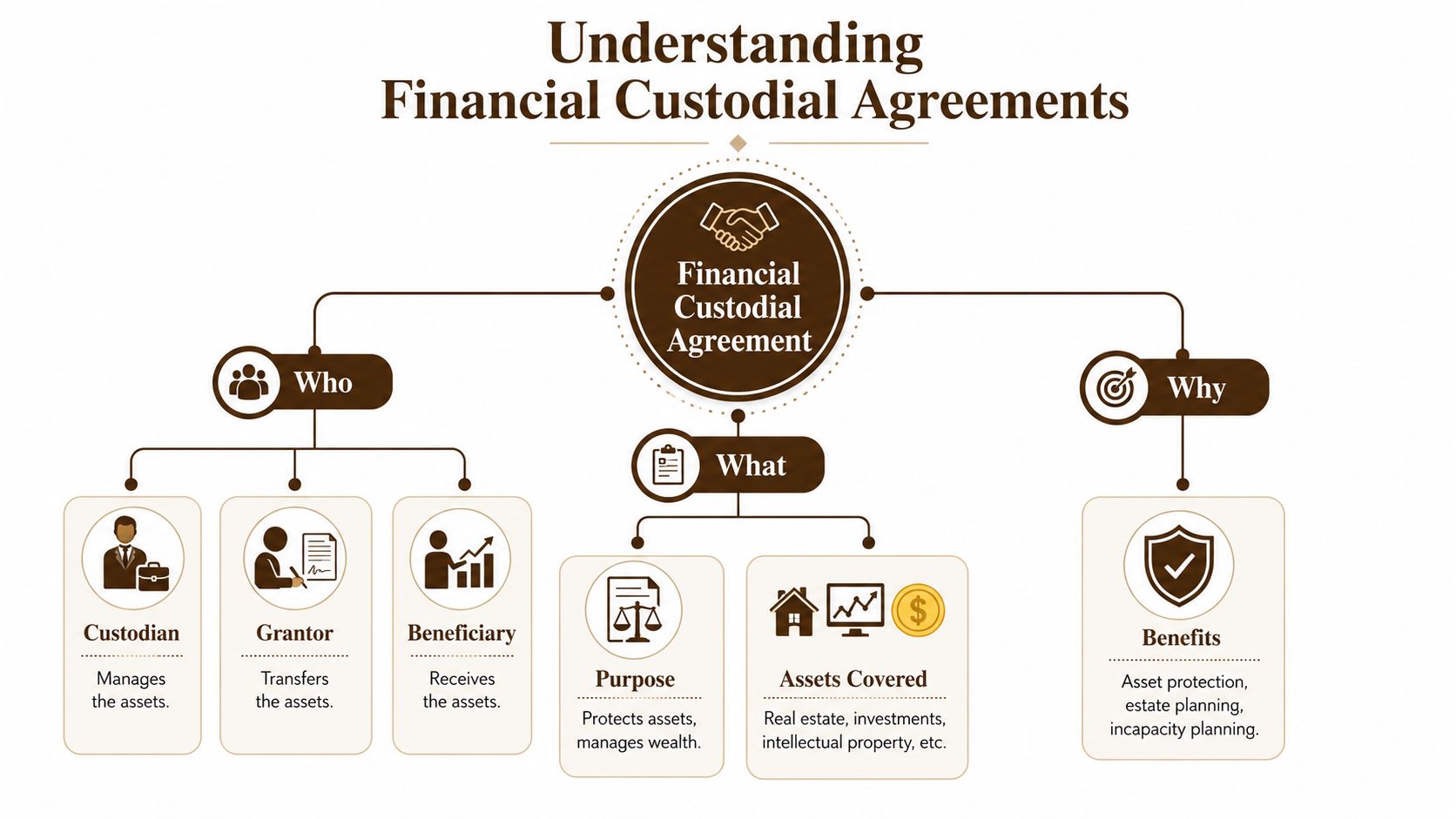
A financial custodial agreement is a legally binding arrangement in which a custodian holds assets for the benefit of the true owner or beneficiary. In the financial world, the law separates the person who holds the asset from the person who benefits from it. Investopedia's explanation of custodial agreements captures that core structure, and California regulators require these agreements to include specific elements. The California Department of Insurance uses forms such as Form 11 as a compliance benchmark to make the custodian's fiduciary duty clear.
Who the parties are
Think of the custodian as a treasurer for someone else's property. The custodian manages, protects, and accounts for the asset, but doesn't get to treat it as personal money.
The usual roles are:
- Grantor or transferor: The person who transfers the property into the custodial structure.
- Custodian: The adult or institution that holds and manages the asset.
- Beneficiary or beneficial owner: The person for whose benefit the property is held.
That distinction matters because families often blur ownership and control. A grandparent may fund the account. A parent may serve as custodian. The child may be the beneficial owner. If the agreement doesn't separate those roles cleanly, conflicts can appear quickly when expenses, taxes, or distributions come up.
Where these agreements show up in California practice
In California, these agreements usually appear in two broad settings.
First, there are statutory custodial accounts, commonly used for minors under UTMA or UGMA-style planning. These can work for gifts of cash or securities where the structure is relatively straightforward.
Second, there are custom-drafted custodial arrangements used in estate planning, probate administration, and trust-related asset management. Those are often better when the asset mix is more complicated or when the family wants more detailed rules about investment authority, records, distributions, resignation, replacement, and termination.
A good agreement usually addresses practical matters such as:
| Issue | Why it matters |
|---|---|
| Asset identification | Prevents arguments over what was actually transferred |
| Management authority | Defines what the custodian may and may not do |
| Records and reporting | Lets the family verify proper handling |
| Distribution rules | Reduces fights over timing and use of funds |
| End point | Clarifies when the custodian must hand over the property |
A solid custodial agreement does not merely name a custodian. It limits discretion, documents duties, and creates a paper trail.
What works in practice is clarity. What fails is assuming everyone in the family shares the same understanding. They often don't, especially after a death, during probate, or when property values rise.
Child Custody vs Asset Custody A Critical Distinction
This is the mistake I see families make most often when they search for a custodial agreement sample. They use the word “custody” and assume all custody documents are variations of the same form. Under California law, they are not.

These are different legal systems
A child custody agreement deals with parental rights and responsibilities. In California family law, that means decision-making authority and parenting time. For example, California Family Code Section 3040 is discussed here, including the statutory presumption that joint legal custody is in the child's best interests, with both parents sharing decision-making over education, healthcare, and welfare.
An asset custody agreement deals with financial property. It belongs in the world of contracts, fiduciary obligations, trusts, and estate administration. The legal questions are completely different. The document should focus on property control, investment authority, protection of assets, and transfer obligations.
You can see the difference quickly:
- Child custody documents address school choices, healthcare decisions, visitation schedules, holidays, and transportation.
- Asset custody documents address title, possession, fiduciary duties, accounting, segregation of assets, resignation, successor appointment, and final transfer of property.
Why the confusion causes trouble
If a family uses a parenting-plan template to handle financial property, the document usually omits the clauses that protect the beneficiary. It may say nothing about segregating the asset, preserving records, restricting transfers, or applying California law to the agreement.
That is not a harmless drafting flaw. It can leave the custodian with broad, undefined discretion and the beneficiary with very little practical protection.
The word “custody” changes meaning depending on the legal context. In California, that difference is not semantic. It controls what the document must actually do.
This also matters for families dealing with both issues at once. It isn't unusual for a parent to be resolving a family-law matter while also receiving an inheritance for a child, creating a minor's account, or managing trust property for a beneficiary. Those situations require separate documents serving separate purposes.
Annotated Custodial Agreement Sample Breakdown
A useful custodial agreement sample is not a blank form with names and dates inserted. The better approach is to understand the clauses that make the document enforceable and workable under California law.
Appointment of custodian
Sample clause:
“The Grantor appoints [Name] as Custodian to hold, manage, and administer the Custodial Property solely for the benefit of [Beneficiary], subject to the terms of this Agreement and California law.”
This clause identifies who is in charge and confirms that the custodian acts for someone else's benefit. That “solely for the benefit” language matters. It pushes the agreement into fiduciary territory and makes it harder for the custodian to justify personal use of the property.
What works is naming both the initial custodian and a successor. What often fails is assuming the first choice will always remain available.
Description of custodial property
Sample clause:
“The Custodial Property consists of the assets listed in Schedule A, together with all additions, substitutions, proceeds, income, and reinvestments attributable to those assets.”
Families get into trouble when they describe assets casually. “Grandma's account” is not enough. “The condo interest” is not enough. If there is a brokerage account, list it precisely. If there is a parcel of real estate, identify it accurately. If there are securities or cash proceeds, define what happens to income and reinvestments too.
A short list at the end of the agreement often works better than cramming every detail into the main body.
Powers duties and fiduciary standards
Sample clause:
“The Custodian may take actions reasonably necessary to preserve and manage the Custodial Property, including collection of income, reinvestment, payment of authorized expenses, and execution of documents consistent with this Agreement. The Custodian shall act in good faith and in the best interests of the Beneficiary.”
This clause should be specific enough to allow administration, but not so broad that it becomes an invitation to abuse. For example, a custodian may need authority to deposit checks, maintain an investment account, sign tax documents, or coordinate with a trustee or probate representative.
But unlimited powers are dangerous. The agreement should address whether the custodian may delegate tasks, hire professionals, or make discretionary distributions. If distributions are allowed, the standards should be clear.
Drafting insight: Broad power clauses are not a sign of sophistication. They are often a sign the form was never tested against a real dispute.
Asset segregation and no self-dealing
This is one of the most important provisions in any financial custodial agreement. A valid custodial agreement sample must explicitly require that assets be segregated and held free and clear of any lien or claim by the custodian. The CIRO custodial framework states that client assets must be segregated, protected from encumbrances, and not disposed of without proper written authorization. It also emphasizes the need to specify the governing State law for jurisdictional clarity.
Sample clause:
“The Custodian shall maintain the Custodial Property separate from the Custodian's personal assets and from any other non-custodial funds. The Custodial Property shall not be pledged, encumbered, borrowed against, or used to satisfy the Custodian's debts or obligations.”
In plain English, the custodian cannot mix the beneficiary's property with personal money or use the asset as financial breathing room. In probate and trust disputes, commingling is often where the worst facts begin.
Accounting records and beneficiary information
Sample clause:
“The Custodian shall maintain complete books and records of all receipts, disbursements, investments, transfers, and material decisions affecting the Custodial Property, and shall provide an accounting upon reasonable request or at intervals stated in this Agreement.”
Where internet templates fall short, practical drafting excels. Most family disputes are not just about wrongdoing. They are about missing information. If nobody can reconstruct what happened, everyone starts assuming the worst.
A workable clause may cover:
- Periodic accountings: Annual reporting is common in many settings, but the right cadence depends on the asset.
- Supporting documents: Statements, receipts, tax forms, and transaction records should be retained.
- Access rights: The beneficiary, parent, trustee, or authorized representative may need defined access.
Termination resignation and successor custodian
Sample clause:
“This Agreement shall terminate upon the earliest of the following events: delivery of the Custodial Property as required by law or this Agreement, resignation of the Custodian with acceptance by a successor, removal of the Custodian under this Agreement, or other termination event expressly stated herein.”
Termination language matters far more than most families expect. If the agreement says only “the custodian serves until the beneficiary is older,” the family may still end up fighting over timing, notice, and handoff procedure.
A strong clause should address resignation, death, incapacity, removal for cause, notice requirements, and delivery of records and property to the successor or beneficiary.
Governing law and dispute handling
Sample clause:
“This Agreement shall be governed by and construed in accordance with the laws of the State of California.”
That line looks simple. It is not optional. If the agreement may touch California probate, trust administration, or property rights, the governing law clause anchors the legal framework. Without it, dispute resolution becomes harder and more expensive.
A dispute clause can also address venue, informal resolution efforts, and access to court remedies when the custodian refuses to account or transfer property.
Drafting and Executing Your Agreement in California
Families usually focus on the wording of the document and forget the operational side. That is where good agreements often fail. A document can read well and still collapse if no one transfers the asset properly, signs in the right capacity, or keeps the supporting records.

A practical drafting sequence
Start with the people, not the form. The right custodian is organized, financially responsible, and capable of saying no to family pressure. That last point matters more than many families realize.
Then work through the asset itself.
Identify the property clearly
Cash, brokerage assets, business interests, and real estate each need different handling. Real property especially should never be dropped into a casual template.Choose the right structure Some transfers to minors fit a statutory California UTMA approach. Others need a specific agreement because the asset is more complex or the family wants tighter controls.
Name a successor custodian
If the first custodian dies, resigns, or becomes unable to serve, the agreement should not leave the family scrambling.Define the custodian's authority
Management powers should match the actual asset. A savings account needs one level of authority. An income-producing property needs another.
If a family expects tension later, the agreement should be drafted for the difficult relative, not the cooperative one.
Execution and follow-through
After the draft is settled, the parties need to sign properly and complete the transfer mechanics. Depending on the asset and the institution involved, notarization may be advisable or required as a practical matter. The account title, transfer documents, and supporting schedules should all match the agreement.
A few practical follow-through items are easy to miss:
- Retitle or transfer correctly: The asset has to move into the custodial structure in a way the institution or public record recognizes.
- Store the signed agreement safely: Keep the final signed version with schedules and transfer records.
- Coordinate with related estate documents: Trusts, wills, beneficiary designations, and deeds should not contradict the custodial arrangement.
- Review over time: A good agreement may still need updates if the asset mix changes, the custodian relocates, or the family situation shifts.
In some cases, the agreement remains a private planning document. In others, it may surface in a probate, trust dispute, conservatorship, or related proceeding. That is another reason to draft it as though a judge may eventually read it.
Common Risks and Red Flags to Avoid
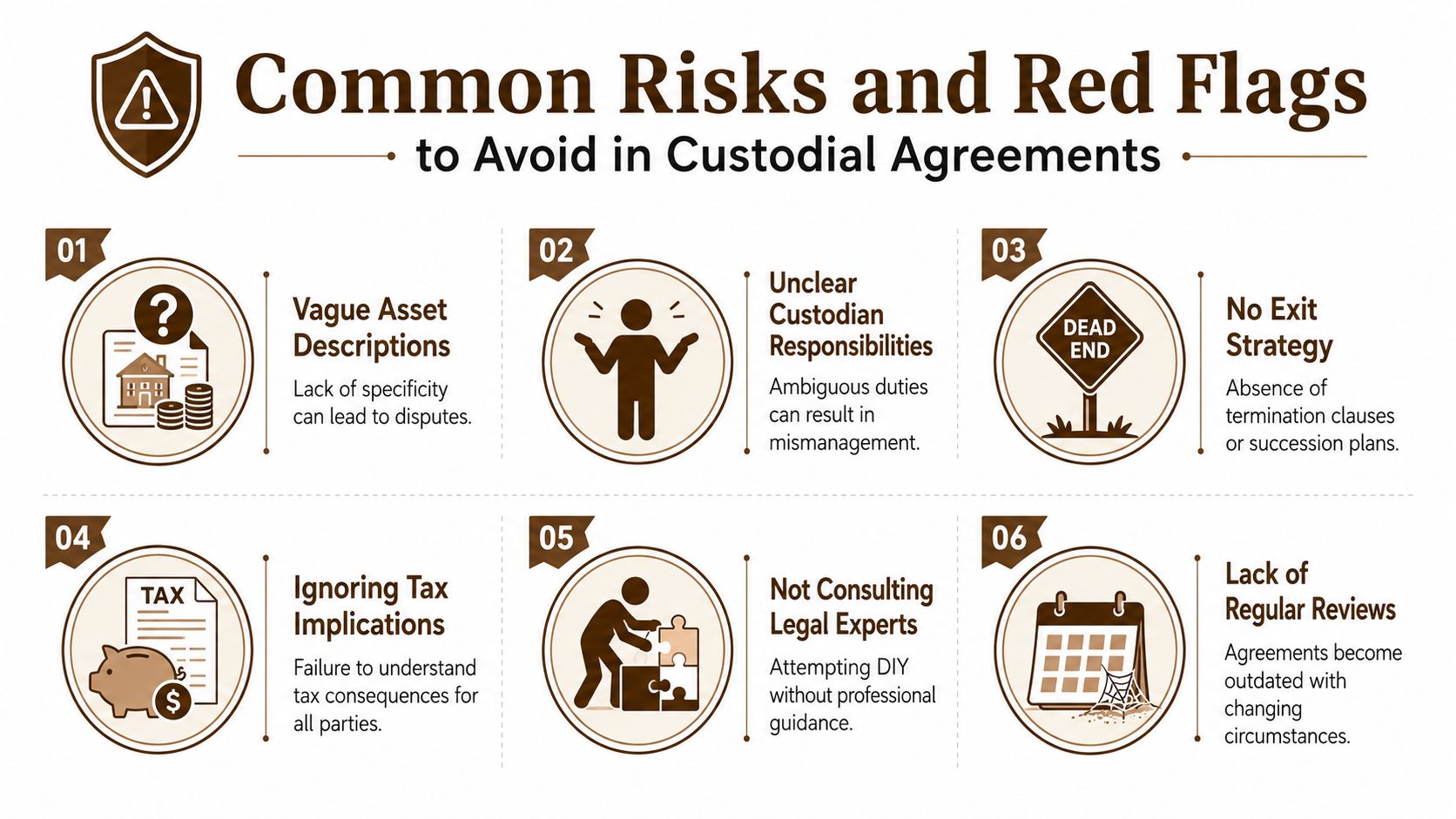
Most custodial disputes do not begin with dramatic misconduct. They start with loose drafting, misplaced trust, and paperwork that never matched the family's real situation.
Problems that trigger disputes
One major red flag is appointing a custodian based only on family status. Being a parent, sibling, or longtime helper does not automatically make someone the right fiduciary. The right person is the one who keeps clean records, respects limits, and understands that the asset is not available for personal emergencies.
Another common problem is vague termination language. That issue has become more important. A 2025 to 2026 projection referenced in this checklist notes a 42% increase in disputes over custodial agreement termination rights in probate litigation, while many public samples still fail to address unilateral termination triggers, notice periods, and post-termination handover protocols.
The most common drafting failures include:
- Unclear asset descriptions: If no one can tell what property is covered, the beneficiary may spend years proving it.
- Missing accounting duties: Without records, even an honest custodian can look suspect.
- No succession plan: Illness, incapacity, or death can freeze administration at the worst time.
- Overbroad discretion: Language that says the custodian may do anything “deemed appropriate” invites conflict.
- No handoff procedure: Ending the arrangement is often where litigation starts.
What works better in practice
A stronger agreement accepts that life changes. People move. Family relationships deteriorate. Beneficiaries reach adulthood. Probate cases uncover old assumptions that no longer fit reality.
The best drafting usually includes a mix of precision and restraint:
- Specific authority: Name what the custodian may do and what requires consent or a defined standard.
- Routine documentation: Require statements, receipts, and accessible records.
- Clear removal and resignation terms: Spell out how replacement happens.
- California governing law: Make the forum and legal framework predictable.
- Practical delivery language: State how assets, records, and control transfer at the end.
Families often spend most of their attention on who gets control first. The safer approach is to spend equal attention on how control ends.
When to Consult an Orange County Estate Planning Attorney
Some custodial arrangements are simple enough that a basic statutory path may be workable. If the asset is modest, the beneficiary is clearly identified, and there is no expected family conflict, the planning can be relatively straightforward.
When a simple approach may be enough
A plain transfer structure may work when the property is limited to cash or standard investment assets, the custodian is reliable, and the family does not need custom distribution standards or special restrictions. Even then, the paperwork should still be reviewed carefully under California law so the transfer and account setup match.
When legal guidance is the safer move
The need for legal guidance goes up quickly when the asset is more valuable, harder to manage, or likely to trigger disagreement.
You should speak with an attorney if any of these apply:
- Real estate is involved: Deeds, title issues, and occupancy questions usually need custom drafting.
- The agreement relates to a trust or probate estate: One document should not undercut another.
- The beneficiary is a minor or vulnerable adult with special needs: Distribution standards and oversight become more important.
- There is family tension: Clear drafting can prevent later accusations of misuse or favoritism.
- The custodian may need replacement rules: Resignation, incapacity, or death should not leave the asset in limbo.
- You want the agreement to hold up in court if challenged: That is not the same as downloading a form and hoping no one disputes it.
A good custodial agreement does one basic job very well. It protects the beneficiary while making the custodian's role clear, limited, and accountable under California law.
If you need help preparing or reviewing a custodial agreement for a child, grandchild, trust beneficiary, or probate matter in Orange County or Los Angeles, Tanner Law can help you evaluate the right structure under California law. Schedule a free consultation to discuss your family's assets, goals, and risks before a vague template creates a preventable dispute.