What Is a Civil Defense Attorney in California?
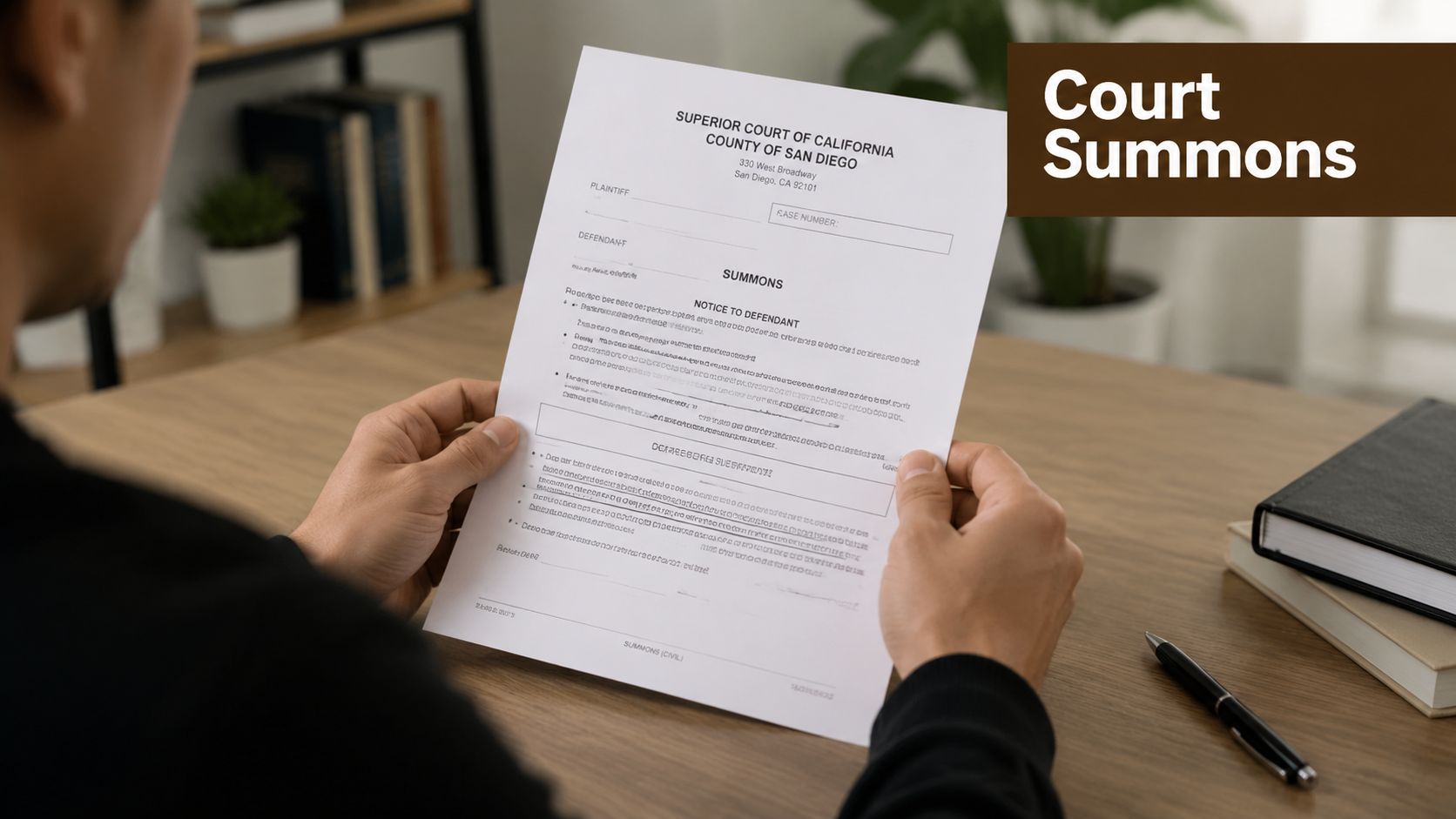
A process server hands you a packet at your front door. Or a certified letter arrives about a dispute over a rental property, a co-owned home, a trust asset, or an unpaid contract. You open it and see a Superior Court caption, legal allegations, and a deadline. In that moment, the same questions often arise: Am I already losing? Did I do something wrong? What happens if I ignore this?
In California, being sued doesn't mean you're liable. It means someone has made claims and is asking a court to act on them. Your job is to respond promptly and carefully. Your attorney's job is to protect your rights, test the other side's evidence, and keep a manageable dispute from turning into a damaging judgment.
That's where a civil defense attorney comes in. If you've been trying to understand what is a civil defense attorney, the short answer is this: it's the lawyer who stands between you and a civil judgment in a non-criminal case. In Orange County and Los Angeles, that role often matters most in property, title, probate, and financial disputes, where one missed deadline or one poorly framed response can affect a home, an investment, or an estate.
Table of Contents
- Understanding Your Role in a Civil Lawsuit
- Defining the Civil Defense Attorney Role
- Key Duties and Strategic Responsibilities
- Common Civil Defense Cases in California
- The California Civil Defense Process Step by Step
- How to Choose the Right Counsel in Orange County
Understanding Your Role in a Civil Lawsuit
One of the most common misunderstandings I see is this: people think a lawsuit is a final verdict in paper form. It isn't. A complaint is one side's version of events. It starts the case, but it doesn't prove the case.
Suppose you co-own a house in Orange County with a sibling after a parent's death. You've been paying taxes and maintenance, but your sibling files suit claiming a larger interest or demanding a sale. Or you bought property and later learn there's a cloud on title because of an old deed issue. Or a contractor claims you breached an agreement and owes money. Those are civil matters, not criminal ones, but the consequences can still be serious.
Your role as the defendant is practical. You need to preserve documents, avoid careless statements, meet deadlines, and get legal advice early. Your attorney then evaluates what the plaintiff must prove, where the allegations are weak, and what defenses are available under California law.
What being sued actually means
A civil case usually asks the court for money damages, a court order, or some other remedy. It does not mean the state is trying to punish you for a crime.
That distinction matters because your response strategy changes. In a civil case, the question is often whether the plaintiff can prove their version of events well enough under the applicable civil standard. Your lawyer's focus is less about dramatic courtroom speeches and more about facts, timing, procedure, and strategic advantage.
Being named in a lawsuit is the start of a legal process, not the end of the story.
The first mistakes to avoid
When people are under stress, they tend to make predictable errors:
- Ignoring the papers: That can make a manageable case much worse.
- Calling the other side to explain everything: Informal conversations often create new problems.
- Assuming truth will sort itself out: Courts require organized evidence and proper filings.
- Waiting too long for counsel: Delay limits your options.
A civil defense attorney helps you slow the situation down, sort facts from accusations, and make reasoned decisions. That's especially important in California real estate and probate-related disputes, where ownership records, trust documents, contracts, and payment histories often tell a more nuanced story than the complaint suggests.
Defining the Civil Defense Attorney Role
A Newport Beach investor opens a lawsuit and sees claims for fraud, quiet title, and cancellation of deed tied to a family property transfer. An Irvine homeowner learns a former business partner is asking the court for an injunction over a disputed ownership interest. In both situations, the immediate problem is not only the accusation on paper. It is the risk to the asset itself.
That is the role of a civil defense attorney. The lawyer represents the person or business being sued in a non-criminal case and works to protect money, property rights, contractual interests, and legal position while the dispute moves through court.
A useful comparison is a structural engineer inspecting a building after someone claims the foundation failed. The engineer does not answer with outrage. The engineer checks the plans, tests the materials, and identifies where the claim breaks down. Civil defense works in much the same way. Your attorney examines the complaint, the governing law, the documents, and the timeline to see whether the plaintiff can prove what has been alleged.
As MetLife's explanation of civil lawyers notes, civil defense is centered on the plaintiff's burden of proof. In practical terms, your lawyer is often trying to show that the other side cannot prove liability under the civil standard, rather than trying to prove some broad idea of personal innocence.
Why civil defense is different from criminal defense
The word “defense” causes confusion because it covers two very different court systems.
A criminal defense attorney responds to charges brought by the government, where the risk can include jail, probation, or a criminal record. A civil defense attorney responds to claims brought by private parties, companies, trustees, neighbors, co-owners, or parties to a transaction. The exposure is usually money, control of property, an injunction, or a court order affecting ownership rights.
That distinction matters in California real estate disputes. In a title fight, for example, the question is often whether a deed is valid, whether a transfer was authorized, whether a co-owner's rights were ignored, or whether a contract can be enforced. For an Orange County homeowner or investor, the lawsuit may be about a house, a rental property, LLC interests, sale proceeds, or the ability to refinance or sell.
Attorney Roles at a Glance
| Attribute | Civil Defense Attorney | Plaintiff's Attorney | Criminal Defense Attorney |
|---|---|---|---|
| Client | Defendant in a non-criminal dispute | Person or entity bringing the civil claim | Person charged with a crime |
| Main objective | Defeat or limit civil liability | Obtain damages or court-ordered relief | Defend against criminal conviction |
| Typical forum | California civil court | California civil court | Criminal court |
| Core question | Can the plaintiff prove the claim? | Can liability and damages be proven? | Can the government prove guilt? |
| Burden of proof at issue | Preponderance of the evidence | Preponderance of the evidence | Beyond a reasonable doubt |
| Common outcome sought | Dismissal, defense judgment, reduced exposure, settlement | Judgment, damages, injunction, settlement | Acquittal, dismissal, reduced charges or sentence |
For clients, the practical point is simple. A civil defense attorney is not there merely to argue. The lawyer is there to protect your position in a dispute where facts, documents, deadlines, and legal standards decide what happens to your money or property.
More than courtroom defense
Many clients picture trial first. In real civil litigation, the more valuable work often happens earlier and less visibly.
A defense attorney may attack a defective complaint, assert affirmative defenses, challenge standing, examine title history, compare signatures across recorded documents, trace escrow instructions, or test whether the plaintiff waited too long to sue. In a property case, those steps can determine whether the dispute stays narrow or grows into a threat to ownership, possession, or saleability.
This is especially important in California title and ownership litigation. A person can lose ground without ever losing at trial. A lis pendens can interfere with a pending sale. A poorly framed response can concede an issue that should have been contested. A settlement made without understanding the chain of title can solve one problem while creating another.
A capable civil defense attorney protects both the lawsuit and the underlying asset. In Orange County real estate and financial disputes, that dual focus often makes the difference between a manageable case and a costly disruption.
Key Duties and Strategic Responsibilities
Civil defense is not passive. A good lawyer doesn't just “show up in court.” The work starts with diagnosis, then moves to strategy, then to execution.
What your lawyer does first
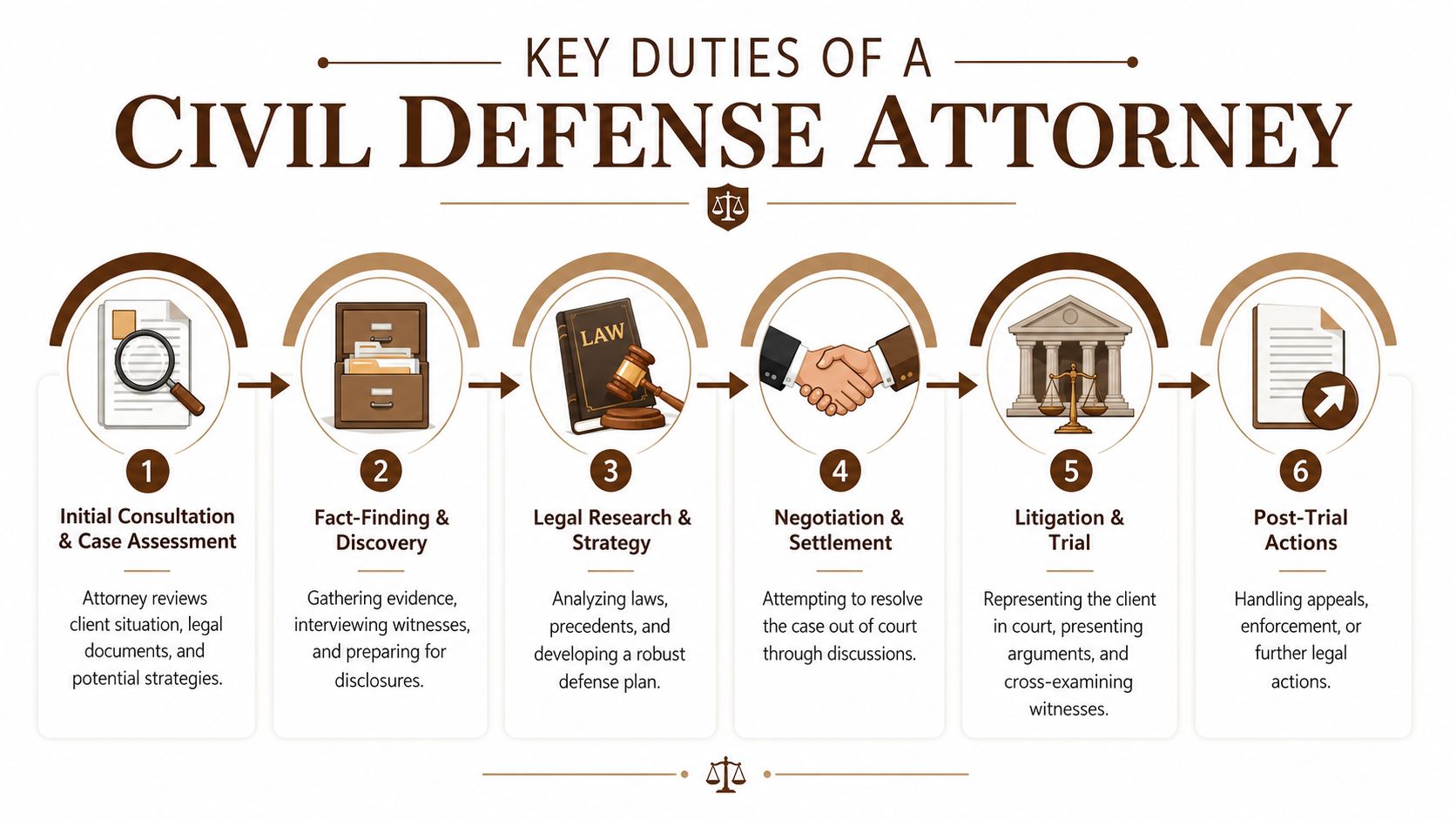
At the beginning of a case, your attorney studies the complaint, attached exhibits, contracts, correspondence, title records, trust terms, payment history, and the timeline. The first question is not “How do we argue?” It is “What, exactly, must the other side prove, and what facts or documents undercut that effort?”
That early review usually leads to a core set of tasks:
Assess the legal exposure
Your lawyer identifies what claims are being made and whether they fit the facts or California law.Preserve and gather evidence
Emails, text messages, escrow records, deeds, probate filings, inspection records, and payment proof can become central.Draft the initial response
That might be an answer, a motion, or another procedural filing designed to protect your position.Strengthen settlement position
A case often settles more favorably when the other side sees that the defense is organized and evidence-based.
Why procedure matters so much
Civil litigation has a deceptively administrative side. Deadlines, formatting, service rules, objections, and filing requirements can decide real outcomes. According to NLADA's litigation role description, an attorney's duty to draft precise legal documents such as motions and briefs, and to conduct depositions, is a critical determinant of case viability. That same source explains that failure to file timely responses can result in default judgments or sanctions.
That point deserves emphasis because clients often underestimate it. A strong factual defense can be damaged by poor procedure. A weaker claim can gain traction if the defendant misses deadlines or fails to respond properly.
Good civil defense is part legal analysis, part disciplined case management.
The strategic responsibilities clients don't always see
Much of the most valuable work happens outside a courtroom. A defense attorney may:
- Use discovery carefully: Written questions, document requests, and depositions can expose inconsistencies and force the plaintiff to commit to a version of events.
- Frame the dispute accurately: A property conflict may look like a simple payment disagreement, but the actual issue could involve title, co-ownership rights, or trust administration.
- Control risk: Sometimes the best result is dismissal. Sometimes it's an early settlement that protects a business relationship, preserves a family asset, or avoids prolonged fees.
- Prepare for appeal if needed: Trial strategy should preserve important issues in case review by a higher court becomes necessary.
Clients often judge lawyers by how they sound. Courts judge them by how they file, object, preserve evidence, and build a record. In California civil defense, those quieter tasks often matter most.
Common Civil Defense Cases in California
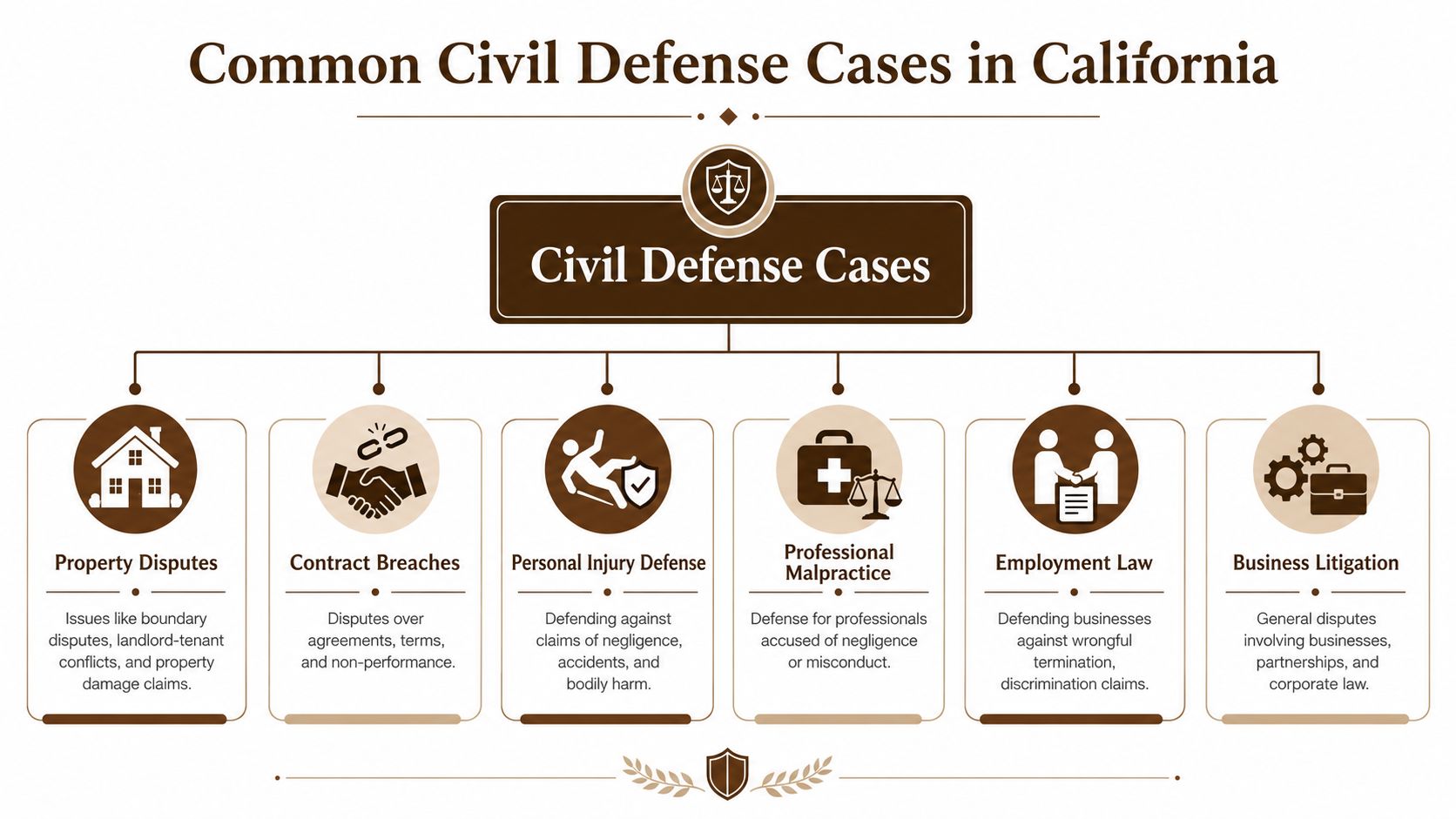
California civil defense covers a wide range of disputes. Some are straightforward. Others involve layered facts, family relationships, title records, or overlapping contract and property issues.
General disputes that lead to civil defense
A civil defense attorney may represent individuals, trustees, landlords, tenants, investors, or small businesses in matters such as:
- Contract disputes: Claims that someone failed to perform, pay, disclose, or complete agreed work.
- Business disputes: Conflicts involving partners, vendors, customers, or management decisions.
- Personal injury defense: Cases alleging negligence and seeking money damages.
- Probate and trust litigation defense: Claims against fiduciaries, beneficiaries, or the validity of decisions affecting an estate or trust.
- Debt and collection disputes: Defending claims tied to alleged balances, charges, or consumer obligations.
For many families in Orange County and Los Angeles, though, the most consequential civil cases involve real property. A home, rental unit, inherited parcel, or investment property is often the largest asset in the dispute.
Why property disputes need a specialized defense approach
Property litigation isn't just another branch of civil law with a different label. It has its own documents, procedures, and remedies. Deeds, chain of title, easements, loan history, probate transfers, vesting language, co-ownership arrangements, and recorded notices can all affect the defense.
In Orange County and Los Angeles, Bidari Civil Defense's discussion of civil litigation defense notes that attorneys frequently file quiet title actions and partition suits in property disputes to resolve clouds on title or divisions of co-owned property under California property law.
Here is where many readers get confused:
- A quiet title action is used to ask the court to determine who owns the property or what interest each party has when title is clouded or disputed.
- A partition suit deals with co-owned property when the owners can't agree on whether to keep, divide, or sell it.
Those are not abstract procedures. They are often the tools that decide whether a family keeps control of inherited real estate, whether investors can clear title, or whether one co-owner can force a resolution.
In property cases, the lawsuit on file and the property problem underneath it are not always the same thing.
Probate-related civil defense
This area also overlaps with probate and estate administration. A beneficiary may challenge a transfer. A family member may dispute ownership of a home that passed outside probate. A trustee may face accusations tied to management of real estate or distributions. In those cases, the defense lawyer needs to understand more than general litigation. The lawyer has to see how title, estate documents, and procedural posture fit together.
That's why the overlooked side of the question, what is a civil defense attorney, matters so much in California real estate. For homeowners and investors, this lawyer is often defending not only against a lawsuit, but for the integrity of ownership itself.
The California Civil Defense Process Step by Step
When clients first face a lawsuit, the process looks chaotic. It's structured. California civil litigation moves through stages, and each stage creates both risk and opportunity.
A visual overview helps at the outset.

From summons to response
The first step is service of the summons and complaint. That is the formal notice that a case has been filed against you. Once served, you should treat the timeline seriously and speak with counsel promptly.
Your attorney will usually review the pleading, identify the claims, and decide whether to file an answer, assert defenses, or challenge the complaint in some way. In contract cases, timing can also involve a deeper issue: whether the claim was filed too late in the first place. Under California contract litigation guidance discussing statutes of limitations, the statute of limitations for breach of a written contract is four years, while breach of an oral contract is two years under California law.
That can materially affect the defense. If a claim is time-barred, the case may be vulnerable before the merits are ever reached.
Discovery motions and settlement
After the initial pleadings, the case moves into discovery. This is the formal exchange of information. Parties request documents, answer written questions, and take depositions.
For defendants, discovery serves two purposes. First, it reveals what the plaintiff has, as opposed to what the complaint merely alleges. Second, it gives the defense a chance to gain an advantage. A plaintiff who has to produce contradictory emails, incomplete accounting, unclear title records, or weak testimony may become more open to resolution.
This is a good point to see the process in action:
Pre-trial motions may follow. These can ask the court to dismiss claims, limit evidence, compel responses, or clarify legal issues before trial. In a real estate case, motions may narrow the dispute to the actual ownership question rather than allowing side issues to consume the case.
Settlement discussions often become productive during or after discovery. Once both sides see the strengths and weaknesses more clearly, mediation or negotiated resolution may make sense. In many civil matters, a timely, well-supported settlement saves money, reduces uncertainty, and protects important relationships or assets.
Trial judgment and appeal
If the case doesn't settle, it goes to trial. Trial is where witnesses testify, documents are admitted, and the judge or jury decides the disputed issues. By that point, much of the extensive work has already been done. The evidence has been gathered, objections prepared, themes refined, and legal issues framed.
After trial, the court enters judgment. Sometimes that ends the matter. Sometimes it leads to post-trial motions or an appeal.
Here is the practical sequence most defendants should expect:
- Review the summons immediately: Don't wait to “see if it goes away.”
- Collect your records: Contracts, emails, title documents, trust papers, and payment proof matter.
- Respond through counsel: A rushed or incomplete filing can create avoidable problems.
- Participate in discovery carefully: Accuracy matters more than speed.
- Evaluate settlement with discipline: Settling can be wise, but only after understanding exposure and bargaining power.
- Prepare as if trial is possible: Even when settlement is likely, trial readiness improves outcomes.
California civil procedure can feel impersonal, but it isn't random. Each step has a purpose. A capable civil defense attorney uses those steps to protect your position rather than passively reacting to the plaintiff's pace.
How to Choose the Right Counsel in Orange County
A common Orange County scenario looks like this. You are served with a lawsuit over a Newport Beach duplex, a family home in Irvine, or an investment property in Anaheim. The complaint uses broad words like fraud, breach of contract, or declaratory relief, but the actual fight is over who owns what interest, whether title is clean, and what the court can order against the property itself. In that situation, the right lawyer is not just a general litigator. You want counsel who can read the lawsuit and the chain of title together, because the property records often explain the case better than the pleading does.
Civil defendants usually must hire private counsel for this kind of dispute. The Los Angeles County Public Defender FAQ explains that the office represents indigent criminal defendants and certain limited matters, not parties defending ordinary civil lawsuits involving property, contracts, or title.
Questions to ask before hiring counsel
A useful consultation should test how the lawyer thinks about your specific kind of dispute in Orange County. Broad questions are less helpful than targeted ones. Ask questions that reveal whether the attorney has handled the court procedures and property issues your case is likely to involve:
Have you defended quiet title, partition, fraudulent transfer, or lis pendens disputes in Orange County Superior Court?
These cases have their own pressure points. A lawyer who has handled them will usually talk about recordings, title history, co-owner rights, and early procedural moves, not just “litigation strategy” in the abstract.If my case involves a clouded title, how do you investigate the chain of title?
Listen for a concrete answer. Strong counsel should discuss deeds, grantor-grantee indexing, escrow records, trust transfers, refinance documents, probate filings, and whether an older instrument appears void, voidable, or ambiguous.What is your approach when the dispute involves an older deed, a family transfer, or a trust amendment?
Orange County property disputes often grow out of informal family arrangements that were never documented cleanly. The lawyer should be comfortable tracing signatures, notarizations, delivery issues, and the effect of later transfers.Have you handled partition actions where one co-owner paid the mortgage, taxes, insurance, or repairs?
Partition cases are not just about forcing a sale. They also involve accounting. You want counsel who understands reimbursement claims, offsets, and the records needed to prove or challenge those numbers.How do you deal with discovery in a title dispute?
A good answer should include who to subpoena and why. That may mean escrow companies, lenders, property managers, accountants, prior trustees, or family members who were present when key documents were signed.If the other side recorded a lis pendens, what would you evaluate first?
That question matters in Orange County real estate disputes because a recorded notice can freeze a sale or refinance. Counsel should be ready to assess whether the underlying claim supports the notice and whether there is a basis to expunge it.What would you want from me in the first week?
The answer should sound practical. Deeds, preliminary title reports, loan papers, trust documents, emails, text messages, wire confirmations, and property tax records often matter more than a long narrative.
The goal is simple. You are testing whether the lawyer sees the property problem inside the lawsuit, not just the lawsuit on paper.
Bad fit versus good fit in a quiet title case
Consider a defendant sued over a quiet title claim involving a rental property transferred years ago between family members. A poor fit is a lawyer who treats it like a generic contract case, focuses on the complaint alone, and waits for formal discovery before examining the deed history. That approach can miss early opportunities to challenge the claim, preserve documents, or frame the dispute around the actual title record.
A stronger fit starts with the recorded instruments, tax history, loan documents, trust papers, and the timeline of possession and payments. That lawyer asks when the deed was signed, who prepared it, whether consideration was paid, whether a trust held title at the time, and whether later conduct supports or undermines the claimed ownership interest. In a property case, that method works like reading the map before arguing about the route.
What strong Orange County representation looks like
In many real estate and financial disputes, the deciding evidence is quiet and technical. It may be the wording of a grant deed, the timing of a refinance, an omitted probate step, an escrow instruction, or a signature that does not line up with the transfer history. Counsel should be able to work comfortably with those records and explain how they affect a party's strategic position, settlement value, and trial risk.
Candor also matters. A good lawyer should tell you whether your documents help, where the weak spots are, and what facts still need proof. For homeowners, trustees, beneficiaries, and investors, that clarity has practical value. It helps you decide whether to fight for title, negotiate a buyout, seek partition terms, challenge a recorded claim, or contain financial exposure before the case drives up costs.
A strong civil defense attorney in Orange County should be able to do three things well at the same time. Read the court file closely. Read the property file even more closely. Then connect the two in a way that helps you make sound decisions under pressure.
If you're facing a civil lawsuit involving real estate, probate, title, contracts, or related financial disputes in Orange County or Los Angeles, Tanner Law offers clear, practical guidance grounded in California law. William T. Tanner has served clients since 1994, brings the added perspective of a licensed real estate broker, and teaches property law, which is especially valuable when a civil case turns on ownership, title, or transactional details. Schedule a free consultation to discuss your situation, understand your options, and get a focused plan for protecting your rights.