Order of Stipulation in California Law: A 2026 Guide
If you're asking about an “order of stipulation,” the practical answer is this: that phrase isn't the proper legal term in California. The correct document is usually a stipulation and order or stipulated order, meaning the parties first agree in writing, and then the judge signs it to make it enforceable.
That distinction is more significant than often understood. In Orange County and Los Angeles property, probate, and family-related disputes, people often come to counsel with a draft they believe is ready to file, only to learn they have the sequence backward, the terms are too vague, or the court needs something more formal before it will sign anything. If you're dealing with co-owned real estate, a probate administration disagreement, a trust dispute, or a civil case tied to a home or inheritance, a stipulation can reduce conflict and move the case forward. But it only works if the agreement is prepared correctly and submitted in the right order.
Many clients are in the same position. A sibling wants to sell inherited property, but another sibling wants more time. Co-owners agree on an appraisal process in a partition action, but not yet on final sale terms. Parties in a probate matter agree to extend deadlines or exchange records without motion practice. These are exactly the kinds of situations where a stipulation is useful. The court doesn't need to decide what everyone already agrees on. It only needs to decide the disputed parts.
The phrase Order of Stipulation is common in conversation, but technically it usually refers to a Stipulation and Order. That's an important correction because the agreement itself and the court's order are two separate things, and California procedure treats them that way.
Table of Contents
- Navigating Your Legal Dispute with a Stipulation
- What Is a Stipulation and Order in California Law
- Stipulated Orders vs Judgments and Dismissals
- How to File a Stipulation and Order in California
- Common Pitfalls When Using Stipulations
- Strategic Uses and Your Next Steps
Navigating Your Legal Dispute with a Stipulation
You are in the middle of a probate or property dispute. One heir wants to list the house. Another wants an appraisal first. Someone needs access for an inspection, and no one wants a routine disagreement to turn into an expensive hearing in Orange County or Los Angeles.
That is where a stipulation often helps.
A stipulation lets the parties put a limited agreement in writing so the case can keep moving. In practice, I see this used to set inspection dates, extend filing deadlines, preserve sale proceeds, confirm access to a residence, or narrow a dispute before the court spends time on it. It is a practical tool, especially when the larger conflict is not resolved but the parties can still agree on a few immediate steps.

Why families often prefer this route
In trust, probate, and real property cases, many early disputes are about management, timing, and access. Who maintains the property while the petition is pending? Can an appraiser enter next week? Should a deadline be extended so financial records can be reviewed first?
A well-drafted stipulation can resolve those issues without forcing the court to decide every small point. That usually saves time, lowers friction, and gives the parties more control over the immediate problem.
It also has limits.
A stipulation is only as useful as its wording. If the document says someone gets “reasonable access” to a property, expect an argument about dates, hours, keys, notice, and who may attend. In Los Angeles and Orange County courts, vague language often creates the very hearing the parties were trying to avoid.
Practical rule: Use a stipulation when the parties genuinely agree on a specific step, and write the terms tightly enough that a judge could enforce them without guessing.
The term people use versus the term courts use
Clients often ask for an “order of stipulation.” In California practice, the more accurate phrase is Stipulation and Order. That distinction matters.
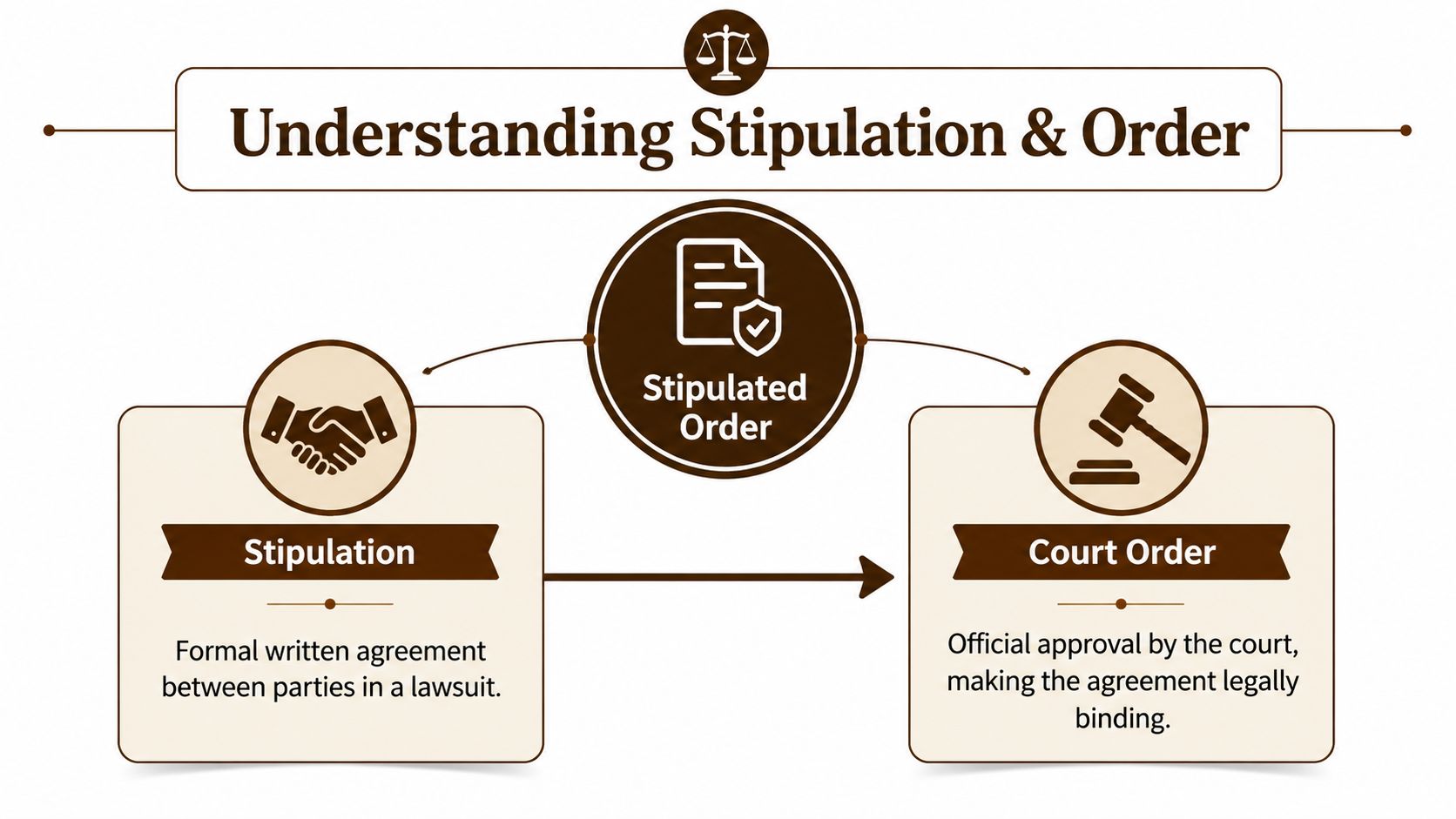
The stipulation is the parties' agreement. The order is the judge's signature that gives the agreement the force of a court order. Until that second step happens, the parties may have a deal, but they may not yet have something the court will enforce as an order.
That is why wording, timing, and local procedure matter. In some departments, a signed agreement can sit for days or longer if the proposed order, caption, or filing method does not match the court's requirements. The practical risk is simple. Clients think the issue is resolved, then learn the judge never signed the order or signed a modified version.
Used properly, a stipulation can reduce conflict and protect property while the larger case continues. Used carelessly, it can create false confidence, missed deadlines, or new disputes about what the parties agreed to.
What Is a Stipulation and Order in California Law
A client signs an agreement, assumes the issue is handled, and then calls my office after the other side ignores it. The usual problem is not the agreement itself. The problem is that the parties had a stipulation, but never got the signed order that makes it enforceable in the case.
In California practice, people often say “order of stipulation.” Courts and lawyers usually mean a Stipulation and Order. That wording is more than technical. It describes two different steps with two different consequences.
A stipulation is the parties' written agreement about a specific issue in a pending case. An order is the judge's approval of that agreement. Until the court signs it, the document may reflect a deal between the parties, but it does not automatically carry the force of a court order.
The stipulation part
The stipulation is the negotiated piece. It sets out exactly what the parties have agreed to do, or not do. In a property or probate matter, that might include access for an inspection, temporary management of rental income, an agreement to continue a hearing, or a protocol for preserving records while ownership issues are sorted out.
Specific wording matters. “Maintain the property” is not enough if no one defines who handles repairs, what dollar limit applies, how fast work must be done, or whether reimbursement will be sought later. In Los Angeles and Orange County, judges see these disputes often. A vague stipulation tends to shift the fight from the underlying issue to the meaning of the agreement itself.
The order part
The order is the court's act. Once the judge signs it, the agreed terms become enforceable through the case. If a party does not comply, the court has a clearer basis to compel performance, impose sanctions, or make later rulings with that violation in mind.
That is the practical difference clients need to understand. A stipulation records consent. The order gives that consent legal force inside the proceeding.
This distinction also explains why filing details matter. A department may reject or delay a proposed order because the caption is wrong, signatures are incomplete, the relief is unclear, or the submission does not match local procedure. I have seen parties reach a sensible agreement, only to lose time and money because they treated the judge's signature as automatic.
Why courts use them
Courts allow stipulated orders because they save hearing time and narrow what requires a ruling. If the parties agree on access, deadlines, document handling, or temporary property safeguards, the judge can focus on the issues that remain contested.
That is especially useful in probate and real estate cases. These matters often involve heirs, co-trustees, co-owners, lenders, or occupants with different interests and different levels of urgency. A well-drafted Stipulation and Order can preserve property, reduce avoidable motion practice, and keep the case on track without giving up disputed claims the parties still intend to litigate.
The trade-off is straightforward. Stipulated orders are efficient, but only if the terms are concrete enough for the court to enforce and narrow enough for the judge to approve without rewriting them.
Stipulated Orders vs Judgments and Dismissals
A common California problem goes like this. The parties reach an agreement, someone refers to it as an "order of stipulation," and everyone assumes the case is basically over. Often it is not. In practice, the core question is what the document does once it is signed and, if needed, entered by the court.
That distinction matters because these documents serve different purposes. A stipulation is the parties' agreement. A stipulated order is the court-approved version of that agreement for a specific issue in an active case. A stipulated judgment is a final resolution of claims being decided. A stipulated dismissal ends the action, usually without the court continuing to supervise the dispute.
Comparison of Stipulated Legal Documents in California
| Document Type | Purpose | Scope | Example in a Property Dispute |
|---|---|---|---|
| Stipulation | Records the parties' agreement | Agreement alone, not yet an enforceable court order unless accepted by the court | Co-owners agree to continue a hearing and allow an appraisal |
| Stipulated Order | Makes an agreed term enforceable through the court | Usually limited to a specific issue or procedural step in an active case | Parties agree that one broker may access the property and the judge signs the order |
| Stipulated Judgment | Resolves all matters being submitted for adjudication, or expressly reserves what remains | Final or near-final disposition | Parties settle how sale proceeds from inherited property will be divided |
| Stipulated Dismissal | Ends the case by agreement | Terminates the action | Quiet title lawsuit is dismissed after the title defect is resolved outside court |
Where the choice changes the outcome
In a partition or probate property matter, a stipulated order is often the right tool when the parties need rules now but are not ready to end the case. The order may cover listing the property, access for inspections, payment of carrying costs, protection of sale proceeds, or deadlines for document exchange. The case stays open because the larger dispute still exists.
A stipulated judgment does something different. It tells the court the parties want a final ruling entered on agreed terms, either for the whole case or for the part being conclusively resolved. If a client still expects later rulings on ownership shares, reimbursement claims, fiduciary issues, or attorney fees, I treat that as a warning sign to slow down and confirm whether a judgment is really intended.
A stipulated dismissal is different again. It ends the action by agreement. That can be the cleanest result after a settlement is fully performed, but it can also remove the court from the picture too early if payment, turnover of property, or recording steps still need oversight.
The practical trade-off
Stipulated orders work well for active litigation because they solve immediate problems without forcing a final settlement before the parties are ready. Judgments and dismissals offer closure, but they require much more care about what is being released, what survives, and whether the court will retain any role afterward.
That is where clients get into trouble in Orange County and Los Angeles. They use the word "stipulation" loosely, or call the document an "order of stipulation," when what they really need is a Stipulation and Order on one issue only. If the title, substance, and requested relief do not match, the filing can create confusion for the clerk, the department, and the parties themselves.
For many property and probate disputes, the safer sequence is narrower first, final later. Get an enforceable order for access, sale preparation, preservation of funds, or interim cooperation. Then, once the remaining claims are resolved, use a stipulated judgment or dismissal that fits what the parties mean to end.
How to File a Stipulation and Order in California
The filing process in California is straightforward in concept, but the details matter. In Orange County and Los Angeles courts, a stipulation that looks complete can still be rejected if the signatures, service method, or formatting don't line up with the applicable rules.
Start with the actual agreement
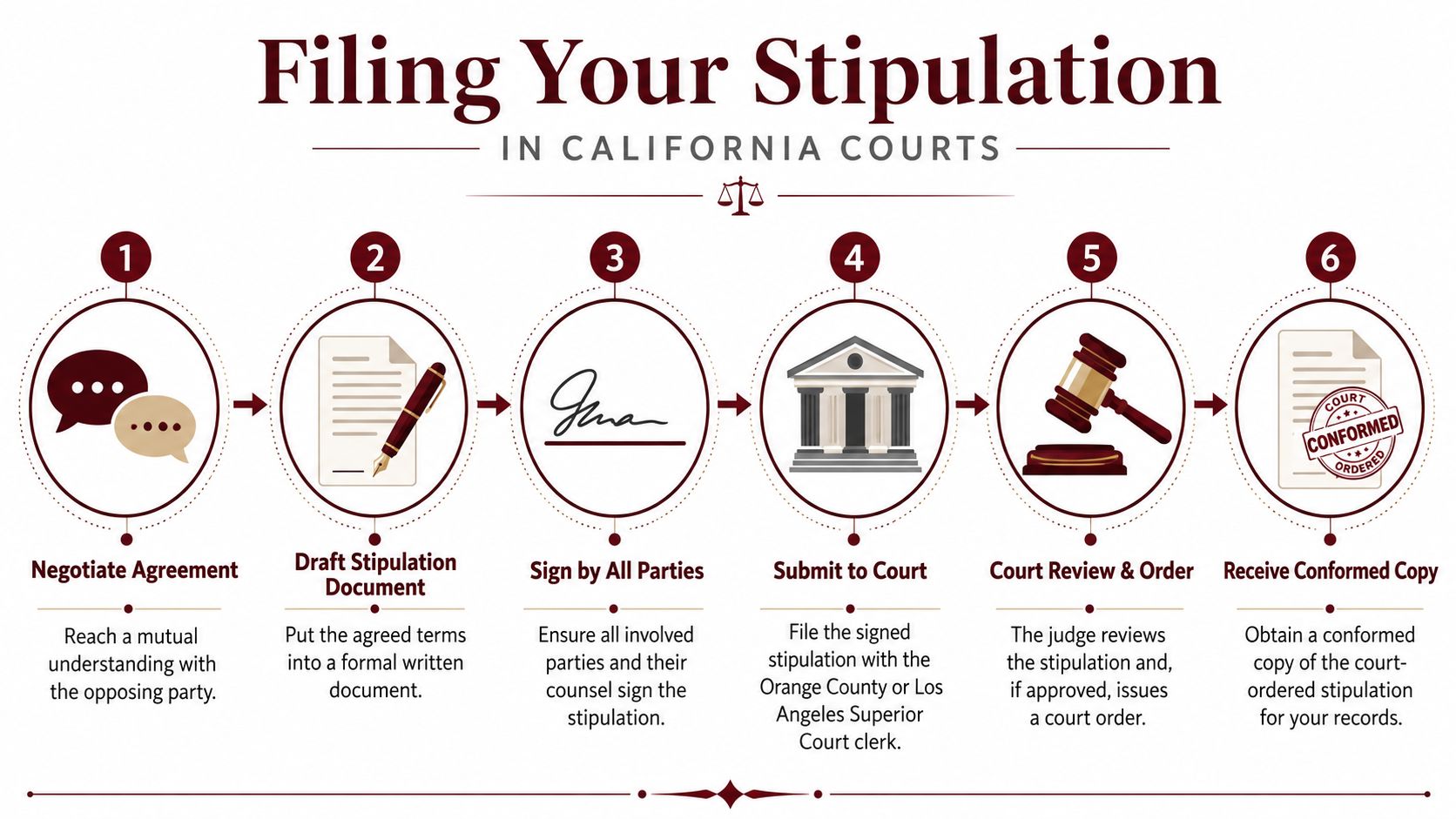
First, the parties negotiate the exact terms. At this stage, practical lawyering proves essential. A usable stipulation doesn't just express goodwill. It identifies who must do what, by when, and under what conditions.
In a probate property matter, that may include terms on occupancy, access for sale preparation, payment of utilities, document exchange, or whether proceeds will be held pending further order. The language should be specific enough that a third party, including a judge, can read it and understand the obligations without guessing.
Get the writing and signatures right
Under California Code of Civil Procedure section 283, as discussed in this California service and filing explanation, an attorney may bind a client to a written stipulation. In Los Angeles Superior Court, e-filing is mandatory, but service of the proposed stipulation must still follow the proper rules. If the parties have consented to electronic service, service can proceed under the electronic service rules. If they haven't, service may need to occur by traditional methods such as personal delivery, mail, or overnight delivery.
That creates a practical checklist:
- Confirm authority early: Make sure counsel has authority to sign, and that the client approves the final terms before filing.
- Circulate the same final version: Problems arise when one side signs an earlier draft and another signs a revised draft.
- Match filing with service rules: E-filing and e-service aren't automatically the same thing in every situation.
A short explainer can help if you want to see the process visually.
Submit it in the form the court expects
After signatures are collected, the signed stipulation is filed with the proposed order for the judge. In federal matters in California's Central District, local procedure can be particularly strict. Under Local Bankruptcy Rule 9071-1(a) in the Central District of California, a stipulation must be filed as a single document containing all disputed issues, each party's contentions, and points of authority where required, and it may not rely on outside documents by reference. If an interrogatory is at issue, the stipulation must include the interrogatory itself, the answer at issue, and the parties' separate contentions.
That rule is a strong reminder of a broader California filing lesson. Don't assume the judge or clerk will assemble the record for you. If the court expects the operative material in the stipulation itself, put it there.
File in sequence, not in hope: the signed agreement comes first, then the request for judicial approval, then the conformed order once the court signs.
Keep a conformed copy and follow the order
Once the judge signs, obtain a conformed copy and store it with your case file. Then follow its terms exactly. A stipulated order is no longer just a compromise between parties. It is a court order, and the court can enforce it like any other order in the case.
Common Pitfalls When Using Stipulations
The biggest mistakes with stipulations usually aren't dramatic. They're procedural, quiet, and costly. A document can look polished and still fail because one term is vague, one signature is missing, or the filing sequence is wrong.

The sequencing problem
One of the most common filing errors is submitting the proposed order before the underlying stipulation is fully executed. In major California markets, up to 42% of stipulations are rejected for improper sequencing, including filing the order before all required signatures are in place, according to the Central District guide on stipulations requiring court approval.
That statistic tracks with what practitioners see in real life. People focus on the judge's signature because it feels like the end goal. But the court expects the parties' agreement to be complete first. If the stipulation isn't finished, there is nothing for the court to approve.
The drafting mistakes that create future litigation
Some agreements fail later, even if they get signed. The usual reason is vagueness.
Consider a probate real estate dispute where the parties agree the home will be sold. That sounds helpful, but it leaves too much open if the document doesn't say who chooses the broker, who pays carrying costs before closing, whether repairs require mutual approval, and how net proceeds will be handled. One missing term today can create a contested motion later.
A safer approach is to pressure-test the draft before anyone signs:
- Ask who performs each task: If a clause says “the property shall be prepared for sale,” identify the person responsible.
- Set dates or triggering events: “Promptly” often causes arguments. A fixed date or event is better.
- Address money directly: If expenses, reimbursements, or reserves are involved, spell out the treatment.
Vague peace terms often produce the next lawsuit. Clear terms usually prevent it.
The authority and scope issue
Another trap is agreeing to something the court won't sign or the parties can't legally promise. A stipulation should stay within the court's jurisdiction and within the actual dispute before the court. If it reaches too far, the judge may reject it or limit its effect.
That concern is especially important in probate and trust matters where several issues may be pending at once. A narrow, well-defined stipulated order is usually stronger than an ambitious document that tries to solve everything in one sweep and leaves loose ends behind.
Strategic Uses and Your Next Steps
A well-drafted stipulation can change the pace of a case.
In California property and probate litigation, the true value is usually not the agreement by itself. It is getting that agreement entered as a court order. Clients often refer to an "order of stipulation," but the practical document is a stipulation and order. The stipulation is the parties' deal. The order is what gives that deal enforcement teeth if someone stops performing.
That distinction matters most in Orange County and Los Angeles courts, where filing delays, rejected proposed orders, and unclear terms can waste weeks. A signed agreement sitting in counsel's email is not the same as an entered order in the court file. If the goal is to stabilize a property, set a sale protocol, require document access, or prevent one side from changing course, the question is not just whether the parties agree. The question is whether the court can sign it, enter it, and enforce it.
A common example is a probate estate with a house that needs attention before trial. The beneficiaries may still dispute who ultimately receives what, but they can often agree on limited steps that protect the asset now. That may include authority for repairs, inspection access, listing conditions, payment of carrying costs, occupancy rules, or a deadline for selecting a broker. Used properly, a stipulation and order creates structure while the larger fight continues.
Where stipulations create real strategic value
The strongest stipulated orders usually do three practical things:
- Narrow the issues: They remove facts, procedures, or interim steps that do not need a hearing.
- Protect property and records: They preserve sale value, rental income, account access, and information needed to evaluate the case.
- Create enforceable deadlines: Once the court signs the order, missed dates and broken promises are easier to address.
Performance conditions deserve special attention. If one side's concession depends on the other side doing something first, say that directly. Orange County Superior Court publishes materials on family support stipulations that show this drafting approach, including language conditioning a waiver on timely payment, on its court forms and filing resources page at Orange County Superior Court family law forms and filing instructions. The same drafting principle carries over well to probate, trust, and real property disputes. If a reimbursement, waiver, turnover of possession, or sale approval depends on performance, the order should tie those points together in plain terms.
This is also where strategy matters. A narrow stipulated order is often more useful than an ambitious one that tries to settle every dispute at once. Judges are more likely to sign a focused order they can enforce cleanly.
What to do before you sign anything
Start with the papers that control the dispute. In these cases, that usually means deeds, the trust or will, probate petitions, prior court orders, loan statements, emails or letters showing the parties' positions, and any draft stipulation already in circulation.
Then separate three categories: what is disputed, what can be agreed now, and what still requires a ruling. That step saves time and avoids a common mistake. Parties often spend energy negotiating broad settlement language when the immediate need is much simpler, such as preserving sale proceeds, setting occupancy terms, or requiring an accounting by a fixed date.
If you are considering a stipulation and order in Orange County or Los Angeles, have counsel review both substance and procedure before anyone signs. I have seen workable agreements lose value because they were never submitted in the right format, were missing signatures, asked for relief beyond the pleadings, or failed to include language the judge needed to sign the order. Those are fixable problems if caught early.
If you're dealing with a probate, estate, or real estate dispute in California and need clear advice on whether a stipulation and order makes sense, schedule a free consultation with Tanner Law. You'll get practical guidance focused on Orange County and Los Angeles courts, with a direct assessment of what can be resolved by agreement, what still requires litigation, and how to avoid filing mistakes that delay the case.