Do All Wills Go Through Probate in California?
No, not all wills go through probate in California. A will doesn't automatically trigger probate. What matters is the type of assets involved and how those assets were titled, and in California some estates can avoid formal probate if they fall under the state's $184,500 small-estate threshold.
If you're reading this after a parent, spouse, or sibling has died, you're probably holding a will and wondering whether the next step is court. That's a very common fear, especially for families in Orange County and Los Angeles who are already dealing with grief, property questions, and pressure from relatives asking what happens next.
The good news is that a will is only one part of the picture. Under California law, the court doesn't ask only, "Is there a will?" It also asks: Was there a house in one name only? Were bank accounts jointly owned? Was there a living trust? Did the person name beneficiaries on retirement or insurance accounts? Those details decide whether probate is required.
A helpful way to think about it is this. A will is like a written instruction sheet. But the court only needs to use that instruction sheet when there are assets that can't transfer on their own. If the assets already have a built-in path to the next owner, probate may be unnecessary.
Table of Contents
- The Common Misconception About Wills and Probate
- When a Will Requires Probate in California
- How California Estates Legally Avoid Probate
- The California Probate Process When It Is Required
- Probate vs Non-Probate A Cost and Risk Comparison
- Actionable Next Steps for Your Family's Estate
- Securing Your Legacy and Protecting Your Family
The Common Misconception About Wills and Probate
Many families assume a simple rule: if there's a will, there must be probate. In practice, California law is more nuanced than that.
A will tells the court who should receive probate assets. It doesn't, by itself, move property out of a deceased person's name. That's why people get confused. They see a signed will and assume the legal system automatically starts. Often, it doesn't.
Across the United States, approximately 60% of estates are estimated to pass through probate, while roughly 40% avoid it completely through non-probate transfer tools such as revocable living trusts, joint ownership with right of survivorship, and beneficiary designations on life insurance and retirement accounts, according to Trust & Will's discussion of whether all wills go through probate. That same source notes that in California, estates valued under $184,500 can use a small estate affidavit in the right circumstances.
The real issue is asset title
The word title signifies legal ownership. It can be compared to the name printed on the label of a file folder.
If an asset is in one person's name alone, and there's no beneficiary form attached to it, that asset usually has nowhere to go automatically after death. The probate court acts like the official office that opens the folder, checks authority, and approves the transfer.
If the asset already has a built-in transfer feature, the court may not be needed at all.
Examples help:
- House in a living trust: The successor trustee can usually manage the transfer outside probate.
- Bank account with a payable-on-death beneficiary: The bank may release funds directly to the named beneficiary.
- Retirement account with a beneficiary designation: It commonly passes according to the beneficiary form, not the will.
- Home owned by spouses in the right form of joint ownership: The surviving owner may receive full ownership automatically.
Practical rule: A will answers the question of who should receive probate property. It doesn't answer whether the property must go through probate in the first place.
That distinction matters a great deal in California, especially when a family home is involved. In Orange County and Los Angeles, real estate is often the asset that turns what looked like a simple estate into a probate matter.
When a Will Requires Probate in California
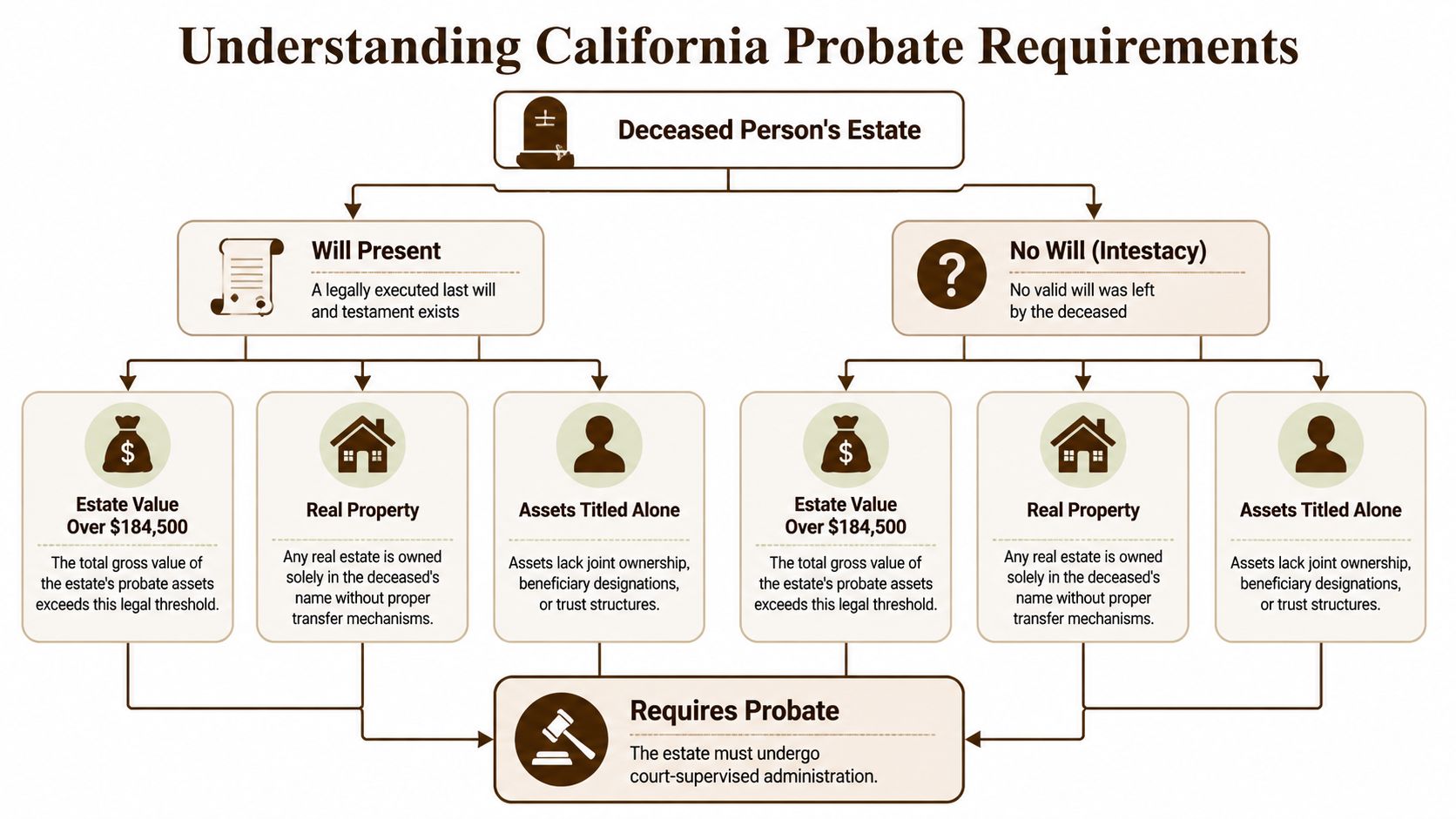
A will requires probate in California when the deceased person leaves behind probate assets that can't transfer automatically by trust, survivorship, or beneficiary designation. The court's job is to confirm authority, protect creditors, and create a clean chain of title.
What probate actually does
Probate is a court-supervised process for wrapping up a person's legal and financial affairs after death. If there's a will, the court usually reviews it as part of appointing the personal representative. If there's no will, the court applies California intestacy rules.
Think of probate as a title-clearing system. If a person dies owning property in their sole name, no one else can sign for that asset because family members know what the deceased "wanted." The legal system still needs a recognized decision-maker.
That is why a will is often best understood as instructions for the court. As KSMO Probate explains in its discussion of why a last will and testament does not avoid probate, a will controls only probate assets, meaning property titled solely in the decedent's name without a living joint owner or valid beneficiary.
The California thresholds that matter
California doesn't require formal probate in every case. Under California-specific guidance on when a filed will leads to probate, a will doesn't automatically trigger probate. Probate occurs only when certain conditions are met, including when the estate exceeds the state's $184,500 small-estate threshold and the estate contains no real property valued over $61,500.
For families, that means the analysis usually starts with three questions:
- What did the person own in their name alone?
- Was any California real estate held outside a trust or survivorship structure?
- Do the probate assets fall within California's simplified procedures, or is a full probate required?
A will is important, but it isn't the engine that drives probate. Ownership is.
A simple example shows how this works. Suppose a widowed parent in Los Angeles leaves a will naming two children equally. If the parent also left a brokerage account in their sole name and a house still titled only in that parent's name, the will doesn't let the children skip court. The court process may still be required to transfer those assets with clear legal authority.
By contrast, if the same parent had moved the house into a trust and set up valid beneficiary designations for financial accounts, the will might play only a backup role.
How California Estates Legally Avoid Probate
Families often ask the wrong question. They ask whether a will avoids probate. In California, the better question is: which assets have been set up to transfer without court involvement?

Living trusts and why they work
The strongest probate-avoidance tool for many California families is a revocable living trust. Assets placed into a properly funded trust are no longer held in the individual's name alone. Instead, the trust holds title, and the successor trustee steps in after death according to the trust terms.
That matters because the trust doesn't die when the person dies. The management structure continues. The trustee can act under the trust document without first asking the probate court for appointment.
A useful analogy is this: probate is like asking a judge for a key after the owner has died. A living trust is like naming the next authorized keyholder in advance.
Other transfer tools that bypass court
Not every asset needs to go into a trust. California families often use a combination of ownership and beneficiary tools.
Consider these common methods:
- Joint tenancy with right of survivorship: When one joint owner dies, the surviving owner may take full ownership by operation of law.
- Community property with right of survivorship: Married couples in California often use this form of title for a direct transfer at death.
- POD accounts: A payable-on-death designation tells the bank who receives the account when the owner dies.
- TOD registrations or deeds where available: A transfer-on-death arrangement can allow certain assets to move directly to the named recipient.
- Beneficiary designations on life insurance and retirement accounts: These usually control the transfer, not the will.
The key isn't the paperwork alone. It's whether the paperwork matches the asset.
A person may sign a beautiful estate plan and still leave an Orange County home outside the trust. When that happens, the plan and the title don't match. The family then learns that the will didn't solve the problem because the asset was never aligned with the intended transfer method.
Local reality: In California, families often discover probate issues when they review the deed to the house, not when they read the will.
For that reason, probate avoidance works best as a coordinated system:
- Use a trust for major assets: Homes, investment real estate, and non-retirement brokerage accounts are common candidates.
- Check account beneficiary forms: Old designations can defeat current intentions.
- Review title after major life events: Marriage, divorce, remarriage, and the death of a prior joint owner often create problems.
- Don't rely on a pour-over will alone: It can help direct forgotten assets into a trust, but it doesn't keep those assets out of probate if they were never transferred during life.
The California Probate Process When It Is Required
Some estates can't avoid probate, and families are better served by understanding the process clearly than by hoping it somehow disappears.
A practical overview helps. This visual lays out the basic sequence.

The main stages in a formal probate
In California, a probate usually unfolds in a series of formal steps through the superior court:
File the petition and lodge the will
The process starts with a court filing asking the probate court to open the estate and appoint a personal representative.Appointment of the executor or administrator
If the will names an executor and the court approves, that person receives authority. If there's no valid will or no suitable executor, the court appoints an administrator.Notice to heirs, beneficiaries, and creditors
Interested parties receive formal notice. Creditors also get a chance to present claims.Inventory and appraisal
Estate assets are identified, gathered, and valued.
Before going further, it helps to see the process described in a different format. This video gives a useful overview of probate administration.
Payment of valid debts, expenses, and taxes
The estate doesn't distribute property first and sort out obligations later. Claims have to be addressed in the proper order.Petition for final distribution
Once administration is complete, the court approves how the remaining assets will be distributed.Closing the estate
After distribution and final approvals, the probate can be closed.
Why families get stuck
The process sounds straightforward on paper, but delays often come from practical problems:
- Missing documents: No deed, no account statement, no clear asset list.
- Unclear title: The decedent may have believed an asset was in the trust when it wasn't.
- Family disagreements: One child lived in the home, another wants it sold, and a third distrusts the executor.
- Creditor issues: A disputed claim can slow everything down.
One point from outside California is still worth knowing because it highlights how seriously courts treat deadlines. As the Texas State Law Library explains in its guide to probating a will, in Texas and many jurisdictions a will must be filed for probate within 4 years of death or it may be treated as ineffective for normal probate purposes. California procedure is different, but the larger lesson is the same. Waiting too long creates risk.
If a loved one has died and there may be real estate or sole-name assets, don't start distributing property informally. First determine whether California probate, a trust administration, or a simplified transfer procedure applies.
Probate vs Non-Probate A Cost and Risk Comparison
For most families in Orange County and Los Angeles, the decision isn't abstract. It's practical. They want to know which path creates more delay, more expense, and more exposure.
Formal probate offers structure and court supervision. That can be useful when title is unclear, creditor issues exist, or heirs are in conflict. The trade-off is that court involvement usually means more paperwork, more procedural steps, and less privacy.
A non-probate transfer, especially through a well-funded living trust, is usually more private and more flexible. The trustee still has duties, and the administration still needs care, but the family doesn't have to ask the court to approve each major step in the same way.
Probate vs. Living Trust at a Glance
| Factor | Formal Probate | Living Trust Administration |
|---|---|---|
| Authority to act | Court appoints a personal representative | Successor trustee acts under the trust document |
| Privacy | Court filings become part of the public record | Administration is generally private |
| Speed | Often slower because of required filings, notices, and hearings | Often more direct when assets are properly titled in the trust |
| Real estate transfer | Court process may be needed to establish clean title | Trustee can often transfer or manage trust property without probate |
| Risk of delay | Higher when hearings, notices, or disputes arise | Lower when the trust is funded and records are organized |
| Main vulnerability | Time, public exposure, and procedural complexity | Problems arise when assets were never transferred into the trust |
Two cautions matter here.
First, probate isn't always bad. Sometimes it's the correct legal tool, especially when a person died owning property outright and no other transfer mechanism exists.
Second, a trust only works if it was funded. A signed trust binder in a desk drawer doesn't avoid probate if the family home, bank account, or investment account stayed in the decedent's individual name.
Families often think they are choosing between a "good" option and a "bad" option. In reality, they're choosing between legal paths with different costs, timelines, and risks.
The right choice depends on the assets, the family dynamics, and whether planning happened before death.
Actionable Next Steps for Your Family's Estate
Once you understand that not all wills go through probate, the next question is what to do now.
If your loved one has already died
Start with documents and ownership records, not assumptions.
- Locate the core papers: Find the will, any trust documents, deeds, account statements, and beneficiary forms.
- Make an asset list: Separate assets into rough categories such as real estate, bank accounts, retirement accounts, insurance, vehicles, and business interests.
- Check how each asset was titled: Sole name, joint ownership, trust ownership, or beneficiary designation.
- Pause distributions: Don't hand over money, sign deeds, or divide personal property until you know the proper legal path.
If there is a valid living trust, CunninghamLegal's California probate guide notes that assets placed in the trust before death bypass probate and are distributed by the successor trustee under the trust's terms. But a pour-over will may still leave some assets exposed to probate if they were never properly retitled.
If you're planning your own estate
A few practical reviews can prevent major problems later:
- Review the deed to your home: Make sure title matches your estate plan.
- Confirm beneficiary designations: Retirement accounts and life insurance pass by contract, not by wishful thinking.
- Fund any trust you create: Signing trust documents without transferring assets into the trust leaves gaps.
- Revisit your plan after major changes: Marriage, divorce, a home purchase, or the death of a named beneficiary can all require updates.
If your estate includes California real estate, blended-family concerns, or the possibility of a dispute, legal guidance is especially important. Those facts don't always guarantee probate, but they do raise the stakes.
Securing Your Legacy and Protecting Your Family
A will is an important document. It expresses intent, names decision-makers, and gives structure where there might otherwise be confusion. But under California law, a will alone usually doesn't determine whether probate happens.
The controlling issue is ownership. If assets are titled in ways that transfer automatically, court involvement may be limited or unnecessary. If assets remain in a decedent's sole name, especially real estate in Orange County or Los Angeles, probate often becomes the mechanism that clears title and authorizes distribution.
That is why good estate planning is less about producing a stack of papers and more about aligning those papers with the assets people own. A living trust, current beneficiary designations, and properly reviewed deeds can spare a family from delay, conflict, and uncertainty. When probate is required, understanding the process early helps families make better decisions and avoid preventable mistakes.
If you're facing questions about a loved one's estate or want to protect your own family from unnecessary probate problems, informed action now is far better than confusion later.
If you need guidance on California probate, estate planning, or property-related inheritance issues in Orange County or Los Angeles, schedule a free consultation with Tanner Law. You'll get clear, practical advice designed for your family, your assets, and the legal issues that matter most.