Mediation vs Litigation for California Property Disputes
A property dispute usually starts with something that sounds manageable. Two siblings inherit a house in Orange County and disagree about whether to sell it, rent it, or keep it in the family. Former partners in Los Angeles own an investment property together and one wants out. A buyer says the seller failed to disclose a problem. A deed shows up that shouldn't exist.
Then the practical questions arrive fast. Who controls the property right now? Who pays the mortgage, taxes, insurance, or repairs while the fight continues? Can this be solved privately, or does a judge need to step in?
Under California law, most property disputes can move in one of two directions: mediation or litigation. They are not interchangeable. One emphasizes negotiated solutions and preserved relationships. The other uses court orders, deadlines, discovery, and trial pressure to force a final result when cooperation breaks down.
For families dealing with probate property, trust assets, inherited homes, and co-owned real estate in Orange County and Los Angeles County, the choice matters. The wrong path can waste money, harden positions, and delay a result that could have been reached earlier. The right path can protect title, preserve equity, and reduce damage to family or business relationships.
The issue isn't whether mediation is always better than litigation, or whether litigation is always more powerful. The issue is which tool fits the dispute you have under California law.
Table of Contents
- Your Path Through a Property Dispute
- Defining the Two Roads to Resolution
- The Mediation and Litigation Processes Explained
- Comparing Cost Time and Control
- Which Path for Your California Real Estate Case
- Potential Pitfalls and Advanced Strategies
- Frequently Asked Questions About Dispute Resolution
Your Path Through a Property Dispute
A common California property dispute doesn't look dramatic at first. It looks like a family text thread that gets colder every week. One heir is living in the house. Another is paying expenses. A third wants an immediate sale. Nobody agrees on value, repairs, or timing.
In other cases, the conflict is more commercial. Co-owners of a duplex or small apartment building in Los Angeles stop trusting each other. One believes the other collected rent without proper accounting. A purchase agreement falls apart and each side blames the other for the failed closing. What began as a business decision turns into a title, possession, or money dispute.
These cases carry two kinds of pressure at once. There's the legal problem, and there's the human problem. In probate and family property matters, people aren't just arguing about land. They're arguing about control, fairness, and history.
Practical rule: If the dispute affects ownership, sale rights, occupancy, or a recorded interest in California real estate, strategy matters early. Delay usually makes the case more expensive and harder to settle.
For many clients in Orange County and Los Angeles County, the first serious decision is whether to push toward negotiated resolution or prepare for court. That decision shouldn't be made from slogans. “Court is too expensive” is sometimes true, but not always helpful. “Mediation is better for everyone” can also be wrong if one side is hiding documents, stalling, or refusing to negotiate in good faith.
A sound approach starts with a few grounded questions:
- What must be protected now: title, possession, sale proceeds, evidence, or strategic advantage.
- How much cooperation still exists: enough for bargaining, or too little for productive negotiation.
- Whether a court order is needed: especially when ownership rights or fraud issues require a binding ruling.
- What outcome solves the problem: sale, buyout, title correction, damages, accounting, or enforcement.
Those questions drive the fundamental mediation vs. litigation analysis in California property disputes.
Defining the Two Roads to Resolution
Litigation is the formal court process. One side files a lawsuit, the other side responds, both sides exchange evidence, and a judge or jury eventually decides the dispute if it doesn't settle first. The decision is binding because the court imposes it.
Mediation is a structured settlement process. A neutral mediator helps the parties negotiate, test risks, and work toward an agreement. The mediator does not decide who wins. The parties decide whether to settle and on what terms.
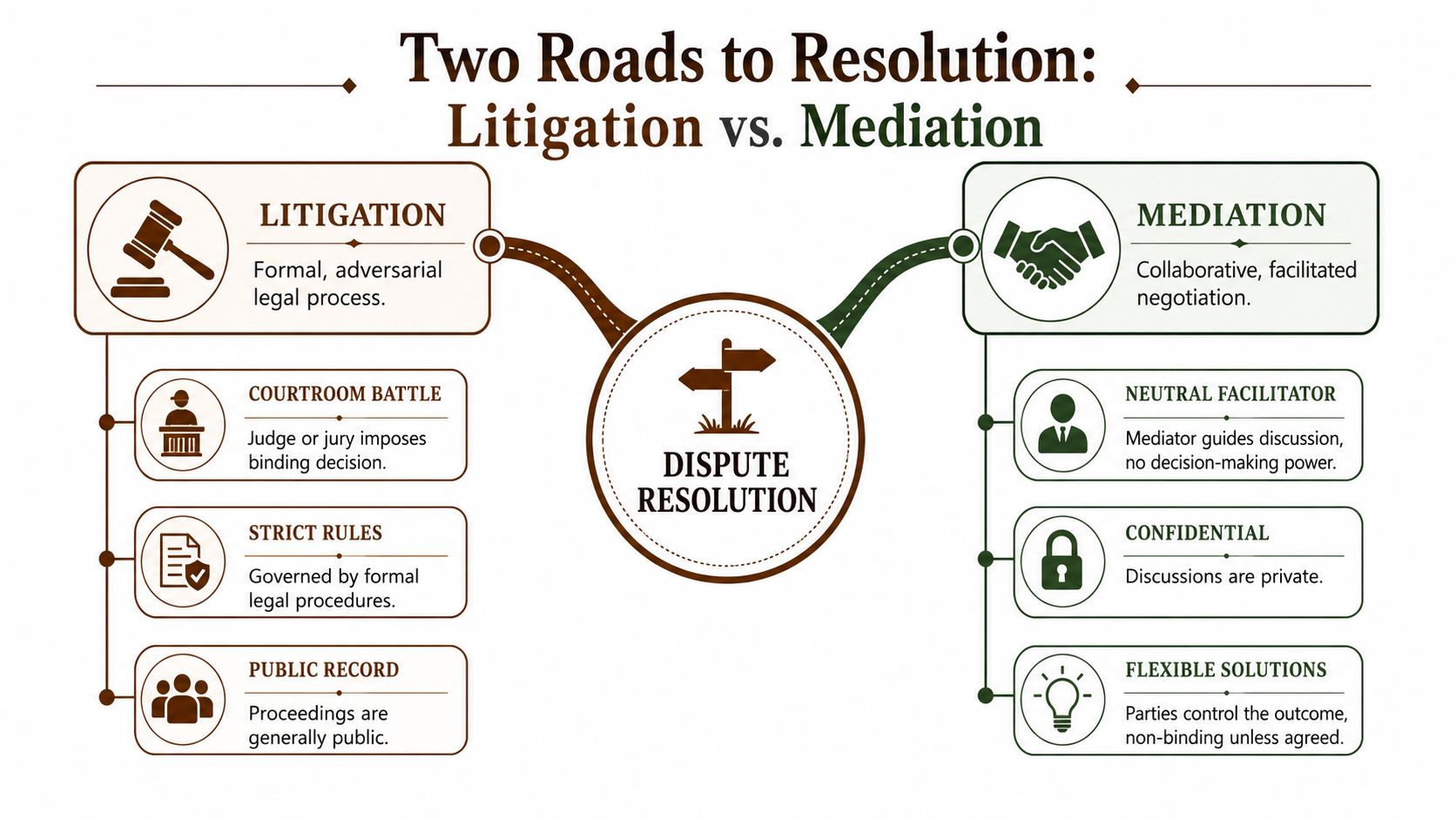
The easiest way to understand the difference is this. Litigation is like sending two trained champions into a formal arena with a referee and rigid rules. Mediation is like bringing in a skilled diplomat to help both sides build a bridge they can both live with.
The core difference is control
In litigation, control shifts to the legal system. California procedure sets the pace. Deadlines matter. Evidence rules matter. Judges decide motions. If the case reaches trial, the court decides the outcome.
In mediation, control stays with the parties. They can discuss a phased buyout, repair credits, move-out timing, sale logistics, confidentiality terms, or a creative possession schedule. Those options may matter a great deal in a property case, especially where family members or ongoing co-owners need a practical result rather than a symbolic win.
Mediation works best when both sides want a solution more than a fight.
Mediation also has an important place inside California disputes
In California estate and probate matters, mediation is not a side issue. It is often part of a key path to resolution. California probate judges have the authority to order parties in estate disputes to attend mediation before trial is scheduled, making mediation mandatory or strongly encouraged in many cases, as discussed in this overview of mediation in trust and estate disputes.
That matters for families dealing with inherited real estate in Orange County and Los Angeles. Even if a case begins as a lawsuit, mediation may still become part of the process. The practical question is not whether mediation exists. It's whether mediation should be used early, after targeted information exchange, or only after the court has established enough pressure to make settlement realistic.
The Mediation and Litigation Processes Explained
The two paths feel different from the beginning. One begins with scheduling, position statements, and negotiation planning. The other begins with pleadings, service, and court deadlines.
How Mediation Usually Unfolds
A property mediation typically starts with agreement on a mediator. In California real estate and probate matters, parties often choose someone familiar with title issues, partition disputes, contract claims, or trust and estate conflict. The right mediator matters because these cases often involve layered facts, not just raw emotion.
After selection, each side usually submits a short statement explaining the dispute, the documents that matter, and the settlement options that might work. In many mediations, there is a joint opening session. In others, the mediator moves quickly into separate meetings, often called caucuses, where each side can speak candidly about risks, priorities, and settlement limits.
The negotiation itself is usually less theatrical than people expect. Good mediation often involves slow movement on the issues that control the case:
- Ownership and title questions
- Occupancy and use of the property
- Sale timing and listing process
- Repair credits or reimbursement claims
- Release language and future claims
- How money will be held and distributed
If the parties reach agreement, counsel typically documents it in a written settlement. That writing matters. In California property disputes, vague handshake resolutions create new problems. A mediated resolution should say who does what, by when, under what conditions, and what happens if someone fails to perform.
How Litigation Moves Through Court
Litigation begins when one party files a complaint. In a quiet title case, partition action, probate-related property dispute, or breach of real estate contract claim, the complaint frames the legal theory and requests relief from the court. The defendant is served and has to respond.
Then the case moves into discovery. During this phase, lawyers gather facts through document demands, written questions, subpoenas, and depositions. In property litigation, discovery often exposes the underlying battle lines. Who paid carrying costs? What was promised in writing? What happened at closing? Who signed the deed? Was there concealment, self-dealing, or misuse of sale proceeds?
After that, motion practice may narrow the case or increase pressure. One side might challenge claims, seek court orders, or ask the judge to resolve legal issues before trial. The court may also hold case management conferences, settlement conferences, or require the parties to attend mediation.
A lawsuit doesn't just ask who is right. It creates deadlines, consequences, and a record.
If the matter doesn't settle, the case proceeds toward trial. That means witness preparation, exhibits, legal briefing, and a formal presentation in court. Trial can produce the decisive result mediation cannot. It can determine title, order partition, award damages, or impose a judgment that one side never would have accepted voluntarily.
Appeal is also possible after trial. That doesn't happen in every case, but it is a feature of litigation and one reason litigation can continue long after a client thought the finish line was near.
Comparing Cost Time and Control
For most clients, the mediation vs. litigation decision comes down to three practical concerns. How much will this cost? How long will it take? Who decides the outcome?
Mediation vs. Litigation At a Glance
| Factor | Mediation | Litigation |
|---|---|---|
| Process style | Collaborative negotiation with a neutral mediator | Formal court process with a judge or jury |
| Decision maker | The parties decide whether to settle | The court imposes a binding result if the case goes to judgment |
| Privacy | Discussions are generally private | Court filings and proceedings are generally public |
| Speed | Often resolved in weeks or months | Often extends much longer because of pleadings, discovery, motions, and trial |
| Best fit | Disputes with room for compromise | Disputes needing orders, findings, or coercive relief |
| Main risk | One side may refuse to bargain in good faith | Time, cost, uncertainty, and loss of control |
A visual summary helps show the trade-offs.
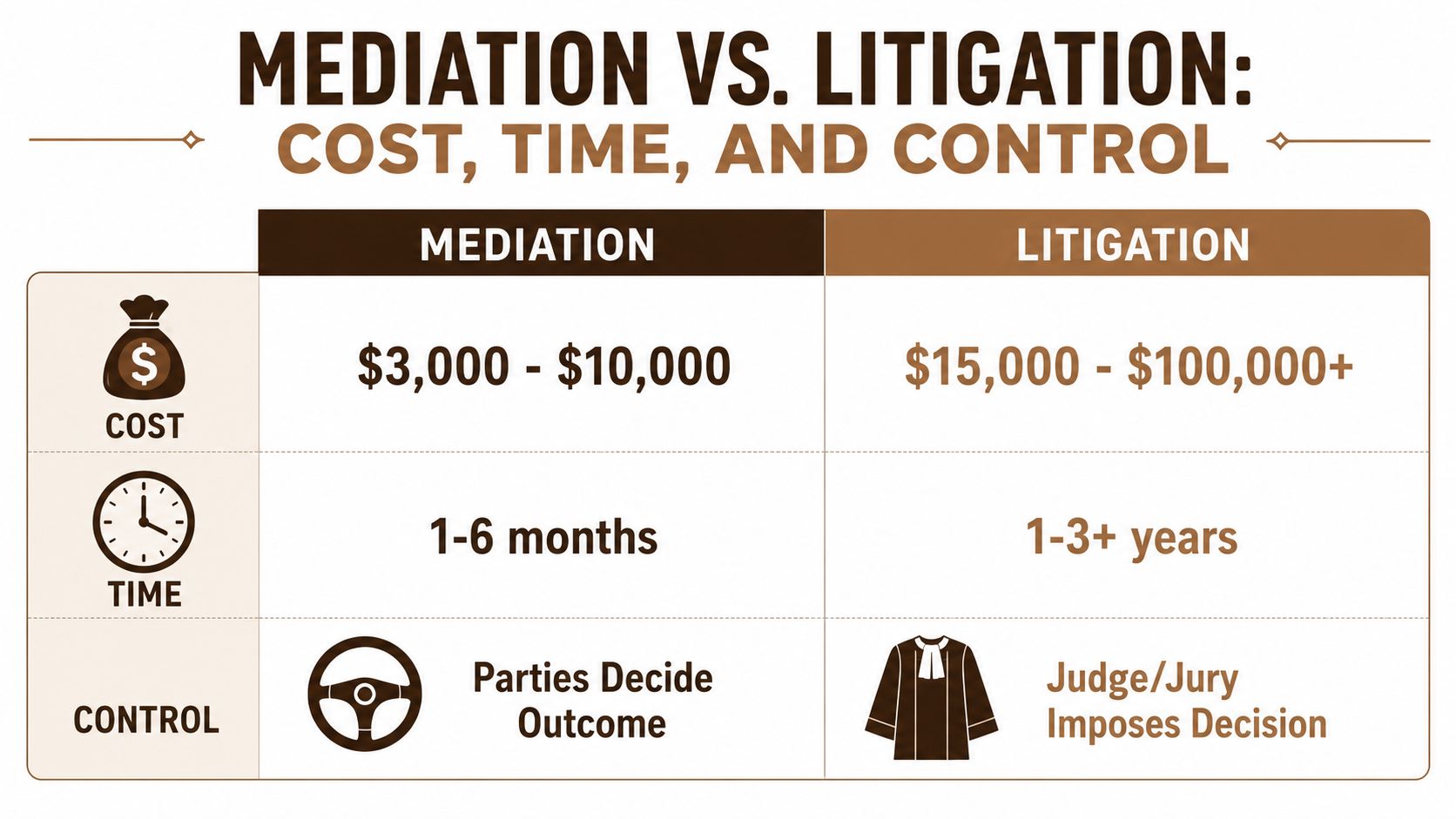
What the Numbers Mean in Practice
Across dispute types, mediation reaches settlement in roughly 70% to 80% of cases according to Wolters Kluwer's discussion of mediation versus litigation. That is one reason mediation has become a serious first option in many civil disputes rather than an afterthought.
The time difference is also substantial. According to Global Legal Law Firm's summary of contract dispute resolution, most mediations conclude within 1 to 3 sessions, typically 4 to 8 hours per session, and often resolve disputes in weeks or months. By contrast, litigation averages 1 to 3 years from filing to trial. The same source notes that mediation can cost $300 to $2,000 per party for simple disputes, while litigation often exceeds tens of thousands of dollars once attorney fees, court costs, and witnesses are involved.
For California probate and estate disputes involving property, costs can become more concrete. In that setting, mediation sessions typically cost $250 to $600 per hour, while litigated estate cases frequently exceed $10,000 and can rise to six figures in high-conflict matters, as described in this California estate dispute comparison.
This embedded overview gives a useful plain-English comparison before turning back to strategy.
Those figures don't mean litigation is wasteful in every case. They mean litigation is expensive because it does work mediation can't do. It compels participation, creates a discovery record, and produces orders that can clear title, force a sale, or award damages.
Why Control Often Matters More Than People Expect
Clients usually focus first on price. In practice, control is often the bigger issue.
In mediation, parties can build terms a court would not ordinarily write for them. In a partition-related dispute, they can agree to list the property with a chosen broker, set a price-reduction schedule, allocate repair responsibility, decide how showings will work, and spell out reimbursement claims. In a contract dispute, they can preserve a transaction, revise deadlines, or restructure performance.
In litigation, the trade-off is different. You gain legal force, but you surrender flexibility. A judge may give you a clean ruling, but not the customized business or family arrangement you hoped for.
Bottom line: Mediation is often more cost-effective when people still have enough trust to negotiate. Litigation becomes more cost-effective when delay, concealment, or refusal to cooperate makes court power necessary.
Which Path for Your California Real Estate Case
Not every property dispute should be handled the same way. In California real estate litigation, the right strategy depends on the kind of claim, the urgency of the threat, and whether the title or transaction problem can be fixed by agreement.

A lawyer who also understands the brokerage side of real estate sees a recurring pattern. Some disputes are valuation and logistics disputes disguised as legal wars. Others are legal wars disguised as negotiation problems. The distinction matters.
Quiet Title Actions
A quiet title case asks the court to determine ownership rights in real property. In California, this often arises when there is a forged deed, a defective transfer, a disputed lien claim, an inheritance issue, or conflicting recorded interests.
Litigation is often the stronger opening move when:
- The title record is clouded: a recorded instrument must be challenged or removed.
- Fraud is alleged: one side claims a deed or transfer was unauthorized.
- Third parties are involved: lenders, lienholders, or unknown claimants may need to be bound by a court judgment.
- Immediate protection is needed: delay increases the risk of further transfers or financial harm.
Mediation can still help later. Once the parties exchange title documents and the legal risk is clearer, settlement may become possible. But a quiet title dispute often needs the structure and authority of the court before serious negotiation begins.
Partition Lawsuits
A partition action is common when co-owners of California property can't agree on sale, buyout, or management. Siblings who inherited a home. Former partners who bought rental property together. Unmarried co-owners whose relationship ended but whose deed did not.
These cases are often excellent candidates for mediation when the core problem is practical rather than fraudulent. If everyone agrees they can't stay co-owners forever, mediation can solve the details that usually cause litigation costs to rise:
- How to value the property
- Whether one owner can buy out another
- Who gets credit for mortgage, taxes, repairs, or improvements
- Whether the property should be sold occupied or vacant
- How sale proceeds should be divided
In Orange County and Los Angeles County, this matters because local market conditions, occupancy realities, and sale preparation issues can materially affect net recovery. A negotiated exit can protect equity better than a prolonged courtroom fight over a result everyone knows is eventually coming.
Real Estate Contract Breaches
Contract disputes sit in the middle. Some belong in mediation first. Others don't.
Mediation is often a strong first move when a deal can still be saved or when both sides mainly disagree about money, credits, repair obligations, timelines, or disclosure consequences. It works well when the parties need a business solution more than a public judgment.
Litigation makes more sense when the breach is tied to deeper misconduct, such as document concealment, refusal to perform despite clear obligations, escrow-related damage, or a dispute where emergency relief is needed. It also becomes necessary when one side wants a binding judicial determination rather than a negotiated compromise.
A simple decision matrix helps:
| Case type | Mediation usually fits when | Litigation usually fits when |
|---|---|---|
| Quiet title | The dispute is narrow and documentation is mostly aligned | Ownership is disputed, fraud is alleged, or title must be judicially cleared |
| Partition | Co-owners accept sale or buyout in principle | One side obstructs, withholds information, or refuses any practical exit |
| Contract breach | A deal can be restructured or settled through payment and terms | The breach is severe, rights must be enforced, or court orders are needed |
The question isn't which path sounds less stressful. It's which path is more likely to produce a usable result under California law.
Potential Pitfalls and Advanced Strategies
Many articles treat mediation as if it's automatically safer, cheaper, and smarter. Often it is. Not always.
When Mediation Helps
Mediation is strongest when both sides have enough information to assess risk and enough motivation to close the gap. In property cases, that usually means the documents are mostly known, the parties have a realistic sense of value, and nobody needs the court to establish basic rights before talking settlement.
A good mediated settlement should be treated with the same seriousness as any other important legal instrument. In a California real estate dispute, the terms should address timelines, signatures, recording obligations, releases, payment mechanics, possession, sale procedures, and remedies if someone defaults. A weak settlement agreement can turn one dispute into two.
Settlement only works if the written terms are specific enough to enforce.
When Mediation Gets Used as a Delay Tactic
There is also a less discussed problem. Some parties misuse mediation as cover for stalling.
Data discussed in Mitchell Hamline's analysis of mediation abuse and litigation consequences shows that mediation participation is routinely misused by attorneys to justify late filings and discovery failures. Courts have treated poor mediation participation as grounds for issuing restraining orders and fee awards. That matters because it shows mediation can backfire when it is exploited procedurally rather than used properly.
In real-world terms, the warning signs are usually visible:
- Repeated postponements: one side agrees to mediate but never commits to dates or document exchange.
- No meaningful authority: the person attending can't approve a deal.
- Information withholding: key records are missing, incomplete, or strategically delayed.
- Performance without follow-through: settlement language is discussed, then ignored once deadlines pass.
When that happens, litigation may be the more cost-effective choice even if mediation looked cheaper at the outset. Court deadlines can stop drift. Discovery can expose facts. Judicial oversight can force movement that private negotiation cannot.
Frequently Asked Questions About Dispute Resolution
Do I still need my own lawyer if we use a mediator
Yes. The mediator is neutral and doesn't represent either side. In a California property dispute, your own lawyer protects your rights, reviews proposed terms, and makes sure any agreement solves the title, money, or possession issues involved.
What happens if mediation reaches an impasse
If mediation fails, the case can still proceed in court. Sometimes the mediation itself is useful because it exposes the underlying disagreements, narrows the issues, and shows what evidence or court orders will matter next.
Can we start with mediation and switch to litigation later
Yes. That is often a sound strategy. Parties may try negotiation first, then file suit if cooperation breaks down or if the dispute requires judicial relief under California law.
Is litigation always more aggressive
Not necessarily. Sometimes filing a lawsuit is the most efficient way to protect a property interest, preserve evidence, or force an answer from someone who won't engage voluntarily. Aggression and effectiveness are not the same thing.
Which option is better for probate real estate disputes
It depends on whether the dispute is mainly about distribution and practical settlement, or whether it involves title defects, fiduciary misconduct, or competing legal rights. Probate-related real estate cases often move through both systems at different stages.
If you're dealing with a property, probate, estate, or real estate dispute in Orange County or Los Angeles County, Tanner Law can help you evaluate the best path under California law. William T. Tanner brings the perspective of both an attorney and licensed real estate broker, which is especially valuable in quiet title actions, partition suits, and real estate contract cases. Schedule a free consultation to discuss your situation, your risks, and the most cost-effective strategy for moving forward.