Disclaiming an Inheritance in California: A Legal Guide
A parent dies, and a son in Orange County learns he's inheriting a house. On paper, that sounds like good news. Then the details come out. The property needs repairs, family members disagree about what should happen next, the carrying costs are high, and the inheritance may create problems the beneficiary didn't expect.
That's where many California families get stuck. They don't want to be ungrateful, but they also don't want to take on a burden that could affect their finances, their taxes, or even their eligibility for public benefits. In those moments, disclaiming an inheritance may be the right legal tool.
A disclaimer is not casual. It's not the same as verbally saying, “I don't want it.” Under California law, the document has to be prepared carefully, signed properly, and delivered correctly. Timing matters. So does the exact wording. One mistake can leave the inheritance legally vested in you, with all the responsibilities that come with it.
For families in Orange County and Los Angeles, this issue often comes up with real estate, trust distributions, and probate estates. If you're dealing with inherited property, cash, or a trust interest you're unsure about, you need a clear answer quickly. If you're overwhelmed by a potential inheritance and want straightforward guidance under California law, schedule a free consultation.
Table of Contents
- An Introduction to Disclaiming an Inheritance
- What Is Disclaiming an Inheritance and Why Do It
- The Legal Requirements for a Valid Disclaimer in California
- Tax and Probate Consequences of Disclaiming
- Drafting and Filing Your Inheritance Disclaimer
- Key Risks and Alternatives to Consider
- Your Next Steps with a California Probate Attorney
An Introduction to Disclaiming an Inheritance
A common California scenario looks like this. A daughter in Los Angeles is named as a beneficiary of her late father's trust. She expected a helpful inheritance. Instead, she learns that one asset is a piece of real estate with ongoing expenses, management problems, and family tension attached to it.
She doesn't want to take title, but she also doesn't want to make a mistake that creates tax issues or probate complications. That hesitation is legitimate. Beneficiaries are often surprised to learn that they aren't required to accept every inheritance because they were named in a will or trust.
Under California law, a beneficiary may be able to refuse the inheritance formally through a disclaimer. When done correctly, the law treats the refused interest as though it never passed to that beneficiary at all. That can be a smart move in the right case, especially when the inheritance carries practical burdens instead of real value.
When refusing can be the wiser choice
Some inheritances create obligations, not relief. Real property can come with deferred maintenance, insurance costs, unpaid obligations, or disputes among heirs. A trust distribution can interfere with broader planning for a family that already has a strategy in place.
Practical rule: If an inherited asset creates more legal or financial exposure than benefit, don't assume you have to accept it.
California residents also need to know that disclaimers are formal legal acts. The deadline is strict. The writing has to say the right things. And once it's done properly, it cannot be undone.
Why this issue needs quick attention
People often lose the option to disclaim because they wait too long or treat the asset as their own before getting advice. That's especially risky when the inheritance involves a house, trust income, or a disputed estate.
If you're in Orange County or Los Angeles and you've been told you're receiving property or money you may not want, get clarity before you act. A free consultation can help you determine whether a disclaimer fits your situation under California law.
What Is Disclaiming an Inheritance and Why Do It
A common California probate scenario looks like this. An adult child learns she is entitled to one-third of a parent's house, but she already receives needs-based benefits, has no money for repairs, and wants no part of a sale fight with siblings. In that situation, a disclaimer may be the right tool. It is a formal refusal of the inheritance so the property passes as the will, trust, or default succession rules direct, without first landing in her hands.
That point matters for both probate and tax planning. A disclaimer is different from accepting an asset and then gifting it away. If done properly, the law treats the disclaimed interest as though it never transferred to the beneficiary at all.
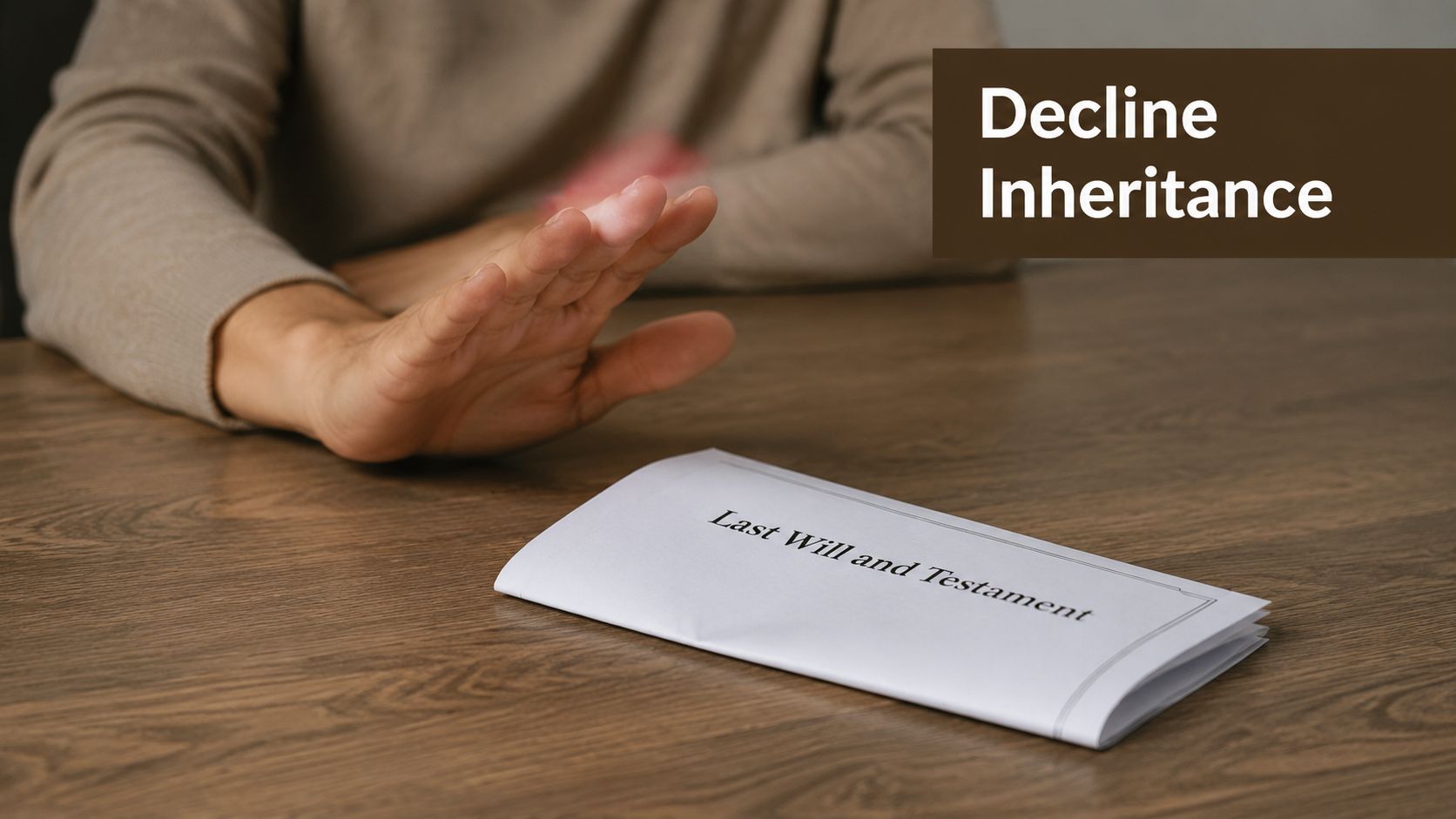
What a disclaimer means in practical terms
In plain English, a disclaimer is a written, irrevocable refusal to take a specific inheritance interest. Federal tax rules also require the refusal to be timely and unequivocal if the beneficiary wants it treated as a qualified disclaimer for tax purposes, as explained in SmartAsset's overview of qualified disclaimers under IRC § 2518.
For clients, the practical rule is simple. Do not act like the owner before getting advice.
Using inherited cash, collecting rent, moving into the property as owner, retitling an account, or directing the executor to send the asset to someone you choose can all create problems. I often have to tell families that the legal issue is not what they meant to do. It is what they already did.
Why people disclaim in real cases
The decision is usually driven by risk, cost, or planning, not family drama.
A beneficiary may disclaim because the asset is more burden than benefit. That happens with houses needing major repairs, fractional interests that invite disputes, mineral rights or business interests with ongoing obligations, or trust distributions that interfere with an existing plan.
Public benefits are another major concern in California. An inheritance can disrupt eligibility for programs tied to asset or income limits. Sometimes a disclaimer helps preserve that eligibility. Sometimes it does not, especially if the beneficiary has already accepted part of the asset or if another planning step would work better. This is one area where a quick answer from a relative or a tax preparer can do real damage.
Disclaimers also come up in family planning. A surviving spouse may prefer that an asset pass under the trust's contingent terms to children. An adult child may prefer not to receive a distribution that would end up exposed to creditors, divorce issues, or a pending bankruptcy matter.
Partial disclaimers can work, but they have to be precise
California beneficiaries are often surprised to learn that a disclaimer does not always have to be all or nothing. In the right case, a person may disclaim only part of an inheritance. For example, a beneficiary might refuse a percentage of a brokerage account, a specific parcel, or the income interest in a trust while keeping another distinct interest.
Precision matters here. “I disclaim enough to stay under the limit” is not good drafting. The document needs to identify exactly what is being refused, and the estate's governing documents need to allow that split to function cleanly. Partial disclaimers are useful, but they are also where sloppy paperwork causes the most avoidable disputes.
A disclaimer is a legal decision with downstream effects. It can protect a beneficiary in one case and create a mess in another.
Before signing anything, review the will or trust, the backup beneficiary provisions, the nature of the asset, and any exposure involving taxes, creditors, divorce, or public benefits. In practice, the right question is not just whether you can disclaim. It is whether disclaiming this asset, in this form, on this timeline, helps your situation.
The Legal Requirements for a Valid Disclaimer in California
A common problem looks like this. A beneficiary wants to refuse an inheritance, tells the trustee not to distribute anything, and assumes that is enough. It is not. In California, a disclaimer works only if it satisfies specific statutory requirements and is handled before the beneficiary accepts the asset or any benefit from it.
Under California Probate Code § 279 as discussed here, the disclaimer has to be in writing, signed by the person disclaiming, identify the creator of the interest, describe the interest being refused, and state the disclaimer and its extent with enough precision for the fiduciary to act on it. If one of those pieces is missing, the trustee, executor, or court may treat the inheritance as accepted by default.
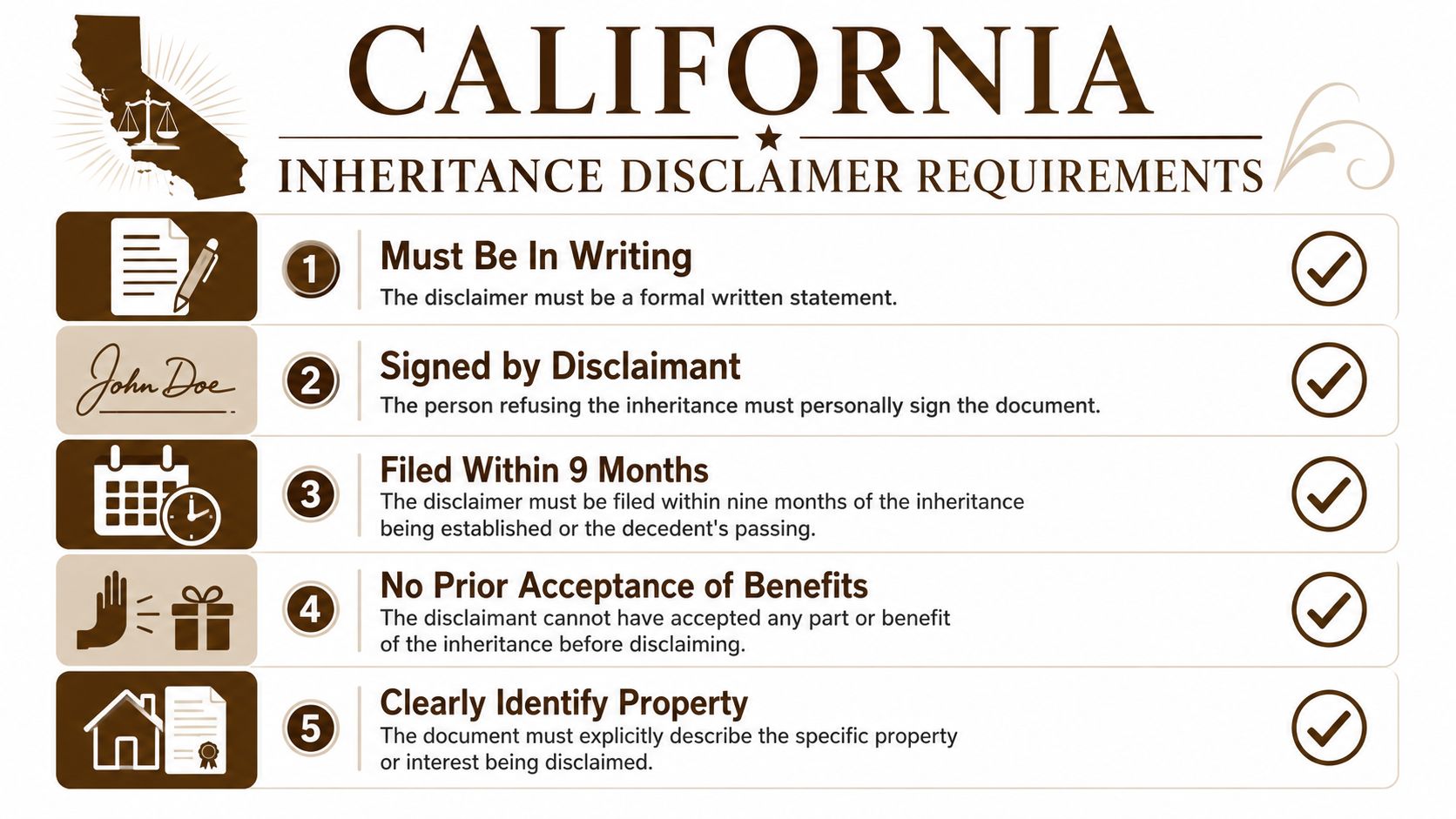
Required elements under California law
For a California disclaimer to hold up, focus on five points.
The disclaimer must be in writing.
A conversation with family members, a text message to the trustee, or a note in an email thread does not replace a signed written disclaimer.The disclaimant must sign it.
The beneficiary refusing the inheritance needs to execute the document. If someone is acting through an agent or fiduciary, authority should be confirmed before anything is submitted.The document must identify the source of the interest.
That usually means naming the decedent, trust, will, or other instrument that created the inheritance right.The property interest must be described precisely.
If the beneficiary is disclaiming a residence, a trust share, mineral rights, or a percentage of a brokerage account, the document should say exactly that. For partial disclaimers, I want the description tight enough that the fiduciary can administer it without guessing.The disclaimer must be timely.
Timing is often where people get into trouble. For tax-sensitive planning, practitioners often work from the federal nine-month framework for a qualified disclaimer, and California administration does not reward delay. Waiting while “thinking it over,” using the asset, or accepting distributions can turn a fixable issue into a permanent one.
A short, workable example often looks like this:
“I, Jane Doe, hereby disclaim all of my right, title, and interest in and to the 25 percent residuary beneficiary share passing to me under the Smith Family Trust dated March 3, 2012, created by John Smith, deceased.”
That sample is not a substitute for legal advice. It shows the level of specificity California fiduciaries expect.
Here is a practical visual summary:
What makes a disclaimer fail
The document can look polished and still fail.
The most common mistake is prior acceptance. If the beneficiary has already taken possession, deposited inherited funds, collected rent, exercised control over an account, or otherwise acted like an owner, the disclaimer may no longer be effective. The same concern applies if the beneficiary receives something in exchange for disclaiming.
Delivery mistakes also matter. In practice, the signed disclaimer should be given to the trustee, personal representative, or other person holding legal title or control of the property, and the estate file should clearly reflect receipt. If the matter is already in probate, filing strategy needs to match the court proceeding and the asset involved.
| Problem | Why it matters |
|---|---|
| Late signing or delivery | Delay can defeat the disclaimer and leave the interest vested in the beneficiary |
| Vague description of the asset | The fiduciary may not be able to administer the disclaimer safely |
| Prior use, possession, or income | Acceptance can waive the right to disclaim |
| Language that tries to redirect the property | A disclaimer refuses an interest. It does not let the beneficiary choose a new recipient |
Public benefits create another layer of risk. A disclaimer that seems sensible in a family discussion can affect Medi-Cal, SSI, or other need-based benefit eligibility in ways that require careful review. That issue is especially sensitive with partial disclaimers, because the structure has to work under the governing document and under the benefit rules at the same time.
Why precision matters in practice
Southern California estates often involve trusts, real estate, and family pressure to “just sign something.” That is where problems start. If the wording is loose, if the wrong asset is described, or if the beneficiary already exercised control over the property, the disclaimer may fail and the tax or benefits strategy may fail with it.
Generic forms are risky for that reason. A legally sound disclaimer should match the will or trust, the exact asset, the distribution history, and the beneficiary's broader situation before anyone signs and submits it.
Tax and Probate Consequences of Disclaiming
A common California scenario looks like this. An adult child wants to refuse an inheritance so it passes to the next beneficiary, but assumes the tax result will always be favorable and the probate court will “update the paperwork.” That assumption causes trouble. A disclaimer can work well, but only if the legal result, the tax result, and the administration result all line up.
Once a disclaimer becomes effective, the disclaiming beneficiary is treated as having died before the decedent for purposes of that interest. The property does not pass through the disclaimant first. It passes under the will, trust, beneficiary designation, or California succession rules that apply after the disclaimer.

What happens to the asset after the disclaimer
The controlling document decides that question.
If a trust names alternate or contingent beneficiaries, the trustee follows those terms. If a will contains substitute gift language, the executor applies it. If the document does not answer the question, California probate rules may determine who takes next.
The practical point is simple. A disclaimer is a refusal, not a rewrite. The person disclaiming cannot choose a new recipient unless the governing instrument already produces that result.
That is where I often slow clients down. Families may agree informally that a disclaimed share should go to a sibling, a child, or a surviving parent. The document may say otherwise. If the trust sends the property to grandchildren in equal shares, or back into a residue clause with different beneficiaries, that is the result the fiduciary usually has to carry out.
Tax treatment can help, but only if the disclaimer is properly structured
A qualified disclaimer can prevent the transaction from being treated as if the beneficiary accepted the asset and then gave it away. That distinction matters. If the disclaimer is valid, the beneficiary is generally treated as never having owned the disclaimed interest for transfer tax purposes.
Federal tax treatment under IRC Section 2518 follows that basic rule. The disclaimer must meet the legal requirements, including timing, form, and lack of control over who receives the property next. If those requirements are not met, the IRS may view the transaction very differently.
That risk shows up in partial disclaimers. A partial disclaimer can be useful in California estate planning, especially where a beneficiary wants to refuse only a fraction of a trust share or only a specific asset. But the portion being disclaimed must be described with care, and the beneficiary cannot keep benefits tied to the part being refused. If the line between the accepted portion and the disclaimed portion is blurry, the tax position gets weaker fast.
The same caution applies to income. If a beneficiary has already accepted rent, dividends, distributions, or other benefits from the asset, counsel needs to review whether that conduct undermines the disclaimer.
Probate and trust administration consequences
From an administration standpoint, a disclaimer changes the distribution path and creates extra work for the fiduciary. The executor or trustee needs a clear written record showing what interest was refused, when the refusal became effective, and why the property is now going to someone else.
That paper trail matters in contested estates.
If the disclaimer is clear and timely, the fiduciary can usually proceed with more confidence. If the document is vague, late, or inconsistent with the estate plan, distribution may stall while the fiduciary asks for court guidance or pushes the issue back to counsel. That means delay, added fees, and more room for family conflict.
In probate matters, the disclaimer may also need to be lodged or filed in the court record depending on how the estate is being administered. In trust administrations, formal court filing is not always part of the process, but delivery to the trustee and accurate trust records still matter. The right path depends on the asset and the posture of the case.
Public benefits are often the hidden problem
For clients receiving or expecting need-based benefits, a disclaimer needs extra scrutiny. Medi-Cal, SSI, and similar programs do not always treat a disclaimer the same way tax law does. A disclaimer that works under probate law can still create a transfer issue, an eligibility problem, or a period of ineligibility under benefits rules.
I pay close attention here because families often focus on taxes and miss the benefits issue entirely. That mistake is expensive.
Partial disclaimers raise the stakes even more. They can be useful, but only if the trust terms, probate rules, and benefit rules all point in the same direction. Before anyone signs, it is worth confirming exactly who will receive the disclaimed interest, whether the beneficiary has already accepted any part of it, and whether refusing it creates a new problem that is worse than the one the family was trying to solve.
Drafting and Filing Your Inheritance Disclaimer
Most problems with disclaimers happen at the drafting stage. People use informal language, describe the property poorly, or leave delivery to chance. In California probate and trust matters, that's risky.
The writing has to be direct. It should identify the decedent or trust creator, describe the interest being disclaimed, state that the disclaimer is irrevocable, and be signed and dated properly. Depending on the situation, additional formalities may also matter.
What the document should say
The disclaimer doesn't need to be theatrical. It needs to be exact.
An illustrative example might read like this:
“I, [Beneficiary Name], hereby irrevocably disclaim all of my right, title, and interest in and to the following property or beneficial interest: [describe the asset or interest precisely], arising under the [name of trust, will, or estate] of [decedent or creator name]. This disclaimer is intended to be complete as to the interest described above, and I have not accepted any benefit from that interest.”
That is not a fill-in-the-blank form. It's an example of the level of specificity a real disclaimer usually needs.
The practical filing path
The exact path depends on whether the asset arises from a trust, probate estate, or another transfer instrument. In many cases, the signed writing should be delivered promptly to the person administering the matter.
Typical recipients may include:
- The executor if the asset is passing through a probate estate.
- The trustee if the inheritance arises under a trust.
- The court file when filing is required or advisable to make the disclaimer part of the formal probate record.
- Other involved professionals such as counsel for the fiduciary when coordination is necessary to avoid distribution mistakes.
Under Stimmel Law's summary of disclaimer requirements, a valid disclaimer must be in writing, often notarized, irrevocable, made before the disclaimant accepts any benefit from the property, and the disclaimant cannot direct who receives the asset next. That's a practical checklist, not a technicality.
A simple working checklist
Before signing, confirm each of these points:
- Identity is clear. The document names the correct decedent or trust creator.
- Property is precise. The interest being refused is described specifically.
- No benefit has been accepted. The beneficiary hasn't used, controlled, or enjoyed the property.
- Delivery is documented. Someone can prove when and to whom the disclaimer was delivered.
- Irrevocability is understood. Once effective, the decision can't be withdrawn because circumstances changed.
A good disclaimer file also includes supporting documents, such as the relevant will or trust provisions, proof of delivery, and communication with the fiduciary.
Where clients go wrong
Clients often think the hard part is deciding whether to disclaim. Usually, the harder part is making sure the disclaimer is effective. Loose drafting, delayed delivery, or family side agreements can undermine the entire effort.
That's why disclaimers should be coordinated with the probate or trust administration itself, not handled as an afterthought. If you want your disclaimer professionally drafted and filed correctly under California law, schedule a free consultation.
Key Risks and Alternatives to Consider
Disclaimers are useful, but they aren't a universal fix. The biggest mistakes happen when a beneficiary assumes disclaiming an inheritance is always simple, always allowed in part, or always helpful for public benefits.
Those assumptions can backfire badly.

Public benefits risk is often misunderstood
One of the most dangerous misconceptions is that disclaiming inherited money or property protects eligibility for SSI or Medicaid. For public benefits purposes, that's often not how the refusal is treated.
According to this discussion of disclaimers and public benefits consequences, a disclaimer is treated as a gift for transfer purposes, meaning the refused asset is deemed transferred to the next beneficiary and can disqualify the person from needs-based assistance. That can create immediate problems for disabled beneficiaries or others relying on means-tested programs.
Don't assume “I never touched the money” means the government will treat it as though nothing happened.
For California families with a disabled child or dependent adult beneficiary, this issue deserves careful analysis before any disclaimer is signed.
Partial disclaimers can be harder than they sound
Many people ask whether they can keep one inherited asset and refuse another. Sometimes they can. Sometimes they can't. The answer depends on the governing document, the type of asset, and the structure of the inheritance.
An Ohio-focused discussion notes that partial disclaimers are often oversimplified, and that some probate courts reject them where the governing estate documents do not clearly allow fractional or asset-specific treatment, as described in this article on disclaiming inherited property in Ohio. The California lesson is the same in practice. You need to examine the exact language of the trust or will before assuming you can split the inheritance cleanly.
Irrevocability and loss of control
Once a valid disclaimer is in place, the disclaiming beneficiary loses control. That person can't later reverse course because the housing market improved, a sibling promised to sell but didn't, or family dynamics changed.
A short comparison helps:
| Issue | Disclaimer | Alternative approach |
|---|---|---|
| Can you change your mind later | No, if validly made | Sometimes, depending on the tool |
| Can you choose the next recipient | No | Sometimes, if you accept and then plan separately |
| Does it affect public benefits analysis | It can | It may still require planning, but the analysis differs |
Alternatives worth discussing
A disclaimer is one option. It isn't the only option.
- Accept and then plan. In some situations, accepting the inheritance first may provide more flexibility, though it can create its own tax and benefits consequences.
- Trust-based planning. Families sometimes use trust structures to manage inherited assets for a vulnerable beneficiary.
- Distribution agreements. In the right case, beneficiaries may be able to resolve concerns through coordinated administration rather than a disclaimer alone.
The correct path depends on the family, the property, and the beneficiary's legal and financial position. Before making an irreversible decision, schedule a free consultation to evaluate the risks and alternatives under California law.
Your Next Steps with a California Probate Attorney
Disclaiming an inheritance sounds simple when reduced to one sentence. In actual California practice, it rarely is. The law demands precise writing, strict timing, clean delivery, and a full understanding of what happens after the disclaimer takes effect.
Because the decision is usually final, it carries significant implications. If the disclaimer fails, the asset may vest in you. If it succeeds, the asset may go somewhere you didn't expect. If public benefits are involved, the consequences can be even more serious.
When legal help matters most
You should speak with a California probate attorney quickly if any of the following apply:
- You inherited real estate in Orange County or Los Angeles and aren't sure whether you want it.
- You're a trust beneficiary and need to know whether refusing part or all of a distribution is possible.
- You receive SSI, Medicaid, or other needs-based benefits and are worried about eligibility.
- There is family conflict about where the asset should go if you disclaim.
- The nine-month deadline is approaching and you haven't taken formal action.
These cases often look manageable until one detail changes the legal result. A single act of acceptance, an unclear partial disclaimer, or a missed delivery step can alter everything.
What careful counsel actually does
Good legal advice here isn't just about drafting a paper. It means identifying the exact nature of the inherited interest, checking the governing trust or will, confirming whether a disclaimer is still available, and evaluating whether a disclaimer is even the best option.
It also means coordinating the disclaimer with the executor, trustee, or probate process so the family has a workable administration path after the refusal. That reduces confusion, protects the record, and helps avoid later disputes.
The best time to analyze a disclaimer is before you touch the asset, not after someone argues that you already accepted it.
For many California families, this is happening while they're grieving, handling property logistics, and trying to keep peace among relatives. Clear legal guidance can remove guesswork at exactly the moment when guesswork is most expensive.
A practical final thought
If you're considering disclaiming an inheritance, don't rely on internet summaries, informal family agreements, or generic forms. California probate and trust matters turn on details. What works in one estate can fail in another because of one clause, one action, or one missed deadline.
Take the time to evaluate the inheritance before it evaluates you. If you need help understanding your options, the consequences, and the proper process under California law, schedule a free consultation.
Tanner Law helps families in Orange County and Los Angeles evaluate whether disclaiming an inheritance is the right move, prepare legally sound disclaimer documents, and address related probate, trust, and real estate issues with clear, practical guidance. If you're facing an inheritance decision and want direct advice specific to your individual situation, schedule a free consultation with Tanner Law.