California Statutory Will: A 2026 Guide for Families
You may be staring at a free California will form right now, wondering whether filling in a few blanks is enough to protect your family. That question comes up often with parents of young children, older homeowners, and adult children helping a parent in Orange County or Los Angeles get basic estate planning done without spending more than they have to.
For some people, a California Statutory Will is a legitimate option under California law. For others, it creates exactly the kind of probate and title problems they were trying to avoid. That risk is especially serious when the estate includes a house, rental property, or any real estate owned with someone else. In Orange County and Los Angeles, that issue shows up often. Families assume the form is simple, then learn later that simple on paper doesn't always mean simple in probate.
Table of Contents
- What Is a California Statutory Will
- The Strict Legal Rules for a Valid Statutory Will
- Statutory Will vs Other California Wills
- A Step-by-Step Guide to Completing the Form
- Common Mistakes and Hidden Dangers to Avoid
- When to Avoid a Statutory Will and Consult an Attorney
What Is a California Statutory Will
A California Statutory Will is a state-created will form authorized by California law. It isn't a fake shortcut or an unofficial template from the internet. It is a real, recognized estate planning document under Probate Code 6240. The form is meant to help California residents with straightforward wishes put a valid will in place without hiring a lawyer for custom drafting.
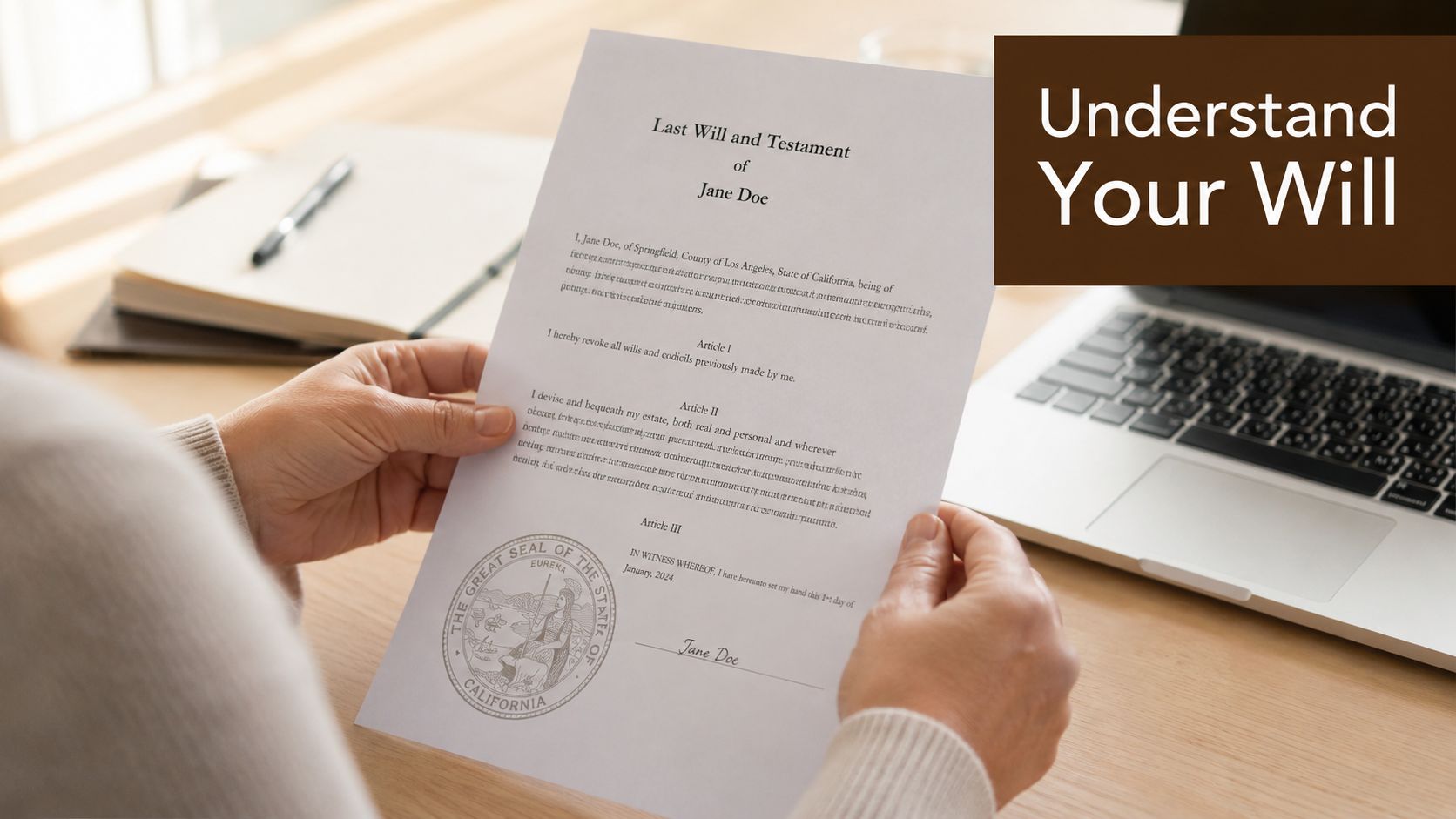
The best way to think about it is as a fill-in-the-blank will. The State of California provides the structure. You supply the names, property gifts, and personal choices. As explained in this overview of a California statutory will under Probate Code 6240, the form is a standardized, one-size-fits-all document designed for people with straightforward estate planning needs and relatively small estates, and it can be used to distribute real estate, personal property, and financial assets such as bank accounts.
What the form can do
For the right person, the form handles several basic estate planning goals:
- Name who inherits your house, personal property, and other assets covered by the will.
- Nominate an executor to handle the estate administration process.
- Leave specific gifts to individuals.
- Name a guardian for minor children.
That last point matters. Many parents focus on who gets the house or bank account, but the guardian nomination is often the most urgent reason to have a will in place at all.
Who the form usually fits
This document works best when the family situation is uncomplicated and the assets are easy to describe. A single person with modest assets and a clear plan may do well with it. A married couple with fully aligned wishes and no unusual property issues may also consider it.
Practical rule: A California Statutory Will is usually strongest when your instructions fit neatly inside the blanks already printed on the form.
What it doesn't do well is adapt. It doesn't offer the flexibility of a trust. It doesn't give much room for customized planning. And once real estate title issues enter the picture, especially co-ownership issues common in Southern California, the limits become much more serious.
Why families in Orange County and Los Angeles should pause before using it
In this region, many estates involve a primary residence that was inherited, refinanced, added to title, or shared with someone other than a spouse. That may include siblings, unmarried partners, parents and children, or investment partners. A statutory will may still be valid as a will, but it often doesn't solve the ownership and transfer issues that families expect it to solve. That's where probate trouble starts.
The Strict Legal Rules for a Valid Statutory Will
The form looks simple. The signing rules are not. California law treats the execution ceremony as a serious legal event, not a casual paperwork step. If the will isn't signed correctly, the problem may not surface until after death, when the person who could have fixed it is gone.
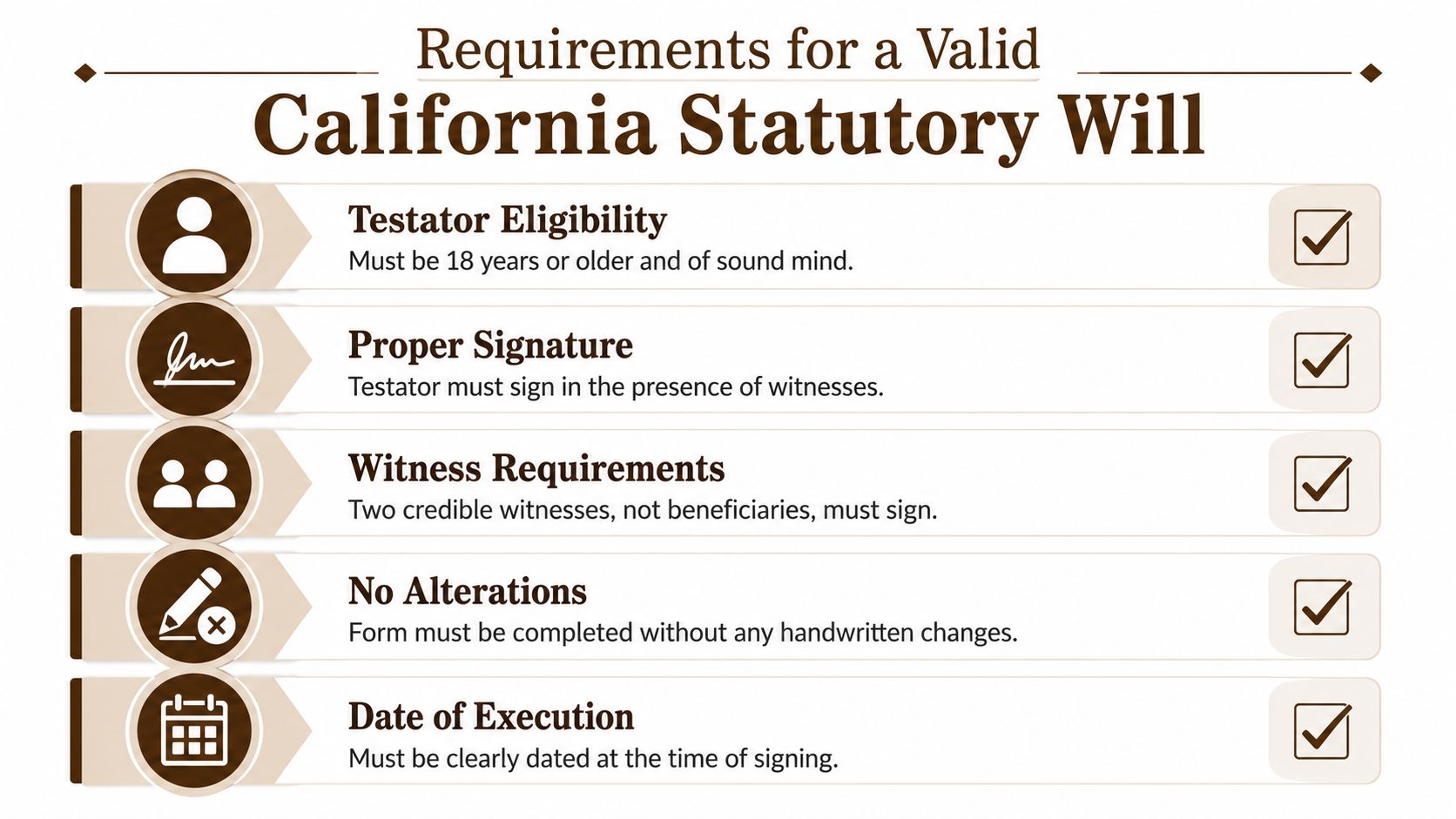
The governing rule is strict. The California Statutory Will form published from Probate Code section 6240 states that the testator must sign and date the document in the presence of exactly two adult witnesses, those witnesses must also sign, notarization is not required for validity, and alterations to the form will invalidate the entire will.
The signing ceremony has to be done correctly
The safest approach is to treat the signing as one coordinated event. The person making the will signs and dates it while both witnesses are present. Then the witnesses sign.
Critical rule: At least two witnesses must sign. Notarization alone is not sufficient.
That point causes confusion because people are used to notarizing legal documents. A notary may be useful for other papers. But for a California Statutory Will, notarization doesn't replace the witness requirement.
Witnesses must be disinterested
The witnesses should not be beneficiaries under the will. In plain terms, the people who inherit under the document shouldn't also serve as the people validating it. California probate practice strongly favors disinterested witnesses because that reduces later challenges and avoids claims that someone pressured the person signing.
A common mistake is using adult children as witnesses when those same children are also receiving property. Families do this because those are the people available in the room. It creates avoidable risk.
You cannot edit the printed text
Many DIY wills commonly fail. People cross out language they don't like. They squeeze in extra instructions in the margins. They handwrite a new clause because they think the form missed something important.
That is exactly what the statutory form forbids.
- No cross-outs: Striking through printed language can invalidate the form.
- No added words outside the blanks: Extra handwritten text can create a fatal defect.
- No “fixing” the template: If the form doesn't fit your wishes, the answer is usually a different document, not a modified form.
If you need to customize the form beyond its blanks, the form probably isn't the right tool for your estate plan.
Why the strictness matters
People often assume a court will honor their intent if the overall idea is clear. Sometimes courts do try to salvage intent in probate disputes. But relying on that possibility is a poor plan. A will should reduce uncertainty, not create a courtroom argument over whether a family member's handwritten note in the margin changed everything.
Statutory Will vs Other California Wills
Choosing a will type in California isn't just a paperwork question. It's a decision about risk, flexibility, and how much uncertainty your family may face later. The California Statutory Will sits at one end of the spectrum. It is easy to access and easy to start. It is not the most flexible option.
A holographic will sits in a different category. That's a handwritten will. An attorney-drafted will sits at the other end, where the document is designed for the family, assets, and likely probate issues.
Comparison of California Will Types
| Feature | Statutory Will | Holographic Will | Attorney-Drafted Will |
|---|---|---|---|
| Cost | Free form, with optional cost only if a separate affidavit is notarized | Usually low direct cost if self-prepared | Higher upfront legal cost |
| Ease of creation | Easy to access and complete if your wishes fit the form | Easy to write, but easy to write badly | Requires planning meetings and drafting |
| Flexibility | Low | Moderate in theory, but often unclear in practice | High |
| Risk of legal challenges | Elevated if execution is flawed or form is altered | Elevated because wording and proof issues are common | Lower when properly prepared and executed |
| Good for complex assets | No | Rarely | Yes |
| Guardian nomination for minor children | Yes | Can be attempted, but clarity may be weaker | Yes |
| Best use case | Straightforward California estate | Emergency or highly simple situation | Families with real estate, blended families, or tailored wishes |
Where the statutory will helps
The statutory form's biggest strengths are accessibility and simplicity. It gives people a lawful way to name beneficiaries and handle basic distributions under California law. For someone who has delayed estate planning for years, a properly completed statutory will can be much better than leaving no will at all.
That said, the form's simplicity is also what limits it.
Where holographic wills create different problems
A holographic will may look more personal because it's handwritten. But handwritten instructions often leave room for fights over meaning, missing property descriptions, or whether the writer intended the paper to be a will at all. Families then spend time and money arguing about interpretation instead of administering the estate.
Where attorney-drafted wills earn their value
An attorney-drafted will is not just longer. It is usually clearer and more deliberate. It can address backup beneficiaries, alternate fiduciaries, custom clauses, and property issues that don't fit cleanly into a form. It can also be coordinated with a trust or with title planning for real estate.
For families in Orange County and Los Angeles, real estate matters most. A house in one person's sole name presents one set of issues. A house owned with a sibling, child, or unmarried partner presents another. A generic form won't diagnose those title problems for you.
A will doesn't just need to say who gets property. It needs to work with how that property is actually owned.
The practical trade-off
If your goals are basic, your assets are uncomplicated, and you can follow directions exactly, a California Statutory Will may be serviceable. If your estate includes co-owned real property, an uneven family dynamic, or any wish that requires explanation, the form's convenience usually stops where probate problems begin.
A Step-by-Step Guide to Completing the Form
If you've decided the form may fit your situation, complete it carefully and stay within the printed structure. Don't treat it like a worksheet you can casually revise. Treat it like a final legal instrument.

Start with the people you are naming
Before you write anything on the form, make a clean list of:
- Your intended beneficiaries.
- Your executor.
- Backup choices if your first choice can't serve.
- Any guardian nominations for minor children.
Use full legal names where possible. If two relatives share the same name, identify them clearly enough that no one will later argue about who you meant.
Work through gifts in a logical order
The form usually asks you to address property distributions in categories. Read each blank carefully before writing. Don't assume the form means what you think it means.
A careful approach looks like this:
- Specific gifts first: Decide whether certain individuals should receive a named asset or item.
- Personal items next: Think through jewelry, family heirlooms, vehicles, or collections.
- Residue of the estate: This is the remainder after specific gifts and expenses. Many disputes start because the person filling out the will focused only on one house or one account and ignored the residue clause.
Choose guardians with care
The statutory form does allow guardian nominations for children, which is one of its most useful features. According to the California statutory will form used by Sacramento Law Library, the person making the will may nominate up to three individuals in order of preference as guardians for minor children under age 18, and only individuals may serve in that role, not banks or trust companies.
That means you should think in layers:
- First choice: The person you trust most to raise your child.
- Second choice: The person who would step in if your first choice is unavailable.
- Third choice: A final backup, if needed.
Parents often spend more time deciding who gets furniture than who would raise their child. The guardian section deserves the more serious attention.
Finish with execution, not edits
Once the blanks are complete, stop. Don't add notes in the margins. Don't attach a side letter trying to rewrite part of the form. If you realize the form doesn't express what you want, that's a sign to move away from the statutory will rather than force it.
When the form is complete, arrange the signing ceremony correctly and keep the original in a place where your family can find it. A valid will that no one can locate creates its own set of probate headaches.
Common Mistakes and Hidden Dangers to Avoid
A common Southern California probate scenario looks simple at first. A parent in Orange County signs a California Statutory Will, writes that one child gets "the house," and assumes the paperwork is done. After death, the family learns title was held with a sibling, an unmarried partner, or a child who had been added to the deed years earlier. At that point, the will has not solved the underlying problem. It has exposed it.
The modified form problem
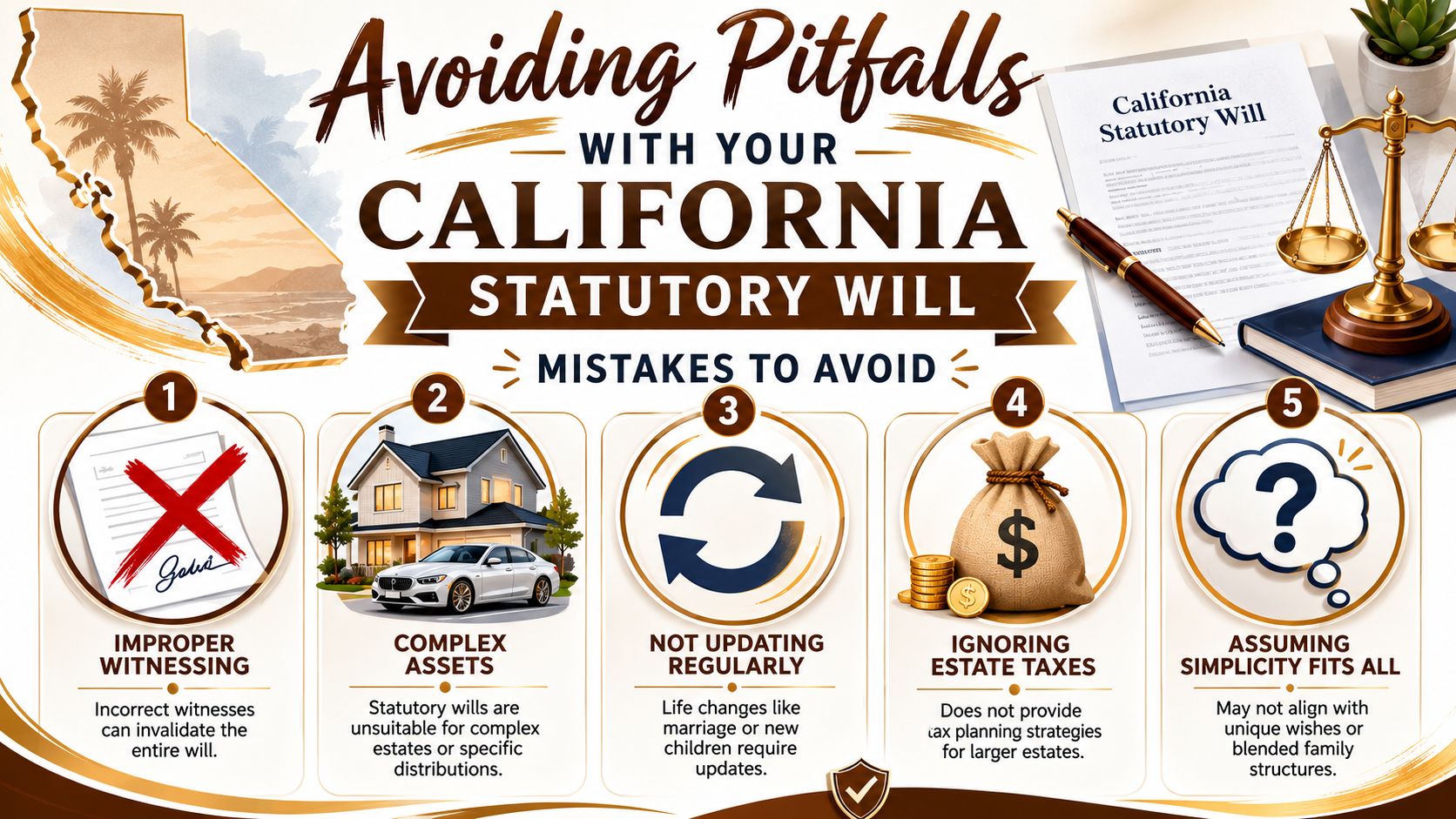
The statutory will works only if the form is completed and signed the way the law expects. Trouble starts when someone tries to "improve" it with handwritten edits, crossed-out clauses, margin notes, or an attached page that changes who gets what. Courts may end up arguing over whether the document still works as a statutory will, or whether it can be treated as some other kind of will under general probate rules, as discussed in this analysis of using a statutory will in California.
That is not a technical problem. It is a litigation problem.
Once family members are fighting over what the decedent meant, the low-cost form has already failed at its main job. I have seen small changes create expensive disputes because each edit raises new questions about intent, timing, and whether the witnesses saw the final version.
Common trouble spots include:
- Handwritten additions after the form is printed
- Cross-outs that conflict with the preprinted language
- Initials or notes with no clear legal effect
- Changes suggested by a beneficiary who later benefits from them
Co-owned real estate is where the form often breaks down
This is the issue many free guides miss.
In Los Angeles and Orange County, families often own property in ways the statutory will does not handle well. Title may be held as tenancy in common. A parent may have added one child to title for refinancing or Medi-Cal planning without understanding the probate consequences. Unmarried couples often buy together. Siblings may inherit partial interests and never clean up the record. Those facts matter far more than the sentence in the will that says who should receive "my home."
A will transfers only what the decedent owned, and only to the extent that asset is subject to probate. It does not rewrite the deed. It does not define an unclear percentage interest. It does not repair a bad prior transfer or resolve whether someone else already had survivorship rights.
That is why co-ownership creates a real title risk, not just a drafting issue.
Clouded title, delayed sales, and post-death disputes
If the will leaves a house to one beneficiary but the recorded title shows shared ownership, the personal representative and the heirs may be dealing with two separate fights at once. One is the probate case. The other is the title problem.
That second problem can stall a sale, refinance, or buyout for months. Escrow officers and title insurers do not ignore conflicting ownership records because a will uses simple language. They want a clean chain of title. If they do not get it, the family may need additional probate filings, recorded affidavits, negotiated settlements with co-owners, or separate quiet title or partition litigation.
A statutory will can pass whatever probate interest the decedent had. It cannot clean up messy title to Orange County or Los Angeles real estate.
Other mistakes that cause avoidable trouble
Some errors are less dramatic than a title dispute, but they still create expense and delay:
- Improper witnessing. Casual kitchen-table signings often fail because the ceremony was handled incorrectly.
- Using the form in a blended-family situation. The preprinted choices rarely match what a second-marriage family intends.
- Assuming every asset passes under the will. Some accounts, deeds, and beneficiary-designated assets pass outside probate.
- Forgetting to review the will after title changes. A refinance, transfer deed, marriage, divorce, or death in the family can make an old statutory will misleading or incomplete.
- Describing property too loosely. Phrases like "my house" or "the rental" can create conflict when the person owned only a partial interest or owned more than one parcel.
The California Statutory Will still has a place. It can work for a narrow set of facts. But once the estate includes co-owned real estate, layered title history, or family members with competing expectations, the form stops being simple and starts creating risk.
When to Avoid a Statutory Will and Consult an Attorney
A common Southern California scenario looks simple until someone dies. A parent in Orange County signs the statutory will, believing it will pass "my share of the house" to a child, but the house is co-owned with a sibling, an unmarried partner, or an adult child added to title years ago. The probate case then becomes partly an estate matter and partly a title problem.
That is the point where the statutory will stops being a low-cost shortcut and starts creating expensive uncertainty.
Clear red flags
Get legal advice before using a California Statutory Will if any of these facts are present:
- You own real estate with anyone other than a spouse. This deserves special attention in Los Angeles and Orange County, where families often hold title as tenants in common, add children to deeds, or mix inheritance planning with refinance decisions.
- You have a blended family. Second marriages, stepchildren, and children from prior relationships often require clearer drafting than the form allows.
- You want to leave different assets to different people. The form gives limited control, which can create fights over what was intended.
- You own rental property, a business interest, or investment assets. Those assets usually call for coordinated estate and title planning.
- You expect a dispute. If relatives already disagree, a basic form can give them more room to argue.
- You are trying to fix a deed or title problem through the will. A will transfers a probate interest. It does not correct title defects.
Co-owned property is where I see the most avoidable damage. The form's rigid structure does not address the practical questions that matter in real cases: What exact interest did the decedent own, did another owner have survivorship rights, was there a prior transfer that changed title, and will a buyer or title insurer accept the probate paperwork without further cleanup? Those are not academic questions. They determine whether heirs can sell, refinance, or even agree on who owns what.
What usually works better
For a very simple estate, the statutory will can still be enough. Once the estate includes Orange County or Los Angeles real estate with shared ownership history, the safer course is usually an attorney-drafted will, a trust-based plan, or focused advice on title before any will is signed.
That does not mean every family needs the most elaborate plan available. It means the plan should match the asset and the title record. In practice, that often saves money because the family avoids probate delays, title objections, and litigation between co-owners after death.
If you're considering a California Statutory Will and want to know whether it fits your family, property, and probate risks, schedule a free consultation with Tanner Law. The firm helps clients in Orange County, Los Angeles, and surrounding California communities evaluate wills, probate exposure, and real estate title issues before a simple form turns into a costly dispute.