Liquidated Damages Real Estate: Protect Your 2026 Investment
You may be dealing with this right now. A buyer for the family home in Orange County has signed, deposited earnest money, and then stops performing just before closing. Or you're advising a trustee, executor, or probate administrator trying to sell a Los Angeles property, and a failed transaction has suddenly created delay, carrying costs, and conflict over the deposit sitting in escrow.
The immediate question is almost always the same. Who gets the deposit, and under what rule? In California, that answer often turns on one clause that many parties initial without much thought: the liquidated damages provision. In practice, that clause can either provide a clean path to resolution or become the center of a separate dispute.
For homeowners, investors, estate planners, and probate counsel, liquidated damages real estate disputes are less about abstract contract theory and more about strategic advantage, timing, and whether the contract was set up correctly from the start. California law gives sellers meaningful protection, but only if the clause fits the statute and only if the facts support enforcement. Buyers also have real defenses, especially when the clause was drafted carelessly or pushed past what the law will tolerate.
Table of Contents
- When a Real Estate Deal Goes Wrong
- What Are Liquidated Damages in a Real Estate Contract
- California Law and the 3 Percent Liquidated Damages Rule
- Drafting and Negotiating an Enforceable Clause
- Enforcing the Clause When a Buyer Defaults
- Challenging the Clause When a Deal Collapses
- A Practical Checklist for California Homeowners and Investors
When a Real Estate Deal Goes Wrong
A failed sale rarely stays simple. The buyer says financing changed, family circumstances shifted, or disclosures created concern. The seller sees something different. Weeks were lost, the property was tied up, backup buyers disappeared, and carrying costs kept running.
That tension gets sharper in probate and trust sales. An executor may already be under pressure from beneficiaries who want the property sold and the estate moved forward. A collapsed contract doesn't just delay closing. It can create claims that the fiduciary accepted weak terms, failed to protect the estate, or mishandled the buyer's deposit dispute.
A familiar California scenario
Take a straightforward Orange County home sale. The parties sign a California form agreement, escrow opens, inspections are handled, and everyone expects a routine close. Then the buyer stops short of the finish line. At that point, the seller usually asks whether the deposit can be retained.
The answer depends less on emotion than on the contract language and the governing California rule. If the agreement contains a properly structured liquidated damages clause, that clause may provide the seller's primary remedy. If it doesn't, the seller may have to prove actual damages the hard way, which is slower, more expensive, and often less predictable.
A deposit dispute usually isn't about who feels wronged. It's about whether the contract created an enforceable shortcut for proving damages.
The practical question behind the conflict
Most clients don't care about doctrine for its own sake. They want to know whether the escrow holder can release funds, whether a demand letter will work, and whether litigation is likely.
That's why liquidated damages matters so much in California real estate practice. It sits at the intersection of transaction drafting and courtroom enforcement. If you're a homeowner, investor, trustee, or probate lawyer advising a client on a sale, this clause deserves more attention than it typically gets at signing.
What Are Liquidated Damages in a Real Estate Contract
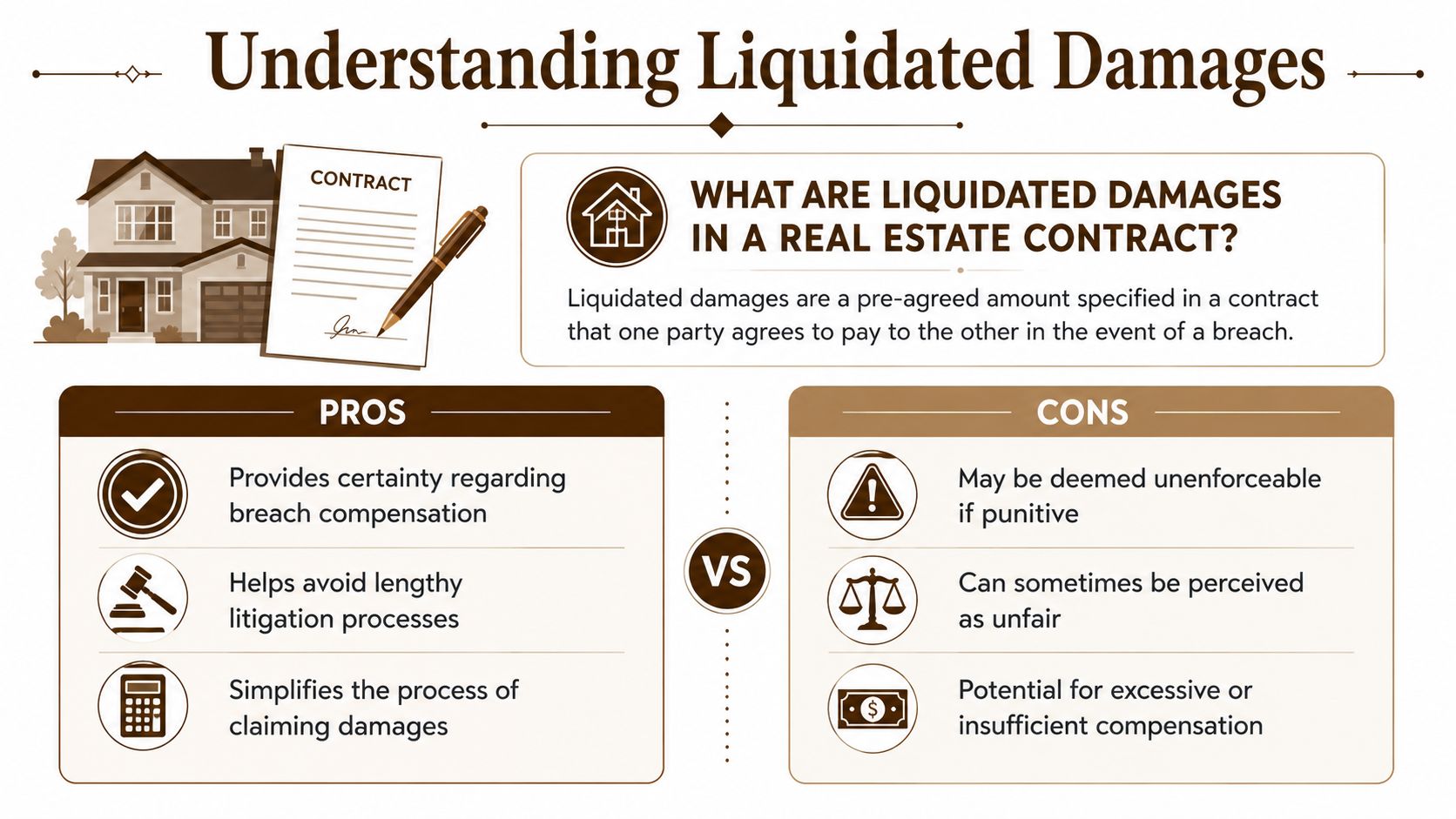
Liquidated damages are a pre-agreed amount that one party may recover if the other party commits a specified breach of contract. In real estate, that usually means a buyer defaulting after placing a deposit into escrow. Instead of forcing the seller to prove every category of actual loss after the deal falls apart, the contract sets the damages amount in advance.
That sounds simple, but enforceability turns on one core distinction. A valid clause compensates. An invalid clause punishes.
The basic idea in plain English
Think of the clause as a contractual estimate made at the outset, when nobody yet knows whether a breach will occur or what the exact fallout would be. If the estimate is reasonable, courts are more willing to enforce it. If the amount looks like a club designed to force performance, courts are much less sympathetic.
That distinction matters because actual damages in a failed sale can be hard to pin down. A seller may lose market momentum, incur added carrying costs, or face delay-related complications in a probate administration. Some of those harms are real but not easy to measure precisely when the contract is signed.
Why courts care about penalties
California courts and courts in other jurisdictions don't enforce liquidated damages clauses just because the parties signed them. They ask whether the clause reflects a legitimate forecast of anticipated harm or an unlawful penalty.
One useful explanation comes from a discussion of the penalty analysis in real estate disputes. Courts use a five-part test to evaluate whether a clause is an unlawful penalty, examining contract language, party intent, subject matter, difficulty of measuring damages, and the stipulated sum, as described in MontanaroLaw's discussion of liquidated damages in real estate transactions.
That framework is more practical than it sounds. Lawyers and judges aren't just reading the number. They're asking questions such as:
- What does the clause say about the triggering breach?
- What were the parties trying to do when they agreed to it?
- Was real harm difficult to estimate at contract formation?
- Does the amount look proportionate to the type of loss the seller could reasonably expect?
Practical rule: If the clause reads like punishment, a court may treat it like punishment.
For experienced clients, especially estate planners and probate attorneys, the takeaway is straightforward. A liquidated damages clause isn't self-executing just because it's printed in a standard form. It works only if the amount and the drafting reflect compensation rather than coercion.
California Law and the 3 Percent Liquidated Damages Rule
A common California dispute starts the same way. The buyer backs out, the seller wants to keep the deposit, and someone says, "The contract has a liquidated damages clause, so this should be easy." Sometimes it is. Often it is not.
Where the 3 percent rule applies
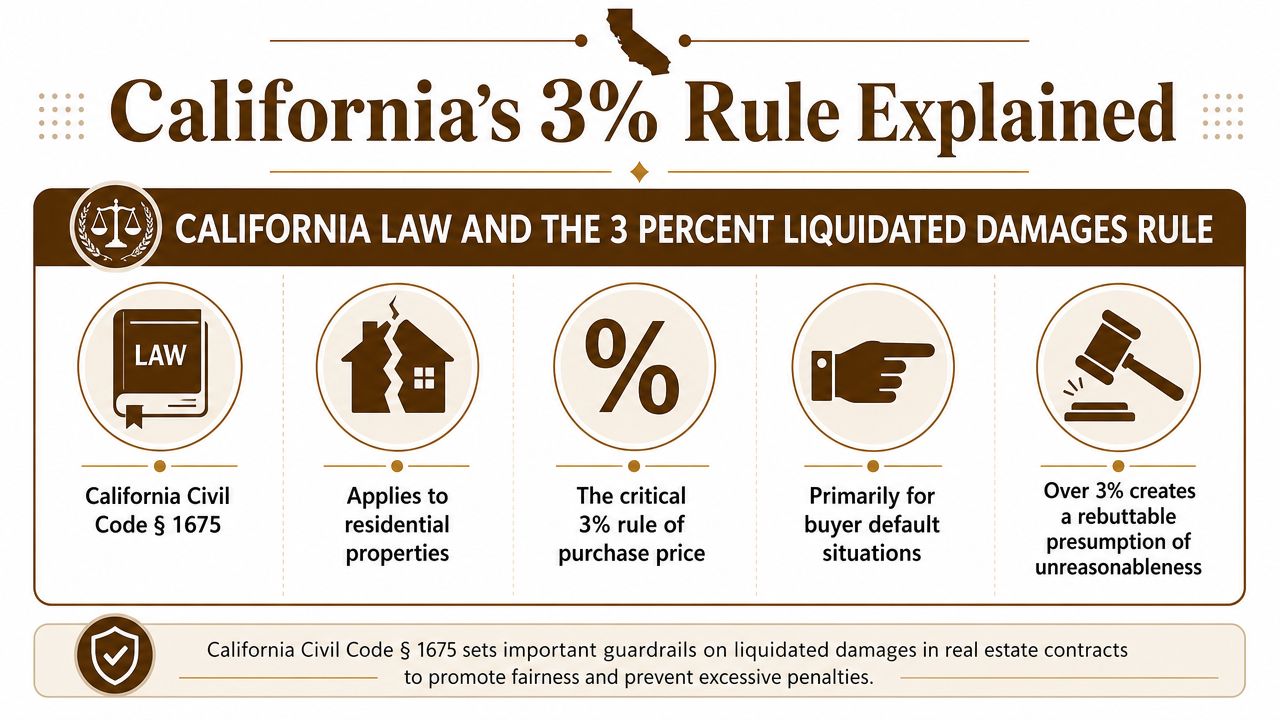
California gives parties a clearer statutory framework than many states do, but only for a defined category of deals. Under California Civil Code, liquidated damages provisions in contracts for owner-occupied residential property of four units or less are presumed valid if they do not exceed 3 percent of the purchase price. Amounts above that level are not automatically void, but they lose the benefit of that presumption and are harder to defend, as explained in Schorr Law's discussion of California liquidated damages rules.
That 3 percent figure matters because it changes the litigation posture from the start. If the clause fits the statute, the seller begins with a stronger argument that the agreed amount should be enforced. If the clause goes higher, counsel should expect a closer fight over reasonableness, drafting, and whether the amount looks compensatory or punitive.
The standard California Association of Realtors form reflects that statutory structure. In practice, many California residential contracts use a liquidated damages amount tied to 3 percent of the purchase price, and the amount remains negotiable except where the buyer intends to occupy the property as a principal residence and the statutory limit controls, as noted in NorCal FSBO's explanation of liquidated damages in California real estate transactions.
Why the 3 percent rule matters in practice
Astute clients often assume a larger deposit gives the seller better protection. In California residential practice, that is only partly true. A larger deposit may create settlement pressure, but if the liquidated damages provision falls outside the statutory safe zone, the seller may spend time and money proving enforceability instead of collecting the amount efficiently.
That is the point many out-of-state investors miss. California's 3 percent presumption can be more restrictive than the approach used in other markets, especially in deals where buyers, brokers, or family advisors import assumptions from commercial transactions or from states with more flexible standards, as described in Mashian Law's discussion of liquidated damages caps in commercial real estate.
For California homeowners, the practical lesson is straightforward. The best clause is usually the one a judge is most likely to enforce without much drama.
What this means in Orange County and Los Angeles practice
In Orange County and Los Angeles, the first real question is not whether the deposit feels large enough. It is whether the transaction falls within the residential category that gets the statutory presumption. That classification affects how the clause should be drafted, how hard the parties should push on deposit size, and what arguments are likely to matter if the buyer defaults.
This issue comes up often in probate and trust sales. A fiduciary selling a family home does not just need a signed contract. The fiduciary needs a contract that can withstand later review by beneficiaries, successor fiduciaries, and sometimes a court. A clause that tracks the California statutory framework is usually easier to defend than an aggressive provision that invites a penalty challenge.
California courts still look beyond the number in the contract. A separate California authority explains enforceability as a two-part inquiry. The amount must be reasonable in light of anticipated harm, and the parties must have made a reasonable effort to estimate that harm because actual damages were impracticable or extremely difficult to quantify when the contract was formed, as discussed in Underwood Law's guide to California Civil Code section 1671.
That is the practical bridge between the statute and real litigation. The 3 percent rule gives many residential sellers a favorable starting point. It does not excuse careless drafting, and it does not save a clause that reads like a pressure tactic rather than a fair estimate of loss.
In California residential deals, the strongest liquidated damages provision is usually the one that stays within the statute and gives the court the fewest reasons to second-guess it.
Drafting and Negotiating an Enforceable Clause
Good results in liquidated damages real estate disputes usually start well before default. They start in drafting. A clause that is vague, incomplete, or overreaching often creates the exact uncertainty the parties were trying to avoid.
What strong drafting includes
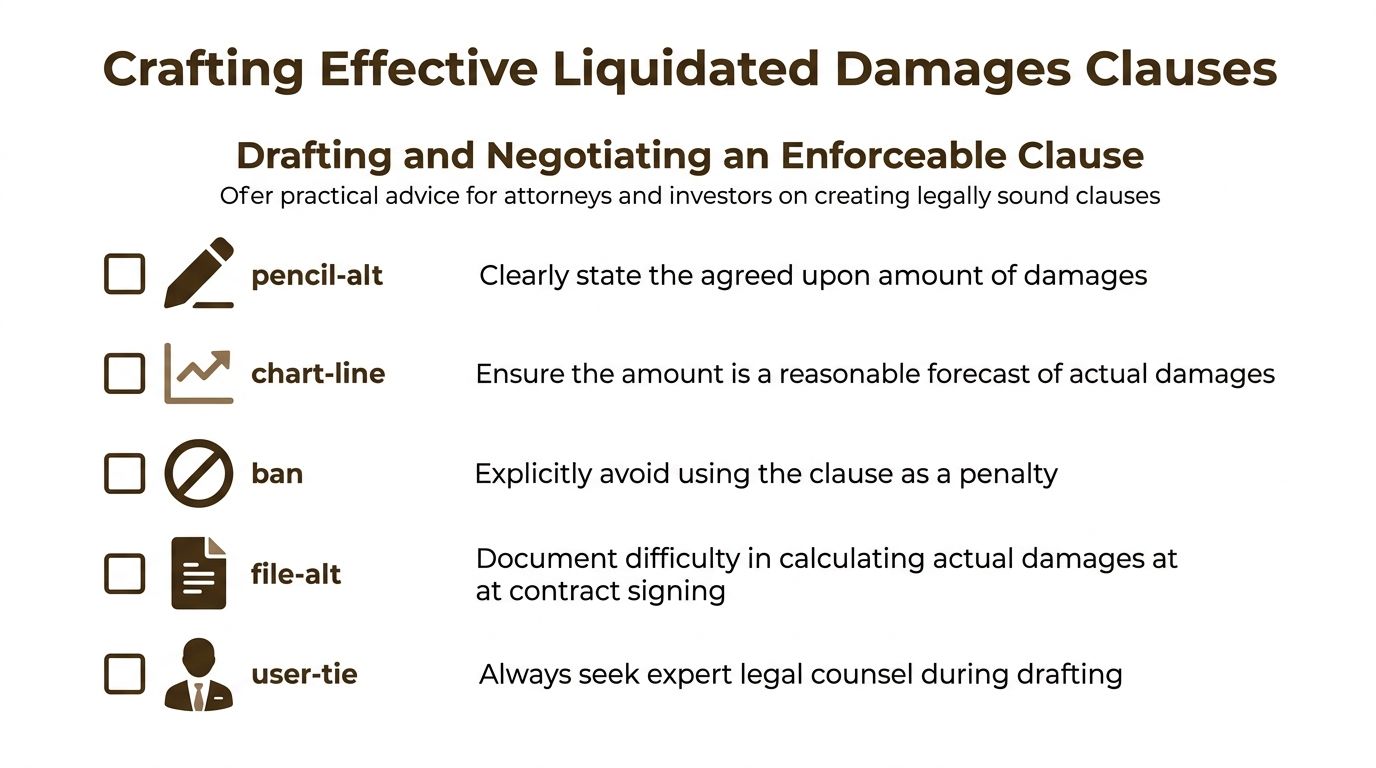
At a minimum, the clause should clearly identify the breach that triggers it. In a sale contract, that often means failure to close after required conditions have been satisfied or waived. It should also explain how the amount is determined and how payment is to occur.
A useful commercial drafting standard states that a valid liquidated damages clause should explicitly define the triggering breach, specify the calculation, and include provisions for caps and payment terms, so the clause functions as compensation rather than coercion, as explained in DiliTrust's overview of liquidated damages drafting principles.
In practice, that means avoiding loose phrasing such as "seller may keep the deposit upon any default" without more detail. Precision matters. So does internal consistency with the rest of the contract, especially contingencies, notice provisions, and escrow instructions.
Negotiation points that actually matter
Often, buyers and sellers find their priorities diverge. Sellers focus on certainty. Buyers focus on limiting downside if the deal unravels for a disputed reason.
The most productive negotiation points usually include:
- The triggering event. Is the clause tied to any failure to close, or only to a clear buyer breach after contingencies are removed?
- The amount. In California residential practice, staying within the statutory framework is often the safer route.
- The paper trail. If the amount could later be challenged, what documents show it was chosen as a reasonable estimate rather than as a threat?
- Escrow mechanics. If default occurs, what authorizations or dispute procedures govern release of the funds?
An experienced seller in a competitive market may insist on the standard California structure and resist efforts to dilute it. A cautious buyer may seek narrower trigger language or stronger contingency language so the clause applies only after specific milestones have passed.
The best-drafted clause doesn't just name a remedy. It matches the transaction's risk points and the parties' actual deal.
For probate and trust sales, counsel should also think beyond the immediate closing. If the sale later becomes part of a fiduciary dispute, judges and beneficiaries will examine whether the clause was commercially sensible and legally supportable when signed.
Enforcing the Clause When a Buyer Defaults
A common Orange County problem looks like this. The buyer stops performing after removing contingencies, the seller has already packed, the successor trustee wants the file closed, and everyone assumes escrow will release the deposit once the seller complains. In practice, the deposit usually stays frozen until the seller follows the contract and builds a record that will hold up in mediation, arbitration, or court.
Enforcement starts with proof, not indignation. The seller needs to show a real buyer default, the seller's own readiness to close, and compliance with the notice and escrow procedures that govern release of the funds. In probate, trust, and investment sales, that record also matters outside the contract dispute. Beneficiaries, co-owners, and later counsel often review whether the fiduciary handled the default with discipline.
What sellers should do first
Start by reading the purchase agreement and escrow instructions together. The question is not only whether the buyer failed to close. The question is whether the buyer failed to close in a way that triggers the clause.
The usual enforcement sequence is straightforward:
- Pin down the default. Confirm that the buyer's conduct falls within the liquidated damages provision and is not excused by an open contingency, seller nonperformance, or a notice defect.
- Assemble evidence of seller performance. Keep the timeline, signed addenda, demand letters, escrow communications, and proof that the seller was ready, willing, and able to close.
- Send the required notice. California disputes often turn on whether the contract's notice procedure was followed exactly.
- Make a formal demand on the deposit. Escrow usually will not release disputed funds based on accusations from one side alone.
- Prepare the case early. If the buyer resists, the seller should be ready for mediation first and litigation next, with the file already organized.
Many sellers often lose momentum here. They rely on broker emails, phone calls, and general frustration. Courts and escrow holders care about the contract, the dates, and the paper trail.
Why the California framework often helps
For one-to-four unit residential transactions, a clause drafted within California's statutory structure can give the seller a strong position. The seller usually does not need to prove every dollar of carrying costs, price reduction, market stigma, or lost opportunity. The fight becomes narrower. Was there a buyer default, did the clause satisfy California requirements, and did the seller follow the contract?
That narrower fight has real value in Los Angeles and Orange County disputes. Cases become more expensive when the seller has to prove actual damages item by item. A valid liquidated damages clause can reduce that burden and improve settlement posture, especially when the deposit amount fits the statutory framework discussed earlier.
Other states often litigate these clauses under broader reasonableness standards, and some courts outside California have enforced much larger deposits. California sellers should not read that as permission to get aggressive. The practical lesson is the opposite. Staying inside California's structure usually gives the seller the cleaner enforcement path.
For homeowners, that can mean faster resolution and less uncertainty. For investors, it can preserve resale timing and financing plans. For probate and trust counsel, it can help keep administration on schedule and reduce the chance that a failed sale turns into a larger fiduciary fight.
Challenging the Clause When a Deal Collapses
From the buyer's side, the key point is this. A liquidated damages clause may be important, but it isn't untouchable. California courts don't enforce these provisions on autopilot.
Where buyers usually attack the clause
The strongest challenge often starts with enforceability rather than sympathy. Buyers usually ask whether the clause complied with California law, whether it was properly completed, and whether the seller is trying to use it as a penalty rather than a fair estimate of loss.
Common lines of attack include the following:
- The amount is excessive under California law. If a residential clause goes beyond the statutory comfort zone, the seller may face a tougher burden.
- The contract formalities weren't handled correctly. In practice, incomplete execution or inconsistent contract language can become central.
- The buyer didn't default under the contract. A live contingency, defective notice, or seller nonperformance can change the analysis.
- The clause is punitive in operation. If the facts suggest the amount was chosen to frighten the buyer into closing rather than to estimate anticipated harm, the buyer has a stronger penalty argument.
A buyer doesn't need to prove the seller suffered no inconvenience at all. The better argument is usually that the clause, as drafted or applied, doesn't meet California's standards for enforceable compensation.
What makes a challenge stronger
Buyers often improve their position when they move beyond broad fairness arguments and focus on specifics. Was the seller ready to perform? Did the buyer still have a contractual right to cancel? Was the deposit forfeiture clause clearly tied to a defined breach? Do the papers show a reasonable estimate of harm, or only an arbitrary number?
In disputes involving family property, inherited homes, or trust-owned real estate, emotions can muddy the record. Counsel should resist that pull. The challenge should stay grounded in the contract, the escrow history, and California enforceability principles.
A buyer's best defense usually isn't "this feels unfair." It's "this clause doesn't satisfy California's rules for enforceable liquidated damages."
This is also where early legal review matters. Once parties harden their positions with escrow demands and threat letters, resolution gets more expensive. A careful review of the file at the first sign of trouble can identify whether the dispute is really about default, contract interpretation, or a defective liquidated damages provision.
A Practical Checklist for California Homeowners and Investors
Most liquidated damages fights are preventable. The contracts that hold up best in Orange County and Los Angeles are usually the ones where the parties addressed the issue clearly before emotions and deadlines took over.
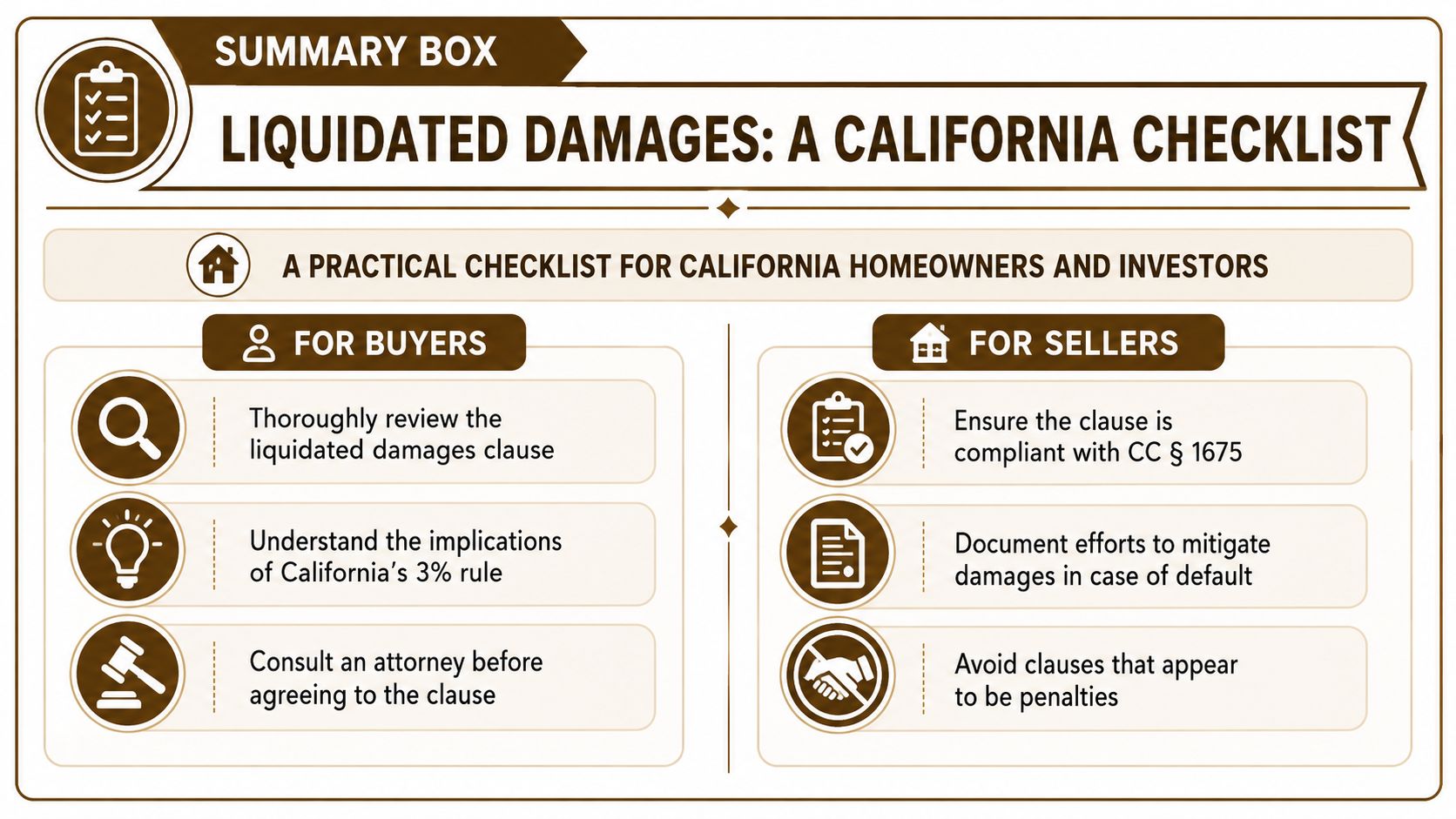
For buyers
- Read the clause before you initial it. Don't assume the deposit automatically comes back if the deal fails.
- Check whether California's residential rule applies. That question can shape the whole risk analysis.
- Match the clause to the contingency timeline. A buyer's cancellation rights and the liquidated damages trigger need to work together.
- Ask how the amount was chosen. If nobody can explain the rationale, that's a warning sign.
- Get legal review early. That is especially important in probate purchases, trust sales, and higher-conflict transactions.
For sellers
- Use clear trigger language. The clause should identify the specific breach that allows retention of the deposit.
- Stay within California's framework when appropriate. Aggressive drafting may create more litigation, not more protection.
- Keep a clean transaction file. Save notices, contingency removals, escrow communications, and proof of your own performance.
- Coordinate the purchase agreement and escrow instructions. A good remedy clause can still get bogged down if the release mechanics are unclear.
- Think ahead to enforcement. If the buyer defaults, you'll need a record that shows the clause was compensatory and properly invoked.
For homeowners, trustees, executors, and their advisors, the practical lesson is simple. Liquidated damages real estate clauses are most effective when they're treated as a strategic part of the transaction, not a boilerplate afterthought. California law offers real structure, but that structure works only when the drafting, negotiation, and enforcement choices line up.
If you're dealing with a failed sale, a deposit dispute, or a contract that doesn't look quite right, Tanner Law can help. William T. Tanner has served clients since 1994 as an attorney and licensed real estate broker, with experience in Orange County and Los Angeles property disputes, probate-related real estate issues, and breach of contract matters. Schedule a free consultation to review your contract, assess your options under California law, and get a practical plan for protecting your property rights and investment.