Prescriptive Easement: Protect Your California Property
A neighbor has used the edge of your driveway for years. No one signed anything. No one went to court. It may have started as a practical arrangement, or maybe you only noticed it when a fence went up, a home went on the market, or a probate file forced the family to look closely at title and boundaries.
That's when the anxiety starts. Is this just a courtesy that can be revoked, or has it turned into a legal right?
Under California law, that question can lead to a claim for a prescriptive easement. In plain terms, a prescriptive easement is a right to keep using someone else's property for a specific purpose, even though the user doesn't own that land. It often shows up in Orange County and Los Angeles disputes involving driveways, walkways, access routes, parking areas, and shared-use features that existed informally for a long time.
For families dealing with probate, estate planning, or a pending sale, this issue can surface at the worst possible moment. A long-standing use that everyone ignored can suddenly cloud title, derail a transfer, or trigger a lawsuit between neighbors and heirs. The good news is that prescriptive easement law is understandable once you break it into parts.
Table of Contents
- Introduction A Common Neighborhood Dispute
- Understanding Prescriptive Easements in Plain English
- The Five Legal Requirements in California
- Easement vs Adverse Possession Key Differences
- How to Protect Your Property or Assert Your Rights
- Navigating a Quiet Title Action in Court
- Why You Need an Attorney for Easement Disputes
Introduction A Common Neighborhood Dispute
You inherit your parents' home in Los Angeles. While preparing the property for sale, a neighbor tells you that his family has always driven across a strip of your side yard to reach the garage. He says they've done it openly for years and plans to keep doing it. There's no written easement in the file. No recorded agreement. Yet the neighbor speaks as if the right is already settled.
That kind of dispute is common because property use often starts informally. One neighbor waves another through. A side gate remains accessible. A shared path becomes routine. Decades later, the original understanding is gone, but the use remains.
A prescriptive easement grows out of use, not paperwork. That's why it catches homeowners off guard. You still hold title to your land, but someone else may claim a legal right to cross it, park on part of it, or use a specific feature of it.
Practical rule: In California, the most dangerous property problems are often the ones owners treat as temporary conveniences.
For families handling probate or trust administration, this issue matters because unclear access rights can complicate distribution, refinancing, and sale. Buyers want certainty. Title disputes create delay. Siblings and beneficiaries may disagree over whether to challenge the neighbor, negotiate terms, or disclose the issue and move on.
The key is to stop thinking of this as a mere neighborly misunderstanding. In California, long-term use can have legal consequences. Once you understand what a prescriptive easement is, what evidence matters, and how quiet title litigation works, the situation becomes far less mysterious.
Understanding Prescriptive Easements in Plain English
A prescriptive easement is best understood as a right to use, not a right to own.
Think of a worn footpath across a vacant lot. No deed gave people permission to use it. No fence stopped them. Over time, the route became the established way to get from one place to another. Property law sometimes recognizes that long-term use as a legal right, even though ownership of the land never changed.
What the right actually gives
That distinction matters. If someone claims a prescriptive easement over your property, they are not claiming the whole parcel. They are claiming a limited, specific use. In many disputes, that means things like passage over a driveway, access to water, or use of a narrow route between lots.
New York law illustrates the point clearly. A prescriptive easement there typically gives rights of passage or use of particular features, not full possession, and it can attach to the deed even if it was never formally recorded, which is why unresolved claims can cloud title and lead to quiet title litigation in transfer and probate matters (New York prescriptive easement cases). California disputes often raise the same practical problem, even though California follows its own rules.

Why owners and families get confused
Most homeowners assume legal property rights only come from a deed, an easement agreement, or a court order. That assumption is understandable, but it's incomplete. A prescriptive easement can arise from conduct over time.
That's why these cases feel unfair to owners. From the owner's perspective, nothing formal happened. From the claimant's perspective, the long-standing use itself is the point. Courts don't reward casual assumptions. They look at what people did on the ground.
A good analogy is a driveway shared in practice but never documented. If one side has used the same route openly for years without permission, the dispute isn't just about manners anymore. It becomes a question of whether the law recognizes that use.
A prescriptive easement doesn't hand over the land. It preserves a pattern of use.
For Orange County and Los Angeles property owners, that difference is especially important in dense neighborhoods where lot lines, fences, garages, and side-yard access don't always match how people have used the property for years.
The Five Legal Requirements in California
California law is specific. A claimant doesn't win by showing that a use was convenient, longstanding, or harmless. The claimant must prove each required element.
California courts recognize a prescriptive easement only when the claimant uses another person's property openly, notoriously, continuously, and adversely, meaning without permission, for an uninterrupted period of exactly five years, as discussed by the California Court of Appeal analysis on prescriptive easements.
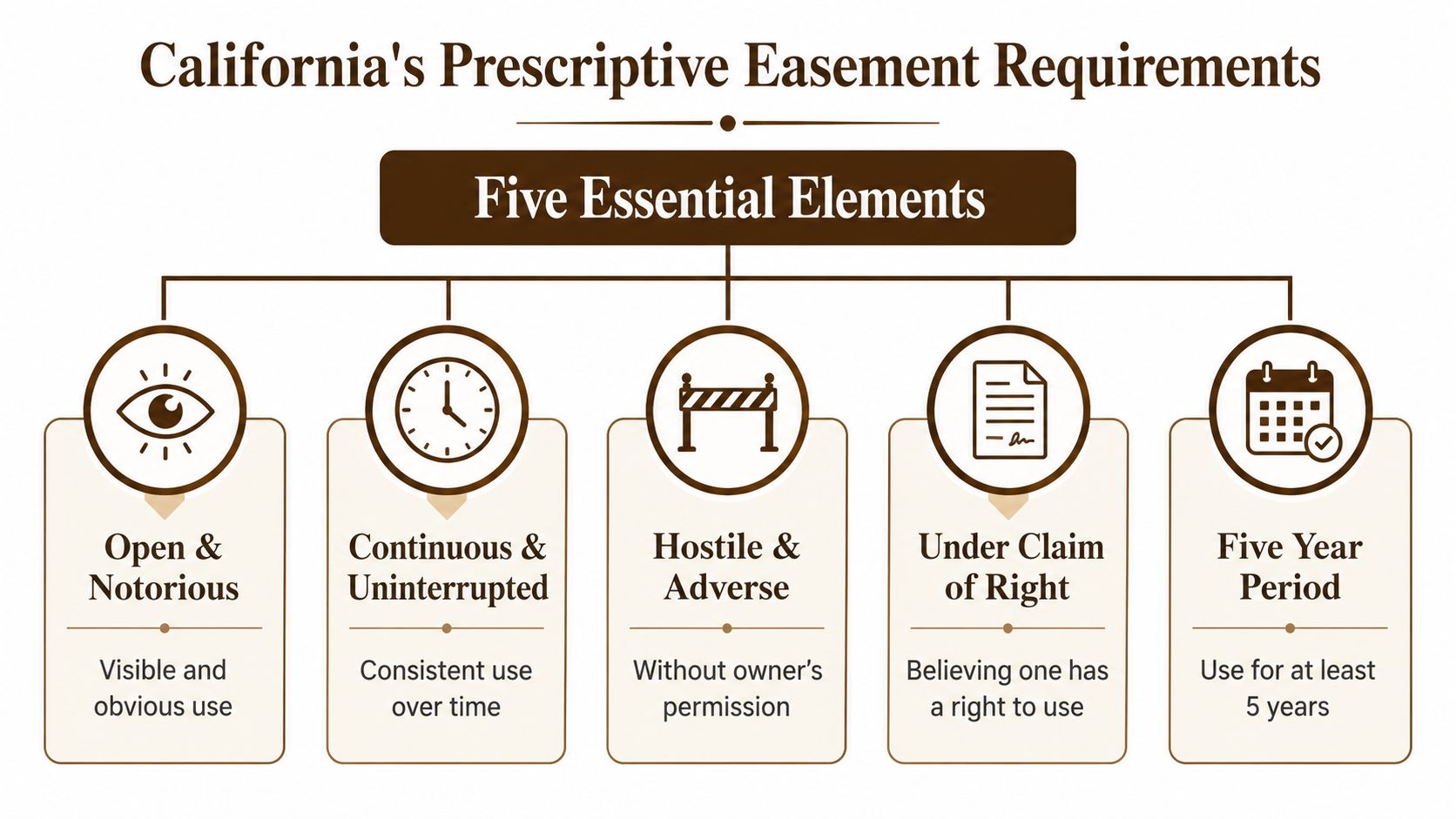
What California courts examine
Another California-focused discussion explains the practical burden this creates. The claimant must establish five years of open, notorious, continuous, hostile, and exclusive use without the owner's permission, and the owner must have actual or imputed knowledge of the use. That discussion also notes that failure to prove any element can sink the claim, making evidence such as photographs, witness statements, utility bills, and documented timelines especially important in court (California prescriptive easement overview).
Here's what those ideas mean in ordinary language.
Open and notorious
The use must be visible enough that an attentive owner could notice it. Secret use usually won't qualify.
A neighbor who regularly drives over the same visible strip of land is in a stronger position than someone who crosses only at night or in a hidden way. If the use leaves tracks, wear patterns, or other obvious signs, that tends to support this element.
Continuous and uninterrupted
The use must continue without significant breaks for the required period. It doesn't have to happen every minute of every day, but it must follow a regular pattern consistent with the nature of the claimed use.
A seasonal path to a beach access point may still be regular if that's how the property is naturally used. But long gaps, abandonment, or repeated interruptions can weaken the claim.
Hostile or adverse
This word confuses people. It doesn't mean angry or aggressive. It means without the owner's permission.
If the owner allowed the use as a favor, the use is permissive, not adverse. That single issue often decides the case. A friendly arrangement can defeat a prescriptive claim because the law distinguishes tolerated use from non-permissive use.
Key distinction: Permission usually defeats hostility. Silence does not necessarily equal permission.
Under claim of right
This element asks whether the user acted as though entitled to make that use, rather than borrowing the privilege from the owner. The conduct matters more than labels.
Someone who consistently uses the route as a matter of assumed right looks different from someone who repeatedly asks, “Do you mind if I pass through again?”
Five-year period
California's statutory period is five years, which is shorter than the period used in some other states. That shorter period is one reason owners in California should respond quickly when they discover ongoing use.
For OC and LA homeowners, the practical lesson is simple. A prescriptive easement case is evidence-heavy. Courts want a timeline, witnesses, photos, and facts that match the legal elements. General complaints and neighborhood gossip won't carry the day.
Easement vs Adverse Possession Key Differences
Homeowners often use these terms interchangeably. That creates costly mistakes.
A prescriptive easement concerns continued use. Adverse possession concerns ownership. If you confuse the two, you may gather the wrong evidence, raise the wrong defenses, or misunderstand what the other side is asking for.
The confusion that causes trouble
One of the biggest points of confusion is exclusive use. For adverse possession, exclusivity matters because the claimant is trying to take title to land. For a prescriptive easement, exclusivity is not required in the same way. As Cornell's explanation of prescriptive easements notes, exclusive use is required for adverse possession, but not for a prescriptive easement. A claimant seeking an easement need only prove open, adverse, and continuous use.
That's why shared driveways, common routes, and access paths can still become easement disputes. Shared use doesn't automatically defeat an easement claim.
| Element | Prescriptive Easement | Adverse Possession |
|---|---|---|
| Primary right claimed | Right to use someone else's land for a specific purpose | Ownership of the land itself |
| What the owner keeps | Legal title remains with the owner | Title may be lost if the claim succeeds |
| Exclusive use required | No, not in the same way | Yes |
| Typical examples | Driveway access, path use, passage over a strip of land | Occupying and claiming a defined piece of property |
| How to think about it | “I can keep using this” | “I own this now” |
This difference matters during probate and sale transactions. If a family learns that a neighbor may have a prescriptive easement, that doesn't necessarily mean the family is losing ownership of the land. But it does mean the property may be subject to an ongoing use right that affects value, marketability, and future plans.
A quick gut-check helps. If the other side is claiming the right to cross, park, pass, or use, you're probably dealing with an easement issue. If the other side is claiming the land itself, the analysis shifts toward adverse possession.
How to Protect Your Property or Assert Your Rights
Here, property disputes become practical. In California, good evidence wins arguments that emotion can't.
If you believe you have a prescriptive easement, your task is to prove a pattern of use with real-world records. If you own the burdened property, your task is to show permission, interruption, lack of notice, or some other break in the claim.

If you are asserting a claim
A persuasive file usually includes more than memory. Courts want evidence anchored in time.
- Dated photographs: Old photos can show a visible path, vehicle tracks, gates, paving, or established patterns of access.
- Witness statements: Neighbors, prior owners, tenants, contractors, and family members can describe how the property was used and for how long.
- Utility bills and service records: These can help establish regular access or explain why a route was consistently used.
- Maintenance receipts: If someone repaired, graded, or maintained the route they were using, that can support the claimed pattern.
- A timeline: Organize events year by year. Who used the area, how often, and whether anyone objected.
In probate-related disputes, personal representatives and trustees should also gather files from the decedent's records. Old letters, surveys, escrow documents, and handwritten notes sometimes reveal whether use was tolerated, disputed, or assumed as of right.
If you are defending your property
Owners often hurt themselves by reacting informally. They complain verbally, but create no record. They allow use “just for now,” but never put permission in writing. Later, the other side describes years of uninterrupted adverse use, and the owner has little paper evidence to rebut it.
Strong defensive steps include the following:
- Document permission clearly: If you are allowing access, say so in writing. A permissive use is different from adverse use.
- Preserve your own evidence: Keep photographs, text messages, emails, letters, and contractor notes showing your understanding of the arrangement.
- Interrupt the claimed use when appropriate: In some situations, a clear objection or physical change may matter. That step should be handled carefully with legal advice.
- Review title and boundary documents: Surveys, deeds, prior escrow files, and probate records can expose inconsistencies in the other side's story.
One of California's most useful statutory tools is Civil Code section 1008. Under California Civil Code section 1008 guidance, a landowner can prevent an easement by prescription from ripening by posting a sign that reads “Right to pass by permission, and subject to control, of owner: Section 1008, Civil Code” at each property entrance or at intervals of no more than 200 feet along the boundary.
That matters because the sign changes the character of the use. It tells the world the use is by permission, not adverse claim.
If an owner wants to stop a future prescriptive easement problem, a properly placed Section 1008 sign can be one of the simplest tools available under California law.
For Orange County and Los Angeles owners, this is especially useful where access patterns are visible and repeated, such as hillside paths, side-yard passages, coastal access routes, and informal driveway encroachments. It is not a substitute for case-specific advice, but it is a practical defense many owners have never heard of.
Navigating a Quiet Title Action in Court
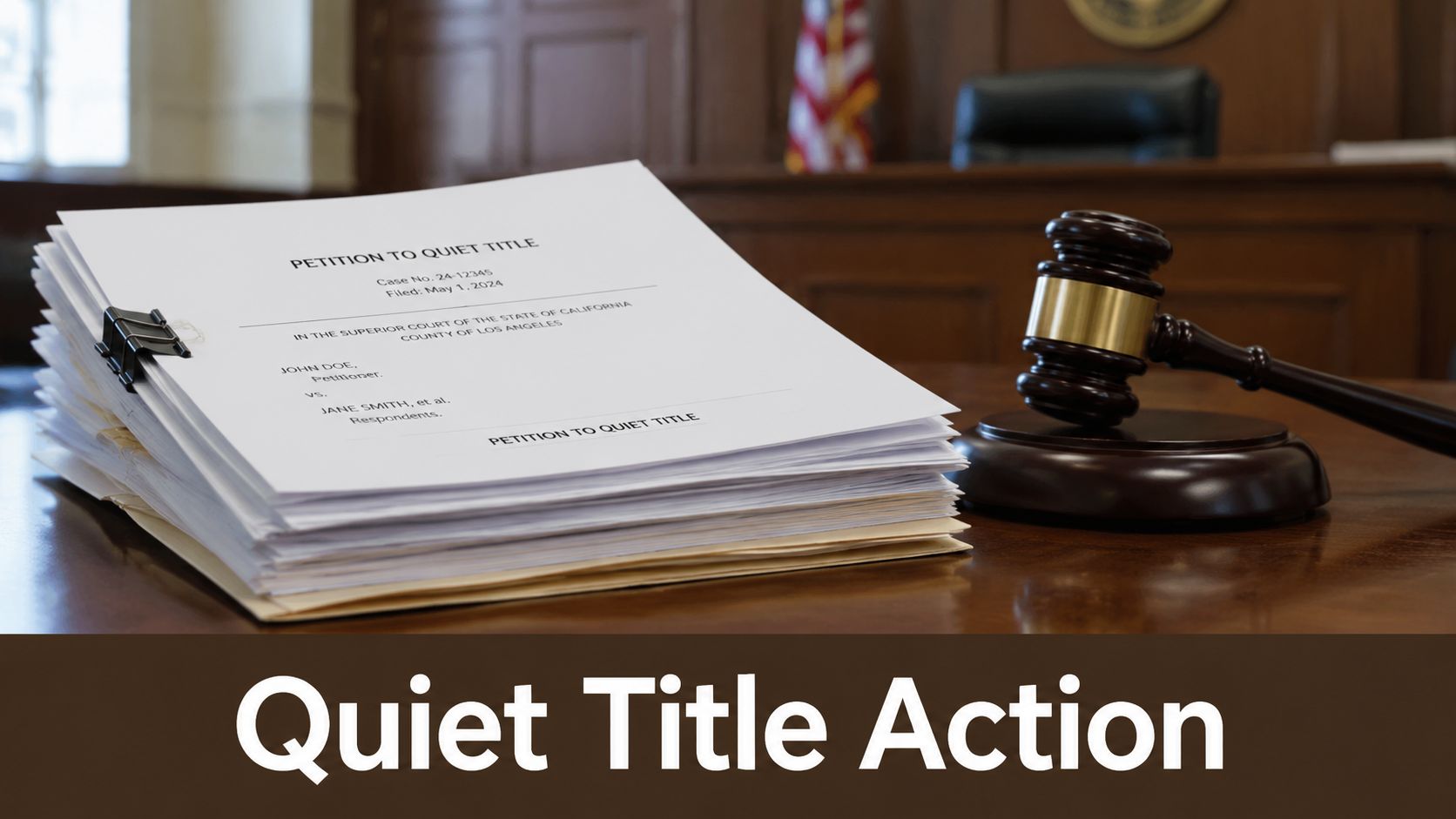
When negotiations fail, the dispute often ends up in a quiet title action or related property litigation. That phrase sounds intimidating, but the basic idea is straightforward. The court is being asked to determine what rights exist in the property and who holds them.
What a quiet title case does
A critical point gets missed in many public discussions. Court action does not necessarily create the prescriptive easement. As explained in the surveying forum discussion of prescriptive easement perfection, the right can exist once the legal elements are satisfied. Litigation is used to perfect title and resolve the dispute, even if the easement was never recorded.
That distinction matters to homeowners. If you assume “nothing exists until a judge signs an order,” you may wait too long to gather evidence or respond to a claim. The lawsuit usually confirms or rejects an asserted right. It doesn't magically bring the underlying conduct into existence.
How the process usually unfolds
In practical terms, a quiet title dispute often moves through several stages:
Filing the lawsuit
One side asks the court to declare whether an easement exists, or to reject the claimed easement and clear title.Discovery and evidence gathering
The parties exchange documents, take depositions, inspect the property, and compare timelines. Old photos, maps, emails, and witness recollections become central.Motions, negotiation, or trial
Some cases resolve through settlement once the evidence is clear. Others go to trial because the facts are disputed.
Many OC and LA cases turn on small details. Did the owner grant permission? Were there gaps in use? Did a predecessor object? Did a gate, fence, or sign interrupt the claim? Those are factual questions, and judges decide them based on records, testimony, and credibility.
A short video can help make the court context more concrete:
For probate and trust administrations, timing matters. If a home is being transferred, sold, or distributed, unresolved easement claims can delay the transaction. Quiet title litigation is often the mechanism used to remove uncertainty so the estate or trust can move forward with a clean record.
Why You Need an Attorney for Easement Disputes
Prescriptive easement disputes look simple from the sidewalk and complicated in court. That's because the law turns ordinary neighborhood behavior into a formal evidence problem.
You should speak with an attorney promptly if a neighbor claims a right to cross your land, if you discover a possible easement while preparing a probate sale, if a title issue appears during escrow, or if you want to grant permission in a way that avoids creating future rights by accident. These cases require organized proof, careful framing of the facts, and a strategy specific to California law.
An attorney also helps you avoid unforced errors. Owners sometimes say the wrong thing in writing, remove access in a way that escalates the dispute, or fail to preserve records that would have defeated the claim. Families handling inherited property face an added burden because key witnesses may be gone and the paper trail may be incomplete.
A prescriptive easement can affect ownership rights, transfer plans, and family peace. Early legal guidance is usually the safest course.
If you're dealing with a disputed driveway, path, boundary use issue, or a possible quiet title problem in Orange County or Los Angeles, Tanner Law can help you evaluate your rights under California law and chart a practical next step. Schedule a free consultation to protect your property, your title, and your peace of mind.