Landlord Eviction Process: A California Landlord’s Guide
If you're a first-time landlord in Orange County or Los Angeles, the eviction problem usually starts the same way. Rent is late again. Messages go unanswered. Promises to pay come and go. You want your property back, but you don't want to make a mistake that costs more time, more rent, and more legal fees.
That instinct is right. In California, the landlord eviction process is a formal court procedure, not a pressure tactic and not a personal confrontation. A landlord who moves too fast, serves the wrong notice, accepts money at the wrong time, or tries to force a tenant out without a court order can seriously damage an otherwise valid case.
Eviction is often necessary. It is also exacting. California law rewards landlords who stay organized, document everything, and treat each step like evidence that may later be reviewed by a judge in Orange County Superior Court or Los Angeles Superior Court.
Table of Contents
- Before You Start the California Eviction Process
- The Critical First Step Issuing the Correct Eviction Notice
- Filing the Unlawful Detainer Lawsuit in Court
- Navigating the Court Process From Answer to Judgment
- Securing and Enforcing the Judgment for Possession
- Managing Costs and Mitigating Risks in Evictions
- When to Hire an Attorney for Your Eviction
Before You Start the California Eviction Process
A landlord usually reaches this point after trying patience first. You've texted. You've emailed. You've posted reminders. Maybe you've even made a payment plan. None of that changes the legal reality. If you may need to evict, you need to stop thinking in terms of informal problem-solving and start thinking in terms of California legal grounds and proof.
Start with just cause, not frustration
California law doesn't let many landlords evict merely because the relationship has deteriorated. Under the Tenant Protection Act of 2019 (AB 1482), landlords must have just cause to evict tenants who have lived in the unit for at least 12 months. The law limits evictions to specific at-fault reasons, such as nonpayment of rent, lease breaches, or criminal activity, and certain no-fault reasons, such as owner move-in, substantial rehabilitation, or demolition. Those protections apply to most apartment buildings and duplexes built at least 15 years ago, as described in California's summary of AB 1482 limits on evictions.
That means your first question isn't, "Am I fed up?" It is, "What legally recognized reason can I prove?"
Use this checklist before you act:
- Confirm coverage: Figure out whether your property falls under California's just-cause rules.
- Identify the ground: Nonpayment, lease violation, nuisance, or a valid no-fault basis each requires a different approach.
- Check your lease: Your written agreement often controls details that later become important in court.
- Review your own conduct: If you've accepted late rent for months without objection, your records need to explain the pattern.
Practical rule: Judges don't evict because a landlord feels disrespected. Judges evict when the landlord proves a legally valid basis and shows strict compliance with procedure.
Build your file before you send anything
Most eviction cases are won or lost before the lawsuit is filed. If your paperwork is sloppy, the tenant's lawyer doesn't need a dramatic defense. They only need one procedural defect.
Gather these items into one file, digital and paper if possible:
| Document | Why it matters |
|---|---|
| Signed lease or rental agreement | Establishes the terms the tenant allegedly violated |
| Rent ledger | Shows missed payments and the timing of default |
| Written communications | Helps prove notice, admissions, and efforts to resolve |
| Photos and inspection records | Useful in damage, nuisance, or unauthorized occupant cases |
| Prior notices | Lets you prove consistency and proper escalation |
Landlords in Orange County and Los Angeles often underestimate how local court practice affects timing, filing logistics, and hearing preparation. Even when the underlying law is statewide, the practical handling of your case can feel very different from courthouse to courthouse.
If you're evaluating whether your situation supports a lawful eviction under California law, schedule a free consultation before sending the first notice. A short review at the beginning can prevent a restart later.
The Critical First Step Issuing the Correct Eviction Notice
The notice is the foundation of the entire landlord eviction process. If the notice is wrong, the case may fail even when the tenant clearly owes rent or violated the lease. California judges see this constantly. Landlords often have a real problem, but they use the wrong notice, include the wrong amount, or serve it the wrong way.
Choose the notice that matches the problem
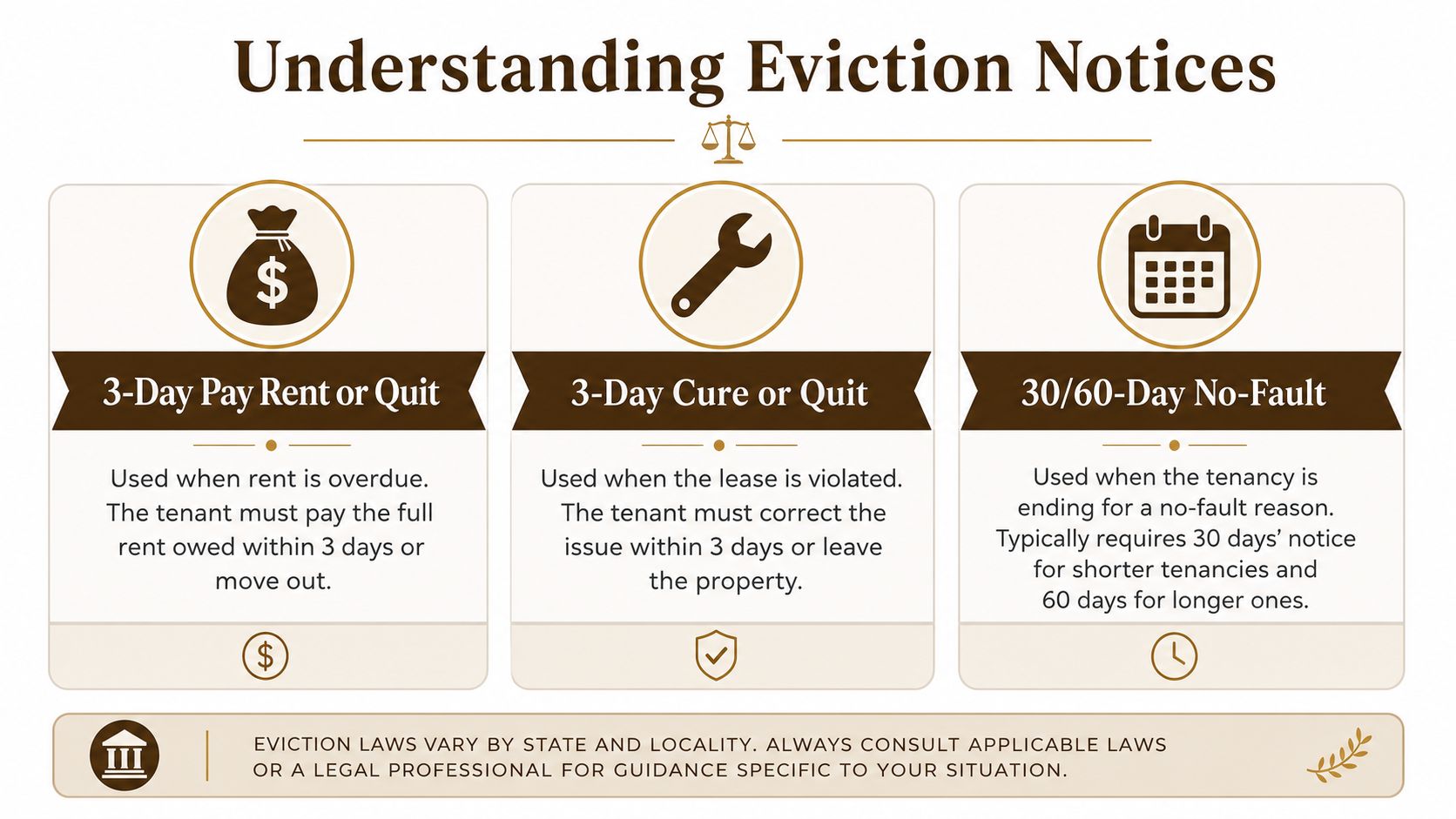
In California, the notice has to fit the reason for termination.
A 3-Day Notice to Pay Rent or Quit is used when the tenant hasn't paid rent. The amount demanded must be accurate. Don't round up. Don't include charges that don't qualify as rent if the lease or statute doesn't allow it. A landlord who overstates the demand invites a defense that the notice was defective.
A 3-Day Notice to Perform Covenant or Quit is used when the tenant can fix the problem. Common examples include an unauthorized pet, unauthorized occupant, or another curable lease violation. The notice should describe the breach clearly enough that the tenant understands what must be corrected.
An Unconditional Quit Notice is reserved for serious situations where the tenant doesn't get a chance to cure. These cases demand caution because judges scrutinize them closely.
Some landlords also deal with longer termination notices in no-fault situations. Those cases require extra care because California's just-cause framework and local rules can overlap, especially in parts of Los Angeles County.
Service errors sink good cases
Even a perfect notice is useless if it isn't served correctly. Service means delivering the notice in a legally recognized way. The details matter. Who served it, when it was served, how it was served, and what proof you kept may all come up later.
Landlords should keep a complete copy of the signed notice and a written record of service. If another adult served it, get a declaration while the facts are fresh. Memory gets worse as the case goes on.
The most common expensive mistake comes after the notice goes out. California guidance states that "the landlord cannot accept rent from you after sending the notice," as explained by the California Courts self-help eviction guidance.
That point deserves plain language. If you serve a rent notice and then accept rent after the notice, you may waive the notice and force yourself to start over.
Here is what tends to work and what doesn't:
- What works: Decide your strategy before serving the notice. If you want possession, act consistently with that goal.
- What doesn't: Serving a 3-day notice, then taking partial payment because the tenant says they'll catch up next week.
- What works: Keeping copies, dates, and proof of service together.
- What doesn't: Using a form you found online without checking whether it fits your exact California facts.
For many landlords, this is the point where legal advice saves the most money. If you want the notice reviewed before it goes out, schedule a free consultation.
Filing the Unlawful Detainer Lawsuit in Court
If the tenant doesn't comply with the notice by the deadline, the dispute moves from landlord-tenant management into civil litigation. In California, the eviction lawsuit is called an Unlawful Detainer. This is the formal court action that asks the judge for possession of the property.
The court filing starts a real case
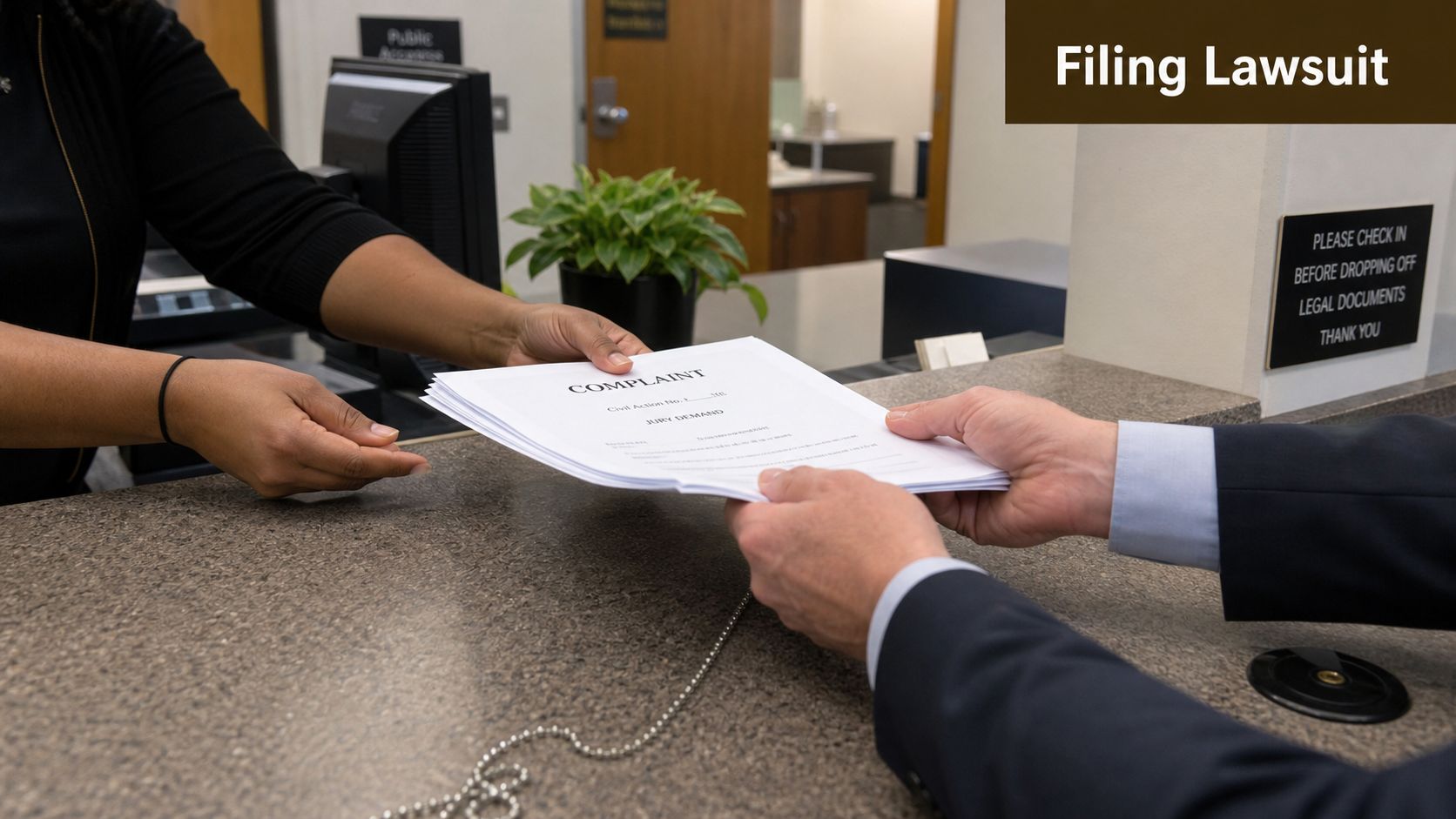
Most California landlords will prepare and file a group of forms that typically includes the Summons (SUM-130), Complaint (UD-100), and Civil Case Cover Sheet (CM-010). The names sound technical, but each has a basic purpose.
- SUM-130: Tells the tenant they are being sued and that they must respond.
- UD-100: States the facts of the eviction case, including the notice served and the reason for possession.
- CM-010: Identifies the case type for the court's administrative handling.
Accuracy matters more than volume. A short, correct complaint is better than a dramatic one full of side issues. Judges in Orange County and Los Angeles want the legal basis, the notice history, and the possession claim presented cleanly.
Filing also means choosing the correct Superior Court venue. For landlords in Orange County, that usually means Orange County Superior Court. For properties in Los Angeles County, it means Los Angeles Superior Court. The property location controls where the case belongs.
Know the tenant response deadline
Before filing the complaint, the landlord must have already served a written notice with a deadline. If the tenant still doesn't comply, the landlord may proceed to court. After the lawsuit is served, the tenant must file a written Answer within 10 calendar days to avoid the court deciding the case without their input, according to this California eviction process summary.
That deadline is short. It also affects your filing strategy because service of the lawsuit papers must be done correctly. You cannot personally serve the tenant if you are a party to the case. Use a qualified adult and keep formal proof of service.
A practical filing packet usually includes:
- The filed complaint set
- A copy of the lease
- The notice that expired
- Proof of service of that notice
- A completed proof of service for the summons and complaint
Many first-time landlords in OC and LA get stalled here. The paperwork isn't conceptually hard, but one mismatch in names, dates, or service method can create delay.
A short explainer may help if you're trying to visualize the filing stage and service process:
If you want to file without avoidable defects, schedule a free consultation before the complaint is submitted or immediately after service issues arise.
Navigating the Court Process From Answer to Judgment
Once the lawsuit is served, the case usually follows one of two tracks. Either the tenant doesn't respond and the landlord seeks default, or the tenant files an Answer and the case moves toward trial. Each path requires different preparation.

Two paths after service
If the tenant fails to respond on time, the landlord may seek a default judgment. That doesn't mean you automatically win without paperwork. You still need proper filings, proper service, and documents that support the requested relief. But if everything is in order, default is usually the faster route.
If the tenant files an Answer, the case becomes contested. In California, once a tenant files an Answer, the court will typically schedule a trial approximately 21 days after the filing, and if the landlord wins, the landlord presents the case and evidence first, including witnesses, as explained in this Disability Rights California guide for tenants facing eviction.
That timeline feels quick because it is quick. You don't have months to organize a messy file after the Answer arrives.
A strong trial package usually includes:
- A clean lease copy: Bring the signed rental agreement and any amendments.
- A precise rent ledger: Judges want clarity, not rough estimates.
- Notice documents: Include the exact notice served and the proof showing how service happened.
- Photos and inspection materials: These help in nuisance, damage, or unauthorized occupant claims.
- Witness planning: If a property manager, maintenance person, or server has first-hand knowledge, prepare them early.
A courtroom rewards sequence. If your documents tell the story in order, your testimony becomes easier and more credible.
Prepare for the defenses landlords see most often
Most tenant defenses aren't surprises. They usually fall into a few recurring categories.
One is improper notice or improper service. If your notice had the wrong amount, the wrong dates, or poor service proof, the tenant will attack the foundation of the case.
Another is habitability. The tenant may argue the unit had serious repair issues and that those conditions affect the landlord's claim. In practice, landlords need dated repair records, work orders, photographs, contractor communications, and proof that access was requested or provided.
A third is retaliation or discrimination. If the tenant recently complained about conditions or asserted legal rights, timing matters. Landlords should be prepared to show the eviction rests on independent, documented grounds that existed apart from any complaint.
Use this preparation grid before trial:
| Defense raised by tenant | Landlord evidence that helps |
|---|---|
| Defective notice | Accurate notice copy, service records, lease terms |
| Habitability | Repair logs, photos, vendor invoices, access requests |
| Retaliation | Timeline showing separate lawful reason for eviction |
| Waiver | Payment records showing no improper acceptance after notice |
In contested cases, the biggest practical mistake is emotional testimony. Judges care about facts, sequence, and documents. Keep your presentation disciplined. If the tenant says something untrue, answer it with records, not anger.
If the tenant has filed an Answer or raised habitability, retaliation, or service defenses, schedule a free consultation before trial preparation hardens around a weak theory.
Securing and Enforcing the Judgment for Possession
Winning in court is not the same as getting the unit back. Many first-time landlords misunderstand this point. A judgment for possession gives you the legal right to recover the property, but it does not authorize you to remove the tenant yourself.
A judgment is not a lockout
After judgment, the next enforcement step is usually obtaining the writ that authorizes law enforcement to carry out the court's order. In practical terms, that means the case moves from the judge's decision to sheriff or marshal enforcement.
The process generally unfolds like this:
- Judgment is entered: The court rules in the landlord's favor.
- Writ paperwork is processed: The landlord obtains the enforcement document from the court.
- Law enforcement is instructed: The writ is delivered to the appropriate sheriff or marshal office.
- A notice to vacate is posted: The tenant receives final notice from law enforcement.
- The lockout occurs: If the tenant still doesn't leave, an officer carries out the eviction.
The key lesson is simple. Possession is restored through the legal enforcement system, not by landlord initiative.
What never works in California
California law is strict here. The only lawful method to evict a tenant is to file a formal lawsuit and wait for a judicial order directing the Sheriff or Marshal to perform the eviction. Landlords cannot turn off utilities, change locks, remove belongings, or otherwise force a move-out themselves, as explained by California Rural Legal Assistance's guide to unlawful lockouts and evictions.
If you win the case and then try to "speed things up" with self-help, you can create a new legal problem for yourself.
Common self-help mistakes include:
- Changing locks: Even if the tenant is behind on rent, this is not the lawful path.
- Shutting off utilities: Pressure tactics often become evidence against the landlord.
- Removing personal property: Don't treat abandoned property rules as lockout permission.
- Using intimidation: Angry calls, threats, or surprise visits rarely help and often hurt.
Orange County and Los Angeles sheriffs each have their own administrative handling and scheduling practices, so the practical timing can differ. What doesn't differ is the legal rule. Only law enforcement completes the physical eviction.
If you've won judgment or you're close to that stage and want the enforcement process handled correctly, schedule a free consultation.
Managing Costs and Mitigating Risks in Evictions
The smartest landlords don't treat eviction as the default answer to every tenant problem. They treat it as one business tool among several, and usually one of the more expensive ones. Prevention is cheaper. Documentation is cheaper. Clean lease drafting is cheaper. Careful screening is cheaper.

The cheapest eviction is the one you prevent
The eviction system is large and persistent. Between 2000 and 2018, landlords filed 69.7 million eviction cases across the United States, averaging more than 3.6 million filings annually, and in a typical year about 2.7 million households received an eviction filing. During that period, total filings increased 21.5%, rising from 3,009,832 cases in 2000 to 3,656,428 in 2018, according to the PNAS national study of eviction filings.
That scale tells landlords something important. Eviction is common. It is not efficient by default.
Risk reduction usually starts well before the tenancy:
- Stronger screening: Verify income, prior landlord references, and application consistency.
- Better lease drafting: Ambiguity in pet rules, occupants, late payment terms, and repair reporting creates future disputes.
- Written communication habits: Follow up calls with email or text confirmation so the file stays usable.
- Routine property oversight: Early repair responses reduce habitability arguments later.
When a business solution beats a court fight
Some cases justify immediate litigation. Others call for a practical exit strategy. One example is cash for keys, where the landlord offers a written move-out agreement in exchange for timely vacancy and acceptable condition of the unit.
This isn't weakness. It is a cost comparison.
A negotiated departure can make sense when:
- The tenant will leave voluntarily: Possession matters more than proving a point.
- The file has defects: A notice or service problem may make litigation slower than settlement.
- The property needs to be re-rented quickly: Vacancy planning may favor certainty over courtroom delay.
- Emotions are rising: Settlement can lower the risk of damage, conflict, and procedural mistakes.
Good landlords don't ask only, "Can I win?" They ask, "What gets me back to stable possession with the least risk?"
If you want help deciding whether to pursue eviction, settlement, or a structured move-out agreement under California law, schedule a free consultation.
When to Hire an Attorney for Your Eviction
Some eviction matters are manageable. Others stop being do-it-yourself cases very quickly. If the tenant hires counsel, raises habitability claims, alleges discrimination, files bankruptcy, or forces you into a heavily regulated local setting, the margin for error narrows fast.
That is especially true in Orange County and Los Angeles. Local practice, filing expectations, and courtroom culture matter. A landlord can have a valid case and still lose time because the notice was poorly drafted, the service record was incomplete, or the courtroom presentation was unfocused.
You should strongly consider hiring counsel when any of these are true:
- The tenant filed a detailed Answer: Contested cases require evidence strategy, not just paperwork.
- You may have accepted rent after notice: Waiver issues can reset the case.
- The property has repair complaints: Habitability defenses need organized proof.
- The eviction is no-fault or tied to special protections: These cases need careful compliance review.
- You need speed with precision: Fixing mistakes later usually costs more than preventing them now.
For first-time landlords, the best legal work often happens before the hearing. It happens when someone reviews the notice, the ledger, the lease, and the service trail before a judge ever sees the file.
If you're dealing with the landlord eviction process in Orange County or Los Angeles, Tanner Law can help you assess the facts, avoid procedural mistakes, and move forward under California law with confidence. Schedule a free consultation to discuss your situation and get clear, practical guidance specific to your property and your goals.