Construction Defect Claim Guide for California Homeowners
You bought a home in Orange County or Los Angeles expecting stability. Then a window corner starts cracking, a ceiling stain keeps returning, or water shows up where water has no business being. At that point, most homeowners ask the same questions. Is this normal settling, a repair issue, or the start of a legal problem?
Under California law, a construction defect claim can arise when a builder, developer, contractor, design professional, or another party in the construction chain failed to deliver work that met the required professional standard. The hard part isn't just spotting the defect. It's following the right process, preserving evidence, and acting before California's deadlines cut off your rights.
Table of Contents
- What Is a Construction Defect Claim
- Identifying Common Construction Defects
- Critical Deadlines California Statutes of Limitation and Repose
- The Pre-Litigation Process Under California SB 800
- Building Your Case Evidence and Responsible Parties
- Resolving Your Claim Damages and Resolution Options
- When to Contact a Construction Defect Attorney
What Is a Construction Defect Claim
A California homeowner in a newer Orange County tract home notices hairline cracking around a bedroom window after the first winter rain. The builder says settling is normal. A few months later, the paint bubbles, the drywall feels damp, and a roofer suspects water is getting in from a flashing problem above the opening. At that point, the issue is no longer just a repair question. It may be the start of a construction defect claim.
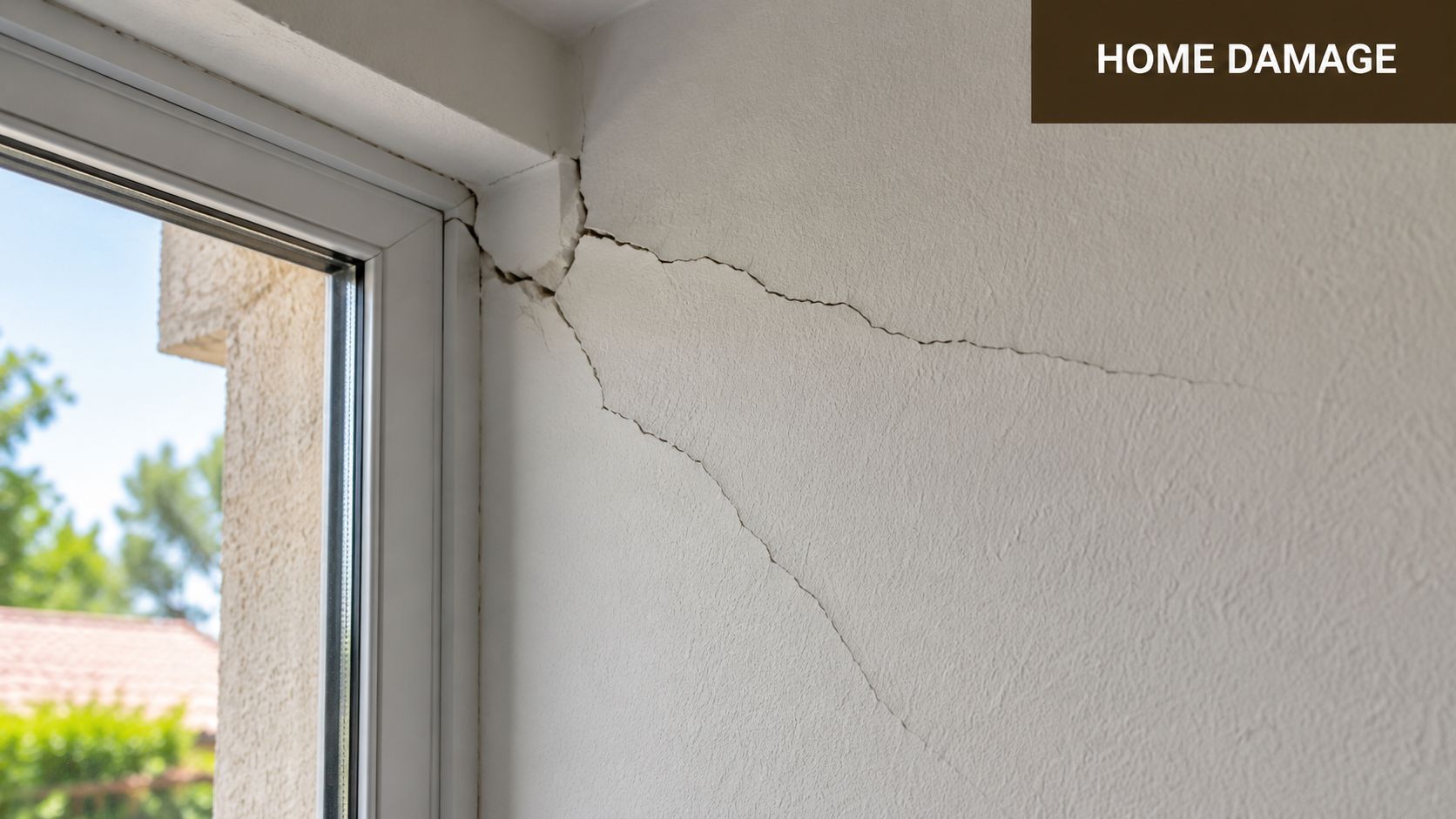
A construction defect claim is the legal process a property owner uses to hold the responsible parties accountable for damage or loss caused by defective design, materials, construction, or site preparation. In plain terms, the home is supposed to perform the way a reasonably built home should. If it does not, and the failure traces back to how the project was designed or built, the law may provide a remedy.
Some defects announce themselves early. Others stay hidden behind stucco, roofing, slab finishes, or walls until weather, time, or ordinary use exposes them. That delayed discovery is one reason California law has developed special rules for construction defect cases, especially in residential projects. For homeowners in Los Angeles and Orange County, the process often involves more than proving that something is broken. It also involves using the right procedure, preserving evidence, and acting before a deadline expires.
A helpful way to view these claims is to compare them to a medical diagnosis. A stain on a ceiling is a symptom. The legal claim focuses on the underlying cause. Was the roof installed incorrectly? Was flashing omitted? Did the plans create a drainage problem? Did a subcontractor use the wrong material? The visible damage matters, but the legal case usually turns on what caused it and who had responsibility for that part of the work.
Practical rule: A defect becomes legally important when the condition suggests that someone on the project failed to meet the level of skill and care expected in that trade or profession.
That is the standard of care. Homeowners often assume a claim exists because a home has a problem. Sometimes that is true. Sometimes it is not. A successful claim usually requires more than frustration and repair invoices. It requires showing that a builder, developer, contractor, design professional, or another participant failed to perform as a reasonable professional would have under similar circumstances, and that the failure caused actual harm.
This distinction matters in California because procedure can shape the outcome as much as the defect itself. A leaking deck in Irvine, widespread window intrusion in Pasadena, or slab movement in a South Bay home may all support a claim, but only if the owner handles notice, documentation, and timing correctly. Miss the wrong deadline or skip a required pre-lawsuit step, and a valid claim can be weakened or lost.
Identifying Common Construction Defects
A homeowner in Orange County may notice a musty smell near a window months before seeing any stain on the drywall. A family in Los Angeles may first suspect trouble when a second-floor balcony feels soft underfoot after winter rain. Those early signs matter because construction defects often show themselves indirectly. The visible symptom is the smoke. The legal problem is the fire behind the wall, under the slab, or inside the building envelope.
When a problem becomes a legal defect
A house can have wear, deferred maintenance, or ordinary settling without giving rise to a construction defect claim. A legal defect usually exists when a builder, subcontractor, developer, architect, engineer, or material supplier failed to perform as a reasonable professional in that role should have under similar circumstances.
That is the standard of care.
Courts and experts do not stop at the question, "Is something wrong with the house?" They usually ask a more precise set of questions. What component failed? How was it supposed to be designed or installed? Who was responsible for that part of the work? Did the condition result from poor construction, a design error, unsuitable materials, code violations, or later homeowner neglect? This discussion of common types of construction defect claims gives a helpful overview of how these failures are commonly categorized.

The main categories homeowners should know
Most residential defect claims fall into four familiar groups. The categories overlap, which is why an experienced inspector or attorney usually looks at the whole assembly rather than one isolated symptom.
Design defects start on paper. The plans may omit needed drainage details, specify an inadequate structural connection, or fail to account for hillside conditions, expansive soil, or water exposure common in parts of Southern California.
Material defects involve products that are defective, unsuitable for the application, or inconsistent with the approved specifications. Examples include premature pipe corrosion, failing sealants, defective roofing components, or exterior products that break down too quickly in sun and moisture.
Workmanship defects arise from poor installation. Windows may be flashed incorrectly, stucco may be installed without proper clearances, decks may lack proper waterproofing, or tile and flooring may be laid over a substrate that was never prepared correctly.
Subsurface defects begin below the surface. Improper grading, inadequate compaction, drainage failures, or poor geotechnical evaluation can lead to slab movement, foundation distress, retaining wall problems, and recurring water intrusion.
Water intrusion deserves special attention. In California homes, moisture often acts like a chain reaction. A small envelope failure at a window, roof edge, deck, or wall penetration can lead to rot, mold, damaged finishes, and structural deterioration that stays hidden for years.
That is one reason many serious claims begin with leaks.
Patent defects and latent defects
California law also separates defects into patent and latent conditions. The distinction sounds technical, but the basic idea is straightforward.
A patent defect is one a reasonable inspection would reveal. A visibly sloped floor, an obvious exterior crack, or misaligned concrete flatwork may fit that category. A latent defect is hidden from reasonable view. Improperly installed waterproofing behind stucco, concealed framing deficiencies, or defective plumbing inside walls are common examples.
For homeowners in places like Irvine, Anaheim, Santa Monica, or Pasadena, this classification is more than legal vocabulary. It affects how a claim is evaluated and how quickly action needs to be taken. A defect that stayed hidden for years may still face hard California cutoff rules, while an obvious condition may trigger earlier timing problems if it was visible long ago.
A practical rule helps here. If the issue appears to involve water entry, structural movement, unsafe electrical work, repeated system failure, or code-related installation errors, treat it as a potential defect first and a simple repair question second. That approach gives you a better chance of preserving your rights under California's procedural rules, including the pre-lawsuit steps that often apply before a homeowner can file suit.
Critical Deadlines California Statutes of Limitation and Repose
A common California homeowner scenario goes like this. You notice moisture at a window in year six, patch the drywall, and assume you still have plenty of time if the problem gets worse. Then an inspection shows failed waterproofing behind the exterior cladding, and the key question becomes whether the legal clock started years ago or is about to expire now.
That confusion is understandable because California uses two different deadline rules, and they measure time from different starting points.
A statute of limitations usually focuses on when you discovered, or reasonably should have discovered, the problem. A statute of repose works more like an outside wall around the claim. It is tied to substantial completion of the home or project, and once that outside deadline passes, the claim can be barred even if the defect stayed hidden.
For homeowners in Orange County and Los Angeles, that distinction matters more than it first appears. Water intrusion, foundation movement, roofing failures, and concealed plumbing or window installation defects may not show their full extent for years. California law still imposes hard cutoff dates.
The two clocks homeowners need to track
Start with the simpler category. Patent defects, meaning defects that a reasonable inspection should have revealed, are generally subject to a 4-year outside deadline from substantial completion under California law. If damage from a patent defect occurs during the fourth year, the filing period may extend, but only in a limited way.
Latent defects, meaning defects hidden from reasonable inspection, generally carry a longer outside deadline. In California, that outer limit may be 10 years from substantial completion, as explained in this discussion of the ABCs of construction defect claims and this overview of California construction defect laws.
The practical lesson is simple. The date you first saw staining, cracking, or sticking doors may matter, but it is not the only date that matters. In many cases, the first date your attorney wants is the substantial completion date because that date often controls the outer boundary.
Why these deadlines cause so many mistakes
Homeowners often focus on the moment the defect became obvious. California deadline analysis is less intuitive than that.
A hidden stucco moisture problem may be a latent defect. A visibly sloped walkway may be a patent defect. The legal treatment differs, and so do the deadlines. The same house can involve both categories at once, which is one reason deadline analysis should happen early, before repairs, negotiations, or insurance conversations create a false sense of safety.
Informal repair efforts also confuse people. A builder's promise to "take care of it" does not automatically stop the clock. Ongoing discussions do not necessarily extend a statute of repose. That is one of the harshest parts of California construction defect law.
California construction defect deadline snapshot
| Defect Type | Governing Law (Example) | Absolute Deadline (Statute of Repose) |
|---|---|---|
| Patent defect | California law governing visible defects discoverable on reasonable inspection | 4 years from substantial completion |
| Patent defect with damage in the fourth year | California law governing visible defects | 1 year after damage occurs, but no later than 5 years total |
| Latent defect | California law governing hidden defects not discoverable on reasonable inspection | 10 years from substantial completion |
A separate summary of claims for construction defects on commercial and multifamily rental properties discusses the 4-year patent defect period and the limited extension when damage appears in the fourth year. Even if your property is a single-family home rather than a rental building, the timing concept is useful because it shows how strict California's visible-defect deadlines can be.
A practical way to protect your claim
Use a three-date checklist as soon as you suspect a serious defect:
- Substantial completion date. This may appear in closing documents, certificates, builder records, or association records.
- First sign of trouble. Write down when you first saw leaks, cracking, settlement, repeated system failure, or similar symptoms.
- Repair and notice history. Save emails, text messages, work orders, inspection reports, and contractor proposals.
Those dates work like pins on a map. Without them, it is hard to tell whether you are comfortably within the deadline, close to the edge, or already facing a serious timing defense.
Missing a statute of repose deadline can end a construction defect claim even when the defect is real, expensive, and well documented.
The Pre-Litigation Process Under California SB 800
You discover water staining around an upstairs window in your Orange County home. A contractor says the problem may trace back to flashing, stucco, or framing. Your first instinct may be to file a lawsuit right away. California often requires a different first step for residential construction defect cases.
The state uses a pre-lawsuit procedure commonly called the Right to Repair Act, or SB 800. If you skip this process, you may damage or even lose an otherwise valid construction defect claim. For many homeowners in Los Angeles and Orange County, this is the procedural maze that causes the most confusion because the claim may be timely under the deadline rules, yet still mishandled if the SB 800 steps are not followed correctly.
A visual overview helps make the sequence easier to follow.

The first move is written notice
The process usually begins with formal written notice to the builder describing the claimed defects. The notice should be specific enough to tell the builder what is wrong and where. "Water intrusion at rear sliding door during rain," for example, is far better than "house has problems."
This notice works like pressing the start button on a legal timeline. Once the builder receives it, California's statutory response process begins.
Under California Civil Code §916, the builder must provide written acknowledgment within 14 days and complete the initial inspection and testing within an additional 14 days, as summarized in this explanation of construction defect law and SB 800 in California.
Formality matters here. A text message to a sales representative or a complaint to the homeowners' association may not serve the same purpose as a properly delivered defect notice with proof of receipt. Homeowners often lose time by assuming the builder was "on notice" in a general sense, when the statute expects a more disciplined paper trail.
Here is the embedded video explaining the process in a more visual format.
What happens after the builder responds
After acknowledgment and inspection, the case can move in several directions.
The builder offers repairs. This is often the outcome SB 800 was designed to encourage. The proposal should identify the scope of work, who will perform it, and how related damage will be addressed.
The builder offers money instead of repairs. That may happen when repairs are disputed, access is difficult, or the parties prefer a cash resolution.
The builder denies responsibility. At that point, the homeowner may be closer to formal litigation, but only after completing the required pre-litigation steps.
The builder does not respond. Silence does not end the problem. It changes the record. Keep copies of the notice, delivery confirmation, follow-up communications, and any inspection requests that were ignored.
A practical way to understand SB 800 is to view it as a required checkpoint before the courthouse. California gives the builder a chance to inspect and propose a fix before the parties shift into full litigation. That does not mean homeowners must accept a weak repair plan or an incomplete inspection. It does mean every step should be documented with care.
Procedure can decide the outcome as much as the defect itself. A homeowner with real water intrusion, slab cracking, or balcony failure can still face setbacks if notice was vague, delivery cannot be proven, or repairs were started before the builder had the statutory chance to inspect. In California construction defect cases, especially in large developments across LA and Orange County, good claims are often weakened by procedural mistakes long before anyone argues about the actual defect.
Building Your Case Evidence and Responsible Parties
A strong construction defect claim is built, not guessed. By the time a lawyer, expert, insurer, or builder reviews the matter, the condition may have changed, repairs may have been attempted, and memories may already be incomplete. That's why documentation carries so much weight.
Who may be legally responsible
Homeowners often focus on the builder because that's the name they know. But several parties may share responsibility depending on what failed and why.

Potentially responsible parties can include:
- Developer or builder. This party often coordinated or delivered the overall project.
- General contractor. The general contractor may have supervised construction and trade sequencing.
- Subcontractors. Roofers, plumbers, electricians, framers, waterproofing installers, and window installers may each have their own role.
- Architects or engineers. If the defect traces back to plans, specifications, or structural calculations, design professionals may be involved.
- Material suppliers or manufacturers. If the problem stems from a faulty or non-compliant product, the supply side may matter.
What to gather before memories and conditions change
Successful claims usually rely on disciplined recordkeeping. Start gathering evidence as soon as you suspect a defect.
- Dated photos and video. Capture the condition from multiple angles, and repeat that documentation as the problem changes.
- Contracts and purchase records. Keep the purchase agreement, disclosure package, plans, specifications, warranty materials, and any repair documents.
- Communication logs. Save emails, text messages, letters, inspection appointments, and notes of phone calls with dates and names.
- Repair history. Keep invoices, receipts, and contractor notes for temporary fixes or prior attempts to solve the issue.
- Professional evaluations. Construction defect cases often turn on expert analysis because the legal question is whether the responsible party failed to meet the standard of care.
The earlier you document the condition, the harder it is for the other side to argue that the damage came from poor maintenance, later alterations, or homeowner neglect.
Insurance adds another layer of complexity. A homeowner may prove there is a defect and still face disputes over whether insurance covers the resulting damage. As the Reinsurance Association of America explains in its archived discussion of construction defect insurance risks, general liability policies often exclude faulty work itself, and state courts differ widely on whether resulting property damage counts as a covered occurrence. That issue can shape settlement strategy even when liability looks strong.
Resolving Your Claim Damages and Resolution Options
A common California homeowner scenario goes like this: you discover serious water intrusion, the builder offers a limited repair, and your first question is not legal theory. It is practical. Who pays to make the home safe and sound, and what happens if the builder's fix does not solve the underlying problem?
That section of the case often decides whether a claim helps the homeowner or only produces another round of incomplete repairs.
How damages are usually evaluated
In many California construction defect cases, the main measure of damages is the reasonable cost to investigate, open up, repair, and restore the damaged area. That can include more than the obvious patchwork. If a shower pan failed and water spread into framing, insulation, flooring, and adjacent finishes, the claim may involve the full chain of repair needed to correct the defect and the resulting damage.
California damages questions can feel counterintuitive. Homeowners sometimes assume the number is tied to what the builder charged years ago or what the defect would have cost to fix on the day the work was completed. Courts often look instead to repair costs when the work is performed or reasonably estimated. This is different from tying value strictly to the date of breach. In plain terms, delayed discovery matters. A hidden defect found in an Orange County home several years later may cost much more to repair than it would have at original construction prices.
Some cases also include related losses. Examples may include temporary housing costs during major repairs, damage to personal property caused by leaks, or loss of use of part of the home. Diminished value can come up too, but it is usually more case-specific and often depends on whether repair will fully cure the problem.
The label on the damage matters less than the proof behind it. A claim for repair costs needs estimates, expert opinions, and a clear explanation of why the proposed work is necessary. A claim for relocation costs needs receipts and a reason the home could not be safely occupied during repair.
Settlement mediation arbitration or litigation
Construction defect claims usually resolve in one of four ways, and each path works differently under California practice.
| Resolution Path | How it works | Best use |
|---|---|---|
| Direct settlement | Homeowner and builder negotiate repair terms or payment | Useful when the defect is defined clearly and both sides want a prompt resolution |
| Mediation | A neutral mediator helps the parties try to reach a voluntary agreement | Helpful when the parties dispute scope, cost, or responsibility but still want flexibility |
| Arbitration | A private decision-maker hears the dispute if the contract requires it or the parties agree to it | Often used where the purchase agreement or warranty documents limit court proceedings |
| Litigation | A lawsuit proceeds through discovery, expert analysis, motions, and possibly trial | Appropriate when causation, damages, insurance, or the identity of responsible parties is heavily disputed |
For California homeowners, especially in Los Angeles and Orange County, the choice is not purely strategic. It is often shaped by the SB 800 process, the builder's response, the contract documents, and insurance positions. A homeowner may want immediate court action, but the claim may first need to pass through a statutory notice and repair procedure. That is one reason these cases can feel like a maze. The shortest route is not always available.
Mediation is often the point where a case becomes concrete. Before mediation, each side may talk in generalities. At mediation, the discussion usually shifts to numbers, repair scope, access to the property, contractor selection, and release language. Homeowners should pay close attention to what the settlement promises. An agreement that says "repair cracks and water damage" is very different from one that identifies the failed building components, the testing required, the method of repair, who will perform it, and what happens if the first repair attempt fails.
Arbitration and litigation are more formal. They can provide a binding result, but they also require stronger expert support and more patience. A homeowner with visible damage may feel the case is obvious. Legally, the harder question is often causation. Was the damage caused by defective window installation, missing flashing, grading problems, plumbing defects, later remodeling, poor maintenance, or some combination? Until that question is answered with evidence, even a serious defect claim can stall.
Resolution is not only about getting money. In many cases, the main goal is a repair plan that fixes the cause, not just the symptom. A wall stain is the smoke. The defect is the fire behind it. If the settlement pays only to repaint the wall, the homeowner may be right back in the same position after the next rain.
When to Contact a Construction Defect Attorney
The right time to contact a construction defect attorney is usually earlier than homeowners think. If you've discovered significant cracking, water intrusion, structural movement, recurring system failures, or a repair issue the builder won't resolve, waiting can make the case weaker and more complicated.
California's rules don't leave much room for improvisation. You may need to identify whether the issue is patent or latent, calculate deadlines from substantial completion, comply with the SB 800 notice process, preserve evidence, and evaluate which parties belong in the claim. Builders and insurers often approach these matters with experienced teams and a prepared position.
This is especially important for families in Orange County and Los Angeles who are trying to protect the value, safety, and livability of their homes. A house isn't just an investment. It's where your family lives, plans, and expects security. When defective construction disrupts that, prompt legal guidance can prevent procedural mistakes that are hard to undo later.
If you're unsure whether the problem is serious enough, that uncertainty is itself a good reason to speak with counsel. Early review often helps homeowners avoid missing deadlines, making damaging statements, or agreeing to incomplete repairs that don't address the true cause of the defect.
If you believe your home may support a construction defect claim under California law, contact Tanner Law to schedule a free consultation. Tanner Law serves homeowners and families in Orange County and Los Angeles with clear, practical guidance on complex property disputes, and can help you understand your rights, deadlines, and options before a preventable mistake costs you your claim.