In Terrorem Clause: A California Family’s Guide
A parent dies. The family gathers in Orange County or Los Angeles expecting a hard day, but a manageable one. Then the will or trust gets read, and the plan is not what everyone expected. One child received the house. Another got a smaller share. A longtime partner appears in the documents. Someone says the parent was pressured. Someone else says the document was changed too late in life. Grief turns into suspicion fast.
That's when families often hear a phrase that sounds harsher than most legal terms: in terrorem clause. In plain English, it's a no-contest clause. It's drafted to discourage a beneficiary from challenging a will or trust by threatening loss of an inheritance if the challenge fails. Many families assume that means no one can question anything. Under California law, that isn't true.
California treats no-contest clauses narrowly. That matters because the wrong move can have serious consequences, but a valid challenge isn't automatically blocked. The details matter. The wording matters. The type of claim matters. For families in Orange County and Los Angeles dealing with probate or trust litigation, the smartest first step is to understand where the true risks are and where the law still allows a challenge.
Table of Contents
- Introduction A Common Family Dilemma
- What Is an In Terrorem Clause
- How California Courts Enforce No-Contest Clauses
- Actions That Can Trigger Forfeiture in California
- Drafting an Effective In Terrorem Clause
- Navigating a Challenge Involving a No-Contest Clause
- Protecting Your Legacy and Your Family in California
Introduction A Common Family Dilemma
A common version of this problem starts with a document that surprises everyone except one person. Maybe a son who handled a parent's finances ends up with control of everything. Maybe a daughter who expected to inherit the family home learns it was left to a sibling. Maybe a trust amendment appears after a diagnosis that had already raised concerns about memory and judgment.
In those moments, families usually ask two questions at once. First, “Can this be challenged?” Second, “If I challenge it, will I lose what I've already been given?” That second question is where the in terrorem clause becomes important.
The clause is supposed to reduce litigation and preserve the deceased person's wishes. Sometimes it does. Sometimes it establishes a stronger position before any petition is filed. But in actual probate and trust disputes, it's not magic language. Courts don't treat it as a blank check, and California in particular doesn't enforce these clauses as broadly as many people think.
Families often make their worst litigation decisions in the first week, before they know whether their concern is a true contest, a procedural request, or a claim that could trigger forfeiture.
For Orange County and Los Angeles families, the practical issue isn't just whether a clause exists. The issue is whether the planned action falls within the narrow set of things California law enforces. That requires careful analysis before anyone files a petition, sends a demand, or asserts a debt against the estate.
What Is an In Terrorem Clause
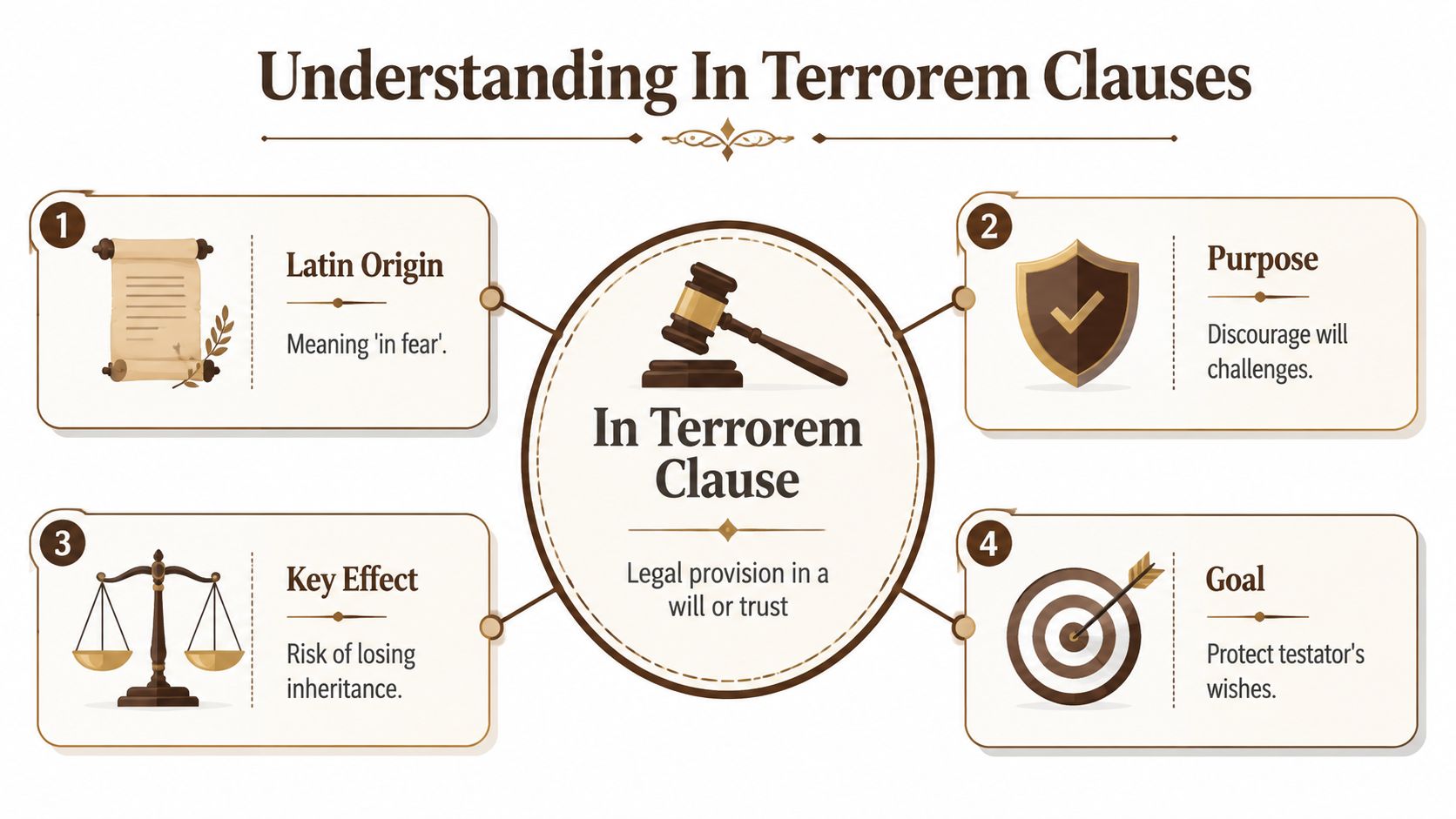
An in terrorem clause is a provision in a will or trust designed to deter challenges. The Latin phrase means “in fear.” Cornell Law School's Wex explanation of in terrorem clauses states that an in terrorem clause, also called a no-contest clause, is enforceable in most U.S. states but is subject to strict construction and often disfavored by courts. The same source explains that the phrase reflects the clause's purpose: to instill fear in heirs that they will lose their inheritance if they dispute the will's provisions.
How the clause works in real life
Think of it as a tripwire in an estate plan. A beneficiary receives something under the will or trust, but that gift comes with a condition. If the beneficiary files the kind of challenge covered by the clause and loses, the beneficiary can forfeit the gift.
That sounds simple, but families often misunderstand two parts of it.
First, the clause is aimed at beneficiaries who have something to lose. If a person was completely left out, the deterrent effect may be much weaker because there may be no gift to forfeit. Second, courts often read these clauses strictly rather than expansively. If the language is sloppy or the challenge doesn't fit the legal category the clause covers, the threat may not work the way the drafter expected.
Why people include one
People use an in terrorem clause because estate litigation is expensive, draining, and personal. A trust contest based on undue influence or lack of capacity can divide siblings for years. A no-contest clause is intended to make a potential challenger stop and calculate risk before filing.
Here's where practical planning matters:
- Protecting final wishes: A parent who expects conflict may want a stronger barrier against a disappointed heir.
- Minimizing coercive tactics: Some beneficiaries threaten litigation to compel a settlement. A well-drafted clause can reduce that pressure.
- Containing family damage: Even when the legal issues are manageable, the emotional cost can be severe.
A no-contest clause doesn't prevent conflict by itself. It works only when the clause is drafted carefully and the family understands what conduct actually triggers it.
In California, that last point is critical. A clause may look absolute on paper, but state law sharply narrows what courts will enforce.
How California Courts Enforce No-Contest Clauses
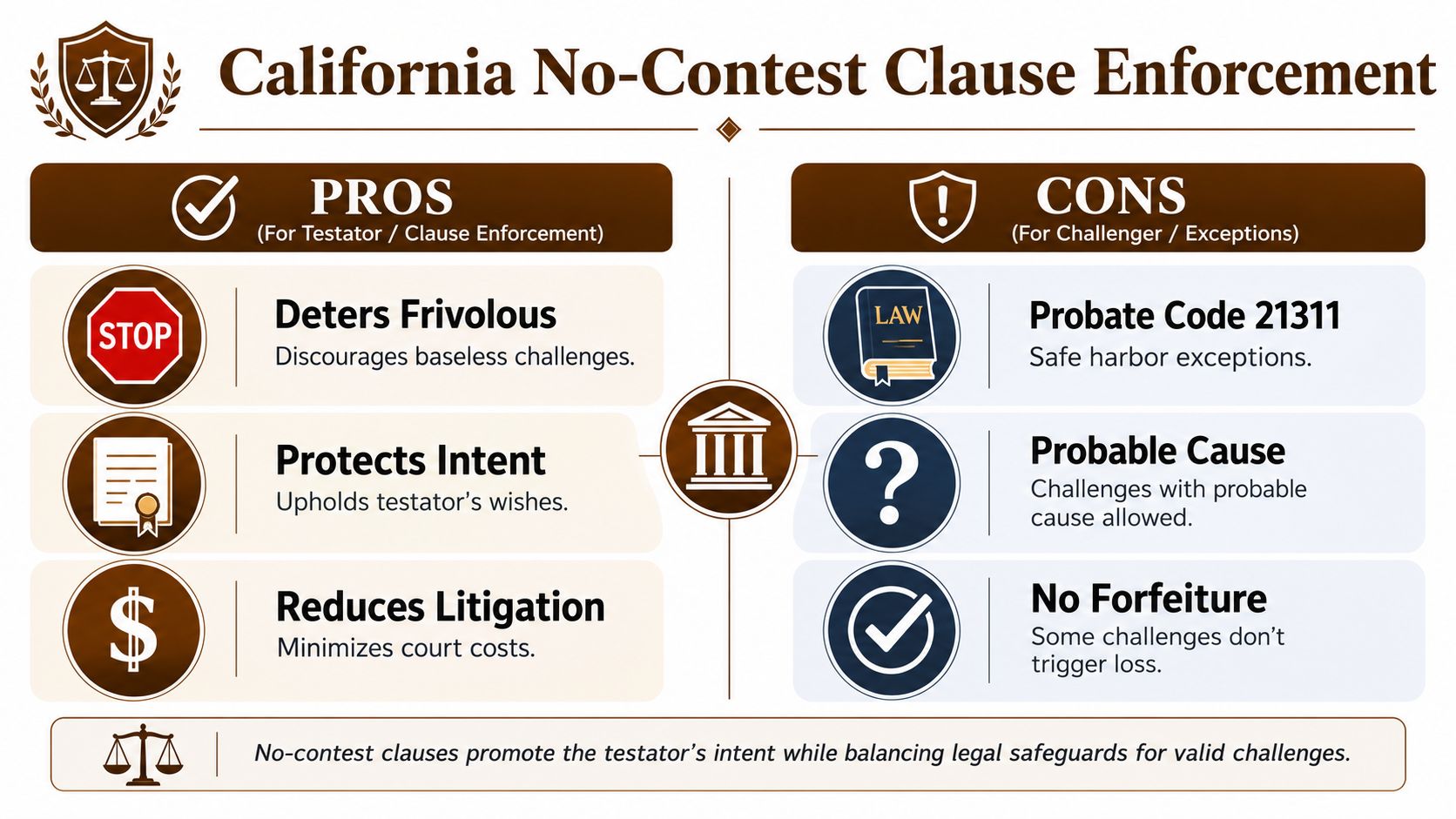
California does not enforce no-contest clauses the way many people expect from movies or old estate planning forms. The controlling rule is narrower. Under California Probate Code Section 21311 as summarized by Trust Law Partners, an in terrorem clause is enforceable only against three specific types of contests: a direct contest brought without probable cause, a pleading challenging the transfer of property on grounds that the decedent did not own it at the time of transfer, and the filing or prosecution of a creditor's claim.
What probable cause means for a family dispute
For most families, the phrase that matters most is probable cause. In plain English, that means the person challenging the will or trust must have a reasonable, evidence-based basis for doing so. Suspicion alone isn't enough. Hurt feelings aren't enough. But a challenge supported by facts may be treated very differently than a speculative attack.
A direct contest usually means a challenge to the validity of the document itself. Common examples include claims that the person lacked capacity, was subjected to undue influence, or signed because of fraud. In California, a no-contest clause generally won't strip a beneficiary of an inheritance for bringing that type of challenge if there was probable cause to bring it.
That rule reflects an important balance. California allows estate planning tools that discourage meritless litigation, but it doesn't give drafters total power to block legitimate claims. If the facts suggest the document may be invalid, the law leaves room to raise that issue.
What California families often get wrong
Families often assume the existence of the clause ends the conversation. It doesn't. The better question is whether the proposed filing falls inside the statute and whether the challenger has factual support.
A useful way to think about it is this:
| Issue | Practical California view |
|---|---|
| Beneficiary dislikes the distribution | Not enough by itself |
| Beneficiary has evidence of coercion or incapacity | May support probable cause |
| Beneficiary wants court help interpreting unclear terms | Often a different issue than a direct contest |
| Beneficiary files first and investigates later | High-risk approach |
The biggest mistake is treating a no-contest clause as either meaningless or absolute. It is neither. It has force, but only within California's framework.
Why narrow enforcement matters
This narrow approach changes strategy for both sides. A beneficiary who may have a valid concern should focus on evidence before filing. A trustee or executor shouldn't assume every objection triggers forfeiture. The statute creates a legal filter, and good probate counsel must evaluate the claim through that filter before taking action.
Practical rule: In California, the key question usually isn't “Is there a no-contest clause?” It's “Is this the kind of claim the statute covers, and is there probable cause for it?”
That analysis can determine whether a challenge goes forward, whether settlement makes sense, and whether the estate should seek enforcement of the clause.
Actions That Can Trigger Forfeiture in California
California families need clear distinctions. Not every disagreement with a trustee or executor is a contest. Not every court filing puts an inheritance at risk. But some actions do, and one category surprises people more than any other.
Direct contests versus non-contest proceedings
A direct contest attacks the validity of the will or trust. If a beneficiary alleges that a parent lacked mental capacity, was manipulated by a caregiver, or was tricked into signing, that's the kind of challenge that can trigger an in terrorem clause if it is brought without probable cause.
By contrast, some proceedings are not direct attacks on validity. A petition asking the court to interpret ambiguous trust language may be very different from a petition claiming the trust is invalid. The same is true of administration disputes. A beneficiary may question an accounting, object to a trustee's conduct, or seek instructions from the court without necessarily contesting the instrument itself.
That distinction matters because families often bundle everything together under the label of “challenging the trust.” California law doesn't.
The creditor's claim trap
The sharpest practical warning in this area involves debts. According to California guidance on no-contest clauses and creditor's claims, unlike direct contests, there is no probable cause exception for creditor's claims unless the will or trust instrument explicitly provides one. If the clause expressly covers creditor's claims, the mere filing of that claim can trigger disinheritance.
That means a beneficiary who is also a creditor must be extremely careful. A common example is a child who says, “I loaned Mom money,” or “Dad promised to repay me for renovations to the house.” In ordinary civil life, asserting a debt might seem routine. In an estate setting, if the governing document contains a clause that reaches creditor's claims, filing that claim can carry forfeiture risk even if the person believes the debt is real.
If you are both a beneficiary and someone who believes the estate owes you money, don't assume your debt claim is separate from the no-contest clause analysis. In California, that can be the most dangerous assumption in the case.
A practical comparison
Here is the safer way to think about common actions:
- Claiming the trust is invalid due to undue influence: Risk depends on whether there is probable cause.
- Asking the court to clarify unclear language: Often a lower-risk procedural step, depending on the filing.
- Objecting to how a trustee is administering assets: Often different from attacking validity.
- Filing a creditor's claim for repayment: Potentially high risk if the clause expressly covers creditor claims.
The wording of the document still matters. So does the exact filing. A family member can lose a strong position by using the wrong procedure or framing the issue poorly. That's why no one should rely on informal advice from siblings, the internet, or the trustee's preferred narrative before acting.
Drafting an Effective In Terrorem Clause
For the person creating an estate plan, a no-contest clause works only if it is drafted with precision. Vague threats don't help. Overly broad language can create confusion rather than protection. Under California law, clarity matters because courts read these provisions narrowly.

What works better in practice
A useful clause should identify the conduct the drafter wants to deter and fit that language to California's actual enforcement rules. It should also be written plainly enough that a court can apply it without guessing what the drafter intended.
Several drafting choices usually make the clause more effective:
- Use clear language: If a court has to resolve ambiguity, the deterrent value drops.
- Match the clause to realistic risks: The clause should address the disputes most likely to arise in that family.
- Leave something meaningful to lose: A no-contest clause has little force against a beneficiary receiving a trivial gift.
Don't omit the destination of a forfeited share
One drafting point is often overlooked. Estate planning commentary discussing Georgia and New York practice notes that courts in states like Georgia and New York often void in terrorem clauses unless the instrument explicitly directs the forfeited property's alternative disposition. While California law has its own framework, this is still a strong drafting lesson.
If the clause says a beneficiary loses a share, the document should also say who gets that forfeited share instead. Does it pass to the other beneficiaries? Does it fall into the residue? Does it go to a named alternate taker? Leaving that point unanswered invites litigation over the very clause that was supposed to prevent it.
A no-contest clause should never create a second fight about where the forfeited inheritance goes.
For Orange County and Los Angeles families, the most effective estate plans are the ones that reduce ambiguity before conflict starts. A carefully drafted clause can help, but only when the broader plan is coherent, the bequests are intentional, and the trust or will accounts for what happens if someone crosses the line.
Navigating a Challenge Involving a No-Contest Clause
When a dispute has already started, the strategy depends on which side you are on. A beneficiary considering a challenge needs to evaluate evidence before filing. A trustee or executor has to decide whether the estate should resist the claim, seek enforcement of the clause, or separate a valid administrative complaint from a true contest.

If you are thinking about challenging the document
The first question is not whether you feel wronged. It's whether you have proof that can support the claim. In many jurisdictions, guidance from the New York State Bar Association explains that a no-contest clause is enforceable unless the contestant had probable cause to initiate the proceeding, and to trigger forfeiture the challenge must not only fail but also have been brought without a good faith belief supported by evidence. California has its own statute, but the practical lesson is the same: evidence comes first.
That usually means gathering documents, communications, medical records where available through proper process, and witness accounts before making a filing decision. If the concern is undue influence, look at who controlled access to the deceased, who arranged the signing, and who benefited from the late change. If the concern is capacity, focus on evidence tied to the time the document was signed.
A beneficiary should also ask a narrower question: “Am I really contesting validity, or am I dealing with interpretation, administration, or a debt issue?” That framing can change the entire risk profile.
If you are the trustee or executor
A trustee or executor has a duty to administer the estate or trust according to the governing documents and California law. That does not mean treating every complaint as a punishable contest. It does mean taking the clause seriously when a beneficiary files a covered claim without adequate basis.
Sometimes the best defense is direct enforcement. Sometimes it is better to show the court that the challenger's filing doesn't affect validity but still fails on the merits. Good fiduciary administration requires discipline rather than retaliation.
This video gives added context on probate and estate dispute issues families often face:
A practical litigation checklist
- Beneficiaries should pause before filing: The first draft of a petition can accidentally turn a manageable issue into a forfeiture fight.
- Trustees should classify the claim correctly: Not every hostile filing is a direct contest.
- Both sides should focus on evidence: Strong facts matter more than strong emotions.
- Everyone should analyze the actual wording: The clause, the trust, and the will must be read together.
The families who handle these disputes best are usually the ones who slow down early, identify the exact type of claim involved, and avoid treating the clause as either empty language or an automatic weapon.
Protecting Your Legacy and Your Family in California
An in terrorem clause can be a useful estate planning tool, but in California it works within strict limits. That is good news for families with legitimate concerns about fraud, undue influence, or lack of capacity. It is also a warning for anyone who assumes a no-contest clause guarantees silence after death.
For beneficiaries, the practical lesson is simple. Don't act on instinct. A challenge to the validity of a will or trust may be allowed if supported by probable cause, but the wrong filing can create avoidable risk. That is especially true when a beneficiary is also considering a creditor's claim against the estate or trust.
For the person creating an estate plan, the message is just as important. A clause should be drafted clearly, tied to real family dynamics, and integrated into a broader plan that reduces ambiguity rather than multiplying it. If the estate plan is sloppy, the clause won't fix it.
California probate and trust disputes are rarely just about legal rules. They are about families, money, grief, and timing. The right legal analysis can prevent a painful conflict from becoming a permanent one.
If your family is dealing with a will or trust dispute in Orange County or Los Angeles, or if you want to include an in terrorem clause in a California estate plan, schedule a free consultation with Tanner Law. You'll get clear, practical guidance specific to your circumstances, whether you are evaluating a potential challenge, serving as a trustee or executor, or trying to protect your family from future probate litigation.