California Affidavit of Heirship Form: Your Guide
A parent dies, and the house in Orange County or Los Angeles is still in that parent's name. The family thought everything would pass automatically, but a buyer, lender, or title officer now says the title isn't clear. That's usually the moment people start searching for an affidavit of heirship form and hoping it will solve the problem quickly.
Sometimes it helps. In California, though, it's not a magic transfer document. Families need to understand what it can do, what it can't do, and why title company practice matters as much as the form itself. From a California real estate and probate perspective, that distinction is the whole game.
Table of Contents
- What Is an Affidavit of Heirship in California
- Is an Affidavit of Heirship the Right Tool for Your Situation
- How to Complete a California Affidavit of Heirship Form
- Executing and Recording Your Affidavit to Clear Title
- Avoiding Costly Mistakes with Your Heirship Affidavit
- Probate and Other Alternatives for Transferring Property
- California Affidavit of Heirship FAQs and Legal Guidance
What Is an Affidavit of Heirship in California
An affidavit of heirship is a sworn statement identifying the people who legally succeeded to a deceased person's estate. In plain English, it's a document that tells the family story relevant to inheritance: who died, whether they were married, whether they had children, whether any child died earlier leaving descendants, and who the heirs are under California law.
That sounds simple, but California treats this document differently from states such as Texas. In Texas, families often hear that an affidavit of heirship can function as a recognized path to transfer title in routine cases. California is more cautious. Here, the affidavit is generally better understood as an evidentiary document. It may help a title insurer evaluate risk. It does not by itself operate like a court order transferring ownership of real property.
What the document actually does
In California practice, the affidavit usually serves one of these purposes:
- Creates a record of family history that can be placed in the property's chain of title.
- Supports title underwriting when a sale or refinance is pending.
- Helps explain an old break in title when someone died years ago and no probate was opened.
- Gives a title officer something concrete to review instead of relying only on informal family statements.
Practical rule: In California, think of an affidavit of heirship as a document that may help clear questions about ownership. Don't treat it as a deed, and don't assume recording it means the property has legally transferred.
Why families use it anyway
Because probate can be time-consuming, families naturally look for a narrower tool when the facts are clean. If there's one house, a straightforward family tree, no active dispute, and a buyer waiting, an affidavit can sometimes help move the file forward with the title company.
That said, the actual audience for this document often isn't the family. It's the title insurer. If the title company won't rely on it, the affidavit may be perfectly drafted and still not solve the transaction problem. In Orange County and Los Angeles, that practical underwriting reality matters more than what a generic online form promises.
Why California law matters
California succession law, community property rules, prior marriages, omitted heirs, and creditor issues all affect whether the family's understanding of ownership is correct. A form that merely lists the current children may be dangerously incomplete if the decedent had an earlier marriage, a deceased child with descendants, or property acquired under different circumstances.
That's why the form works only when it's drafted as part of a legal analysis under California law, not as a fill-in-the-blank shortcut.
Is an Affidavit of Heirship the Right Tool for Your Situation
The right question isn't whether an affidavit of heirship form exists. It does. The right question is whether your facts fit the small group of California situations where the document is useful.
Situations where it can work
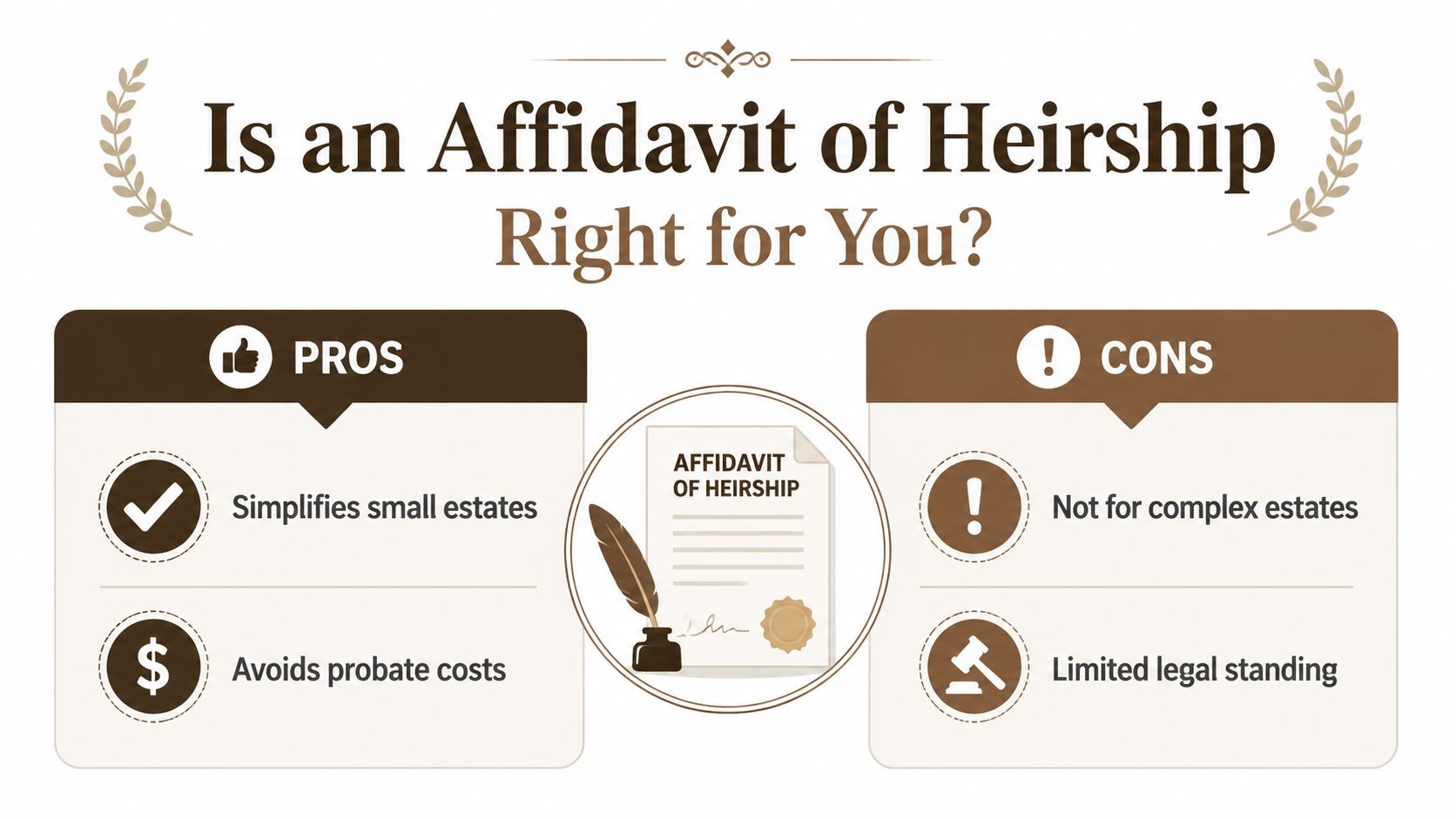
An affidavit is most likely to help when the title issue is narrow and the family history is stable. Common examples include an older family residence, no pending fight among heirs, and a planned sale to a third party where the title company is open to curative documentation.
Look for these green flags:
- All heirs agree and no one disputes who should inherit.
- The family tree is clear with no missing branches, prior-marriage children, or uncertain paternity questions.
- The decedent left no unresolved ownership confusion about whether the property was separate property, community property, or jointly held.
- There's no live contest over a will or over the validity of estate planning documents.
- The transaction is practical rather than adversarial. For example, a title officer wants better evidence before issuing a policy.
Situations where it usually fails
An affidavit is a poor tool when the problem is legal, not clerical. If ownership is contested, witness statements won't replace a court order.
Use caution if any of these apply:
| Situation | Why the affidavit may not work |
|---|---|
| Heirs are fighting | A title company won't want to underwrite through a live dispute |
| There are unclear debts or creditor issues | The estate may need a formal probate process |
| The decedent had multiple marriages or estranged children | Missing one heir can undermine the entire document |
| There's a questionable will | Probate court may need to determine validity |
| The family wants finality, not just a sale | An affidavit offers less legal certainty than a court order |
The more complicated the family history, the less useful a generic affidavit becomes.
What title companies in Orange County and Los Angeles care about
Title companies don't all take the same view. One underwriter may consider a well-supported heirship affidavit if the risk appears contained. Another may refuse to insure without probate or another court-based solution. That's especially true if the death happened recently, the property has substantial value, or the file suggests any chance of a missed heir.
From a real estate broker's perspective, transactions often stall at this point. Sellers think they've solved the issue because they recorded a document. Escrow then learns the underwriter still won't insure marketable title. At that point, the family loses time and negotiating power.
A practical way to decide
Before relying on an affidavit of heirship form, ask these questions in order:
- Who are all possible heirs under California law?
- Is there any dispute, uncertainty, or missing family information?
- Does the title company handling the eventual sale or refinance appear willing to review an affidavit package?
- Would a more formal procedure solve the problem with greater certainty?
If those answers aren't clean, the affidavit may become an expensive detour rather than a shortcut.
How to Complete a California Affidavit of Heirship Form
A strong California affidavit of heirship form reads less like a template and more like a careful family-history declaration tied to a specific parcel of real estate. The drafting has to be complete, internally consistent, and credible to a title officer who didn't know the decedent.
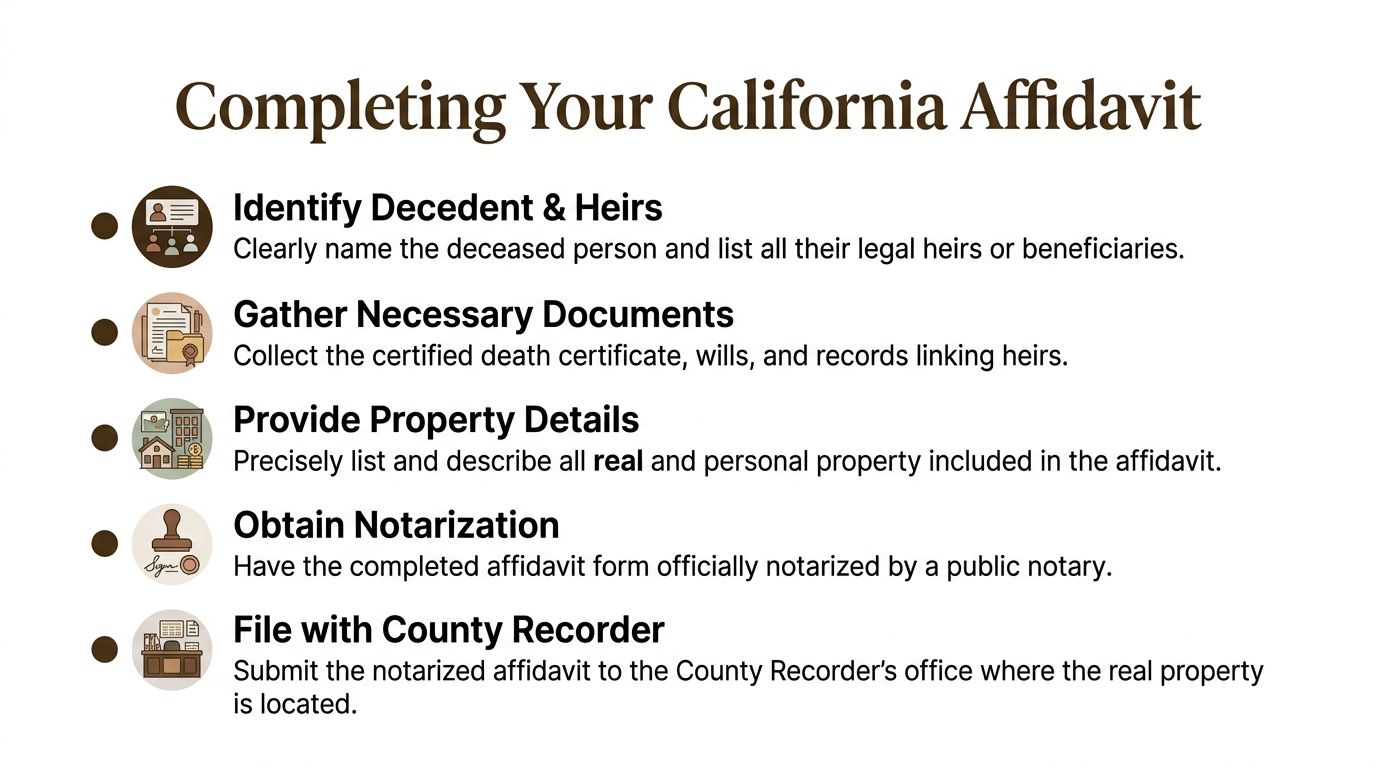
Start with this overview before anyone signs:
Identify the decedent and the property correctly
The document should begin with the deceased person's full legal name and basic death information. Use the name that appears on title and cross-check it against the death certificate. If there were common name variations, the affidavit should account for them clearly.
The property description matters just as much. Don't rely only on the street address. Title officers usually want the full legal description from a deed, not just the mailing address.
A good opening clause often looks like this:
The decedent, [full legal name], died on [date], and at the time relevant to this affidavit was the record owner of the real property commonly known as [property address], legally described as [legal description].
State the family history in logical order
Many forms frequently contain inaccuracies. California inheritance depends on relationships, not assumptions. The affidavit should tell the family history in a clean sequence.
Include:
- Marital history of the decedent, including prior marriages if relevant.
- Children of the decedent, whether living or deceased.
- Descendants of any deceased child, because they may inherit by representation.
- Statement regarding a surviving spouse, if any.
- Statement regarding whether the decedent died with or without a will, if that fact is known and relevant to the title issue.
A useful narrative clause can read like this:
During the decedent's lifetime, the decedent was married to [name], and the following children were born to or legally recognized by the decedent: [list names]. If any child of the decedent predeceased the decedent, that child's descendants are as follows: [list names and relationships].
List every heir, not just the heirs who are involved
Families often give me the names of the people actively handling the property. That isn't enough. The affidavit needs the names of all persons who could have an inheritance claim under California law based on the known facts.
Use a simple table in the draft to avoid omissions:
| Name | Relationship to decedent | Current address | Living or deceased |
|---|---|---|---|
| [Name] | [Relationship] | [Address] | [Status] |
| [Name] | [Relationship] | [Address] | [Status] |
If someone is deceased, identify their descendants where relevant. If an address is unknown, say that directly rather than leaving a blank.
Use two disinterested witnesses with real knowledge
This is the credibility core of the document. The witnesses should be adults who knew the decedent and the family well enough to testify to the family history from personal knowledge. In practice, long-time neighbors, close family friends, clergy, or long-standing business associates can work.
They should not be heirs and should not have a direct financial stake in the property. In California title practice, using an interested witness weakens the affidavit immediately.
Witnesses should be able to explain how they know the family, not just sign because someone asked them to.
Draft for clarity, not drama
Overwriting hurts these documents. So does legal jargon that obscures the facts. The most persuasive affidavits are simple, chronological, and specific.
A filled-out snippet might look like this:
Affiant states that she has known the decedent for many years and is familiar with the decedent's family history. At the time of death, the decedent was not survived by any child other than the following: [names]. No other persons are known to affiant to claim heirship through the decedent.
Attach supporting documents where appropriate
Depending on the file, it may help to assemble a supporting package for title review, such as:
- Certified death certificate
- Prior recorded deeds
- Marriage or divorce records if family history requires clarification
- Death records for predeceased heirs
- A preliminary title report if one has already been issued
Those documents don't replace the affidavit, but they make it easier for a title officer to trust what the affidavit says.
Executing and Recording Your Affidavit to Clear Title
Drafting the affidavit is only half the job. Execution and recording are where families either create a usable title document or end up with a paper file that no one relies on.
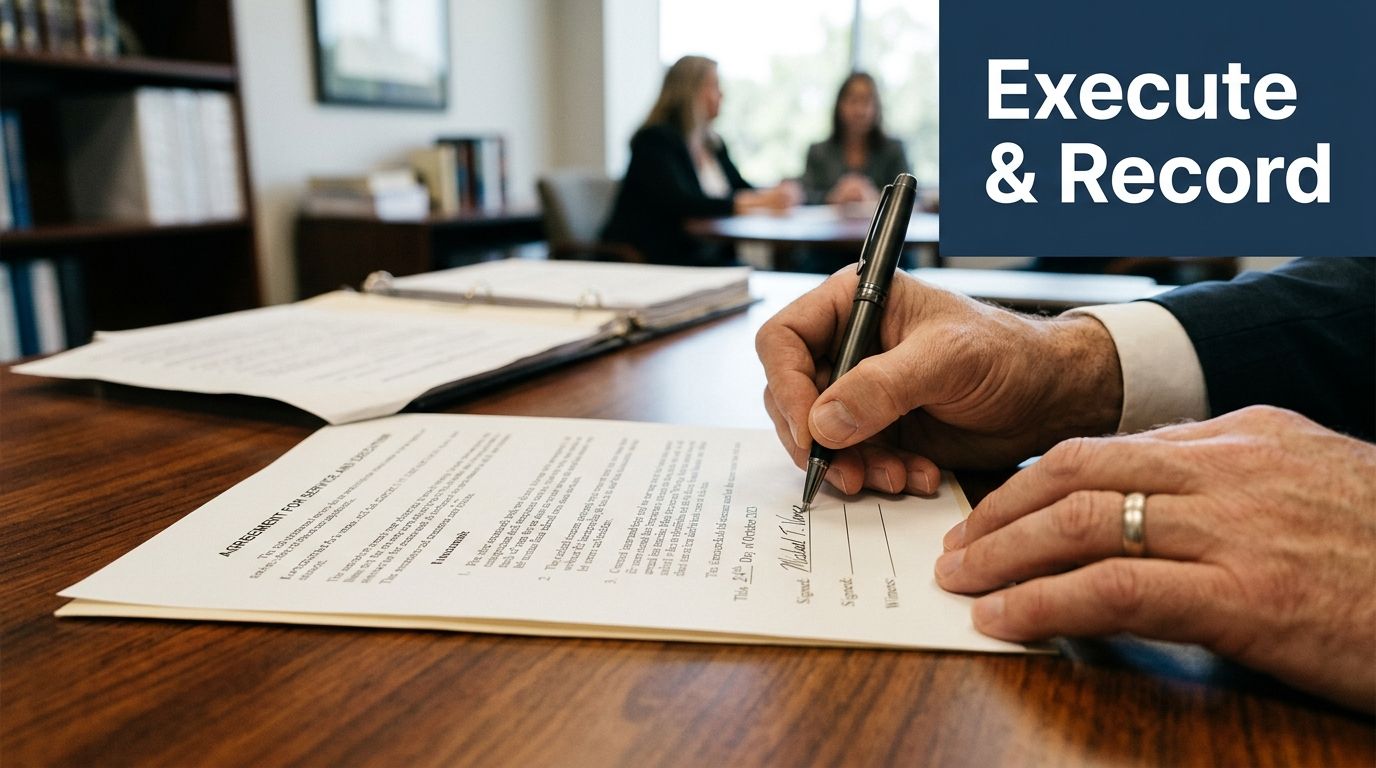
Sign before a notary
The signatures need to be notarized. That means the signer appears before a notary public, proves identity, and signs or acknowledges the signature in the manner required for notarization. This is not optional for a document meant to be recorded and reviewed in a real estate file.
In practice, coordinate the signing carefully. If the affidavit uses witness declarations, make sure each witness signs exactly where the document indicates and that the notarial certificates match the signer and capacity involved.
Make sure the final version is recorder-ready
County recorder offices in California review documents for recording requirements. If the document lacks required formatting, signatures, acknowledgments, or recording cover information, the recorder may reject it.
Before submission, confirm:
- The legal description is attached and legible
- Names are spelled consistently throughout
- Notary acknowledgments are complete
- The document identifies the property clearly
- Any required cover sheet or transfer-related statement has been considered
Recording places the document into the public land records. It doesn't guarantee the affidavit is legally sufficient for every title purpose.
Record in the county where the property sits
If the property is in Orange County, record with the Orange County Recorder. If it's in Los Angeles County, record with the Los Angeles County Recorder. Recording means the document becomes part of the public record tied to that parcel.
That matters because future buyers, lenders, escrow officers, and title examiners search that chain of title. A recorded affidavit gives them a document to review. An unrecorded affidavit sitting in a family folder usually does very little to solve a title problem.
After recording, send it to the title company
Families often stop too soon. Recording is important, but if a sale or refinance is pending, the title company still needs to review the recorded affidavit and decide whether it will insure over the issue.
That review may lead to one of several outcomes:
| Result | What it means |
|---|---|
| Accepted | The title company is willing to proceed, sometimes with conditions |
| Accepted with additional requirements | More declarations, death records, or indemnity may be requested |
| Rejected | The family likely needs probate or another formal transfer path |
That final underwriting decision is why it's smart to think about the title company's likely position before relying on the affidavit strategy.
Avoiding Costly Mistakes with Your Heirship Affidavit
The most common mistake is starting with the wrong assumption. Families assume any affidavit of heirship form they find online will work in California if it looks official enough. That's where trouble starts.
California is not Texas. A Texas-style form often assumes a stronger title function than California practice allows. If you import that approach into an Orange County or Los Angeles transaction, you may end up with a recorded document that satisfies the family emotionally but doesn't satisfy escrow, the buyer, or the title underwriter.
The forms that cause the most problems
Out-of-state forms are risky for several reasons. They may use inheritance concepts or execution language that doesn't track California law. They also tend to oversimplify family relationships.
The worst offenders usually share these flaws:
- They imply the affidavit transfers title rather than merely serving as evidence.
- They omit California-specific inheritance issues such as prior-marriage descendants or community property context.
- They assume the witnesses can be loosely connected to the family when title practice often demands stronger personal knowledge.
- They provide almost no room for a full family narrative, which is exactly what a title examiner needs.
Witness errors can sink the whole document
I've seen families use a son, daughter, or in-law as a so-called disinterested witness because that person knew the facts best. From a practical title standpoint, that can defeat the purpose. If the witness stands to benefit from the transaction, the declaration loses force.
Another recurring problem is using witnesses who know only one side of the family story. A witness may know the decedent's current household but have no idea about children from an earlier relationship. That gap can be fatal if a title officer spots it.
A witness who says too little is almost as problematic as a witness who shouldn't be signing at all.
Incomplete family history is the classic title defect
The affidavit has to account for all branches of inheritance, not just the heirs in possession of the property. Omitting a deceased child, grandchildren of a deceased child, an estranged child, or a prior spouse with relevant property history can create a hidden defect that surfaces only when a deal is on the line.
Real estate and probate intersect. A title company doesn't need proof that the current occupants believe they own the house. It needs confidence that there isn't a missing claimant waiting in the background.
The biggest misconception
The affidavit itself does not transfer ownership of California real property in the way a deed or court order does. Its practical power lies in persuasion. It gives a title insurer a factual basis to evaluate whether it's willing to insure a transaction despite the death-related break in title.
That distinction matters because families set deadlines based on the wrong expectation. They list the property, open escrow, and only then learn that the affidavit won't carry the file. By then, everyone is under pressure, and the better route, often probate or another formal petition, should have started earlier.
Probate and Other Alternatives for Transferring Property
An affidavit of heirship is only one option, and in California it's often the least final option. When the goal is actual transfer of ownership with dependable legal effect, families should compare it against the alternatives instead of treating it as the default.
Full probate
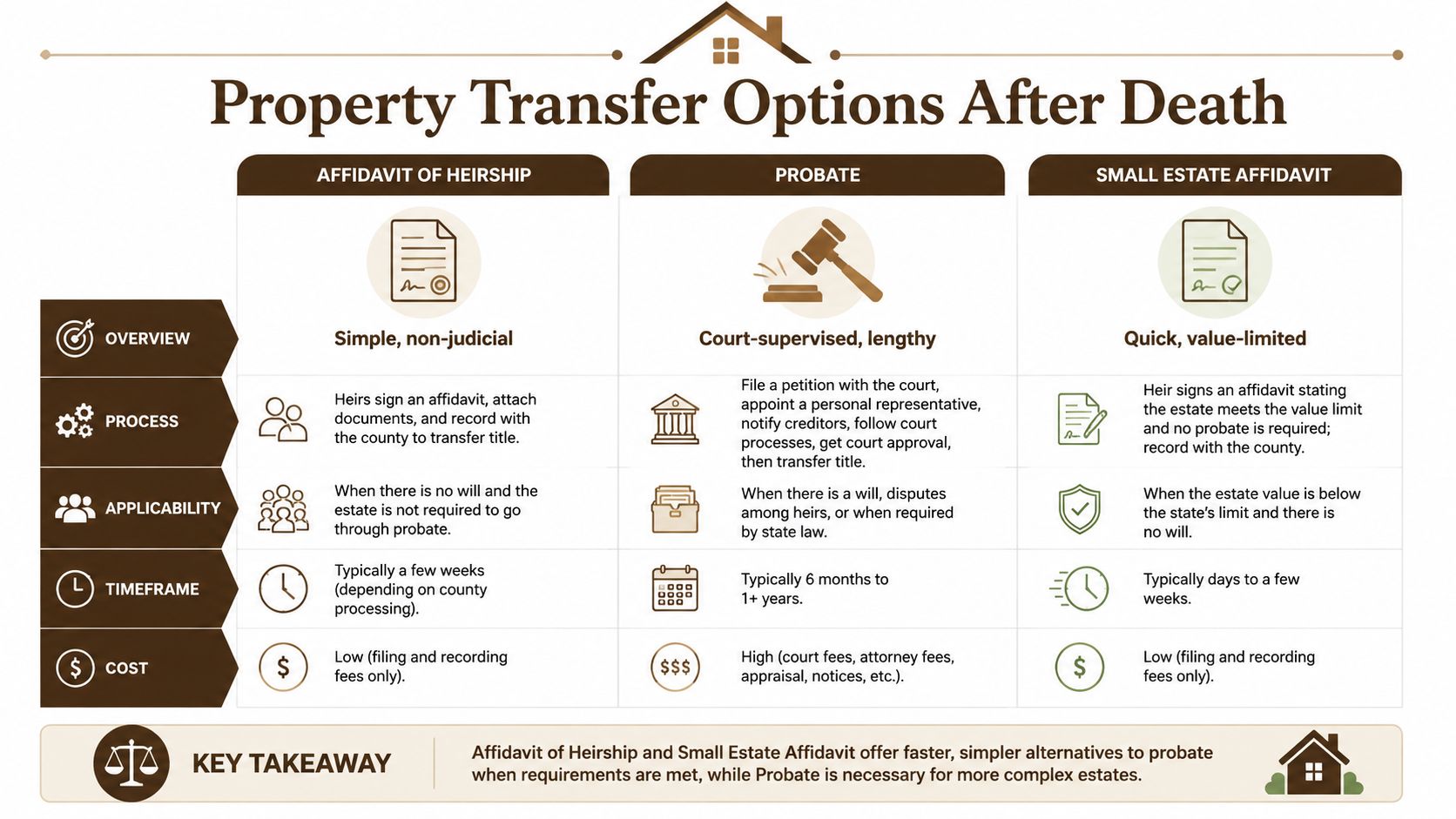
Probate is the court-supervised process for administering a decedent's estate. It's more work, but it also gives the strongest legal finality. If there are disputes, unclear heirs, creditor issues, or a need for judicial authority to transfer the property, probate is often the cleanest path.
For title purposes, probate usually produces the kind of court-backed record title insurers prefer. That's why a slower route can still be the more efficient route overall.
Small estate procedures
California also has simplified procedures in some circumstances. The challenge is that families often confuse a small estate affidavit for personal property with a method for transferring a house. The rules for real property are narrower and need to be analyzed carefully under current California law.
Where the estate qualifies, a simplified court or affidavit-based process may be available for certain transfers. But eligibility, asset valuation, and the type of property involved matter. A family shouldn't assume that because the estate feels modest, the house can pass through an abbreviated affidavit alone.
Spousal property petition
For a surviving spouse or registered domestic partner, a spousal property petition can be one of the most effective California tools. If the property passed by reason of the marital relationship and the facts support that remedy, this path can be much more powerful than an heirship affidavit.
It's often especially useful where the surviving spouse needs recognized title for refinance, sale, or estate planning.
Side-by-side practical comparison
| Option | Best for | Main strength | Main weakness |
|---|---|---|---|
| Affidavit of heirship | Narrow title-curative situations | Non-judicial and potentially streamlined | Limited legal weight in California |
| Probate | Complex estates or disputed ownership | Court authority and finality | More formal and time-intensive |
| Small estate route | Qualifying modest estates | Simpler than full probate in the right case | Not available in every real property situation |
| Spousal property petition | Surviving spouse cases | Strong targeted remedy | Only fits specific relationships and facts |
The right answer depends on the facts, the county, the underwriter, and whether you need mere evidence or a legally operative transfer mechanism.
California Affidavit of Heirship FAQs and Legal Guidance
Will every California title company accept an affidavit of heirship
No. Acceptance varies by underwriter, by the facts in the file, and by the level of perceived risk. Some title companies may consider a carefully prepared affidavit package. Others will insist on probate or another court-based procedure before issuing a policy.
Can I use a generic affidavit of heirship form I found online
Usually, that's not the safest approach. Generic forms often reflect another state's law or leave out family-history detail that California title practice requires. A form can look polished and still be unusable for your property.
How long does the process take
It depends on the family history, how quickly records can be gathered, how easy it is to locate qualified witnesses, and whether the recorder and title company raise follow-up issues. Clean files move faster. Complicated family trees do not.
What does it usually cost
Cost varies with the complexity of the title problem, document preparation needs, notary logistics, recording charges, and whether the matter later turns into a probate or quiet title issue. The cheapest-looking option at the start isn't always the least expensive once delay and failed escrow are taken into account.
Is the affidavit enough to sell the property
Sometimes, but not by itself in every case. The practical question is whether the title insurer will issue coverage for the buyer. If it won't, the recorded affidavit won't complete the sale.
When should I talk to a California attorney
Early. If the property is in Orange County or Los Angeles and a death-created title issue has already surfaced, early legal review usually prevents avoidable delay. That's especially true where there are prior marriages, deceased children, missing heirs, or disagreement within the family.
An affidavit of heirship can be useful in California, but only when it fits the facts and the title company will treat it as meaningful evidence. Used correctly, it can help. Used casually, it can waste months.
If you're dealing with inherited property, probate concerns, or a clouded title in Orange County or Los Angeles, Tanner Law can help you evaluate the right California strategy. Schedule a free consultation to get clear, practical guidance before a title problem becomes a failed sale or a larger probate dispute.