Joint Tenants in Common: CA Property Rights
When joint tenants in common comes up, you're probably dealing with a deed, a family property, or a probate problem that suddenly made title law feel very personal.
A common California example goes like this. Two siblings inherit a house in Los Angeles from a parent. One wants to keep it as a rental. The other wants to sell. Then someone finds an old deed using language nobody fully understands, and the question becomes urgent: are they joint tenants or tenants in common? That answer can control who inherited what, whether probate is involved, and whether one owner can force a sale.
The same confusion shows up when unmarried partners buy a home in Orange County, when adult children are added to title for convenience, or when investors contribute different amounts to a down payment. The phrase "joint tenants in common" blends two different ownership systems. California law treats them very differently, and choosing the wrong one can create partition lawsuits, quiet title actions, and expensive fights over who owns what.
Table of Contents
- Understanding California Property Co-Ownership
- The All-or-Nothing Path Joint Tenancy in California
- The Flexible Path Tenancy in Common in California
- Joint Tenancy vs Tenancy in Common Key Differences
- Common Co-Ownership Disputes and Legal Solutions
- How to Choose the Right Title and When to Call an Attorney
Understanding California Property Co-Ownership
In California, co-ownership isn't just about whose names appear on the deed. It's about what legal rights each owner has while everyone is alive, and what happens when one owner dies, moves out, transfers an interest, or stops cooperating.
The phrase joint tenants in common causes confusion because it combines two distinct forms of title. A person can hold property as a joint tenant or as a tenant in common, but those aren't the same thing. One is built around survivorship. The other is built around separate transferable shares.
Why people get this wrong
Most clients don't come in because they were fascinated by title doctrine. They come in because something already happened.
- A parent died: Now the children need to know whether the property passed automatically or through the estate.
- A co-owner wants out: One person wants to sell, but the other won't sign.
- Money wasn't equal: One owner paid most of the mortgage and now wants credit for it.
- The deed is vague: The recorded document doesn't clearly match what the family thought they agreed to.
A deed can look simple and still create major consequences. In California, title language can determine whether an owner has the right to leave their share by will, whether probate applies, and whether a lawsuit may be necessary to clear title.
Practical rule: If co-owners don't understand their title before a death or dispute, they're often forced to learn it in the middle of probate or litigation.
A simple way to think about it
Use this mental shortcut:
| Ownership form | Core idea |
|---|---|
| Joint tenancy | All owners are on one track together, with survivorship built in |
| Tenancy in common | Each owner holds their own share of the same property |
That distinction matters most in Orange County and Los Angeles when family homes pass informally from one generation to the next. People often assume "co-owning" means everyone has the same rights and expectations. It doesn't.
Under California law, title should match the owners' real goals. If the goal is automatic transfer to the survivor, one structure may fit. If the goal is leaving a share to children, reflecting unequal contributions, or preserving separate inheritance rights, another may fit better. When the deed doesn't match the plan, disputes usually follow.
The All-or-Nothing Path Joint Tenancy in California
A common California dispute starts with a simple sentence in a lawyer's office: "We put both names on title, so everything should be straightforward." Sometimes it is. Sometimes that choice sets up a fight after a death, a breakup, or a sale that one owner wants and the other resists.
Joint tenancy is the most rigid form of co-ownership. It works like two people holding the same ticket to the same asset, on the same terms, for the same duration. The main feature is the right of survivorship. When one joint tenant dies, that person's interest passes automatically to the surviving joint tenant or joint tenants.

That automatic transfer is powerful. It also surprises families more often than you might expect. A child may assume a parent's half of the home will pass under a will or trust. If title is held in joint tenancy, that assumption can be wrong as to that property interest. The survivor takes by operation of title, not because probate approved it.
The four unities California requires
California treats joint tenancy as a specific legal arrangement, not a casual label. The structure traditionally depends on four matching features, often called the four unities. Courts and practitioners still use this framework because it explains why some deeds create survivorship rights and others do not. A helpful overview appears in the Cornell Legal Information Institute's explanation of joint tenancy.
Those four unities are:
Time
The owners receive their interests at the same time.Title
The interests come through the same deed or other instrument.Interest
Each owner holds the same type and size of share.Possession
Each owner has an equal right to possess the whole property.
If one piece is missing, the title may not function as a true joint tenancy. In practice, that problem often surfaces only after someone dies or a co-owner files a partition or quiet title action.
What survivorship really does
The survivorship feature overrides a common expectation. An owner cannot leave a joint tenancy interest to someone else by will if the joint tenancy is still in place at death. The interest does not wait for probate. It disappears into the surviving joint tenant's ownership.
That result can be exactly what the owners wanted.
It can also produce litigation. I see this in blended families and parent-child arrangements. A mother adds one child to title for convenience, expecting all children to share later. After the mother's death, the child on title claims the whole property by survivorship. The siblings then start asking whether the deed reflected the actual agreement, whether undue influence was involved, or whether a quiet title case is necessary.
Why lawyers call it all-or-nothing
Joint tenancy leaves little room for customization. The owners must be aligned in a very particular way. Equal shares. Equal possession rights. A built-in transfer to the survivor.
That simplicity is the attraction. It can also be the trap.
Joint tenancy often fits owners who want one outcome: if one dies first, the survivor gets the property interest automatically. It usually fits poorly where contributions were unequal, where one owner wants to leave a share to children from a prior relationship, or where the parties are already concerned about future sale disputes. In those situations, the wrong deed can turn an avoidable title problem into a lawsuit over ownership, reimbursement, or the right to force a sale.
The Flexible Path Tenancy in Common in California
Tenancy in common is the flexible alternative. If joint tenancy is like co-pilots with one flight plan, tenancy in common is more like investors owning different percentages of the same company. They share the asset, but they don't have to own equal pieces, and one owner's interest doesn't automatically disappear into the others at death.

This is often what people mean, loosely and incorrectly, when they say "joint tenants in common." In California, tenancy in common usually offers the flexibility people are looking for.
Why tenancy in common feels more practical
Tenants in common can hold equal or unequal shares. One person may own 50 percent. Another may own 30 percent. Another may own 20 percent. The law doesn't require matching interests.
A useful explanation appears in this discussion of joint tenancy and tenants in common: a key technical distinction from joint tenancy is the absence of the four unities; once a joint tenancy is severed, the interest reverts to tenancy in common among the former joint tenants, and the severed interest may then be sold or devised independently. This structure is particularly valuable in estate planning where contributors have disproportionate investments or where step-families or investors need to align ownership percentages with contributions.
That is why tenancy in common often works better for:
- Unmarried partners who want separate estate rights
- Siblings inheriting a family property
- Friends or investors contributing different amounts
- Blended families trying to preserve separate inheritances
The big tradeoff
Tenancy in common gives flexibility, but it removes survivorship.
If one tenant in common dies, that owner's share doesn't automatically pass to the co-owner. Instead, it passes according to that person's estate plan, or under California succession rules if no plan exists. That can be exactly what the owner wanted. It can also produce a difficult new co-ownership arrangement.
Consider a simple example. Two brothers own a duplex in Orange County as tenants in common. One dies and leaves his share to his two adult children. The surviving brother doesn't become sole owner. He now co-owns the property with his niece and nephew.
Client warning: Tenancy in common often solves the inheritance-control problem, but it can create a management problem if the next generation doesn't agree.
Why drafting matters
Tenancy in common is flexible enough to be useful and loose enough to become dangerous if nobody writes down the rules.
A well-planned arrangement usually addresses:
- Use of the property
- Responsibility for mortgage, taxes, and repairs
- What happens if one owner wants out
- How a buyout price will be determined
- Whether family members get a first chance to buy before an outside sale
Without those terms, California law still provides default rules, but default rules rarely reflect the family's actual expectations. That's when disputes shift from kitchen-table promises to court filings.
Joint Tenancy vs Tenancy in Common Key Differences
The difference between these two forms of title becomes clear when you compare them side by side.
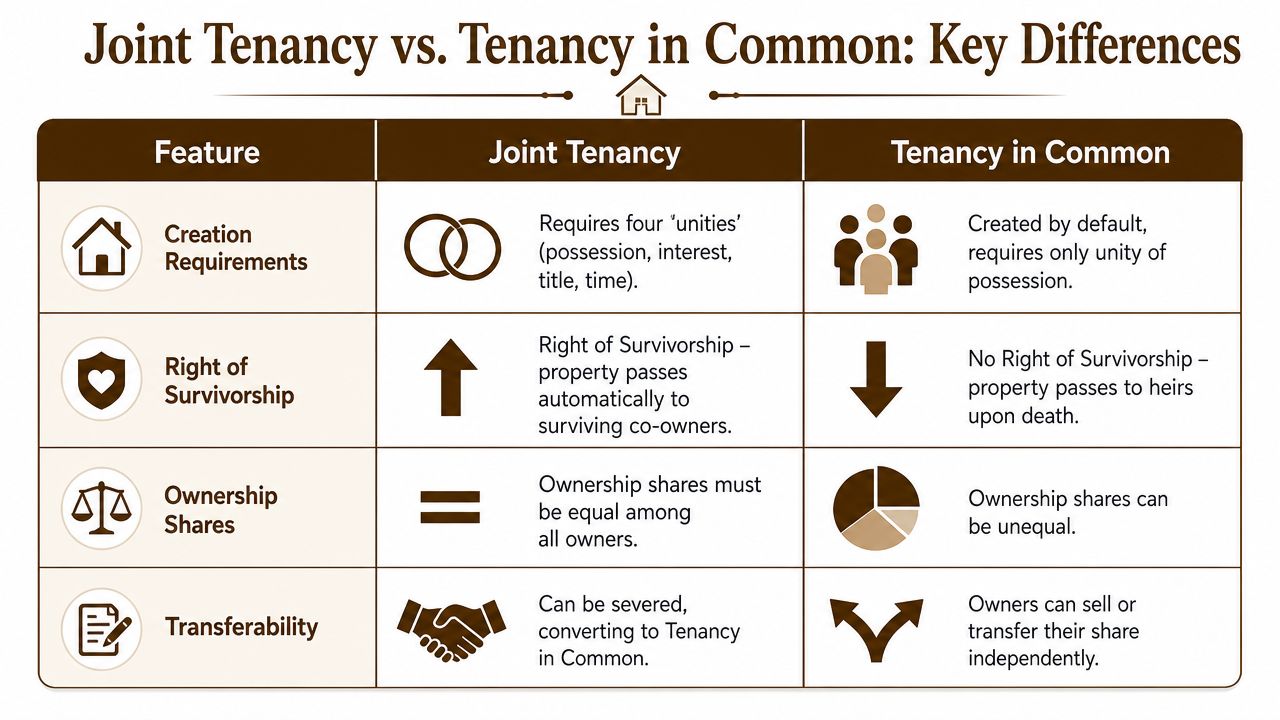
| Feature | Joint Tenancy | Tenancy in Common |
|---|---|---|
| Survivorship | Yes. A deceased owner's interest passes automatically to surviving owners | No. A deceased owner's share passes through their estate plan or succession rules |
| Ownership shares | Must be equal | Can be equal or unequal |
| Creation | Must be expressly created with the required structure | Often the default when survivorship language is absent |
| Transfer during life | A transfer can break the arrangement | Each owner can generally transfer their separate share |
| Estate planning effect | Limits control over who inherits the share | Preserves control over who inherits the share |
A visual summary helps many property owners compare the two before they sign a deed.
Severance changes everything
One of the most misunderstood rules in California is severance. A joint tenancy can be broken. When that happens, the right of survivorship can disappear as to the transferred interest.
As explained in this analysis of joint tenancy and tenancy in common, in California, a joint tenancy exists only when expressly declared in the will or transferred to be a joint tenancy in the deed. Any conveyance of one joint tenant's interest generally severs the joint tenancy into a tenancy in common as to that interest. Because a severed joint tenancy loses its right of survivorship, the death of a co-owner after severance means that their fractional interest passes through their estate rather than to the remaining owner.
That's not a technical footnote. It's often the turning point in a family dispute.
A practical California example
Suppose three siblings inherit title as joint tenants. One sibling later transfers their interest as part of a refinancing arrangement or private deal. That transfer may sever the joint tenancy as to that interest. Now the ownership structure is no longer the simple survivorship arrangement everyone thought they had.
If that sibling later dies, their interest may pass through their estate instead of automatically to the surviving siblings. The result can be surprise probate, surprise heirs, and a title record that no longer matches family assumptions.
What this means in the real world
If your priority is automatic transfer to the surviving owner, joint tenancy may fit.
If your priority is control, unequal percentages, or separate inheritance rights, tenancy in common usually fits better.
But the deed alone isn't enough. Owners also need to think about what happens if someone dies, wants to sell, stops paying, or transfers an interest without warning. Those aren't remote possibilities in California practice. They're the disputes that regularly lead to partition and quiet title litigation.
Common Co-Ownership Disputes and Legal Solutions
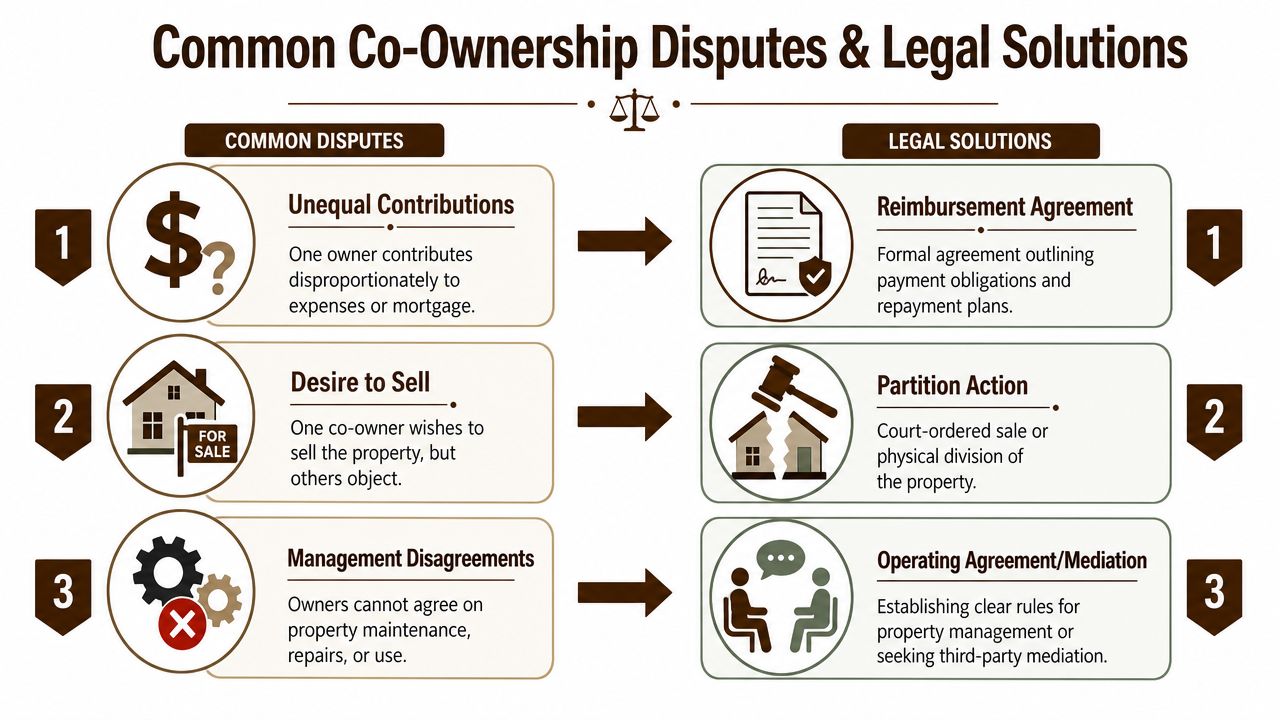
Most co-ownership problems don't begin with open hostility. They begin with assumptions. One owner assumes they'll be reimbursed for paying the mortgage. Another assumes living in the property gives them a larger claim. A sibling assumes the house can't be sold without unanimous consent. California courts see the fallout when those assumptions collide.
Partition actions
A partition action is the lawsuit co-owners file when they can't agree on whether to keep, divide, or sell property. In California, this is one of the most common and most disruptive co-ownership cases.
California treats the partition right among tenants in common as very strong. A single owner may demand partition. Courts often end up ordering a sale when physical division isn't practical, especially with residential property.
Common flashpoints include:
- One owner wants to cash out
- One owner lives in the home and blocks a sale
- Co-owners disagree over repairs or rental use
- Heirs inherit a share and don't want long-term co-ownership
Recent California analyses note that residential properties held as tenants in common after informal family arrangements are disproportionately drawn into forced-sale disputes over contributions, maintenance, and use. That lines up with daily practice in Orange County and Los Angeles, where inherited homes often become unworkable once one person wants liquidity and another wants sentiment to control the outcome.
Quiet title actions
A quiet title action is different. This lawsuit asks the court to determine who holds valid title when the record is clouded or disputed.
Quiet title issues often appear when:
| Problem | Why it happens |
|---|---|
| Old deed language is unclear | The document doesn't clearly state the intended form of title |
| Family transfers were informal | Someone was added to title without full documentation |
| A death changed expectations | Survivorship was assumed, but the deed says something else |
| Competing claims arise | Heirs, buyers, lenders, or co-owners assert conflicting rights |
A quiet title case may need deed analysis, probate records, trust documents, and evidence of the transfer history. These cases are detail-driven. Small drafting choices can have major consequences.
In co-ownership litigation, the fight is often less about abstract fairness and more about what the deed, the probate file, and the payment history can actually prove.
Contribution and reimbursement disputes
Even when title is clear, money issues remain. One owner may have paid the property taxes, insurance, mortgage, or major repair bills for years. Another may have occupied the property without contributing. Those facts matter.
Disputes usually center on questions like these:
Who paid carrying costs?
Mortgage payments, taxes, insurance, and repairs can affect credits and offsets.Who had exclusive use?
If one owner lived there while others were excluded, that may affect accounting.Was there an agreement?
A written buyout or reimbursement agreement can prevent a later credibility contest.What is the property worth now?
Valuation disputes can derail settlement even when everyone agrees a buyout is appropriate.
Why written agreements matter
California law gives co-owners rights. It doesn't give them harmony.
A carefully drafted co-ownership agreement can reduce the risk of forced sale by addressing use, expenses, valuation, buyout rights, and dispute resolution before conflict starts. Without one, co-owners often end up paying lawyers to reconstruct an agreement they never wrote down.
How to Choose the Right Title and When to Call an Attorney
A common California dispute starts like this. Two siblings inherit a house and take title without much discussion. One pays the taxes and insurance. The other assumes the property will stay in the family. A few years later, one wants a sale, the other wants to keep the house, and both are surprised to learn that the deed they signed set the rules long before the argument began.
That is why title choice deserves more attention than many buyers and families give it. A deed is not just a label. It works like the operating system for the property. It controls what happens at death, who can transfer an interest, and whether a future disagreement turns into a buyout discussion, a partition action, or a quiet title lawsuit.
A practical way to choose
Start with the outcome you want, not the title term that sounds familiar.
If your main goal is automatic transfer to the surviving co-owner, joint tenancy may fit. If your main goal is preserving separate shares for children, unequal contributors, or different estate plans, tenancy in common usually fits better.
Before you sign or change a deed, ask:
Do you want your co-owner to receive your share automatically at death?
If yes, joint tenancy may match that goal.Did the owners contribute different amounts to the purchase?
If yes, tenancy in common usually makes more sense because title can reflect unequal percentages.Do you want your share to pass under your will or trust?
If yes, survivorship can defeat that plan.Is there a real chance one owner will want out later?
That question matters more than people expect. Many partition cases begin with a casual assumption that everyone will stay aligned.Would you be willing to co-own the property with your co-owner's heirs?
In a tenancy in common, that is often the practical result after a death.Have you written down who pays expenses, who can live there, and how a buyout price will be set?
If not, you are leaving major terms to later conflict.
Here is the point clients often miss. Joint tenancy is simpler on the question of who inherits. Tenancy in common is more flexible while everyone is alive. Neither choice prevents conflict by itself. The deed sets the ownership structure, but it does not create a plan for daily management, reimbursement, occupancy, or exit rights.
When legal help makes sense before a problem starts
Some title decisions are routine. Others deserve legal review before anyone signs.
You should speak with a California attorney if:
- You are buying property with someone other than a spouse
- You are adding a child, partner, sibling, or parent to title
- Your estate plan and your deed may point in different directions
- A co-owner has died and you are not sure what happens next
- A refinance, transfer, or prior deed may have changed title without anyone fully understanding the effect
- One owner wants to sell and another refuses
- You suspect the recorded deed does not match the actual agreement
From a litigation perspective, these are not small issues. They are the facts that later drive partition complaints, probate fights, and quiet title cases. By the time the dispute reaches court, the central question is often narrow and unforgiving: what does the deed say, and can anyone prove a different legal or equitable interest?
That is why an early review can save money. A lawyer can compare the deed, the trust or will, the purchase contributions, and any side agreements before those documents pull in different directions.
The bottom line for California families
Joint tenancy works well when the owners want the same survivorship result and are comfortable with equal, undivided ownership. Tenancy in common works well when the owners want separate shares, separate heirs, or more customized planning. The better choice is the one that matches your actual intent and is supported by a written agreement if the relationship becomes strained.
In practice, the expensive mistake is usually not choosing joint tenancy instead of tenancy in common. It is signing a deed without asking what happens if one owner dies, one owner stops paying, or one owner files for partition.
If your title documents and your estate plan are telling different stories, a California court may be asked to decide which one controls.
If you're dealing with co-owned property, probate complications, a partition threat, or an unclear deed, Tanner Law can help you evaluate your rights under California law and build a practical strategy to protect your ownership interest. Schedule a free consultation to discuss your property, your title documents, and the best next step.