Constructive Notice Real Estate: Your CA Legal Guide
A family often learns what constructive notice means after a death, not during a calm planning meeting. A parent passes away, the house in Orange County or Los Angeles is supposed to transfer through probate or trust administration, and everyone believes title is straightforward. Then the title report shows a recorded deed, lien, abstract of judgment, or notice from years ago that no one remembers seeing.
At that point, the issue is not just who inherits the home. The issue is whether California law treats the family, the personal representative, the trustee, and even a future buyer as if they already knew that document existed.
That rule catches families off guard.
In practice, I see this most often where real estate and inheritance law overlap. An outdated transfer document can affect whether property belongs in the probate estate. A recorded lien can reduce what beneficiaries receive. A prior deed can create a fight over whether a house was really held in a trust, transferred outside probate, or still titled in a decedent's individual name at death. County recording systems do not care that the family never saw the paperwork. If the document was properly recorded, the law may treat it as notice to the world.

Constructive notice is one of those legal rules that sounds technical until it affects a house your family expects to keep or sell. It can protect heirs when title was properly documented. It can also create expensive problems when estate planning was incomplete, recordings were inconsistent, or no one checked the public record until after death.
For families handling an estate in Southern California, this doctrine is not abstract. It shapes title, timing, advantage in disputes, and the steps an executor, administrator, or trustee should take before distributing or listing property.
Table of Contents
- Introduction
- What Is Constructive Notice in Real Estate
- Actual vs Constructive vs Inquiry Notice
- How Constructive Notice Works Under California Law
- Constructive Notice in California Probate and Trusts
- Steps to Protect Your Property Interests
- When to Consult a Real Estate Attorney
Introduction
When a family inherits a house, they usually focus on the emotional and practical tasks first. They secure the property, locate the will or trust, and start asking how to transfer title. What often gets missed is the public record. That's where constructive notice lives, and that's where many probate fights begin.
In everyday terms, constructive notice means the law treats recorded property information as public knowledge. If a deed, lien, mortgage, or similar document is properly recorded, the legal system may assume everyone dealing with that property had notice of it, whether they looked it up or not.
Practical rule: In California real estate disputes, "I never saw the document" often isn't a winning argument if the document was properly recorded.
That rule exists for a reason. Real estate markets can't function if ownership and claims stay hidden. Buyers need a reliable system. Lenders need one too. So do heirs trying to determine whether a deceased parent's home passes free and clear, or subject to old encumbrances.
Why families run into trouble
The hardest cases usually aren't dramatic fraud stories. They're ordinary family situations with incomplete information.
- A sibling finds an old deed: A recorded transfer from years ago changes who owns the house.
- An executor discovers a lien: Estate distribution stalls because title isn't as clean as everyone assumed.
- A beneficiary sees conflicting paperwork: The trust says one thing, county records suggest another.
Why this doctrine matters so much in inheritance cases
Constructive notice doesn't just affect sales. It reaches directly into probate administration, trust disputes, quiet title litigation, and partition cases. If the public record shows a prior interest, California courts may give that record serious weight when deciding who owns what.
For families, that means one thing. Before you assume a home can be transferred, sold, or distributed, you need to know what the county records say.
What Is Constructive Notice in Real Estate
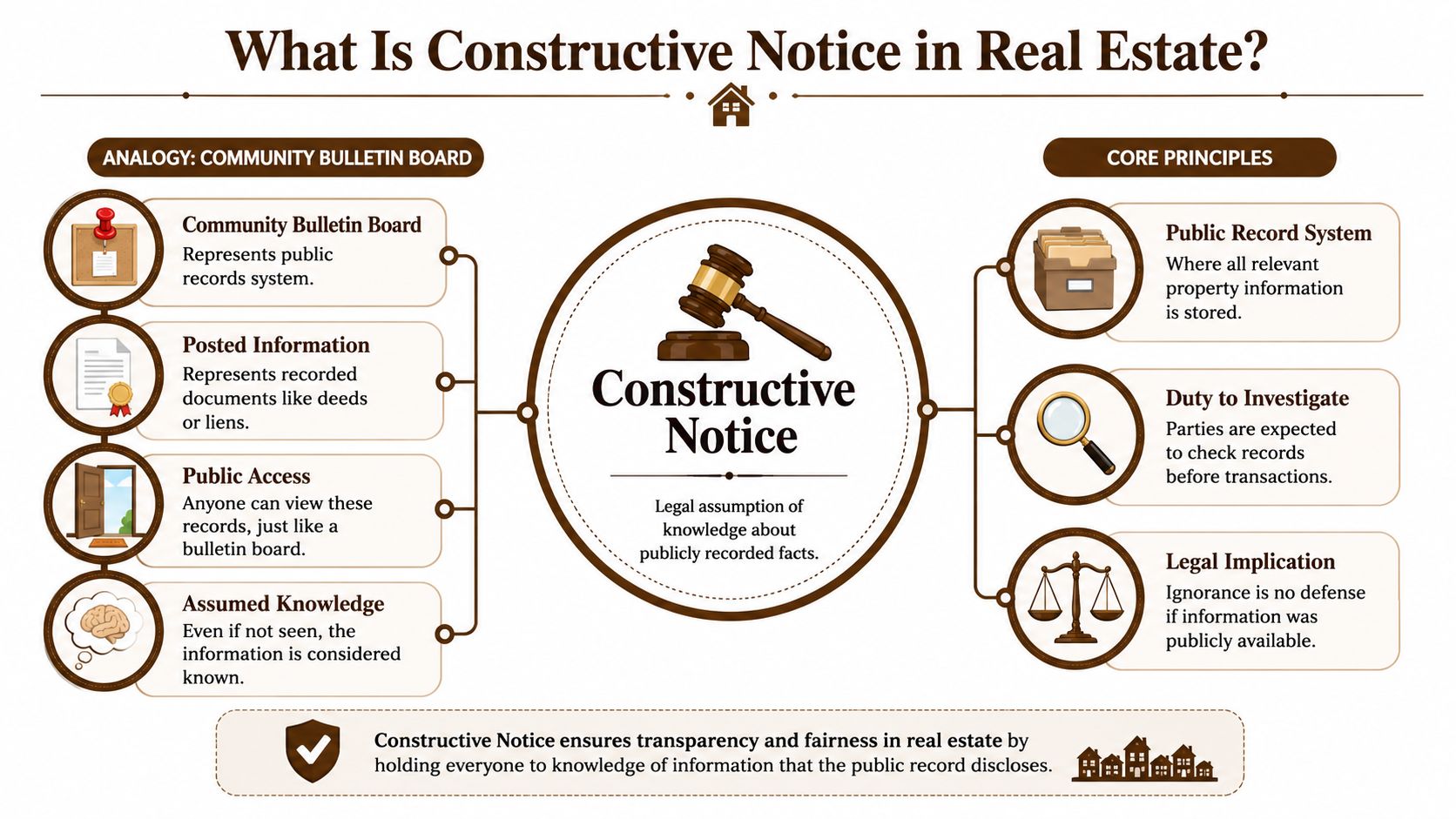
Constructive notice in real estate is a legal presumption. The law assumes a person knows a fact because it was available in the public record, even if that person never read the document.
A simple analogy helps. Think of the county recorder's office as a public bulletin board or library catalog. Once a deed, lien, or mortgage is properly posted there, the law treats it as available to everyone. You don't have to prove that a particular buyer or heir opened the file. The legal system treats the information as publicly known.
The core idea
Constructive notice is not about what someone knew in their mind. It's about what the law says they were responsible for knowing because the information was publicly recorded.
That distinction matters. Families often say, "No one told us about that lien," or "We didn't know Dad signed that deed." Those statements may be factually true. They still may not defeat a recorded claim.
If a document affecting title is in the county records, California law may treat that document as "known" to later parties dealing with the property.
Why the law uses this rule
Without constructive notice, real estate ownership would become unstable fast. Hidden transfers and secret liens would undermine sales, refinancing, and inheritance administration. Recording laws solve that problem by rewarding people who properly record their interests and putting later parties on legal notice.
Here is what constructive notice is designed to do:
- Promote transparency: Public records create a common reference point for property rights.
- Prevent secret deals: A person can't claim an interest and expect later parties to guess it exists.
- Protect recording diligence: The party who records first usually strengthens that party's position.
- Encourage investigation: Buyers, executors, and trustees are expected to review the public record before acting.
What documents can trigger it
In California, constructive notice commonly arises from recorded:
- Deeds
- Deeds of trust or mortgages
- Liens
- Judgments affecting title
- Easements
- Notices tied to pending litigation, such as a lis pendens
In probate matters, families can get blindsided. A document may have been recorded long before the decedent's death, and the family may have never discussed it. That silence doesn't erase the filing.
What doesn't work
What usually doesn't work is relying on assumptions. Possession of keys, payment of property taxes, or a verbal understanding within the family may matter in some disputes, but they don't replace a careful review of the recorded chain of title.
Actual vs Constructive vs Inquiry Notice
California property disputes often involve three related concepts: actual notice, constructive notice, and inquiry notice. They overlap, but they aren't the same. Understanding the difference helps families see why ignorance isn't always a defense.
Under California Civil Code § 1214, a buyer claiming innocent purchaser status must lack both actual notice and constructive notice of a prior claim. A properly filed lien means the buyer can't legally claim ignorance, as explained in this discussion of California's innocent purchaser defense.
Comparison of Legal Notice Types in Real Estate
| Type of Notice | Definition | Example |
|---|---|---|
| Actual Notice | Direct knowledge of a fact or claim | A sibling tells a buyer that the home is already subject to a co-owner's interest |
| Constructive Notice | Knowledge the law imputes because a document was properly recorded or otherwise publicly available | A deed of trust appears in county records, even though the buyer never reviewed it |
| Inquiry Notice | Knowledge the law may impose when visible facts would prompt a reasonable person to investigate further | Someone other than the seller occupies the house, suggesting possible unrecorded rights |
How these play out in real life
Actual notice is the simplest. A person knows because someone told them, handed them the document, or they otherwise learned the fact directly.
Constructive notice is less intuitive. The person may swear they never saw the filing, but the public record can still bind them.
Inquiry notice sits in the middle. It applies when facts on the ground would make a reasonable person ask follow-up questions. If a property appears occupied by someone whose rights aren't explained, or the paperwork obviously conflicts, a buyer or fiduciary may have a duty to investigate further.
Why this matters for families: A beneficiary may not have actual notice of a prior transfer, yet still be affected by constructive notice from the recorded deed and inquiry notice from facts that should have prompted further review.
The innocent purchaser issue
Families sometimes assume a later buyer can wash away old title problems. That's not always true. In California, a buyer generally needs to be without both direct knowledge and legally imputed record knowledge to claim protected status against earlier interests.
That means these arguments are often weak:
- "I didn't search the records."
- "No one mentioned the lien."
- "The deed was old, so I assumed it didn't matter."
A better approach is to treat title investigation as mandatory, not optional. That applies to purchasers, trustees, executors, and heirs deciding whether to sell, refinance, or distribute property.
How Constructive Notice Works Under California Law
California gives constructive notice real legal force through its recording statutes. The key rule appears in California Civil Code § 1213. Once an instrument such as a deed is properly recorded in the county where the property is located, it gives constructive notice to subsequent purchasers and mortgagees. A recorded deed for an Orange County home is legally known to a potential buyer in Los Angeles, as described in Barnes Walker's explanation of California-style constructive notice principles.
The county recorder is the hub
For practical purposes, the county recorder's office is where this doctrine becomes real. In California, documents affecting title are recorded in the county where the property sits. If the home is in Orange County, that's where the critical filing usually happens. If it's in Los Angeles County, that's where counsel starts.
The recording office is not a passive archive. It functions as the official public system that puts later parties on legal notice.
What usually gets recorded
Constructive notice most often arises when someone records one of the following:
- Grant deeds or quitclaim deeds
- Deeds of trust
- Liens
- Judgments affecting title
- Easements
- Lis pendens, which is notice of pending litigation involving the property
Once properly recorded, these documents can affect priority, transfer rights, and dispute outcomes.
Timing matters
In title disputes, the recording date can be more important than family expectations or handshake understandings. That's because priority often turns on what was in the public record when a later party acquired rights.
This catches families off guard in estate matters. A trust may identify a beneficiary, but if an earlier recorded document already changed title, the trust administration process has to account for that reality.
Recording isn't paperwork for its own sake. It's the step that tells the legal system who may have rights in the property.
What California families should take from this
When someone dies owning real estate, don't assume title can be read from a will, a trust summary, or family memory alone. California law places enormous weight on recorded instruments. The public record may confirm the family's understanding, or it may reveal a problem that has to be resolved before transfer.
A basic title review often answers questions that otherwise become litigation:
- Who held record title before death.
- Whether a transfer was already recorded.
- Whether liens or encumbrances remain of record.
- Whether a pending lawsuit clouds title.
Constructive Notice in California Probate and Trusts
A daughter in Orange County brings in her mother's trust and says the house is supposed to go to all three children equally. The trust says that. The county record says something else. Five years before death, a deed was recorded putting title in one son's name. That recorded deed changes the conversation immediately.
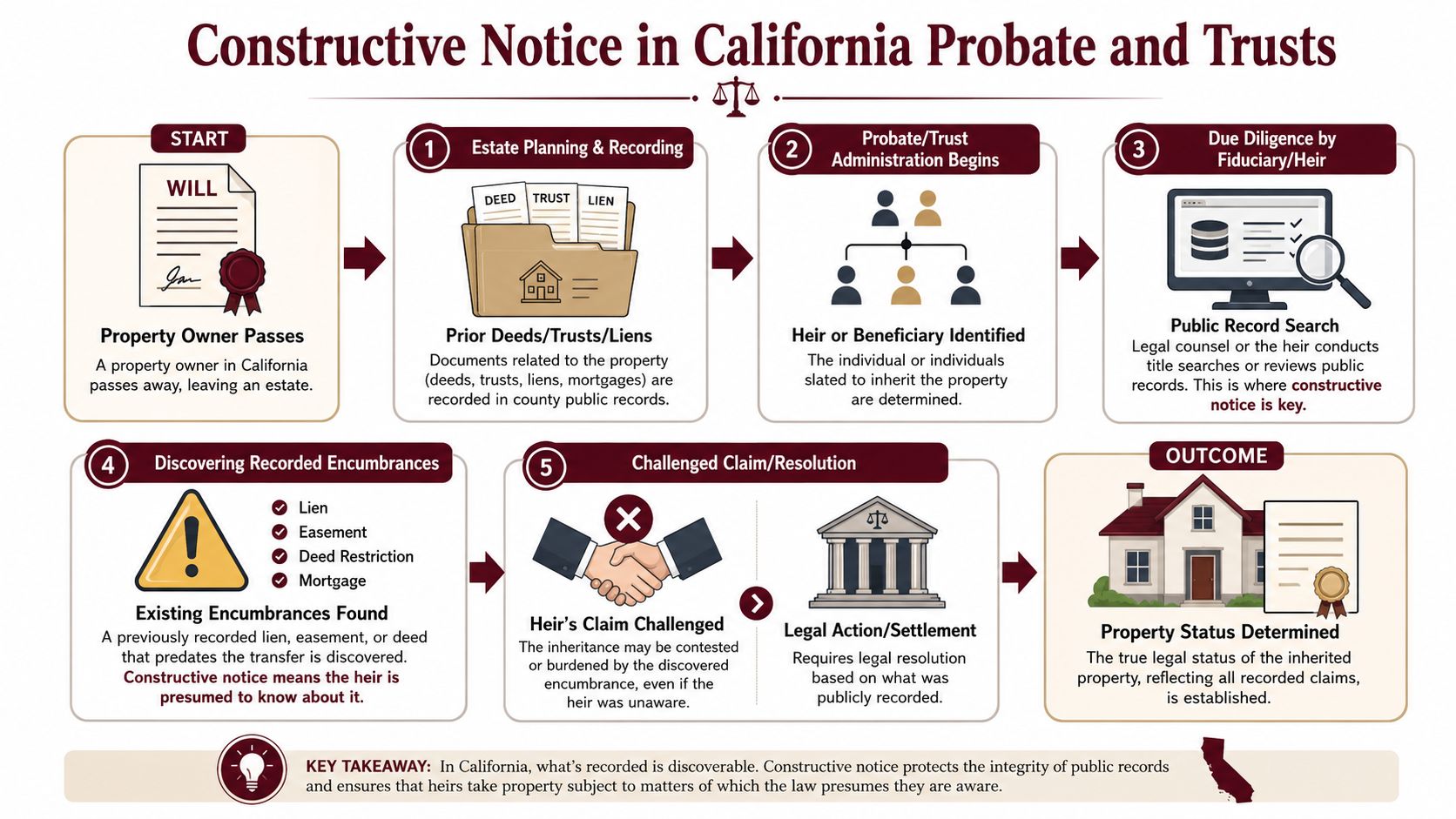
In probate and trust administration, constructive notice stops being an abstract title concept. It decides whether a home can be transferred, sold, refinanced, or distributed at all. For heirs and fiduciaries in Los Angeles and Orange County, the practical question is rarely just what the decedent intended. The question is what the public record showed at the time rights were created, changed, or challenged.
That is why this issue surfaces so often in inheritance disputes. Families usually focus on the will, the trust, or what was said at the kitchen table. Title problems usually come from somewhere else. A recorded deed to one child. An unreleased deed of trust from an old refinance. A lien no one mentioned because everyone assumed it had been resolved years ago.
Three recurring probate scenarios
Recorded transfer to one heir
A parent tells the family the house will be divided equally, but an earlier recorded deed names only one child. In many cases, the first legal question is not whether the promise was sincere. It is whether the recorded transfer was valid, delivered, and still effective at death.
Lien discovered during administration
The personal representative lines up a sale, and title shows a recorded claim against the property. That can delay closing, reduce net proceeds, and force the estate to decide whether to pay, contest, or otherwise resolve the claim before distribution.
Old financing never cleared
A loan may have been paid off years ago, but if the reconveyance was never recorded, title still looks clouded. That creates delay, buyer concern, and extra legal work at the worst time, usually after a sale is already in motion.
Later in the process, it helps to hear the issue explained visually:
A real probate file often turns on details that families do not expect to matter. I handled a matter in Orange County involving a house held for years outside the trust, even though the settlor believed it had already been placed into the trust with the rest of her assets. One child had been helping with finances. Another child lived in the property. After death, the family assumed the trustee could sign transfer documents and move on.
The title report showed a recorded grant deed from years earlier that did not match the trust plan the family had been relying on. It also showed an old deed of trust that appeared to remain of record. Neither issue was obvious from the estate planning binder. Before anyone could discuss equal distribution, we had to determine whether the deed was effective, whether the asset belonged in the trust or probate estate, and whether the old loan had been reconveyed. That meant gathering payoff records, reviewing signatures and acknowledgments, and matching the timeline of recordings to the decedent's capacity and intent at the time. The legal work was manageable, but the delay and family tension were very real.
This is the part many general real estate articles miss. In probate and trust administration, constructive notice does not only affect a later buyer. It affects heirs, beneficiaries, trustees, and executors who assumed the estate plan alone controlled the result.
Why trust and probate documents are not enough by themselves
A trust can express a clear plan and still fail to control title to a specific property if the property was never transferred into the trust, or if a later recorded instrument changed the title picture. Probate documents have a similar limit. They address how property should pass through the estate process. They do not erase a previously recorded interest.
Families find this frustrating because it feels technical. In practice, the rule is fairly simple. County land records are the legal filing cabinet for real property rights. If something important was recorded there, the estate has to deal with it directly.
That does not mean the family automatically loses. It means the case becomes a title analysis, not just an inheritance discussion. Sometimes the answer is a petition. Sometimes it is a corrective deed, a recorded reconveyance, a quiet title action, or a negotiated resolution among beneficiaries.
In inheritance disputes, expensive mistakes often start with a simple assumption: that the trust binder tells the whole story.
What works in practice
The best early move is to compare the estate plan against the title record before making promises to beneficiaries. Trustees and executors should confirm how title was held at death, identify any recorded transfers or claims, and address conflicts before listing the property or preparing distribution papers.
That early review saves time, reduces avoidable conflict, and gives the family a realistic path forward.
Steps to Protect Your Property Interests
A family often learns about constructive notice at the worst possible moment. The house is ready to sell, distributions have been discussed, and then the preliminary title report shows a recorded lien, an old deed, or a notice that no one in the family knew existed. In probate and trust administration, the best protection is early title work, followed by a clear plan for fixing what the record shows.
In my practice, I have seen recorded liens from one county stall an estate sale or distribution involving property in another. That surprise is common in Orange County and Los Angeles matters, especially when a decedent owned multiple properties, refinanced over the years, or moved assets in and out of a trust without cleaning up the record afterward.
Start with the record before you make promises
Order a preliminary title report early. Do it before listing the property, signing a sale contract, or telling beneficiaries when they will receive their share. A family can work around many title problems if they catch them early. Problems become more expensive once a closing date is set or beneficiaries start relying on expected numbers.
Review the report with care. Do not stop at “there is a lien.” Identify the type of lien, who recorded it, and when. A recently recorded mechanic's lien raises a different set of questions than an old abstract of judgment or a deed of trust that should have been reconveyed years ago.
Use this checklist:
- Confirm vesting at death: Check exactly how title was held. Individual name, trustee of a trust, joint tenancy, community property, or some other form.
- Trace the chain of title: Look for deeds recorded close to death, corrective deeds, quitclaim deeds between family members, and transfers that do not match the estate plan.
- Classify each recorded claim: Tax lien, deed of trust, judgment lien, mechanic's lien, lis pendens, easement, HOA lien, or something else. The strategy depends on the category.
- Check recording dates carefully: Priority often turns on timing. A claim recorded last month calls for a different response than one recorded ten years ago and never enforced.
- Look for missing releases: Paid loans and settled claims still cloud title if the reconveyance or release was never recorded.
- Compare the title record to the trust or will: If the plan says the house goes to one beneficiary but title was never transferred into the trust, the administration path may change.
One practical point matters more than families expect. County records do not care what everyone "understood." They reflect what was recorded.
Record curative documents without delay
Many inheritance title problems become harder because the family waits too long to record the document that fixes the issue. Court orders, deeds, affidavits, and reconveyances do little for title until they are placed in the public record where buyers, lenders, and title officers can see them.
Documents that often need prompt recording include:
- Executor's deeds or administrator's deeds
- Affidavits of death of joint tenant
- Affidavits of death of trustee
- Court orders confirming sale or determining ownership
- Full reconveyances or lien releases
- Settlement agreements or stipulations that change ownership and are intended to affect title
Before recording, confirm that the document is drafted correctly, signed properly, and indexed to the right property and parties. A flawed recording can create a second problem instead of solving the first.
Match the remedy to the title problem
Different defects require different tools. Families lose time when they treat every cloud on title the same way.
A missing reconveyance may be handled through payoff proof and a recorded release. A dispute over whether property belongs to the trust may require a probate petition or trust-related court relief. A plainly invalid deed may call for a quiet title action. Co-owners who inherited together but cannot agree may need a partition case or a negotiated buyout. If a valid lien exists, the right move may be payment from sale proceeds rather than a fight over priority.
Title insurance also has a role, but families should use it for what it does well. It helps surface recorded issues before closing and may provide coverage under the policy terms. It does not erase every defect, and it does not replace legal analysis when probate, trust administration, and title questions overlap.
Avoid informal fixes
Side agreements, text-message understandings, and unsigned family notes rarely solve a recorded title problem. They usually create false confidence, then fail when a buyer, lender, or title company asks for recordable proof.
Address title issues while the estate is still being administered, not after a sale falls apart. That timing gives the executor, trustee, heirs, and beneficiaries more options and usually lowers the cost of getting the property into a condition that can be sold or distributed.
When to Consult a Real Estate Attorney
Families should consider legal help as soon as there's uncertainty about title to inherited property. That includes situations involving a surprise deed, an old lien, conflicting trust paperwork, missing reconveyance documents, co-owner disputes, or a planned sale during probate.
The reason is straightforward. Constructive notice real estate rules give unusual power to the public record. If county filings and family expectations don't match, delay can make the problem harder to solve. An attorney can evaluate the chain of title, explain whether California's notice rules affect priority, and recommend whether the matter calls for cleanup, negotiation, probate relief, or litigation.
This is especially important in Orange County and Los Angeles, where families often deal with high-value real estate, blended families, older estate plans, and property that has changed hands informally over time. A short review now can prevent a larger dispute later.
If you're dealing with inherited property and something about title doesn't look right, trust that instinct. The issue may be fixable, but it should be addressed before distribution, sale, or refinancing.
If your family is facing questions about constructive notice, probate real estate, a clouded title, or a disputed inheritance in Orange County, Los Angeles, or nearby courts, schedule a free consultation with Tanner Law. Tanner Law helps families, heirs, trustees, and executors sort out recorded claims, ownership disputes, and title problems with practical California guidance.