Breach of Trust Meaning: A California Guide for Families
You may be reading this because something feels off.
A parent died. A house in Orange County is tied up in a trust. A sibling who became trustee won't answer basic questions. Or a real estate professional handled sale proceeds, made decisions behind closed doors, and now the numbers don't add up. In Los Angeles and Orange County, these situations often lead families to search for the breach of trust meaning under California law.
That instinct is usually right. When someone controls money, property, or important decisions for another person's benefit, the law expects care, honesty, and loyalty. If that person abuses the role, ignores required duties, or causes harm through carelessness, California law may treat that conduct as a breach of trust.
Many people assume this only applies when there is a formal trust document signed and notarized. That's not always true. One of the most important and least understood issues in California law is that a breach of trust can sometimes arise even without a formal trust instrument, especially when a person places themselves in a position of confidence and then misuses that position.
Table of Contents
- Understanding a Breach of Trust in California
- Defining a Breach of Trust Under California Law
- The Three Categories of a Trust Breach in California
- Real-World Breach of Trust Examples in OC and LA
- Your Legal Options and Critical Deadlines
- How Tanner Law Protects Your Rights and Assets
Understanding a Breach of Trust in California
A common California family dispute often unfolds gradually. A trustee says, “Don't worry, I'm handling it.” Months pass. There's no accounting. The family home in Irvine hasn't been sold, rented, or maintained properly. Beneficiaries hear that money was moved, but no one can explain where it went.
That's when concern turns into a legal question. Not every mistake is wrongdoing, but not every wrongdoing looks dramatic at first. A breach of trust often begins with ordinary warning signs such as delayed communication, unexplained decisions, conflicts of interest, or missing records.
Why families get confused
The term “trust” often conjures images of estate planning documents. Under California law, that's only part of the picture. The legal problem is broader. It focuses on whether someone who owed duties to another person violated those duties and caused harm.
A breach of trust can happen through an act or an omission. In other words, doing the wrong thing can create liability, but so can failing to do what the law required.
In probate and real estate disputes across Orange County and Los Angeles, the emotional difficulty is part of what makes these cases hard. The person you suspect may be a sibling, stepparent, longtime agent, caregiver, or business partner. Families often hesitate because they don't want to accuse someone unfairly. That hesitation is understandable, but legal clarity matters.
What the issue usually comes down to
In practical terms, these cases often turn on a few basic questions:
- Who controlled the property or decision-making: Was someone acting as trustee, agent, broker, manager, co-owner, or informal decision-maker?
- What duty applied: Did that person owe loyalty, honesty, care, disclosure, or proper recordkeeping under California law?
- What went wrong: Did they misuse assets, hide information, favor themselves, or handle matters carelessly?
- Who was harmed: Did the beneficiary, heir, or co-owner lose money, property value, or legal rights?
Once you understand those pieces, the breach of trust meaning becomes much clearer.
Defining a Breach of Trust Under California Law
A plain English definition
The simplest definition is this. A breach of trust happens when a person responsible for managing property or acting for another person's benefit fails to meet the duties that role requires.
A trustee is the most obvious example. If a trustee manages trust money for beneficiaries, California law expects the trustee to act carefully and for the beneficiaries' benefit rather than personal advantage. If the trustee breaks those duties, the trustee can be held liable.
The legal rule is stated clearly in this discussion of breach of trust and case law:
“A breach of trust is legally defined as any act or omission by a trustee that violates the fiduciary duties explicitly imposed by the trust instrument, relevant statutes, or case law precedents, regardless of whether the violation was intentional or negligent. This violation creates a direct liability where the trustee must redress the breach.”
That language matters because it answers a question people ask all the time. Intent is not always required. A trustee can create liability through deliberate misconduct, but also through negligence.
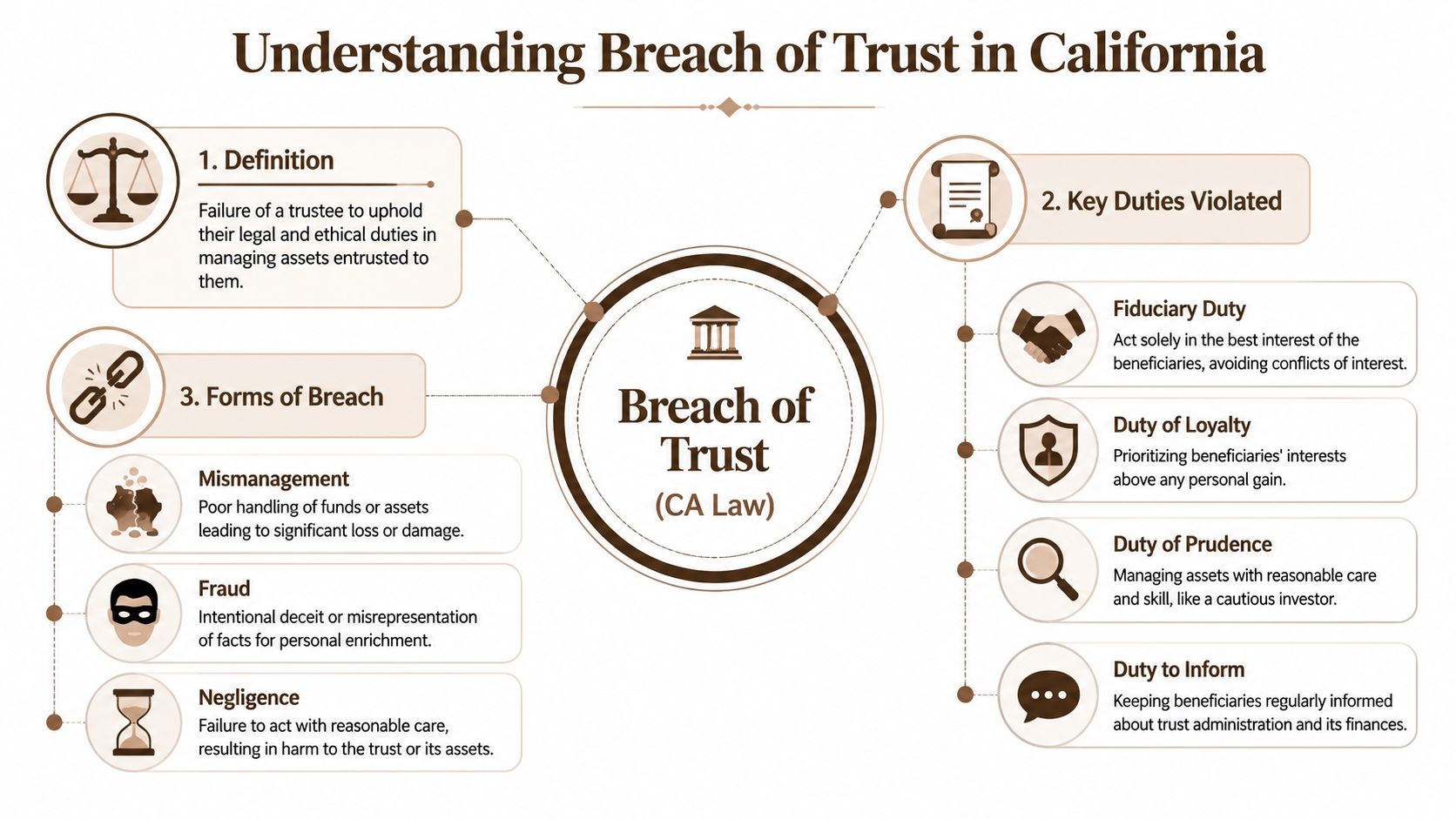
Here is the required visual summary:
The duty behind the rule
A good way to understand fiduciary duty is to think about a designated driver. That person has accepted responsibility for others' safety. The role carries trust, and that trust changes what the law expects. A trustee is similar, except the trustee is protecting money, property, and the beneficiaries' interests.
Under California law, the trustee's duties commonly include:
- Loyalty to beneficiaries: The trustee can't put personal gain ahead of the people the trust is meant to protect.
- Prudent management: The trustee must handle assets with reasonable care, not casual guesswork.
- Disclosure and information: Beneficiaries usually have a right to basic information about trust administration.
- Following the trust terms: A trustee must carry out the instructions in the trust, not invent new rules for convenience.
What qualifies as a violation
A breach doesn't only mean theft. It can include self-dealing, failing to keep records, withholding information, ignoring legal requirements, or making poor decisions that a careful trustee should have avoided.
Practical rule: If a person had a duty to protect property or act for someone else's benefit, and that person instead caused loss through disloyalty, secrecy, or carelessness, California law may treat that conduct as a breach of trust.
That's the core of the breach of trust meaning in everyday life. It is less about labels and more about duties, conduct, and harm.
The Three Categories of a Trust Breach in California
California law doesn't treat every breach the same way. The law recognizes different forms of misconduct, and that matters because the facts shape the remedy, the evidence needed, and sometimes whether a person without a formal title can still be held responsible.
According to Lewman Law's discussion of California breach categories, California law explicitly recognizes three distinct categories of breach of trust: intentional breach, negligent breach, and constructive breach.
How California groups these cases
The easiest way to see the difference is side by side:
| Category | What it looks like | Common example |
|---|---|---|
| Intentional breach | Deliberate wrongdoing for personal gain | Embezzling trust funds or lying about trust assets |
| Negligent breach | Careless handling of duties without malicious intent | Failing to communicate, ignoring legal requirements, or mismanaging records |
| Constructive breach | Liability imposed because the person created a position of trust, even without a formal fiduciary title | A non-trustee using trusted control over property or funds in a harmful way |
Intentional breach is the clearest. A trustee knows the rule and breaks it anyway. If a trustee transfers trust money into a personal account, that is the kind of conduct people immediately recognize as wrongful.
Negligent breach causes more confusion. A trustee may think, “I didn't mean to hurt anyone.” That defense often isn't enough. If the trustee failed to keep records, missed important obligations, or let trust property deteriorate through inattention, the law may still find a breach.
Why constructive breach matters
Constructive breach is the nuance many families miss. Here, the breach of trust meaning expands beyond the formal title of “trustee.”
A person can step into a de facto fiduciary role by conduct. That means the person took on influence, control, or responsibility in a way that justified reliance by others. If that person then abuses the position, California law may allow a claim even though no trust document named them trustee.
The key question is not always, “Was there a signed trust document?” Sometimes the real question is, “Did this person act like a trusted fiduciary and then violate that trust?”
This matters in real estate disputes, family property conflicts, and inheritance matters where one person informally takes charge. A broker, caregiver, co-owner, or advisor may not fit the traditional image of a trustee, but their conduct can still trigger serious legal consequences.
Real-World Breach of Trust Examples in OC and LA
A family often learns what a breach of trust means only after the damage is already underway. One relative has the keys, the records, or the authority to speak for everyone else. Another person keeps saying, “Trust me, I'm handling it.” By the time questions start, money may be missing, a property may be tied up, or a sale may already be in motion.

A probate example involving family property
A mother in Orange County leaves her home in a living trust. Her son becomes trustee. His job is straightforward on paper. Protect the house, keep accurate records, treat all beneficiaries fairly, and give honest information about what he is doing.
Instead, he moves into the property, stops answering basic questions, and arranges to buy the house himself for less than the other beneficiaries believe it is worth. He says he will clean up the paperwork later. He never gives a full accounting of rent, expenses, or the sale terms.
That is a classic self-dealing problem. A trustee cannot treat trust property like a personal opportunity fund. The role works like a guardrail. Once the trustee starts using trust assets for his own advantage, the court will look closely at whether he put his interests ahead of the beneficiaries.
A California court would usually examine several practical questions:
- Was the sale fair? If the trustee bought the property below market value, the trust may have suffered a measurable loss.
- Were the beneficiaries told enough to protect themselves? Silence can matter as much as an outright lie.
- Were records kept? Missing accountings often signal larger trouble.
- Did the trustee benefit personally from the position? Personal gain is often the center of the dispute.
Families sometimes get stuck on intent here. They focus on whether the son meant to cheat anyone. The stronger question is usually whether he honored the duties that came with control over the property.
A real estate example without a formal trust document
Now take a Los Angeles sale involving inherited rental property. Two siblings co-own the building. One lives out of state and relies heavily on a local broker who starts doing far more than listing the property. The broker handles communications, recommends repairs, talks directly with prospective buyers, and tells the family which offers are “safe” to accept. Over time, the siblings stop making independent decisions and begin following the broker's lead.
Then they learn the broker had an undisclosed relationship with the buyer, or stood to benefit from steering the sale in a particular direction.
There may be no trust document at all. No one was formally named trustee. That does not always end the analysis under California law.
The question becomes whether the broker, manager, caregiver, co-owner, or other informal decision-maker stepped into a position of confidence and control that created fiduciary-like duties in practice. Lawyers often describe this as a de facto fiduciary situation. In plain English, the person acted like a trusted protector of someone else's interests, invited reliance, and then abused that role.
A court may test that issue by looking at conduct, not labels. Did the person take charge of decisions? Did others reasonably rely on that person's advice or management? Did the person hide a conflict, divert money, or push a transaction that served personal interests over the family's interests?
That is the nuance many families miss. Breach of trust claims do not always begin with a formal trust instrument. Sometimes they begin with an informal arrangement where one person gained unusual influence over property or money and used that influence unfairly.
If someone took control of the process, encouraged your reliance, and then used that position to benefit themselves, you may still have a serious claim even if no signed trust document exists.
These disputes show up often in Orange County and Los Angeles around inherited homes, jointly owned property, sale proceeds, caregiver involvement, escrow disputes, and family deals built on verbal understandings instead of clear paperwork.
Your Legal Options and Critical Deadlines
If you suspect a breach of trust in California, the next question is practical. What can you do?
The answer depends on the facts, but California courts have broad power to protect beneficiaries and property interests. In many cases, a court can order action quickly if the evidence shows trust assets are at risk.

What a California court can do
Depending on the situation, legal remedies may include:
- Compelling an accounting: The trustee may be ordered to produce records and explain transactions.
- Suspending or removing the fiduciary: If the person in control can't be trusted, the court can replace them.
- Surcharge: The court can order repayment for loss or depreciation caused by the breach.
- Disgorgement or recovery of profits: If the wrongdoer benefited personally, the court can require those gains to be returned.
- Voiding unauthorized acts: Improper transfers or transactions can sometimes be unwound.
- Tracing property: If assets were moved or mixed with other funds, the court may allow efforts to trace and recover them.
A legal claim is not just about punishment. It is about restoring the property, protecting beneficiaries, and stopping further harm.
Why waiting is dangerous
Many families wait because they want more proof, or because they hope the person in control will finally cooperate. That delay can be costly. Evidence gets harder to find. Property may be transferred. Money may be spent. Witness memories fade.
Deadlines matter. The exact filing deadline depends on the type of claim, the facts, when the breach was discovered, whether disclosures were made, and the procedural posture of the trust or probate case. That is why early legal review matters in California trust litigation.
“I need more time to see what happens” is one of the most expensive choices a beneficiary can make.
There is another reason to act promptly. In California, misappropriation of trust property exceeding $950 can be classified as a felony under the rule summarized in Keystone Law's explanation of breach of trust consequences. That threshold marks the point where conduct can move beyond civil liability and into potential criminal exposure.
The criminal issue won't arise in every case. But it shows how seriously California law views misuse of trust property. Even when a family wants only a civil remedy, the underlying conduct can be severe.
Steps that usually help right away
If you believe a breach occurred, these actions usually make sense:
- Preserve records. Save emails, texts, account statements, closing papers, and property documents.
- Write down the timeline. Include dates of conversations, transfers, refusals to provide information, and suspicious transactions.
- Avoid informal confrontations that create new problems. A rushed accusation can lead to document destruction or harden positions.
- Get legal advice early. A California attorney can assess the duties involved, identify the right claims, and evaluate deadline risks.
How Tanner Law Protects Your Rights and Assets
Families dealing with breach of trust concerns often come in with the same fear. They know something is wrong, but they don't know whether the problem is serious enough to justify legal action. In California, that uncertainty is common, especially when the person involved is a relative or a trusted real estate professional.
The first job is to separate suspicion from proof.

Red flags that deserve legal attention
Certain patterns show up again and again in Orange County and Los Angeles trust and property disputes:
- Silence instead of transparency: A trustee or decision-maker won't provide records, updates, or straight answers.
- Personal benefit: The person in control appears to be using property, money, or influence for their own advantage.
- Unexplained losses or transfers: Funds moved, title changed, or sale proceeds disappeared without a clear lawful basis.
- Pressure and secrecy: Family members are told to sign quickly, stay quiet, or “trust the process.”
- Informal control by a non-trustee: A broker, co-owner, caregiver, or advisor effectively ran the show and then caused harm.
Those signs don't automatically prove liability, but they justify immediate review.
What effective legal help looks like
An experienced California attorney can investigate the facts, demand records, analyze whether a fiduciary or de facto fiduciary duty existed, and determine whether the case belongs in probate court, civil court, or both. In many matters, the critical early move is requiring a formal accounting or seeking court intervention before more damage occurs.
For families dealing with inherited homes, co-owned real estate, disputed sale proceeds, or trustee misconduct, the legal work often includes reviewing title history, trust terms, communications, transaction documents, and evidence of conflicts of interest. In cases involving a non-trustee, the analysis turns to conduct, reliance, control, and whether California law would treat that person as occupying a constructive position of trust.
The right legal approach isn't just about filing a claim. It's about stopping further loss, preserving evidence, and choosing the forum and remedy that best protects your rights.
If you're facing questions about the breach of trust meaning in a probate, estate planning, or real estate dispute, you don't have to sort it out alone.
If you believe a trustee, broker, co-owner, caregiver, or other trusted person has mishandled money or property, schedule a free consultation with Tanner Law. The firm helps families and property owners in Orange County and Los Angeles evaluate suspected breaches, protect assets, and take prompt action under California law.