Community Property with Right of Survivorship
You and your spouse bought a home in Orange County or Los Angeles. The escrow officer slid over a stack of documents and asked a question that sounded routine: how do you want to hold title?
Many families answer that question quickly, then move on to the loan, the keys, and the move-in date. Years later, after a death, a refinancing, or a dispute among relatives, they discover that title wasn't a small paperwork detail. It was one of the most important estate-planning decisions attached to the home.
For California couples, Community Property with Right of Survivorship can be a powerful tool. It combines shared marital ownership during life with an automatic transfer to the surviving spouse at the first death. That can simplify administration and change the tax picture in ways many families don't fully understand until it's too late.
This matters even more when a home becomes the center of a later conflict. Questions about who owns what, whether probate is required, whether title needs to be cleaned up, or whether a future sale triggers tax problems often show up together. That's why families need more than a definition. They need a practical understanding of what this title form does.
Table of Contents
- An Introduction to California Property Ownership
- What Is Community Property with Right of Survivorship
- Comparing CPWROS Joint Tenancy and Community Property
- The Key Benefits Tax Savings and Probate Avoidance
- How to Create and Transfer Property into CPWROS
- Common Disputes and Long Term Planning Concerns
- Is CPWROS Right for Your Family A Final Checklist
An Introduction to California Property Ownership
California law gives married couples several ways to hold title to real property. That choice affects what happens while both spouses are alive, what happens when one dies, and whether the family ends up in probate court.
For many people, title sounds abstract. It isn't. Title is the legal label on ownership. It tells the world whether a home is owned by one person, by spouses as community property, by co-owners in joint tenancy, or in another form. If the deed uses the wrong vesting language, the result after death may be very different from what the couple intended.
Under Cornell Law School's explanation of community property with right of survivorship, in community-property states this form of title means the surviving spouse automatically becomes the sole owner when the first spouse dies, and the asset generally avoids probate entirely. That point is central. If spouses hold title as ordinary community property without survivorship language, the deceased spouse's one-half interest passes through will, trust, or intestacy instead.
Why families get tripped up
A lot of confusion comes from the fact that California recognizes more than one title form that sounds similar. People hear phrases like "community property," "joint tenancy," and "right of survivorship" and assume they all do roughly the same thing. They don't.
One title form may avoid probate at the first death. Another may preserve favorable tax treatment. Another may create complications if the deed doesn't match the family's estate plan.
A deed is not just a receipt for the house. It's an instruction sheet for what happens later.
Why this matters in California
In California, homes often carry decades of family history and a large amount of built-up value. That makes title decisions especially important. A title choice can affect:
- Transfer at death: Whether the surviving spouse takes the property automatically or has to deal with a probate process.
- Future disputes: Whether children, stepchildren, or other heirs later question ownership.
- Real estate decisions: Whether a later sale, refinance, or transfer becomes harder than it should be.
For married couples and registered domestic partners in California, Community Property with Right of Survivorship is often worth close attention because it was designed to solve a very specific problem. Families wanted the community-property character of the asset during marriage, but also wanted an automatic transfer to the survivor at the first death.
What Is Community Property with Right of Survivorship
The easiest way to understand Community Property with Right of Survivorship, often shortened to CPWROS, is to break it into two parts.
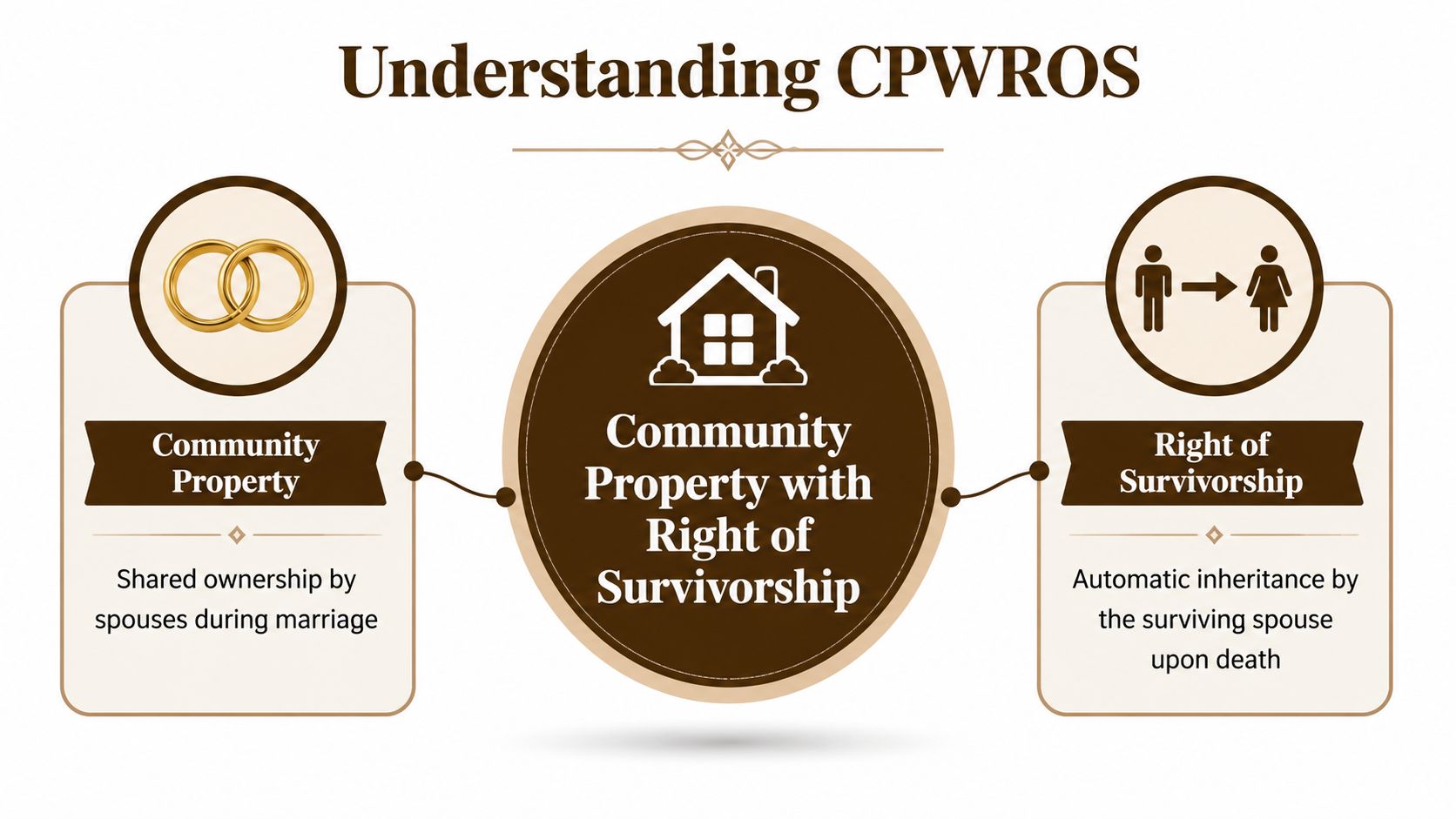
Community property
In California, married couples and registered domestic partners often acquire property that is treated as community property. In plain English, that means the property belongs to the marital community rather than being carved into two unrelated investments.
It functions as a household account both spouses build together. Each spouse has a present ownership interest during the marriage. The property is shared, not merely borrowed from one another.
That idea matters because California doesn't view marital property the same way many non-community-property states do. Title still matters, but the legal character of the property also matters.
Right of survivorship
Now add the second piece: right of survivorship. This is the automatic transfer feature.
A simple analogy helps. Picture a paired ticket that says, "If one owner dies first, the other takes the whole thing automatically." No waiting for a judge to decide who gets that asset under a will. No need to route that particular property through intestate succession.
When survivorship applies, the transfer happens because the title itself says so.
Put together, it creates a hybrid
In California, Grossman Law's discussion of this title form explains that Community Property with Right of Survivorship lets a married couple or registered domestic partners hold real property so that, on the first death, the survivor takes the entire property automatically and the asset generally avoids probate administration. The transfer occurs by operation of title rather than by will or intestacy.
That makes CPWROS a hybrid. During life, the property keeps its community-property character. At death, it behaves with the efficiency people often associate with survivorship ownership.
Practical rule: CPWROS is meant for couples who want shared marital ownership now and automatic survivor ownership later.
Where readers often get confused
Some families assume CPWROS means "the house is outside all estate planning forever." That's not right. It addresses what happens at the first death for that property. It doesn't replace every other planning tool.
Others assume any deed with both spouses' names on it must include survivorship. That also isn't right. The deed must use the correct vesting language. If survivorship language is missing, the outcome can change.
A final point matters in California practice. If the couple's deed, trust, refinance documents, or later transfer papers don't line up, the family may face avoidable title questions later. That's when a simple title choice can turn into a probate issue, a quiet title problem, or a dispute among heirs.
Comparing CPWROS Joint Tenancy and Community Property
A common Los Angeles or Orange County scenario goes like this. A married couple bought their home years ago, refinanced once or twice, signed a trust later, and never looked closely at the deed again. After the first death, the family wants to know a simple answer. Who owns the house now, and can it be sold without a court process?
The answer often turns on a few words in the recorded title.
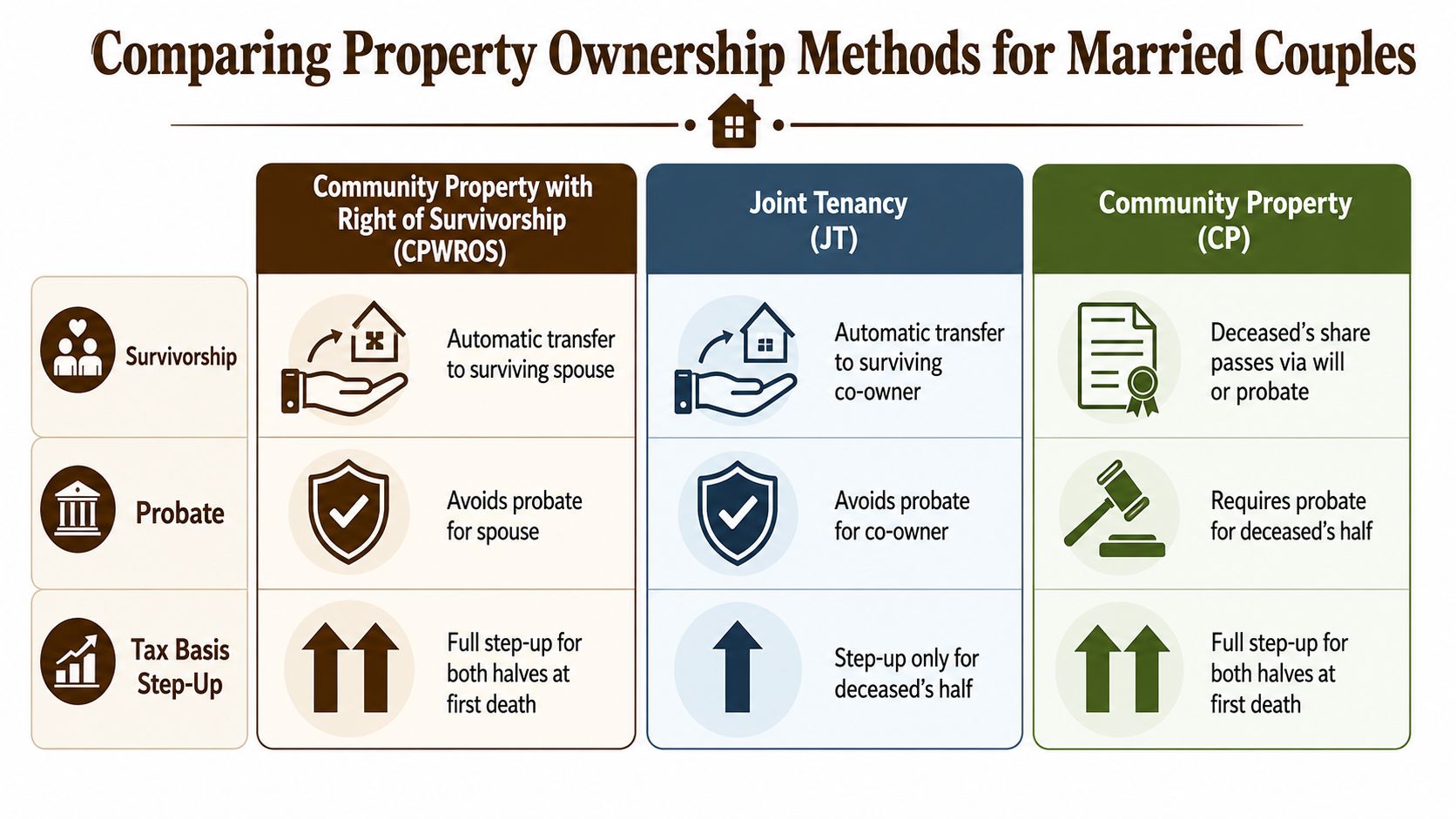
Quick comparison table
| Title form | What happens at first death | Probate impact | Tax basis treatment discussed here | Typical use |
|---|---|---|---|---|
| Community Property with Right of Survivorship | Surviving spouse takes the whole property automatically | Generally avoids probate for that asset | Full step-up in basis for the entire property, discussed more fully in the tax section | Married couples or registered domestic partners in California who want survivorship and community-property treatment |
| Joint Tenancy | Surviving co-owner takes automatically | Often avoids probate for that asset | Different tax result from CPWROS | Co-owners who want survivorship, whether or not the property is marital property |
| Community Property | Deceased spouse's interest passes under will, trust, or intestacy | May require probate or another transfer method for the deceased spouse's share | Community-property tax treatment may still be favorable, but there is no automatic survivorship feature | Married couples whose larger estate plan uses a trust or another transfer structure |
Why CPWROS and joint tenancy get confused
CPWROS and joint tenancy can look similar from far away because both use survivorship. At the first death, title can pass to the survivor automatically.
That similarity causes real mistakes.
Families often focus on the same practical goal: "I want the surviving spouse to own the house right away." Fair enough. But the label on title also affects what kind of ownership exists during life, how the property is treated for tax purposes after death, and whether later disputes are easier or harder to resolve.
A good way to picture it is this. Joint tenancy is built around the survivor taking by title. CPWROS tries to preserve that survivor feature while still treating the property as marital property during the couple's lifetime.
How CPWROS differs from standard community property
Regular community property starts from a different place. It reflects the idea that each spouse owns a one-half community interest while both are alive.
What it does not do, by itself, is add survivorship.
So if spouses hold title as community property only, one spouse's half does not pass automatically to the survivor just because a death occurred. That half passes under the deceased spouse's trust, will, or intestacy rules. In many families, that works perfectly well because the couple already has a coordinated trust plan. In other families, the lack of survivorship creates delay, confusion, or both.
The tax difference that changes real-world decisions
The tax treatment is one of the biggest practical differences between CPWROS and joint tenancy. CPWROS can carry the community-property basis advantage that many married couples want to preserve, while joint tenancy may produce a less favorable result after the first death.
That point matters most when the surviving spouse later sells the home, especially in high-value neighborhoods where appreciation can be substantial. What looked like a small wording choice on a deed can later affect capital gains in a very concrete way.
This is one reason title disputes are not just "paperwork problems." In probate and real estate litigation, title often becomes the doorway to larger fights over sale proceeds, reimbursement claims, or whether the survivor can transfer clean title without first fixing the record.
Which form is more likely to create later conflict
No deed form prevents every dispute. The trouble usually comes from inconsistency between the deed and the rest of the plan.
Common examples include:
- Trust mismatch: The couple signs a trust, but title stays in a vesting form that does not match the trust's transfer plan.
- Refinance changes: Loan documents or a new deed alter the vesting language, and no one catches the change.
- Inheritance assumptions: Adult children assume a will controls the house, even though the recorded deed points in a different direction.
- Post-death sale pressure: The surviving spouse wants to sell, but another family member claims the deceased spouse's share passed through the estate.
When a deed's language conflicts with family assumptions, the recorded deed typically dictates the legal outcome.
That is where quiet title and partition problems often begin. In Southern California practice, families rarely come to a lawyer saying, "We have a vesting issue." They come in saying, "My brother says Mom promised him part of the house," or "Escrow found a title problem after Dad died." The vesting choice made years earlier often sits at the center of that dispute.
A practical way to evaluate the choice
CPWROS is often chosen by spouses who want two things at once. They want the survivor to receive the property automatically at the first death, and they want to keep the community-property character during life.
Joint tenancy may still fit in some situations, especially where survivorship is the main goal and the ownership relationship is not rooted in California marital property rules. Standard community property may fit where the couple's trust is doing the transfer work and the plan has been kept current.
The better question is not which label sounds familiar. The better question is which title form matches the family's actual plan for death, taxes, future sale decisions, and the possibility of a later title fight.
The Key Benefits Tax Savings and Probate Avoidance
A common Southern California scenario goes like this. One spouse dies, the survivor assumes the house is now "theirs," and then escrow asks for proof of authority or a clear chain of title before a sale can close. At the same time, the survivor may be sitting on decades of appreciation in an Orange County or Los Angeles home. That is why this title choice matters in two very practical ways: it can simplify the transfer at the first death, and it can change the tax result years later when the property is sold.
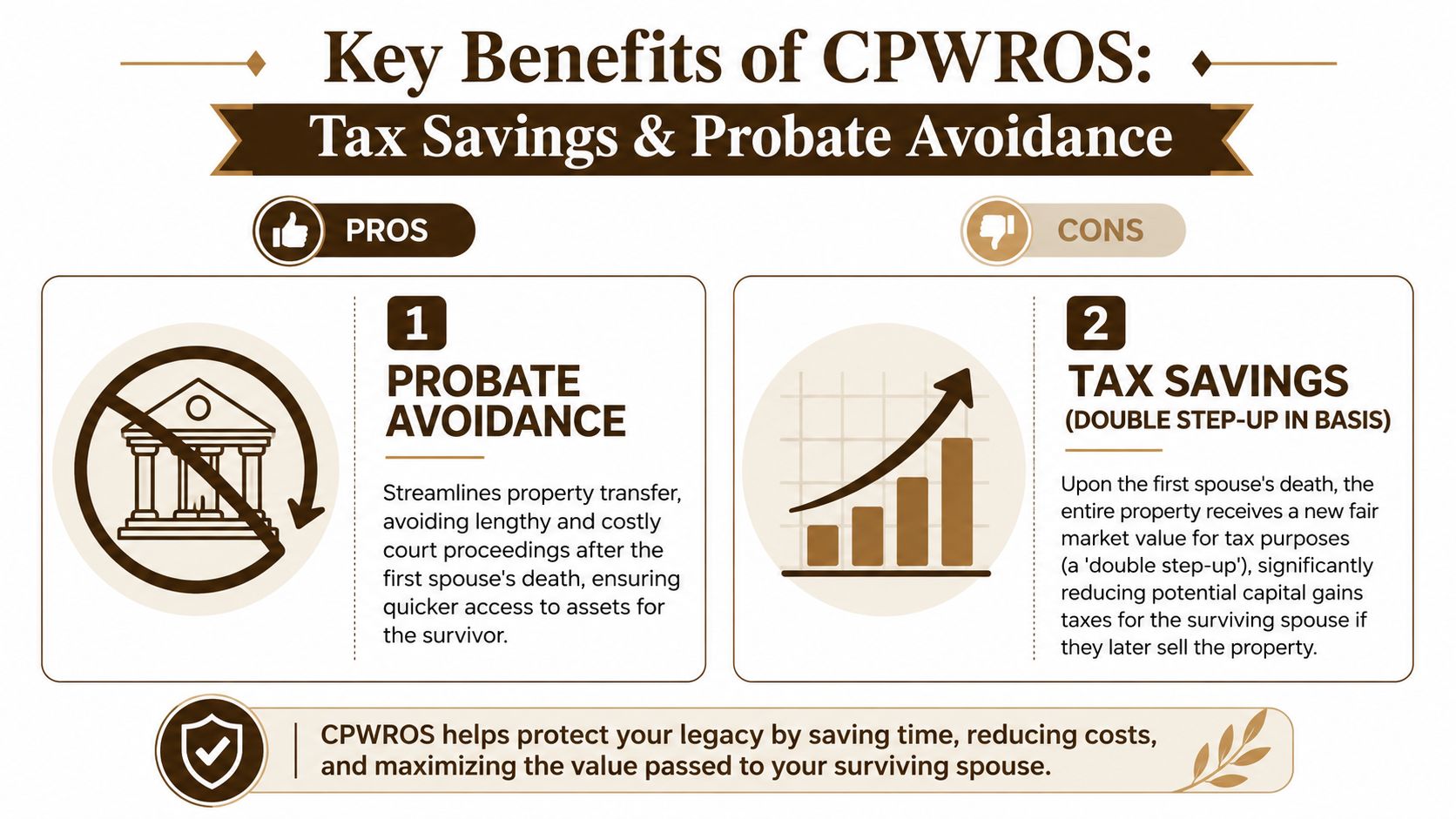
Probate avoidance in real life
Probate is the court process used to transfer a deceased person's property when title does not pass automatically by operation of law or by another effective transfer method. For a family, that often means filings, notices, waiting periods, and extra steps before the county records and a future buyer see a clean title.
The practical problem is often timing.
A surviving spouse may need to sell, refinance, or settle a mortgage issue while still grieving. If title is unclear, that delay can turn into a real estate problem. In my practice, families usually discover the issue when escrow, a lender, or a title company asks for documents they do not have.
The embedded video below from EZ-Probate explains why the mechanics of property transfer after death matter so much.
With CPWROS, the surviving spouse generally becomes the sole owner automatically at the first death. The deed works like a set of instructions already built into title. For that asset, the transfer usually does not depend on a full probate proceeding.
That point also matters beyond convenience. In Los Angeles and Orange County, title confusion after a death often becomes the starting point for larger disputes, including quiet title claims, delayed closings, and fights over whether someone else has an interest in the property.
Families rarely call because title passed cleanly. They call when a sale stalls, a refinance is blocked, or a relative starts questioning who actually owns the house.
Why the basis step-up matters
The tax side is easier to understand if you picture basis as your property's tax starting number. When the home is sold, capital gain is generally measured from that number. If the number is low and the sale price is much higher, the taxable gain can be much larger.
That matters a great deal for long-held California homes. A couple may have bought a house decades ago for a modest amount, then watched it rise sharply in value. After the first spouse dies, the survivor may not sell right away. The sale often happens years later, after downsizing, a move closer to children, or a change in health.
For married couples holding California property as community property with right of survivorship, the tax treatment is often more favorable than many families expect. At the first death, the entire property may receive a step-up in basis to fair market value as of the date of death, assuming the property qualifies as community property and the facts support that treatment. In plain terms, the tax starting number may reset for the whole house, not just half.
That reset can reduce capital gains tax if the surviving spouse later sells.
Why this can matter more than joint tenancy
Joint tenancy can also avoid probate at the first death. The key difference is that probate avoidance and tax treatment are not the same issue.
A simple way to picture it is this: survivorship answers who gets the house next. Basis answers what tax number the survivor carries into a later sale. Families often focus on the first question and overlook the second until escrow is open and tax consequences become urgent.
For California spouses, that distinction can make CPWROS more attractive than joint tenancy when the goal is both a direct transfer at the first death and better post-death tax planning.
The part families often miss
The first death is only one chapter of the plan.
After the survivor becomes sole owner, the next decisions still matter. Should the property stay in the survivor's individual name. Should it be transferred into a trust. Should the survivor update the estate plan before remarriage or before adding a child to title. Those choices can affect later taxes, creditor exposure, and whether the family ends up in a future quiet title or partition dispute.
That is why CPWROS should be evaluated as both a death-transfer tool and a long-term planning decision. The right deed can prevent one problem at death while setting up a much better result when the property is sold later.
How to Create and Transfer Property into CPWROS
Community Property with Right of Survivorship doesn't appear by accident. The deed has to say it clearly. If the vesting language is missing or sloppy, the county records may show a different ownership form than the spouses intended.
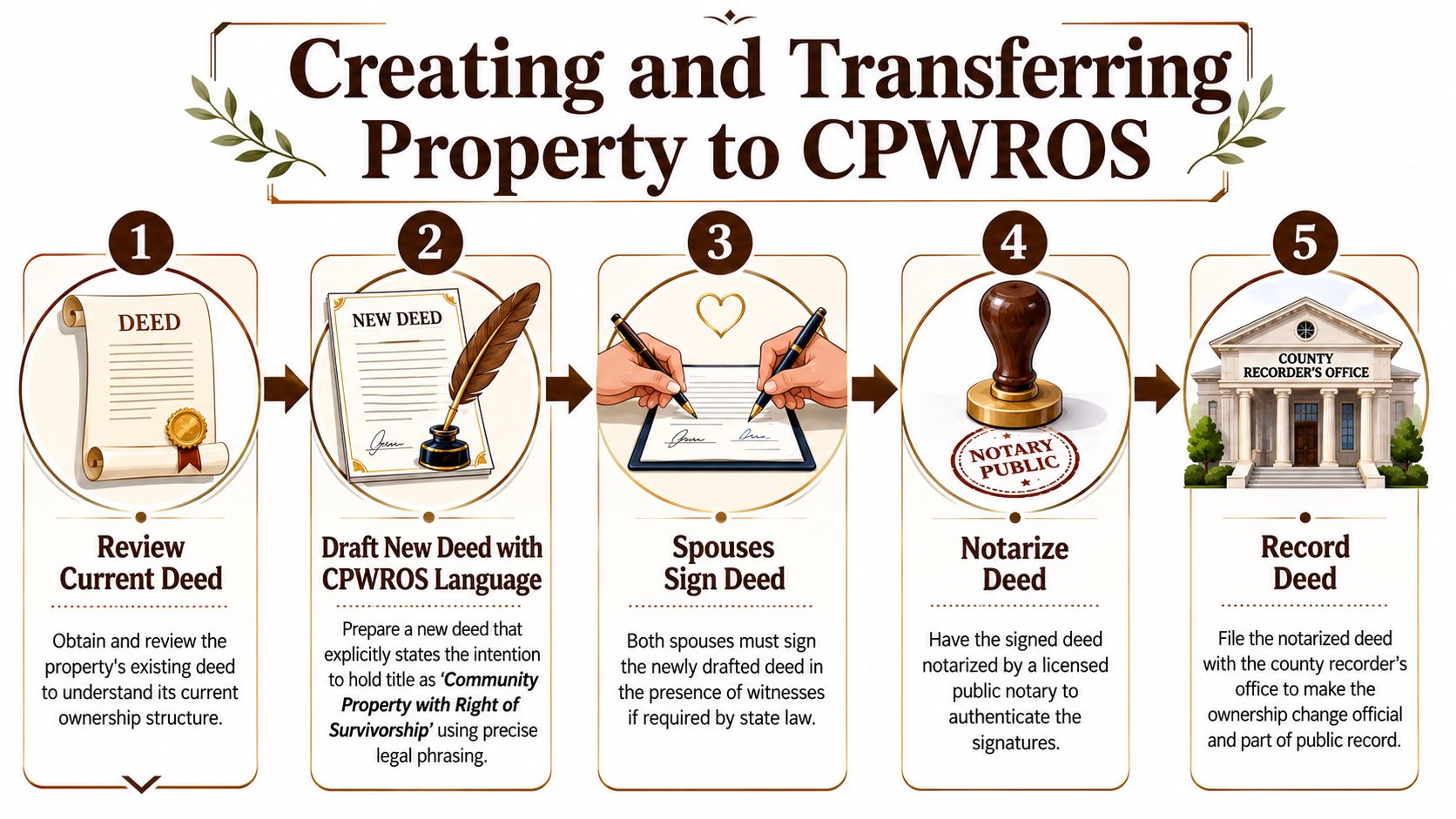
Step one through step three
Start with the current deed. Don't rely on memory, loan paperwork, or what someone said at closing years ago. Get the recorded deed and read the vesting language carefully.
If the property isn't already held as CPWROS, a new deed is usually prepared to transfer title into that form. In California practice, that may involve a grant deed or quitclaim deed, depending on the circumstances and the legal purpose of the transfer.
Then both spouses must sign the new deed correctly. Signatures usually need notarization before the document can be recorded.
Sample vesting language for illustration only: "A and B, husband and wife, as community property with right of survivorship."
This is only a simplified example, not legal advice. The correct wording depends on the owners, current title, and transfer details.
Step four and step five
After signing, the deed must be notarized and recorded in the county where the property is located, such as Orange County or Los Angeles County. Recording is what places the ownership change into the public land records.
Without recording, the transfer may not accomplish what the spouses thought it would accomplish. An unrecorded or incorrectly recorded deed can create later title headaches for the surviving spouse and heirs.
Common mistakes to avoid
Some of the most common problems are simple:
- Wrong vesting language: The deed says "community property" but leaves out survivorship.
- Incomplete transfer: The deed is signed but never recorded with the county recorder.
- Bad coordination: The deed conflicts with a trust, prior deed, divorce history, or separate-property claim.
A related issue comes up with lender transactions. Families refinance, sign a package of documents, and assume title stayed the same. Sometimes it did. Sometimes it didn't. A review of the recorded documents matters.
Why legal review is worth it
This isn't just form-filling. A deed can affect ownership rights, tax consequences, and later probate administration. If a couple is trying to align title with a broader California estate plan, the lawyer drafting the deed should understand both real estate transfer mechanics and what happens after death.
That review becomes even more important when the property has a layered history, such as inherited interests, prior marriages, trust transfers, or existing title defects.
Common Disputes and Long Term Planning Concerns
CPWROS can work very well, but real life doesn't stop being complicated because a deed uses the right words.
One common problem appears after the first spouse dies. The surviving spouse becomes sole owner automatically, but the family may still disagree about what that means. Children from a prior relationship may believe the deceased parent intended them to inherit part of the house. If title was held as CPWROS, the survivor's automatic ownership can collide with family expectations.
When title and family expectations don't match
A mini-scenario helps. A married couple in Los Angeles holds their residence as CPWROS. One spouse dies. The surviving spouse becomes sole owner. Later, the deceased spouse's adult child argues that a will promised the child part of the home.
That dispute often starts with grief but turns into a title fight. The legal answer may depend on the recorded deed, the estate documents, and whether someone is challenging the transfer itself. In some cases, the family may need a quiet title action to remove competing claims and confirm ownership.
When co-ownership conflict still appears
Another scenario comes up before death rather than after. During the marriage, spouses may disagree about whether to sell, refinance, or transfer the property. Marital conflict, separation, debt pressure, or elder-care needs can put the house at the center of the dispute.
A partition action usually arises when co-owners cannot agree on what to do with jointly held property. In a marriage, the analysis may overlap with family law issues and the community-property character of the asset. Even when partition isn't the final remedy, the underlying problem is familiar. One owner wants movement. The other doesn't.
Creditors and title clarity
Creditors can also complicate the picture. CPWROS is a title form, not a magic shield. If one spouse has serious debt exposure, the family needs specific legal advice about how creditor rights interact with the property.
Title clarity matters just as much. If a deed was recorded incorrectly, if an old deed was never properly replaced, or if later paperwork created contradictions, the surviving spouse may run into trouble proving clean ownership. That's where title litigation becomes more than a technical exercise. It can be the only path to a sale, refinance, or settlement.
The smoother the first transfer looks on paper, the less likely the family is to end up fighting about ownership later.
The planning issue many families miss
An often-overlooked issue is what happens after the first death, especially when the survivor later sells or remarries. According to Orange Coast Title guidance on community property with right of survivorship, CPWROS can pass automatically and receive a 100% basis adjustment, but many explanations don't address downstream planning choices, including whether title should be changed again after the survivor becomes sole owner and whether second-marriage planning alters the best approach.
That is exactly where disputes often begin. A surviving spouse may keep the property for years, then remarry, add someone new to title, sign a new trust, or die without updating anything. The original CPWROS deed may have worked perfectly at the first death, but the later planning may still fail if no one revisits the title.
Is CPWROS Right for Your Family A Final Checklist
For many married couples and registered domestic partners in California, Community Property with Right of Survivorship is a smart way to hold title to a home. But it isn't automatic, and it isn't ideal for every family.
Use this checklist to evaluate whether it fits your situation:
- You want a simple first-death transfer: If your main goal is for the surviving spouse to take the property automatically, CPWROS deserves serious attention.
- You care about tax planning after the first death: If a future sale could matter, the basis treatment discussed above may make this title form especially attractive.
- Your property is in California and held by spouses or registered domestic partners: This is a specific legal tool, not a universal ownership form for all co-owners.
- Your deed and estate plan need to work together: If you already have a trust or other planning documents, title should match that plan rather than fight it.
- You don't have a complex blended-family concern that calls for more control: If children from prior relationships, second-marriage planning, or special distribution goals are involved, a trust-based plan may be a better fit.
When CPWROS may not be enough
Some families need more than a survivorship title. If the actual concern is incapacity planning, control after the second death, or protecting children from a prior marriage, title alone may be too narrow.
A good legal plan asks several questions at once. Who owns the property now? Who controls it if one spouse becomes incapacitated? What happens at the first death? What happens after the second death? And will the deed still make sense if the survivor later changes course?
If you're unsure how your home is titled, or whether your current deed still matches your family's goals, get it reviewed before a crisis forces the issue.
If you own real property in California and want clear guidance on whether Community Property with Right of Survivorship is the right fit, schedule a free consultation with Tanner Law. Tanner Law helps families and property owners in Orange County and Los Angeles address title questions, probate concerns, quiet title disputes, partition matters, and practical next steps for protecting their homes and ownership rights.