How to Contest a Trust in California
You receive a trustee's notice after your parent's death and discover that a trust amendment signed shortly before death leaves the family home and investment accounts to one sibling, while a caregiver suddenly appears as a beneficiary. The document may look official, but the timing, circumstances, and sudden change raise obvious questions. You're not only asking whether the trust is valid. You're asking whether the assets can be distributed before anyone investigates.
Under California law, that timing can control the entire case. A trust contest is a formal legal proceeding, not merely a family disagreement. The person challenging the trust must identify a recognized legal ground, preserve evidence, follow probate procedures, and file before the applicable deadline expires. Waiting for relatives to cooperate or assuming the trustee will pause distributions can leave you with fewer practical remedies.
Table of Contents
- When a Trust Feels Wrong and What to Do First
- Legal Grounds for Contesting a Trust in California
- Who Can Contest a Trust and Critical California Deadlines
- Gathering Evidence to Build a Strong Trust Contest
- Filing the Contest and Protecting Assets During Litigation
- Litigation Strategy and Realistic Outcomes
- When to Hire a Probate Litigator and Next Steps
When a Trust Feels Wrong and What to Do First
A suspicious trust change usually comes with a confusing paper trail. One family member may have controlled the parent's appointments, mail, banking, and contact with the estate-planning lawyer. Another may have received little information until after death. The trustee may then ask everyone to accept the new document as final, even though the amendment appears inconsistent with years of family discussions.
That instinct deserves careful attention, but suspicion alone won't invalidate a trust. Courts look for evidence connecting the unusual result to a legally recognized defect, such as undue influence, incapacity, fraud, or improper execution. A beneficiary who acts quickly can also take steps to preserve assets and records before the dispute becomes harder to prove.
Treat the notice as a deadline document
In California, a trustee's statutory notice can start a strict contest period. A person who receives that notice generally must file a trust contest within 120 days after service, or within 60 days after receiving a copy of the trust terms during that 120-day period, whichever deadline is later. The rule appears in California Probate Code sections 16061.7 and 16061.8, as explained in this California trust limitations discussion.
Read every page of the notice, record the date and method of delivery, and keep the envelope or electronic transmission. Don't assume that asking the trustee for more information stops the clock. A request for records may help your investigation, but it isn't a substitute for calculating and protecting the filing deadline.
Preserve the estate before distribution
Contacting a California trust litigator early can help determine whether the trustee should voluntarily pause distributions or whether the court should be asked for emergency relief. Depending on the facts, available tools may include a petition, temporary restraining order, preliminary injunction, or other request designed to prevent the transfer, sale, concealment, or depletion of trust property.
Practical rule: If a trustee is preparing to distribute a home, brokerage account, business interest, or other significant asset, evidence preservation and asset protection should be considered at the same time, not one after the other.
Don't confront the suspected beneficiary by threatening them, remove documents from the parent's home, or access accounts without authorization. Those actions can create evidence problems and distract from the central questions: what changed, who participated, what did the settlor understand, and can the assets still be protected?
Legal Grounds for Contesting a Trust in California
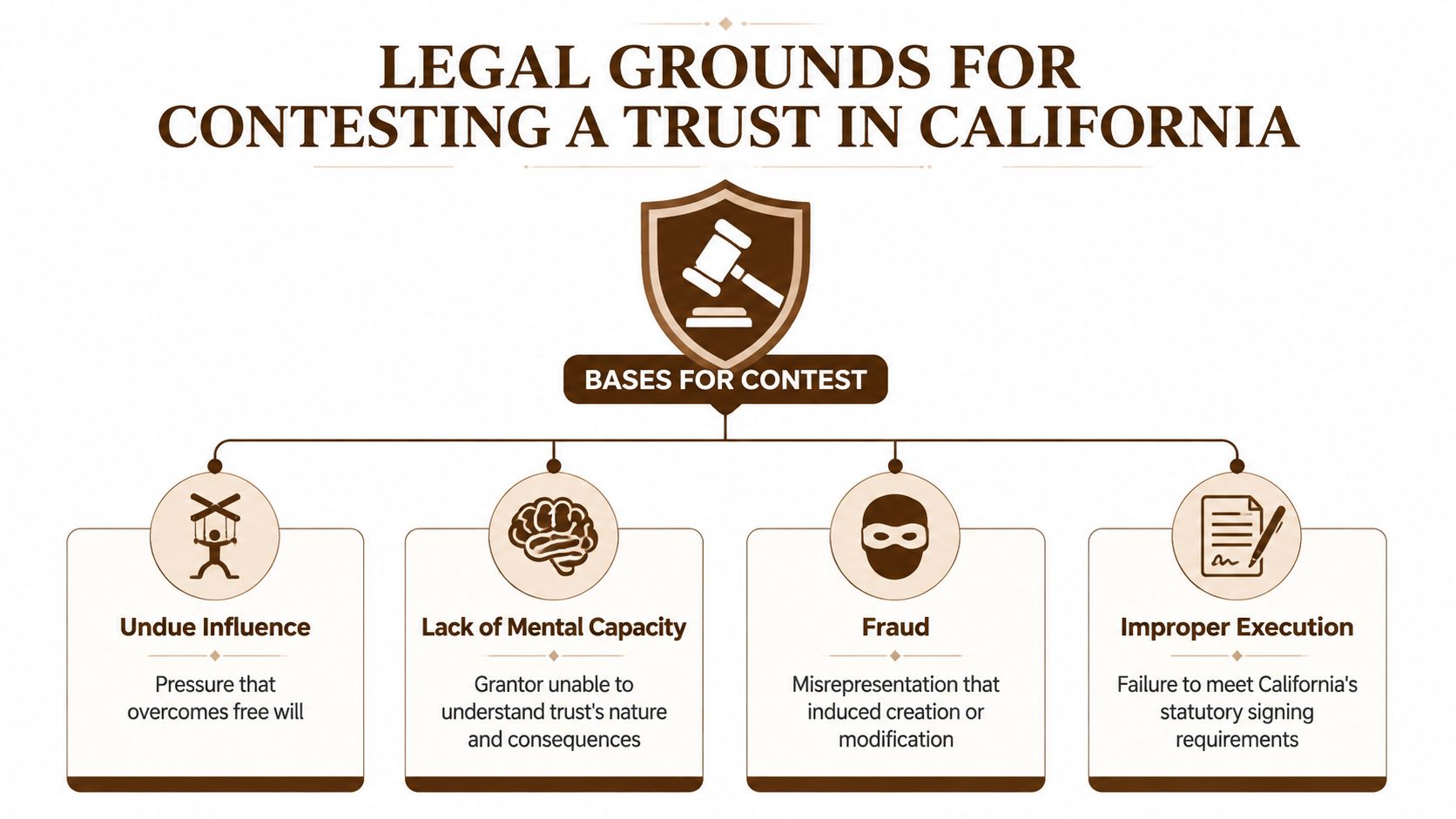
California trust contests succeed when the challenger proves that the trust, amendment, or specific provision resulted from a legally recognized defect. An unfavorable distribution isn't enough. Courts generally need facts showing that the settlor's decision wasn't legally effective or wasn't the product of an independent, informed choice.
Undue influence
Undue influence means pressure or manipulation overcame the settlor's free will. Stronger cases often involve a person who occupied a position of trust, supplied the settlor's care, isolated the settlor from family, arranged the lawyer meeting, controlled communications, or benefited directly from the change.
The most useful evidence usually shows a pattern rather than one unpleasant conversation. Look for calendars, texts, emails, caregiver invoices, transportation records, medical notes, drafts of earlier documents, and testimony from people who observed the settlor before and after the amendment. A last-minute change by itself may be suspicious, but it doesn't prove coercion without evidence about the settlor's vulnerability and the influencer's conduct.
Lack of mental capacity
A capacity claim asks whether the settlor understood the basic nature and consequences of creating or changing the trust. The challenger may need to show that the settlor couldn't understand the property involved, the people who might reasonably be expected to benefit, or the general effect of the estate plan.
Medical records can help, but a diagnosis alone usually doesn't answer the legal question. Records close in time to the signing, notes from the drafting lawyer, medication information, testimony about conversations, and evidence of confusion or comprehension are more useful. The fact that a person had a serious illness also doesn't automatically mean they lacked capacity when they signed.
Fraud
Fraud may exist when someone deliberately misrepresented or concealed important information and that deception induced the settlor to create or modify the trust. Examples might include falsely telling a parent that a child stole money, presenting a document as something other than an amendment, or hiding the identity of a beneficiary.
The case needs proof of the statement or concealment, why it was false, who made it, and how it affected the settlor's decision. Family recollections that a beneficiary “lied” are a starting point, not complete evidence. Messages, emails, financial records, drafts, and witnesses who heard the communication can make the theory concrete.
Improper execution
An improper execution theory focuses on whether the trust or amendment followed the required signing formalities. The relevant requirements depend on the instrument, the governing law, and the circumstances. A missing signature, defective acknowledgment, inconsistent witness evidence, or document that doesn't match the purported final version may matter.
Don't treat a technical irregularity as an automatic victory. The court may examine the document's terms, surrounding records, and applicable California rules before deciding whether the defect invalidates the instrument or only affects a particular provision. A lawyer should compare every version and inspect the original, not rely solely on a scan or family summary.
Who Can Contest a Trust and Critical California Deadlines
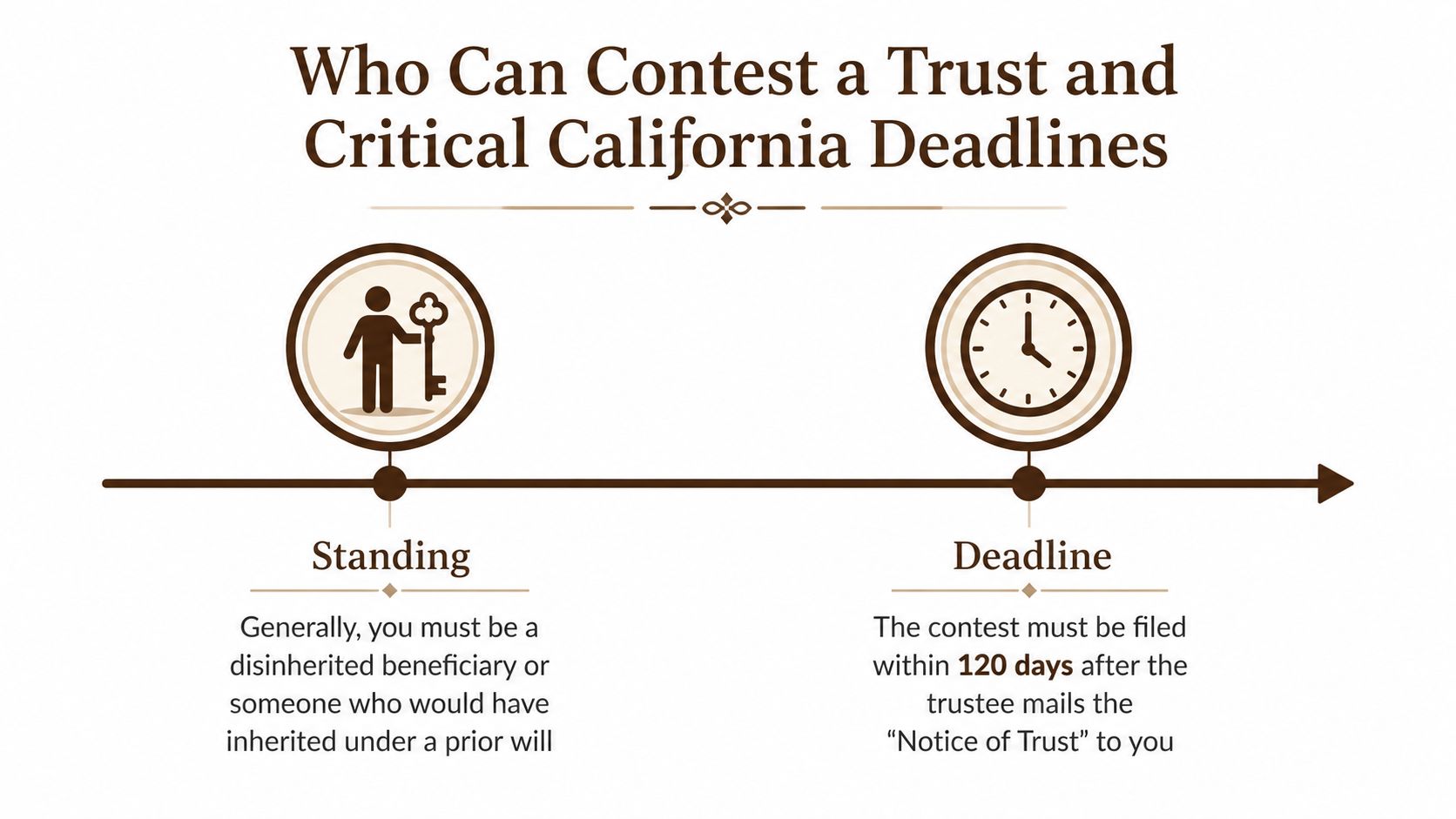
The first threshold question is standing, meaning whether you have a legally sufficient interest in the outcome. A beneficiary, heir, or other person whose financial rights would change if the trust were invalidated may have standing. Someone with only a personal objection, but no affected legal or financial interest, generally faces a different problem.
Standing can be complicated when several documents exist. A challenger may benefit under an earlier trust, a will, intestacy rules, or a different amendment. The court may need to compare those competing instruments before determining whether invalidating the challenged document would improve the person's position.
Calculate the notice-triggered clock
California's notice rules are unforgiving. A person who receives the trustee's statutory notice generally has 120 days from service to file a trust contest, or 60 days from delivery of the trust terms during that 120-day period, whichever is later. The trustee's notice should contain the warning language that explains the deadline, but you should independently calculate it.
California legislation also clarified that this limitation period applies when a revocable trust becomes irrevocable because of a settlor's death. The California Lawyers Association's discussion of Assembly Bill 1745 explains the connection between that triggering event and the required notice language.
Create a written timeline immediately:
- Date of death: Identify when the trust became irrevocable, if the settlor's death caused that change.
- Date and method of service: Save the notice, envelope, email, and attachments.
- Trust terms delivered: Record when you received the trust and amendments.
- Potential filing deadline: Have counsel calculate both possible deadlines.
- Asset activity: Track proposed distributions, sales, transfers, and account changes.
A request for the trust document may reveal important evidence, but it won't necessarily protect your rights. If the trustee won't provide records or intends to distribute assets, counsel may need to act before the investigation is complete.
The following video provides general background on the trust-contest process. It isn't a substitute for advice about your notice date, standing, or filing strategy.
Gathering Evidence to Build a Strong Trust Contest
The strongest trust contests are built from contemporaneous evidence, not family conclusions formed after a disappointing distribution. Start with the original trust, every amendment, schedules of assets, signature pages, notices, lawyer correspondence, and any document showing when and how the challenged instrument was prepared.

Build the documentary record
Ask for records through appropriate channels and preserve what you already lawfully possess. Useful categories include:
- Trust instruments: Obtain the signed trust, amendments, pour-over wills, powers of attorney, and related estate-planning drafts.
- Medical material: Identify records close to the signing date, including cognitive assessments, medication lists, care notes, and hospitalization records.
- Financial information: Look for account statements, property records, transfer documents, loan paperwork, and unusual withdrawals.
- Communications: Preserve texts, emails, letters, calendars, voicemails, and appointment records showing who arranged meetings or controlled access.
- Professional files: Determine whether the drafting attorney, notary, witnesses, accountant, or financial adviser has relevant information.
Don't edit screenshots, forward messages in ways that lose metadata, or annotate originals. Keep a clean copy and write a separate log explaining where each item came from.
Identify witnesses who saw the important moments
A witness who can describe the settlor's actual words and behavior is usually more valuable than someone who merely believes the amendment was unfair. Potential witnesses may include the drafting lawyer and staff, notary, signing witnesses, doctors, caregivers, neighbors, relatives, financial advisers, and people who had regular contact with the settlor.
Write down names, contact details, what each person personally observed, and whether they may have a conflict. Don't coach anyone or circulate a shared family narrative. Inconsistent or exaggerated testimony can damage an otherwise legitimate claim.
Use experts for specific questions
Experts should answer defined questions, not provide general support for a family theory. A medical expert may analyze capacity from records and timing. A forensic accountant may trace transfers and compare financial activity with the trust documents. A handwriting professional may examine disputed signatures when authenticity is in question.
Your initial checklist should answer three questions: What changed? Who had access and influence? What did the settlor understand at signing? Any gap should guide the next records request or witness interview, while the filing deadline continues to run.
Filing the Contest and Protecting Assets During Litigation
A California trust contest commonly begins with a petition filed in the appropriate probate court. The petition should identify the trust or amendment at issue, explain the legal grounds, describe the petitioner's interest, and request specific relief. Depending on the dispute, relief may include invalidating an amendment, enforcing an earlier instrument, removing a trustee, recovering property, or obtaining account information.

File, serve, and ask for targeted protection
The filing location depends on the trust, the settlor, the trustee, the assets, and applicable California probate rules. Counsel must identify interested parties, prepare the petition and supporting declarations, pay the required filing fee or seek an available fee waiver, obtain a hearing date, and serve the required papers correctly.
Serving the petition isn't a formality. A person who wasn't properly served may challenge the proceeding, delay the hearing, or argue that the court didn't obtain proper notice. A careful lawyer also considers whether the trustee, beneficiaries, financial institutions, escrow holders, or property managers need specific directions.
Stop distribution before it becomes a recovery case
If assets may be distributed, sold, transferred, or concealed, ask promptly about emergency relief. A temporary restraining order can address immediate danger, while a preliminary injunction may preserve the status quo during litigation. The court will typically focus on the likelihood of harm, the strength of the legal position, the balance of hardships, and whether the requested order is specific and enforceable.
A vague request to “freeze everything” may be less persuasive than a narrowly focused request identifying the account, property, proposed transaction, and conduct that must stop. Supporting declarations should explain the imminent risk with documents, transaction notices, trustee communications, or other first-hand evidence.
Asset-preservation principle: Winning a contest after property has been sold or distributed may require a separate recovery effort. Preventing the transfer can be simpler than tracing it later.
The court may require an undertaking or other protection for the restrained party. Because emergency motions require prompt preparation and service, don't wait until the hearing date is close if the trustee has already announced a distribution.
Litigation Strategy and Realistic Outcomes
Trust litigation forces a choice between pursuing a court ruling and seeking a negotiated resolution. Trial offers a formal decision and may be necessary when the opposing side refuses to disclose records, disputes obvious misconduct, or offers terms that don't protect your actual interest. It also brings expense, uncertainty, public filings, witness credibility disputes, and the possibility that the court rejects the claim.
Settlement and mediation can resolve control of property, payment terms, trustee replacement, accountings, or release language without requiring every issue to reach trial. That flexibility matters when family members want certainty or when the evidence supports risk on both sides. Mediation is most productive after the parties have enough documents to evaluate the likely result, but waiting for perfect discovery can waste time when assets are moving.
Compare the practical paths
| Path | What it can accomplish | Main trade-off |
|---|---|---|
| Negotiated settlement | Resolves defined financial and administrative terms through agreement | You give up the chance to obtain every requested remedy at trial |
| Mediation | Lets a neutral facilitator test positions and design creative solutions | It doesn't force agreement, and preparation still requires evidence |
| Court litigation | Produces binding rulings through pleadings, discovery, motions, and trial | The process can be adversarial, costly, and unpredictable |
The outcome may be broad or narrow. A court might invalidate the entire trust, strike a single amendment, restore an earlier distribution plan, order an accounting, remove a trustee, or award another remedy supported by the pleadings and evidence. A petitioner who loses may face fee exposure, and a no-contest clause can create additional risk.
Understand California's no-contest rule
California's no-contest-clause law is narrower than many beneficiaries assume. Under Probate Code section 21311, a beneficiary can generally lose an inheritance when the challenge is a direct contest brought without probable cause. The statute defines probable cause objectively, based on facts known when filing that would lead a reasonable person to believe there is a reasonable likelihood the requested relief will be granted after further investigation or discovery. The statutory text is available through California Probate Code section 21311.
That standard doesn't mean every case should be filed. It means counsel should assess the evidence available at filing, the requested relief, the clause's language, and the likely consequences before choosing an aggressive strategy.
When to Hire a Probate Litigator and Next Steps
A California trust contest becomes especially risky to handle alone when multiple beneficiaries, blended-family tensions, valuable real estate, business interests, cross-border assets, or suspected financial exploitation are involved. The notice-triggered deadline leaves little room for filing mistakes, and an incomplete petition can narrow the relief you later seek.
Look for a probate litigator who handles trust contests, understands California procedure, knows the Orange County and Los Angeles courts, and has meaningful trial experience. Ask who will personally handle the case, how the lawyer evaluates emergency asset protection, what records should be gathered first, and how fees and litigation expenses will be explained. Be cautious of anyone who promises a guaranteed result after a short conversation or treats family suspicion as proof.
Bring the trust and amendments, trustee notice, envelopes, medical records, financial statements, messages, and a written timeline to the consultation. Early advice can preserve options that disappear when a deadline passes or assets leave the trust.
Tanner Law can review the trust documents, notice dates, suspected misconduct, and asset-distribution risk in a focused initial discussion. Schedule a free consultation by visiting Tanner Law to discuss practical California trust-contest and asset-preservation options before time limits or irreversible transfers narrow your choices.