Tenancy in Common in California: A Complete Legal Guide
A sibling has died, and you're now looking at a family home in Santa Ana with a deed that names several owners. One person wants to keep living there, another needs liquidity, and nobody is sure whether the property must go through probate or can be transferred. That uncertainty is common with tenancy in common in California, particularly when families inherit real estate without a written co-ownership plan.
The answer depends on the deed, the ownership percentages, the deceased owner's estate plan, and whether a co-owner seeks partition. California law treats these issues differently from joint tenancy and community property. The practical consequences can include probate administration, title fragmentation, a negotiated buyout, or a court-supervised sale.
Table of Contents
- How Tenancy in Common Works in California
- Understanding Ownership Rights and Fractional Interests
- Tenancy in Common vs Joint Tenancy and Community Property
- What Happens When a Co-Owner Dies
- Partition Actions and Resolving Co-Owner Disputes
- Drafting Tips and Protective Clauses for TIC Agreements
- Protect Your Property Rights with Tanner Law
How Tenancy in Common Works in California
Consider two friends who buy an Irvine rental property together. They contribute different amounts, but the deed doesn't clearly create a joint tenancy or another form of ownership. Under California law, the ownership is generally presumed to be tenancy in common, unless the instrument states otherwise.
That presumption has deep roots. California's original 1872 Civil Code established the framework that an interest created for several people is presumed to be an interest in common unless the document provides a different arrangement. The statutory structure has continued through later amendments, including amendments effective January 1, 2017 and January 1, 2024. You can review the historical foundation in the original California Civil Code.
Why the default matters
A default rule can control the outcome when buyers or heirs assume they have created something else. If a deed names multiple owners but doesn't establish joint tenancy, California's presumption may place them in a tenancy in common. That affects inheritance, probate, transfer rights, and partition litigation.
A tenant in common owns an undivided share of the whole property. The owner doesn't automatically own the bedroom on one side of the house, a particular floor, or a marked section of land. Instead, each owner holds a legal interest throughout the property, subject to the rights of the other owners.
The ownership form also survives changes in personal circumstances. A co-owner can die, transfer an interest, become estranged from the others, or decide to leave the investment. Unless a written agreement addresses those events, the parties may be forced to rely on California's default rules at precisely the time cooperation becomes difficult.
Practical rule: Never assume that naming several people on a deed creates survivorship rights. Read the vesting language and obtain advice before signing or transferring title.
For families in Orange County and Los Angeles, the most important early question is simple: What does the recorded deed say? A title report, deed, trust documents, and later transfer instruments should be reviewed together. The label “co-owner” doesn't answer whether the property is held in tenancy in common, joint tenancy, community property, or another arrangement.
Understanding Ownership Rights and Fractional Interests
California tenancy in common gives each owner an undivided interest in the entire property, not a physically separated piece. California guidance explains that tenants in common generally have the right to possess and use the whole property, even when their ownership shares differ. The California property tax guidance on tenancy in common describes this undivided ownership structure.

Your share can be unequal
California law doesn't require tenants in common to own equal percentages. A deed or agreement might provide that one owner holds 70% and another holds 30%, for example. Those figures describe the owners' fractional interests in the whole property, not separate physical areas. The California Department of Real Estate's tenancy-in-common guidelines address unequal fractional ownership.
Ownership percentages can affect the distribution of sale proceeds, responsibility for certain expenses, voting arrangements established by agreement, and the amount an owner receives in a buyout or partition. They don't necessarily allow the larger owner to exclude the smaller owner from the property.
Possession and use require practical rules
Each tenant in common generally has a right to possess and use the entire property. That right creates problems when one owner lives in the home, another expects rental income, and the deed says nothing about access, maintenance, or expenses.
A workable agreement should address:
- Occupancy: Identify who may live at the property and whether exclusive possession requires compensation.
- Expenses: State how owners will handle taxes, insurance, repairs, utilities, mortgage payments, and improvements.
- Income: Explain how rent or other revenue will be collected, accounted for, and distributed.
- Management: Establish who can approve repairs, hire contractors, communicate with tenants, or manage a rental.
- Records: Require access to statements, invoices, leases, and other financial documents.
A tenant in common can generally transfer or sell that owner's share without first obtaining the consent of every other co-owner, subject to any valid agreement or other legal restriction. The buyer receives the transferring owner's undivided interest, which can introduce an unfamiliar person into the ownership group.
A fractional interest is still an interest in the whole property. It isn't a private corner that one owner can control without regard to the others.
That distinction matters during a dispute. One owner's claim to a particular room or yard area may have practical importance, but it doesn't automatically change the legal nature of the ownership.
Tenancy in Common vs Joint Tenancy and Community Property
The deed's vesting language can determine whether a deceased owner's share must be administered through an estate. Tenancy in common has no right of survivorship, while joint tenancy generally includes survivorship by operation of the ownership form. Community property has its own rules and is generally associated with married couples or registered domestic partners, although the specific deed and estate plan still matter.
| Feature | Tenancy in Common | Joint Tenancy | Community Property |
|---|---|---|---|
| Creation | Arises when multiple owners hold title and the instrument doesn't create another form, unless the deed states otherwise | Must be created with language establishing joint tenancy and the required ownership structure | Generally created through community property vesting between spouses or registered domestic partners |
| Ownership shares | Owners may hold unequal fractional interests | Owners generally hold corresponding interests under the joint tenancy structure | Spouses or registered domestic partners generally hold community interests under California law |
| Right of survivorship | No automatic survivorship | The deceased owner's interest generally passes to surviving joint tenants outside ordinary probate procedures | Survivorship and probate consequences depend on the vesting, estate plan, and applicable California law |
| Probate impact | The deceased owner's share generally passes through probate, trust administration, or intestacy | Survivorship can allow the surviving owner or owners to take the deceased owner's interest without ordinary probate transfer | Estate administration may still be relevant, particularly if title and estate documents don't align |
| Transferability | An owner can generally transfer their individual share, subject to agreements and legal restrictions | A transfer can affect or sever the joint tenancy structure | Transfers between spouses and to third parties can have distinct legal and tax consequences |
| Typical use | Family inheritance, investment ownership, and situations where owners want separate inheritable shares | Co-owners who deliberately want survivorship treatment | Married couples or registered domestic partners planning ownership under California community-property rules |
Don't choose by label alone
The phrase “community property” isn't interchangeable with “joint tenancy,” and “co-owned” doesn't identify the legal form. The deed, marital status, written agreements, trust documents, and later transfers all matter.
A couple who wants survivorship should address it deliberately. A family that wants each person's share to pass to that owner's own children may prefer a structure without survivorship, but it must also plan for the probate and management consequences that follow.
California's Civil Code section 682 framework should be read with the actual title documents, not used as a substitute for reviewing them. A title correction or ownership change can require careful drafting and recording.
What Happens When a Co-Owner Dies
When a California tenant in common dies, that owner's interest doesn't automatically pass to the surviving co-owners. The share generally moves through probate, trust administration, or intestacy, depending on the decedent's documents and circumstances. The surviving owners keep their own interests, while the estate, trust, or heirs become the parties connected to the deceased owner's share.

The decision tree after death
Start with the title and estate documents. Don't sign a deed based only on an assumption that the surviving owners “inherit” the property.
- Confirm the vesting. Obtain the recorded deed and determine whether the decedent held a tenancy-in-common interest.
- Locate the estate plan. Check for a will, revocable trust, or transfer-on-death deed. The California probate guidance on avoiding probate explains why joint tenancy and other planning mechanisms can produce different transfer procedures.
- Identify the person with authority. A personal representative, trustee, or other authorized fiduciary may need to handle the deceased owner's interest.
- Determine whether probate is required. A separate estate-planning mechanism may avoid ordinary probate, but tenancy in common alone doesn't do so.
- Update title only after proper authority exists. The title company will need legally sufficient documents before recording a transfer to heirs, beneficiaries, or a buyer.
- Address ongoing management. Taxes, insurance, mortgage obligations, repairs, occupancy, and rental income still need a written arrangement while administration continues.
Why title fragmentation creates conflict
Suppose one owner leaves a share to multiple beneficiaries. The property can end up with additional co-owners, each holding an interest connected to the original share. Those new owners may have different financial needs and different views about whether to sell, rent, refinance, or occupy the property.
The property doesn't automatically sell merely because a co-owner died. The estate administration process and the remaining ownership structure must be addressed first. If the owners cannot agree, a partition action may become the mechanism for resolving the dispute.
After a death, title cleanup is not clerical housekeeping. It determines who has authority to negotiate, sign, sell, or defend the property.
A beneficiary or personal representative may also need to consider partition under California Probate Code section 11950. The California probate partition overview explains that a court may physically divide inherited property or order a sale and distribute proceeds according to ownership interests.
Partition Actions and Resolving Co-Owner Disputes
A partition action is a court proceeding to divide co-owned real property or sell it and distribute the proceeds. It becomes relevant when owners can't agree about keeping, selling, managing, or dividing the property. A partition case can involve valuation, title review, liens, occupancy claims, sale procedures, and disputes about each owner's share of proceeds.
California changed the process for many tenancy-in-common cases through the Partition of Real Property Act, effective January 1, 2023. The law applies to covered partition actions filed on or after that date. The statutory text for Code of Civil Procedure section 874.311 identifies the covered property and agreement conditions.
Which cases fall under the Act
The Act applies when:
- The property is held in tenancy in common.
- No recorded agreement binding all cotenants governs partition.
- The action was filed on or after January 1, 2023.
A written agreement can materially change the analysis. If all cotenants are bound by a recorded agreement that governs partition, the statutory procedure may not apply in the same way. Counsel should review the deed, recorded agreements, amendments, and any relevant estate documents before filing.
The litigation path is more structured
For covered cases, California's statutory framework gives courts a process for addressing appraisal, buyout, and sale sequencing. The filing owner shouldn't assume that filing immediately produces a sale. A non-filing co-owner may have an opportunity to seek a buyout under the statutory process, while valuation becomes central to the dispute.
That creates strategic consequences for both sides. The owner seeking to exit may want a sale, but filing can trigger a process in which another owner seeks to purchase the filing owner's interest. The owner who wants to retain the property must assess financing, appraisal disputes, liens, and the ability to meet court requirements.
Physical division versus sale
A court can consider whether the property can be divided in a practical and legally workable way. For a single-family residence in Los Angeles or Orange County, a physical division may not be realistic, making a sale or buyout more likely. A sale can be voluntary, negotiated, or court-supervised, depending on the circumstances and the governing procedure.
Before filing, decide whether your real goal is an exit, a buyout, or control of the property. The correct litigation strategy depends on that answer.
Partition also costs money and time. Parties may incur attorney fees, appraisal expenses, title charges, sale costs, and costs associated with contested hearings. A negotiated buyout or agreement may preserve more control, but it only works when the parties can resolve valuation and payment terms.
Drafting Tips and Protective Clauses for TIC Agreements
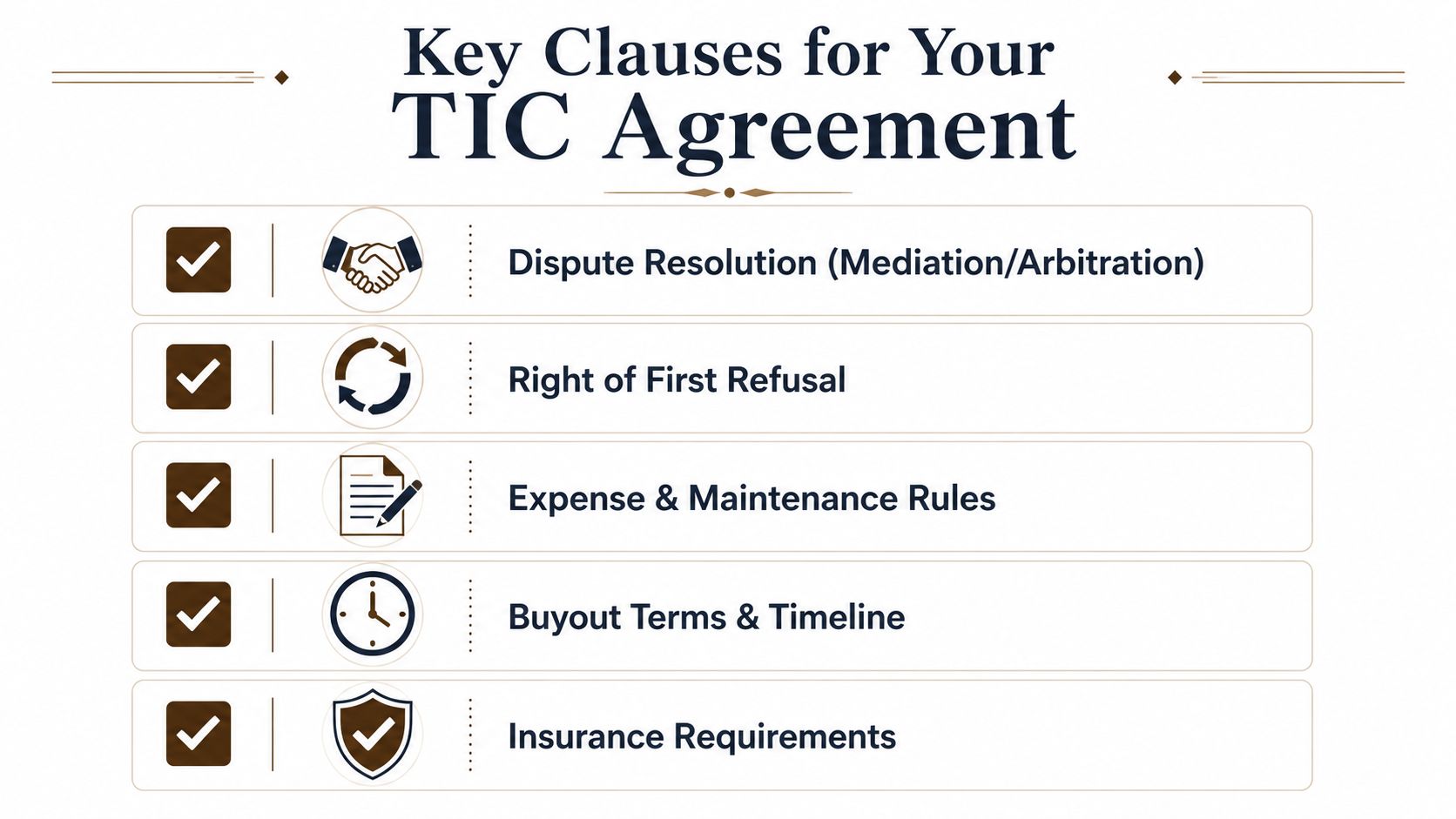
A written tenancy-in-common agreement can prevent a deed from carrying the entire relationship. It should explain how the owners will operate the property while cooperation is easy, and what happens when cooperation breaks down. The agreement should also be reviewed against California law and the owners' estate plans.
Start with money and authority
The agreement should identify each owner's fractional interest and explain whether contributions and distributions follow those percentages. It should address what happens if one owner pays more than their share of mortgage payments, taxes, insurance, emergency repairs, or capital improvements.
Include a decision-making system that distinguishes routine maintenance from major decisions. A property manager may handle ordinary repairs, while a sale, refinance, lease, or major improvement may require a defined level of consent.
Useful provisions include:
- Expense and maintenance rules: Set payment deadlines, reimbursement rights, reserve funding, and procedures for emergency work.
- Occupancy terms: Explain who may live at the property, whether rent is owed for exclusive use, and how access will be scheduled.
- Income accounting: Require regular statements and establish how rental income will be deposited and distributed.
- Insurance requirements: Identify required coverage, named insureds, claim authority, and responsibility for deductibles.
- Records and notices: Establish where financial records are kept and how owners receive formal notices.
Plan the exit before anyone wants out
A right of first refusal can give the remaining owners an opportunity to purchase an interest before it is transferred to an outside buyer. The clause should define the notice, price, valuation method, response period, closing process, and treatment of liens or unpaid expenses.
Buyout provisions should also identify a valuation process. The agreement might require a neutral appraisal, explain how competing valuations are handled, and provide a payment schedule if the parties agree to installments. A vague promise to negotiate later usually doesn't resolve the hardest issue, which is how to determine a fair price.
The strongest TIC agreement answers the question nobody wants to discuss at the closing table: how does an owner leave?
Address dispute resolution and partition
Mediation can give owners a structured opportunity to resolve disagreements without immediately escalating the matter. Arbitration may provide a private decision process, although the clause must be drafted carefully and may not address every issue involving title or third parties.
The agreement should state whether the owners waive, limit, or regulate partition rights to the extent California law permits. It should be recorded when appropriate, so later purchasers and lenders can understand the restrictions. Because the 2023 Partition of Real Property Act applies based partly on whether a recorded agreement governs partition, recording and drafting details matter.
For an owner considering a new acquisition or revising an inherited ownership arrangement, Tanner Law is one California option for reviewing real estate ownership, partition issues, and related civil disputes. A lawyer should tailor the document to the property, financing, family relationships, and estate plan rather than relying on a generic form.
Protect Your Property Rights with Tanner Law
Tenancy in common can be practical when owners want separate fractional interests, but the structure brings consequences that deserve attention before a dispute or death occurs. A deceased owner's share may require probate or trust administration. A new heir can become a co-owner. A disagreement about sale or occupancy can lead to partition litigation, with the January 1, 2023 statutory changes affecting the available process in covered cases.
The right response depends on the documents and the objective. A family planning ahead may need coordinated deed and estate planning. A surviving owner may need title cleanup and guidance about the estate's authority. An investor may need a TIC agreement addressing expenses, transfers, management, buyouts, and partition. A co-owner already facing litigation needs a careful review before making an offer, filing a case, or accepting an appraisal.
William T. Tanner combines experience as an attorney and licensed real estate broker. His practice serves clients in Orange County and Los Angeles courts and handles property disputes, partition suits, quiet title matters, real estate contracts, probate, and related civil issues. Clients receive direct attorney access and cost-conscious guidance focused on the practical path forward.
A deed creates the starting point. Careful legal planning determines whether co-ownership remains manageable after the first disagreement or death.
Tanner Law helps California property owners address tenancy-in-common agreements, probate-related title issues, partition disputes, and related real estate litigation with direct attorney guidance. Schedule a free consultation by visiting Tanner Law to discuss your ownership documents, co-owner conflict, or next steps after a co-owner's death.