Notice to Creditors in California Probate: A Practical Guide
A family in Orange County can spend weeks handling funeral arrangements, locating a will, and protecting the home, only to discover that the estate has another urgent problem: unpaid debts. A credit card statement may arrive after the personal representative thought the financial review was complete. An old medical bill may be buried in a drawer. A notice to creditors is the California probate procedure that helps bring those claims into the open and gives the estate a structured way to address them.
The process is more than a newspaper announcement. The timing and method of notice can affect whether a creditor may pursue payment from estate assets, whether a late claim is barred, and whether the personal representative has exposed the estate to avoidable risk. California law treats the representative as a fiduciary, not merely as a grieving family member completing paperwork. A fiduciary must act carefully for the estate and its beneficiaries.
Table of Contents
- When a Simple Notice Becomes a Family's Hardest Deadline
- What a Notice to Creditors Actually Does in California Probate
- Who Must Be Served and How Publication Works
- Why California's Deadline Differs from Other States
- How Creditors Respond and What Defenses Personal Representatives Have
- Sample Notice Language and Common Procedural Pitfalls
- When to Call a Probate Attorney and How Tanner Law Can Help
When a Simple Notice Becomes a Family's Hardest Deadline
Consider a representative situation. A middle-aged daughter is appointed to handle her father's estate after his unexpected death. She finds the mortgage records, closes obvious accounts, and gathers statements from the kitchen desk. Then she discovers a credit card bill and an unpaid medical invoice she never knew existed.
The notice to creditors may already have been published. That publication can start a statutory deadline, and the family may not realize that the calendar matters until a creditor contacts them. A missed deadline can delay distribution, create conflict among beneficiaries, and raise questions about whether the representative acted prudently. It can also create personal exposure in circumstances where the representative distributes estate property without properly addressing enforceable debts.

The representative carries more than a stack of forms
California Probate Code sections 9000 and following govern creditor claims and the process for presenting them. The signature on a notice or related filing isn't a ceremonial act. It represents that someone responsible for the estate is taking steps to identify creditors, provide legally meaningful notice, and preserve records showing what was done.
That work often begins with ordinary documents:
- Bank and credit card records: Look for recurring charges, balance statements, and automatic payments.
- Medical and care records: Contact known providers and review recent correspondence.
- Tax and property files: Unpaid taxes, assessments, insurance premiums, and secured obligations may require separate treatment.
- Personal files: Letters, emails, calendars, and conversations can identify creditors who won't appear in a simple account search.
Practical rule: Treat every bill as a question to investigate, not as a debt to pay immediately.
The central difficulty is that California uses more than one timing trigger. Publication helps reach creditors the representative doesn't know about. Direct mailed or personal notice addresses creditors who are known or reasonably identifiable from the estate's records. The effective deadline can therefore depend on both what the representative knew and when the creditor received notice, not merely on the date of death.
Families often focus on finding a newspaper and completing a form. The more consequential work is usually quieter: building a creditor list, preserving mailing evidence, tracking publication, and reviewing every claim before estate assets are distributed.
What a Notice to Creditors Actually Does in California Probate
In practical terms, a California notice to creditors is a formal announcement that tells potential creditors how to present claims against a decedent's estate. It works alongside direct notice and statutory claim procedures. It doesn't itself establish that a bill is valid, and it doesn't authorize the representative to pay every person who sends an invoice.
California's system uses a dual-trigger claims bar. Under the rules described for California probate, an unsecured claim is timely only if it is filed by the later of four months after Letters are first issued or 60 days after the creditor receives mailed or personal notice. The California creditor-claims overview explains why direct notice can materially extend the effective filing window for a known creditor while the estate still faces a strict outside deadline.

Publication and direct notice serve different purposes
The broader creditor-claim provisions appear in California Probate Code sections 9000 through 9004. Separate notice provisions in sections 9050 through 9053 address how creditors are informed. California Probate Code § 9051 requires notice to a creditor within the later of four months after Letters are first issued or 30 days after the personal representative first learns of the creditor, as stated in the text of section 9051.
The creditor still must present a proper claim. Under California Probate Code § 9052, the claim must be filed with the court and a copy delivered to the personal representative. The deadline is the later of four months after Letters were first issued to a general personal representative or 60 days after individual notice is mailed or personally delivered, as set out in the text of section 9052.
What the notice doesn't do
A notice to creditors does not:
- Validate a debt: The representative must still evaluate whether the obligation is genuine, enforceable, and owed by the estate.
- Pay a creditor: Payment requires a proper review of the claim, available assets, priority issues, and the administration process.
- Replace a formal claim: A phone call, invoice, or collection letter isn't necessarily the same as a claim filed and served as required.
- Eliminate every possible exception: Late-claim rules and statutory exceptions can matter, particularly when notice or service was defective.
The safest working rule is straightforward. Publishing and serving notice can reduce uncertainty, but skipping the process shifts risk back onto the estate and may create personal problems for a representative who distributes assets prematurely.
Who Must Be Served and How Publication Works
California notice to creditors uses two service tracks. One addresses creditors the personal representative knows about or can reasonably identify from estate records. The other uses publication for creditors who remain unknown after a reasonable review. This distinction creates two practical risks: defective notice to a known creditor and inadequate reach for an unknown one. The representative should document how each creditor was identified and which track was selected. For additional guidance on California creditor claims, see California probate creditor claims.
Known creditors generally require direct service by personal delivery or first-class mail. Use the most reliable address available, keep a copy of the notice, and preserve evidence showing when and how delivery occurred. The published notice must instruct creditors to file claims with the Superior Court and deliver a copy to the personal representative or trustee, as described in California Probate Code section 19040.
The two service tracks
| Service Track | Who Receives Notice | Method Required | Proof Required |
|---|---|---|---|
| Direct service | Known or reasonably identifiable creditors | Personal delivery or first-class mail | Mailing or delivery records filed or preserved for the court |
| Publication | Creditors the representative does not know about | Publication in a qualifying newspaper serving the county | Newspaper affidavit or other publication evidence |
Publication must follow California requirements and the applicable court's local practice. The notice must be published for at least 15 days in a qualifying newspaper likely to reach creditors in the county where the estate is administered. The representative should confirm the newspaper and retain its affidavit or other proof. An advertisement in an arbitrary publication may not satisfy the statutory procedure, as noted above.
Errors that create avoidable exposure
A known creditor should not be served only through publication. Other avoidable problems include mailing to an outdated address when estate records identify a better one, overlooking a creditor identified in account statements, or discarding mailing records after service.
Publication may occur before Letters are issued, which can affect the practical time available to some early-filed claimants. Date control therefore matters. Record the first publication date, every direct-service date, the date Letters were issued, and the date the court receives each claim. Those records help show whether the representative followed the correct track for known and unknown creditors.
Why California's Deadline Differs from Other States
California does not use the date of death alone as the controlling date for the ordinary notice-to-creditors analysis. The method and timing of notice matter. Publication and direct service can produce different deadlines, particularly when a creditor is known and receives individual notice.
Ohio illustrates why families shouldn't borrow rules from another state. Under Ohio Revised Code section 2117.06, unsecured claims against an estate must be presented within six months after the decedent's death, and a late claim is described as “forever barred” against heirs, devisees, legatees, and distributees in the Ohio statutory text.
The timelines are built around different events
| Issue | California | Ohio |
|---|---|---|
| Primary timing reference | Notice and issuance of Letters affect the applicable deadline | Death starts the principal filing bar |
| Known-creditor treatment | Mailed or personal notice can create a later applicable deadline | Notice generally serves case management and risk control rather than starting the main limitations period |
| Unknown-creditor treatment | Publication-based rules and the applicable late-claim provisions control | The statutory death-based bar is central |
| Practical focus | Identify creditors, select proper service, and preserve timing records | Calculate from death and review the statutory claim rules |
| Result of a late claim | Often barred after the applicable deadline, subject to statutory issues | A late claim may be forever barred under the cited statute |
California's publication deadline and direct-notice deadline shouldn't be treated as interchangeable. The California creditor-claims explanation describes the later-of structure for unsecured claims and the distinction between known creditors who receive mailed or personal notice and unknown creditors reached through publication.
A California family also shouldn't assume that a debt is barred because several months have passed since death. The correct analysis requires the governing law, the claim type, the date Letters were issued, the date of first publication, the creditor's notice history, and any applicable statutory procedure.
How Creditors Respond and What Defenses Personal Representatives Have
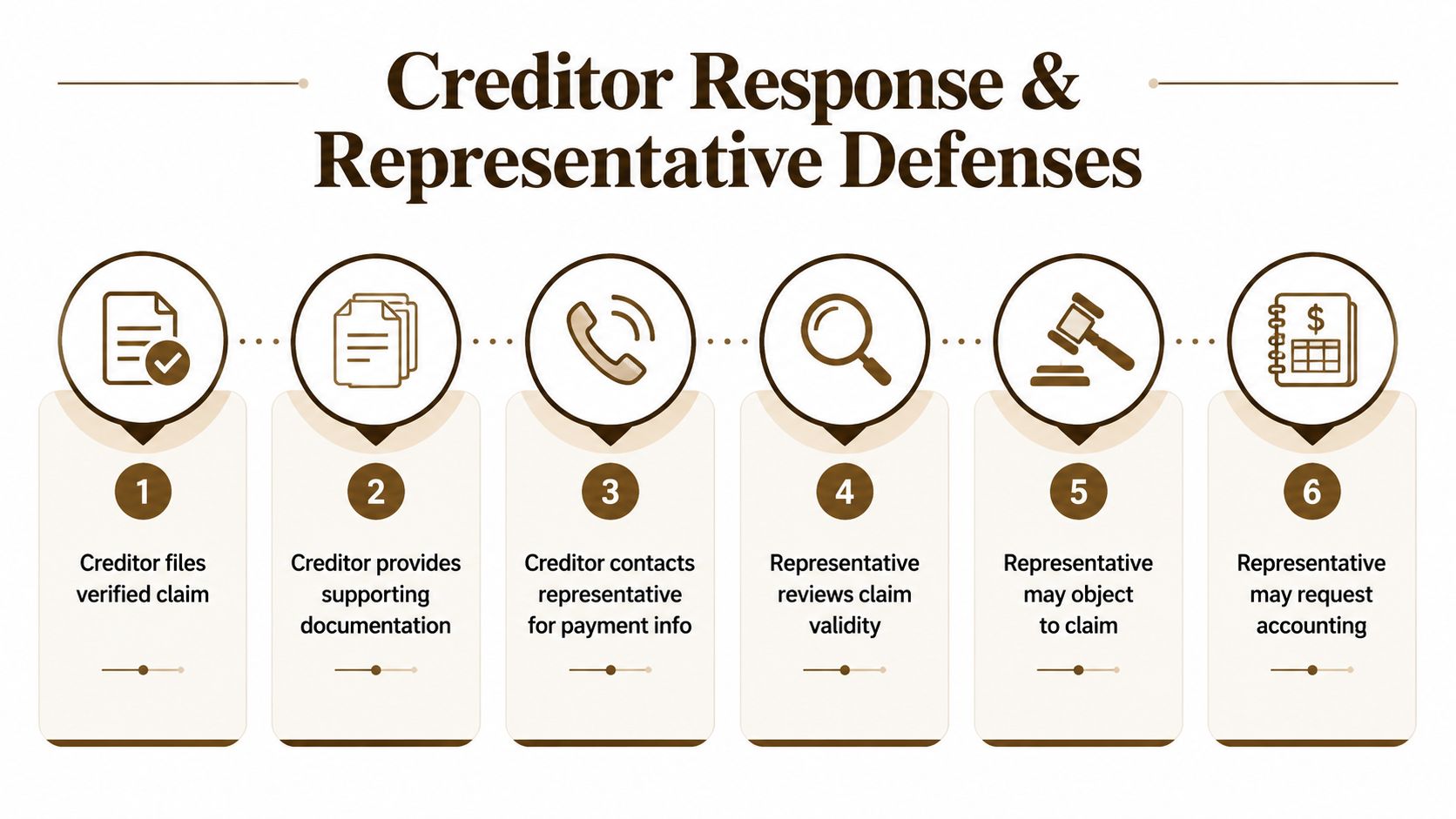
A creditor seeking payment should use the required claim process and provide records supporting the amount. The personal representative may also receive calls, account statements, collection letters, or information requests. Each communication deserves review, but none replaces checking whether a formal claim was properly presented and filed within the applicable deadline.
The representative should not admit liability to end a difficult conversation. Before paying, review the account, services provided, amount demanded, estate records, and legal status of the obligation. A decedent's debt does not automatically become the representative's personal debt.
A disciplined response protects the estate
Review each claim in a consistent record-based process:
- Confirm the filing: Determine whether the creditor filed with the court and delivered a copy as required.
- Check timing: Compare the filing date with the applicable publication, Letters, and direct-notice dates.
- Review the evidence: Examine contracts, statements, invoices, payment histories, and account ownership.
- Separate estate liability from personal liability: Confirm whether the obligation belongs to the estate rather than the representative individually.
- Calendar the response: Preserve the deadline for allowance, rejection, or objection under the applicable procedure.
- Escalate disputed claims: Obtain legal review before distributing property or making an admission.
A late claim may be barred, but the representative should still analyze it rather than discard it without review. Potential defenses include improper service, missing verification, an uncertain amount, duplication, prior payment, release, or inadequate supporting documents. The representative should also distinguish a creditor claim from a creditor request under Probate Code section 9050 and from petitions that could affect heir property or estate administration.
The strongest defense is usually a reliable record, not an argument with the collection department.
A creditor may seek payment from estate assets or challenge the representative's administration. Preserve publication affidavits, mailing records, returned mail, claim copies, account statements, and correspondence. Those records help establish what notice was given, when it was given, and how the estate handled the response.
A valid claim may need to be allowed and paid according to the estate's resources and legal priorities. The practical goal is accurate classification, timely review, and consistent documentation. Speed alone is not a defense, and an informal response can create a larger problem if it concedes facts or liability.
Sample Notice Language and Common Procedural Pitfalls
A general sample can help a family understand the structure of a California notice to creditors, but it shouldn't be treated as a court-specific form. The Superior Court caption, county, estate name, case number, publication details, and current statutory language must be checked before anything is submitted or published.
General orientation sample
SUPERIOR COURT OF CALIFORNIA, COUNTY OF [COUNTY]
Estate of [DECEDENT NAME], Deceased
Case No. [CASE NUMBER]
NOTICE TO CREDITORS
Notice is given to the creditors of the decedent that all persons having claims against the estate must present those claims in the form and within the time required by California law.
A copy of the signed claim, together with supporting documentation, should be mailed or delivered to the personal representative or the attorney for the personal representative at the address stated in the applicable court notice.
Publication information: [NEWSPAPER, COUNTY, DATES, AND REQUIRED PUBLICATION DETAILS]
That language is only orientation. The California statutory notice provision states that the notice must tell creditors to file claims with the Superior Court and deliver a copy to the personal representative or trustee. The notice also must be given for at least 15 days, and current court and publication requirements should be confirmed before use.

Mistakes that regularly cause trouble
- Using publication as a substitute for direct notice: A known creditor may require mailed or personal notice.
- Mailing to the wrong address: Use the best address reasonably available from estate records and keep returned mail.
- Losing proof: Preserve the affidavit of publication, mailing receipts, delivery records, and copies of the notice.
- Confusing deadlines: The four-month rule and the later deadline that can follow mailed or personal notice don't answer every possible late-claim question.
- Using unverified paperwork: A bill or demand letter isn't automatically a properly verified claim.
- Publishing without procedural authority: Confirm the representative's appointment, court requirements, and publication timing before proceeding.
The wording, format, publication cadence, and mailing list should follow current California law and local requirements. A notice prepared from an old online example may omit language or timing details that matter in the pending estate.
When to Call a Probate Attorney and How Tanner Law Can Help
DIY probate can be reasonable when the estate is straightforward, the representative can identify the assets and debts, beneficiaries cooperate, and no one is disputing ownership or entitlement. Even then, a representative must understand the difference between a creditor's informal demand and a claim that has been filed and served under California law.
Counsel becomes the smarter choice when the records are incomplete, creditors are numerous, the estate owns real property, a beneficiary disputes the representative's actions, or a known creditor was missed. The same is true when a representative is considering distribution while claims remain unresolved. Real estate can add separate concerns involving title, mortgages, insurance, taxes, possession, and sale authority.
Questions that justify legal review
- Was a creditor overlooked? Determine whether direct notice was required and whether a late claim remains actionable.
- Is the debt disputed? Review contracts, account history, releases, payments, and documentation before admitting or rejecting liability.
- Does the estate own property? Coordinate creditor administration with title, sale, partition, or trust-funding questions.
- Are beneficiaries in conflict? Protect the estate record before a disagreement becomes a petition or litigation.
- Are deadlines unclear? Reconstruct Letters, publication, mailing, filing, and response dates from reliable documents.
A probate attorney can help organize the creditor inventory, review claims, prepare objections or responses, preserve service evidence, and advise the personal representative before assets are distributed. The goal isn't to make every estate adversarial. It's to identify risk early and resolve valid obligations without sacrificing property or beneficiary rights.
If a parent, spouse, or other family member has died and you're unsure whether notice to creditors was properly handled, schedule a free consultation with Tanner Law. The firm can review creditor claims, probate deadlines, real estate issues, and related disputes, then give you a practical plan for protecting the estate and the personal representative.
Schedule a free consultation with Tanner Law to discuss notice to creditors, disputed bills, missed creditors, or probate property in Orange County or Los Angeles. Bring the Letters, publication records, creditor correspondence, and mailing proof if you have them, so the attorney can help assess the next step.