Do You Need a Lawyer for Probate in California
A spouse dies in Orange County, and the surviving family is suddenly responsible for a home, bank accounts, personal property, debts, and paperwork that cannot wait forever. The family may have a valid will, but that doesn't answer the immediate question: do you need a lawyer for probate in California?
The straight answer is this: California probate doesn't always require a lawyer, but a California estate involving real property, disagreement, unclear ownership, creditor problems, or tax concerns usually deserves legal counsel. The right decision depends on four filters: the value of the estate, the type of assets involved, the family relationships, and whether the will is valid and workable. A small, uncontested estate may qualify for a simplified transfer. A home, disputed claim, or blended family can change the analysis quickly.
Table of Contents
- The Question California Families Ask First
- What Probate Really Is in California
- Simple Versus Complex Estates in California
- When a Lawyer Becomes Essential
- Costs Timelines and How Long This Takes
- Mistakes That Turn Probate Into a Lawsuit
- Your Next Steps in Orange County
The Question California Families Ask First
Consider a common Orange County situation. A spouse dies leaving a $750,000 home, a small brokerage account, and a paid-off car. The surviving spouse is named as executor and assumes that the will makes the process automatic. It doesn't. A will tells the court what the decedent intended, but the executor still may need authority to collect assets, address debts, transfer title, and distribute the estate.
The family may ask whether hiring a probate attorney is an unnecessary expense. That question is understandable, especially when the surviving spouse is grieving and believes the estate is straightforward. The better question is whether the executor can safely complete the required steps without making a mistake that delays distribution or creates personal liability.
California provides simplified procedures for some estates. For example, the California Courts small-estate transfer guidance explains that certain personal-property estates may avoid formal probate when the decedent died on or after April 1, 2025, and the estate value is $208,850 or less. The same guidance says at least 40 days must pass after death before that affidavit can be used, and no court hearing is required.
Practical rule: The existence of a will doesn't make every estate simple, and the existence of probate doesn't automatically make a lawyer mandatory.
Four filters that usually decide the answer
- Estate value: Does the estate fit a California simplified procedure, or does its value and structure require formal administration?
- Asset mix: Are assets passing through a trust, joint tenancy, or beneficiary designation, or does a house need title transferred through probate?
- Family dynamics: Do all heirs agree, or are there estranged relatives, a blended family, or someone likely to challenge the will?
- The will: Is the original document available, properly executed, and consistent with the way the decedent owned property?
A Costa Mesa family with one cooperative heir and assets that pass outside probate may be able to manage much of the process independently. A Laguna Beach estate with a house, several heirs, and an unclear will presents a different level of risk. Orange County probate practice is court-based, document-heavy, and dependent on local filing procedures. The decision shouldn't be reduced to a slogan such as “always hire a lawyer” or “you can do it yourself.”
What Probate Really Is in California
Probate is the California court-supervised process for identifying a deceased person's assets, paying valid debts and expenses, and transferring what remains to the proper beneficiaries. The person responsible for the estate is the personal representative. If the will names an executor and the court appoints that person, the representative acts as executor. If there is no usable will, the court may appoint an administrator.
The personal representative does not just follow family instructions. The role carries fiduciary responsibilities. That means the representative must protect estate assets, keep estate money separate from personal funds, deal fairly with interested parties, and keep records showing what happened to the property. California Courts describe the personal representative as the person responsible for representing the estate in probate, while Texas court guidance similarly describes counsel as representing the executor in that role, not the beneficiaries. The technical distinction matters because a probate lawyer generally represents the personal representative, not every family member.
The basic California process
A typical formal administration involves several connected tasks:
- Opening the case: The proposed personal representative files a petition with the probate court and gives required notice to interested people.
- Obtaining authority: After appointment, the representative receives court-issued authority, commonly called Letters.
- Identifying property: The representative locates probate assets and prepares an Inventory and Appraisal for the court.
- Addressing debts: The representative reviews creditor claims and pays only obligations that the estate properly owes.
- Managing property: Real estate and other assets may need protection, valuation, sale, or transfer under court rules.
- Closing the estate: After expenses and claims are resolved, the representative seeks authority for final distribution.
A valid will does not necessarily allow the family to skip court. California's formal probate process may still be required to pass title to assets that were owned solely by the decedent. Assets already held in a properly funded trust, owned jointly with survivorship rights, or controlled by a beneficiary designation may follow a different path.
Simplified procedures are not a shortcut for every asset
California has more than one simplified route. The California Courts real-property procedure information describes a separate procedure for a particular item of real property worth $69,625 or less for deaths on or after April 1, 2025. That limit is distinct from the $208,850 personal-property limit. Families shouldn't combine the two thresholds or assume that one affidavit applies to every asset.
A lawyer's role is often most valuable before the first filing. Reviewing the title, will, beneficiary designations, and debts can reveal that a seemingly simple estate belongs in a different procedure.
Simple Versus Complex Estates in California
A California estate is simple because its legal risk is low, not merely because its dollar value is modest. The best DIY candidates usually have assets that transfer without court involvement, beneficiaries who agree, no serious creditor issue, and no property transaction requiring judicial authority.
A small estate with one bank account and a cooperative beneficiary is different from a small estate with three heirs who disagree about a house. Conflict can make an otherwise modest estate expensive. Conversely, a larger estate may be administratively manageable when most assets pass by trust or beneficiary designation and no one contests the plan.
The asset mix matters more than the label
Real property deserves special attention. A deed, mortgage, title defect, unpaid property charge, or disagreement over whether to sell can turn a routine administration into a property case. Orange County families also need to distinguish between a home that transfers outside probate and a home owned solely by the decedent. The title controls much of the practical analysis.
A Costa Mesa condo that falls within an available simplified procedure may require a carefully prepared affidavit and supporting documentation. A Laguna Beach home that must move through formal probate can require court authority, valuation, notice, and a process for confirming the proper transfer or sale. Those are not interchangeable tasks.
Other warning signs include:
- Multiple heirs: Agreement today may not continue after someone receives an appraisal or learns the proposed distribution.
- Blended families: A surviving spouse, children from an earlier relationship, and stepchildren may have different legal interests.
- Unclear testamentary documents: A missing original, handwritten will, or inconsistent amendment can create an avoidable dispute.
- Creditor uncertainty: A representative who distributes too early may leave the estate unable to address a valid obligation.
- Business interests: A sole proprietorship, membership interest, or unfinished contract may require valuation and continued management.
- Property outside California: Another state may require a separate proceeding or local assistance.
A practical comparison
| Feature | Simple Estate | Complex Estate |
|---|---|---|
| Ownership | Assets pass through a trust, joint ownership, or beneficiary designation | Solely owned real property must be transferred or sold |
| Family | One or more beneficiaries agree and can be located | Heirs are estranged, blended, missing, or in conflict |
| Documents | Original will is available and consistent with asset ownership | Will is missing, handwritten, amended, or disputed |
| Debts | Known obligations can be identified and addressed | Creditor claims are disputed or creditors are unknown |
| Management | No business, unusual investment, or title problem | Business interests, valuation issues, or property defects exist |
| Court role | A simplified procedure may be available | Formal administration and continuing court supervision are likely |
The legal system treats complexity as a collection of risks. If one major risk appears, obtain at least a focused legal review before filing or distributing anything.
When a Lawyer Becomes Essential
My recommendation is direct: hire a California probate lawyer before opening the case when the estate includes solely owned real property, disagreement among heirs, business interests, disputed debts, or an uncertain will. Those features can affect the petition, notices, valuation, authority to sell, and final distribution. Waiting until a dispute has already developed usually gives counsel fewer options and gives the family more problems to solve.
A self-managed case is more realistic when the estate fits a simplified California procedure, the assets clearly pass outside probate or qualify for the applicable transfer process, the beneficiaries agree, and no real property requires a court-confirmed transaction. Even then, a one-time review can be sensible. The cost of correcting a rejected petition or an incorrect transfer can exceed the cost of checking the plan first.
Compare the two paths
| Estate Feature | DIY May Work | Hire a Lawyer |
|---|---|---|
| Real property | No house or land requires probate transfer | Decedent solely owned a home, rental, or other California property |
| Beneficiaries | Everyone is identified, reachable, and in agreement | A blended family, omitted heir, minor, incapacitated person, or hostile beneficiary is involved |
| Will | Original will is available and uncomplicated | Validity, interpretation, or later documents are questioned |
| Creditors | Debts are known and uncontested | Claims are disputed, substantial, or difficult to identify |
| Business assets | No business or unusual investment requires management | Estate includes a company, membership interest, or active operation |
| Authority | No sale or unusual transaction is needed | Representative must sell, refinance, partition, or resolve title |
| Tax concerns | No apparent tax filing or valuation issue | Estate or asset values create federal or state tax questions |
Orange County families should also account for local court practice. The Lamoreaux Justice Center in Santa Ana handles centralized probate filings, and local filing expectations can affect how quickly a petition moves. The personal representative remains responsible for accurate documents even when court staff provide procedural information.
California's Independent Administration of Estates Act can give a representative more flexibility, but the will can exclude administration under that law. That is one reason a lawyer should read the will closely instead of assuming that expanded authority is available.
Costs Timelines and How Long This Takes
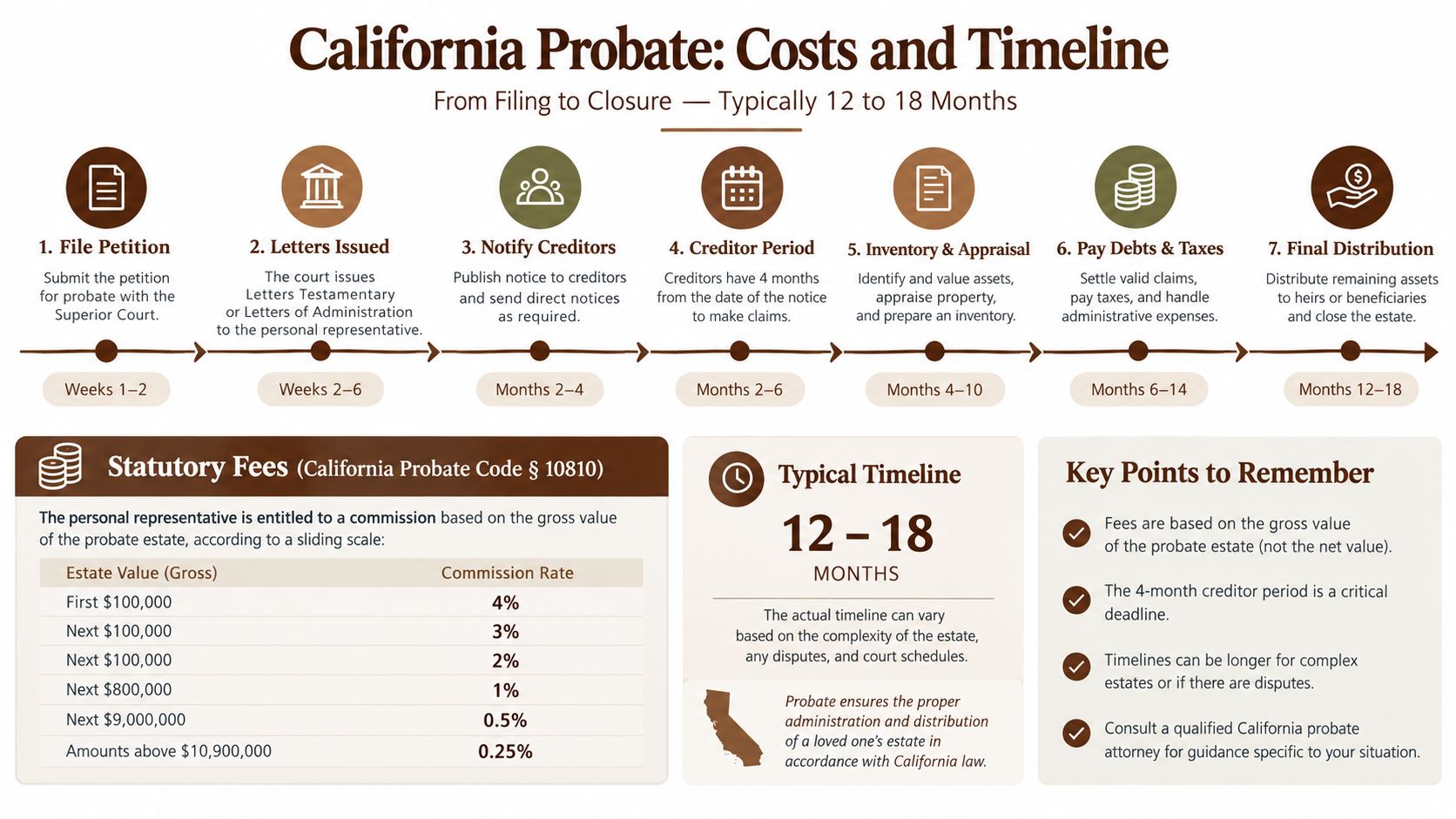
Probate costs extend beyond a lawyer's invoice. The estate may also pay court filing charges, publication costs, certified-copy fees, appraisal expenses, bond premiums, recording charges, property maintenance, and sale-related expenses. The total depends on the county, the assets, the procedure selected, and whether someone contests an issue.
California formal probate may involve statutory attorney fees based on a percentage of the gross estate value rather than an hourly model, according to the California Courts formal probate guidance. Fees may increase when the case requires unusual work, and they generally come from estate assets after court approval. Ask the lawyer to identify what the fee covers, which services cost extra, and whether property sales, tax work, or disputes fall outside the standard scope.
For an executor, the practical cost question is simple: how much value and risk does the estate contain? A modest estate with no California real property may justify handling routine tasks without counsel. A home, rental property, unresolved title, or proposed sale can make legal review worthwhile before the representative signs anything or distributes proceeds.
Time is another real cost
Probate requires time for notices, creditor issues, asset valuation, court review, and distribution. The California Courts formal probate guidance makes clear that formal probate follows a court-supervised process, so families should not expect an immediate transfer of assets. Orange County scheduling, filing quality, required notices, and the court's response time affect the actual duration.
Real property commonly adds delay. The representative may need an appraisal, authority to market the property, approval for the sale, title work, or a resolution of liens and ownership questions. A will contest or serious creditor dispute can extend the case further. If the estate contains a house, consult counsel before listing it, accepting an offer, or dividing sale proceeds among heirs.
Ways to control avoidable expense
- Inventory carefully: Find every account, policy, vehicle, parcel, debt, and digital record before choosing a procedure.
- Separate estate funds: Open an estate financial account and preserve a clear record of receipts and payments.
- Question claims properly: Do not pay a family member or creditor simply because the request sounds urgent.
- Review authority first: Confirm that the will and court appointment permit the proposed sale or transfer.
- Ask about administration authority: If a simplified option is available, identify which hearings or approvals it may avoid.
A lawyer cannot remove court costs or difficult assets. Good counsel can prevent repeated filings, unauthorized transactions, and mistakes that cost more to repair than to avoid.
Mistakes That Turn Probate Into a Lawsuit
The most expensive probate mistakes usually begin with a reasonable family assumption: “Everyone agrees, so we can handle this informally.” Agreement doesn't give an executor authority that the court hasn't granted. It also doesn't protect a representative from a later beneficiary who believes the estate was mishandled.
Real property creates the largest exposure
Selling a California home before obtaining the required authority can cloud title, disrupt the transaction, and invite a partition or other property dispute. An executor shouldn't sign a binding sale, distribute sale proceeds, or treat a house as personal property merely because the family expects the sale to happen.
Creditor handling creates a separate danger. Paying family members first, ignoring a claim, or distributing assets before the estate has addressed its obligations can expose the representative to a demand for repayment. The Alameda County probate guidance explains why legal help is often advisable in complex estates, including help with deadlines, filing errors, delays, and family disputes. It also emphasizes the important point that counsel represents the personal representative, not the beneficiaries.
Other recurring errors include:
- Commingling funds: Depositing estate money into a personal account destroys the clean record a representative needs.
- Self-dealing: Buying estate property, favoring one heir, or approving an unusually favorable transaction creates a fiduciary conflict.
- Acting before appointment: A proposed executor shouldn't assume that naming in the will alone provides court authority.
- Ignoring family status: A child or spouse who was unintentionally omitted may have rights that affect distribution.
- Distributing too early: Informal payments can force the representative to recover money from relatives who no longer have it.
Before each major decision, answer three questions:
- Do I have written authority for this step?
- Does the decision benefit the estate rather than a particular person?
- Have I documented the decision through the proper filing, account record, inventory entry, or written approval?

Your Next Steps in Orange County
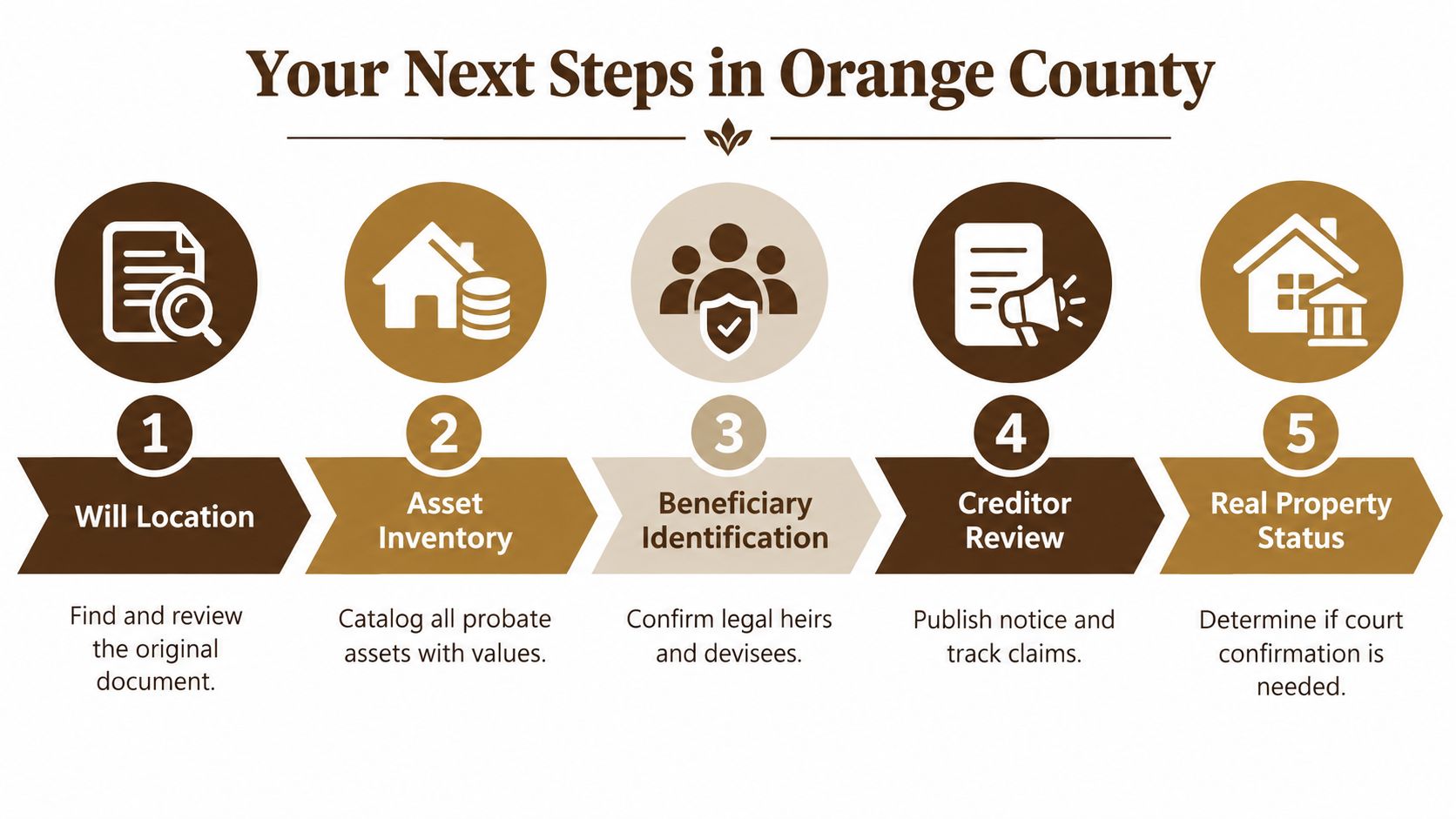
If you're the executor, start with documents rather than family promises. Use this five-part checklist:
- Locate the will: Secure the original and identify every later document.
- Build the inventory: List probate and non-probate assets, ownership, approximate value, and account statements.
- Identify beneficiaries: Confirm heirs, devisees, addresses, and any minor or incapacitated person's interests.
- Review creditors: Gather bills, loans, taxes, liens, and collection letters before distributing property.
- Analyze real property: Check every deed, loan, trust document, and title issue affecting a home or investment.
Then obtain death certificates, preserve the decedent's property, and avoid selling or distributing major assets until you know what authority applies. Orange County families generally file probate matters through the Lamoreaux Justice Center in Santa Ana, and court rules require electronic filing for most documents. Confirm current filing procedures before submitting a petition because local requirements can change.
If family conflict appears early, consider a structured conversation, mediation, or another appropriate dispute-resolution process before positions harden. Those options don't replace legal advice, but they may help the family resolve a property or distribution issue without turning every disagreement into litigation.
Tanner Law offers Orange County families case-specific guidance on probate administration, real-property issues, creditor concerns, and disputes, including a review of likely fees, timelines, and whether a simplified procedure or formal probate is appropriate. Schedule a free consultation by visiting Tanner Law so you can make the decision with a clear understanding of your California estate's risks.